















































































































































































































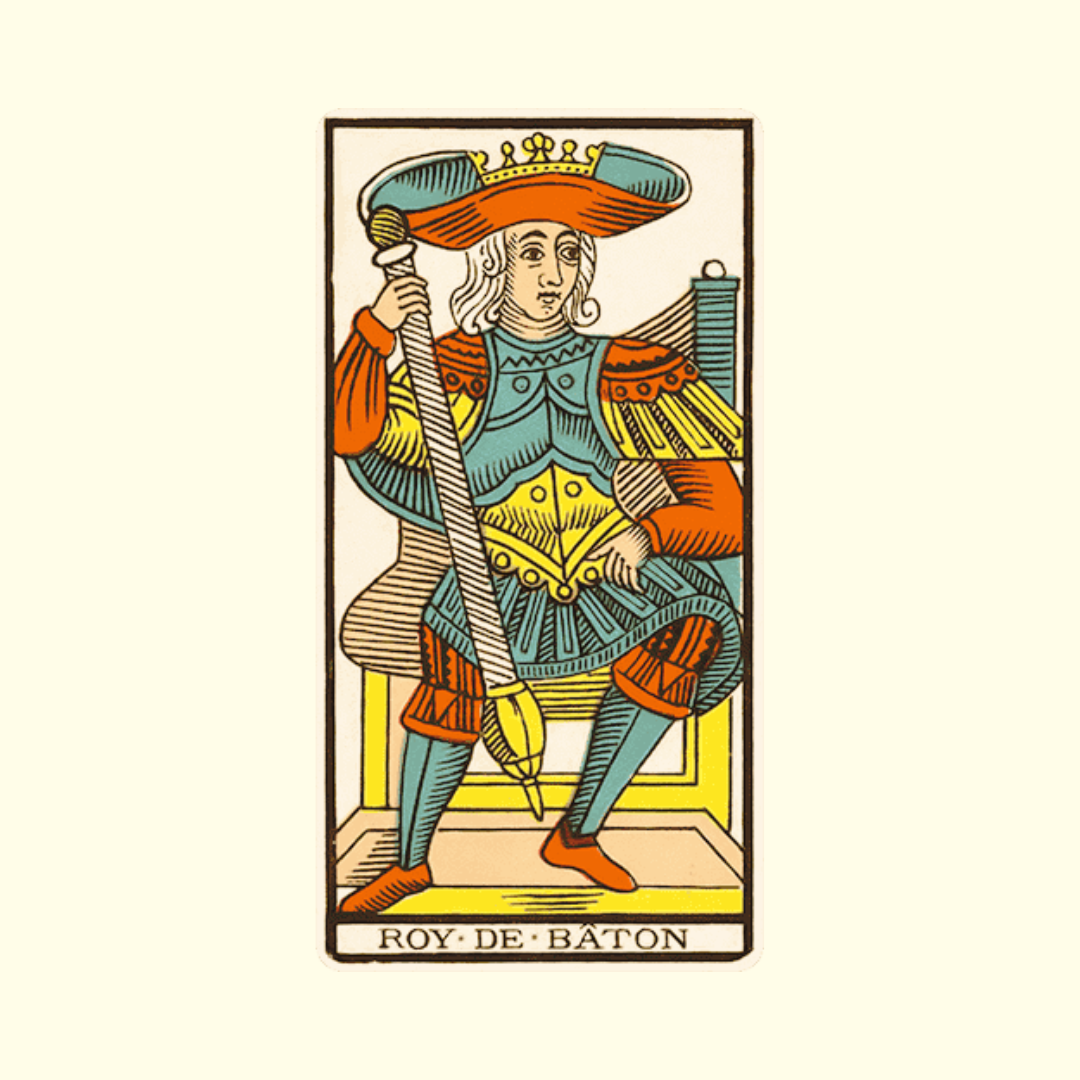

The King of Wands gives direction to Fire. In the Tarot de Marseille, he carries the staff as the emblem of an already established authority. In the Waite-Smith, he sits on a throne adorned with lions and salamanders, holding an upright flowering staff. The card speaks of vision, decision, honesty, and the ability to inspire others - then asks whether power truly serves the work or only the person who holds it.
The King may represent a person, a leadership role, or the attitude needed to govern a situation. He does not automatically designate a mature man, a husband, or a hierarchical superior. His rank indicates responsibility: he must choose a direction, accept its consequences, and make the actions of others possible.
Mathers connects the King of Wands with knowledge and education, then with counsel when the card is reversed. In its nomenclature, the Golden Dawn gives it the title “Prince of the Chariot of Fire” and the Air of Fire: a rapid, noble, and generous force, but prone to haste. Waite emphasizes honesty, awareness, and ardor. The King therefore does not lack energy; his challenge is to organize it without becoming authoritarian.
From the King of Marseille to the lion throne
In a Tarot de Marseille, the King is crowned and holds the staff of his suit. The shape of the emblem, the position of the legs, and the decoration of the clothing vary according to the workshops. No heraldic lion or narrative salamander is required. The image asserts rank and possession of the tool before any detailed psychology.
Smith shows a King seated in profile or slightly turned, his gaze directed beyond the card. His staff remains alive and leafy. Lions and salamanders decorate the throne and clothing; a salamander appears near the base. Waite points out the lion on the backrest and the hairstyle worn beneath the crown. The direction of his gaze gives the King a horizon: his power is already seeking the next field of action.
Iconographic reference. The crowned King and the staff belong to both families of decks. The lion throne, salamanders, and flowering staff are specific to the Waite-Smith. The winged King on a chariot drawn by a lion, described in Book T, belongs to another visual construction.
Divinatory transmission
In 1888, Mathers attributes to the King of Wands a countryman, a landowner, knowledge, and education. Reversed, he describes a naturally good but severe man, then counsel, advice, and deliberation. Knowledge occupies a central place here: authority is justified by understanding and the ability to provide direction.
In the nomenclature of Book T, the “King of Wands” is given the title “Prince of the Chariot of Fire” and the Air of Fire. The winged figure drives a chariot drawn by a lion. The text describes it as swift, strong, hasty, somewhat violent, but just, generous, and noble. When poorly surrounded, it becomes cruel, intolerant, prejudiced, and difficult in character.
Waite gives the King ardor, animation, passion, and nobility. He emphasizes honesty and awareness, then cites news related to an unexpected inheritance. Reversed, the King remains good, but severe, austere, and nevertheless tolerant. A current reading may retain direction, frankness, authority, and advice without using dated physical descriptions as a means of identifying a person.
Meaning in a spread
In a favorable reading
The King of Wands indicates clear direction and a will capable of bringing resources together. The querent can set a course, make a decision, defend a project, or assume a position of responsibility. His authority becomes fruitful when it provides others with a vision, resources, and room to act.
The card favors initiatives that require courage and reach: starting a business, launching something, negotiating, speaking publicly, or making a judgment call. The King is not content merely to have an idea. He sets the priority, accepts accountability for the outcome, and knows that example carries more weight than words.
In a tension reading
Direction becomes a personal will imposed on everyone. The King decides quickly, listens little, and confuses opposition with a lack of loyalty. His confidence may conceal insufficient preparation, his contempt for smallness may become contempt for details, and his taste for movement may prevent the team from consolidating what has just been launched.
The card may still show theatrical authority, a promise without resources, intolerance, unsolicited advice, or a leader who claims collective credit for the outcome. The useful question becomes: what facts authorize this decision, and who will be able to challenge or correct it without fearing they will lose their position?
Love, work, and finances
The King transforms energy into direction. The area specifies what he governs, the decision expected, and the accounts he will have to give.
| Area | Favorable interpretation | Tension aspect | Question to ask |
|---|---|---|---|
| Love | Frank partner, acknowledged desire, shared project carried forward with consistency and protection. | Domination, decision made for two, relationship organized around a single ambition. | Does the shared direction result from agreement or imposed authority? |
| Work | Leadership, entrepreneurship, strategic decision-making, responsible person who provides resources. | Impulsive leader, cult of personality, launch without follow-up, or intolerance of criticism. | Who can review and correct the decision? |
| Finances | Directed investment, firm negotiation, commercial vision, and accountability for the outcome. | Overconfidence, prestige spending, a wager made without sufficient study. | What figures support the announced vision? |
| Creation | Major project, clear artistic direction, and the ability to rally people around a work. | Creation used as a territory of power, with collaborators reduced to carrying out orders. | Does leadership strengthen the work of others? |
| Collective life | Honest spokesperson, arbitration, advice grounded in experience and knowledge. | Authoritarianism, prejudice, opaque decision-making, or responsibility refused after failure. | What rule requires the leader to be accountable? |
Read the associations
The King brings vision, authority, and decision-making. The neighboring card shows what he directs, the legitimacy of his power, and how his project will take shape.
| Association | Possible dynamic | Point of caution |
|---|---|---|
| King of Wands + Queen of Wands | Leadership and relational influence complement each other in a strong alliance. | Avoid rivalry between formal power and power based on buy-in. |
| King of Wands + Emperor | Consolidated authority, strategy, structured enterprise, or government decision. | The framework may become rigid or personal. |
| King of Wands + Three of Wands | Commercial vision, expansion, negotiation, or a project extending beyond the initial field. | Measure resources before expanding. |
| King of Wands + Justice | Legitimate decision, contract, arbitration, and clearly assigned responsibility. | Authority must be able to explain its criteria. |
| King of Wands + Devil | Ambitious power, great powers of persuasion, an alliance of convenience, or a desire for domination. | Dependence, constraint, and hidden benefits must be examined. |
| King of Wands + Hanged Man | The leader must suspend action, change perspective, or give up imposing the pace. | The pause may protect the project from an overly hasty decision. |
Correspondences according to the schools
The sovereign holding his wand belongs to the Tarot of Marseille. The Air of Fire and the Chariot of Fire come from the Golden Dawn. The throne with lions and salamanders is a composition by Smith commented on by Waite.
| Reference point | Attribution | Historical scope |
|---|---|---|
| Suit | Minor arcana, court figure of the Wands | Rank of the King in 78-card tarot decks. |
| Tarot of Marseille | Crowned king holding a wand | Court figure without a throne, with imposed salamanders. |
| Mathers, 1888 | Owner, knowledge, education | Reversed: severity, advice, counsel, deliberation. |
| Golden Dawn | Prince of the Chariot of Fire | Title given to the “King of Wands” in Book T. |
| Element | Air of Fire | Direction, movement, and circulation of the Wands element. |
| Astrology | Last decan of Cancer at 20° of Leo | Celestial region attributed by the Golden Dawn. |
| Waite-Smith | King with a flowering wand, lions, and salamanders | Composition published in 1909. |
| Age and gender | No mandatory identity | The card may represent a person, a role, or a way of making decisions. |
| Stone and plant | No shared historical agreement | Recent lists should not be confused with the attributions cited. |
| Reading keywords | Vision, direction, honesty, authority, advice, responsibility | Context distinguishes leadership from domination. |
Reading advice
First ask what direction the King has set and what information he relies on. A credible vision can be summarized, quantified, and challenged. Then look for the means: people, budget, schedule, and decision-making rule. Without them, authority remains a posture.
If the card represents the querent, invite them to make a decision and then report back. If it represents an outside person, observe whether their actions confirm their honesty and whether disagreement remains possible. The King of Wands leads better when he does not need to diminish others to prove his strength.
Choosing a tarot deck to work with this card
To find this arcana in a complete deck, compare the Tarots of Marseille, the Rider-Waite-Smith, and all of our Divinatory Tarots. If you are a beginner, also see How to choose your first tarot deck?.
Sources and reference texts
For the history of tarot decks and suits: Victoria and Albert Museum, A History of Tarot Cards; British Museum, reproduction of Nicolas Conver’s Tarot of Marseille.
For divinatory and occult texts: S. L. MacGregor Mathers, The Tarot, 1888, card meanings; Liber LXXVIII, “The Prince of the Chariot of Fire,” publication of material from Book T; Arthur Edward Waite and Pamela Colman Smith, The Pictorial Key to the Tarot, King of Wands, 1911.










