















































































































































































































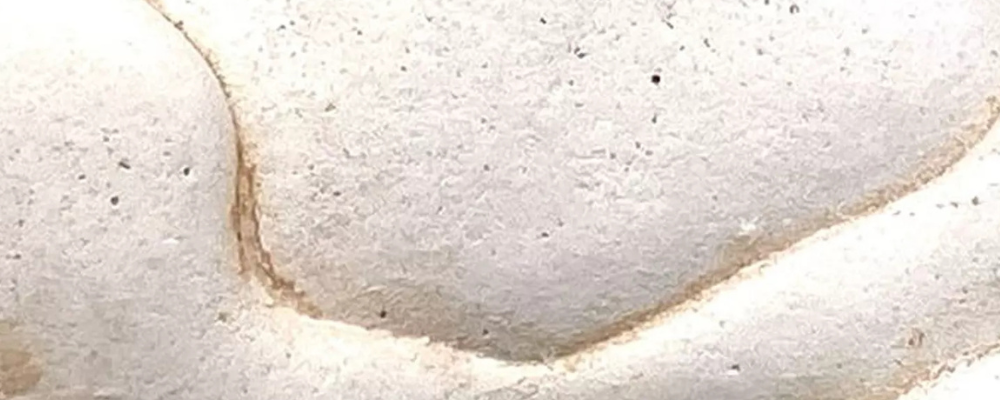
Round, knotted, or marked with lines that suggest a body, a face, or an animal, the Fairy Stone seems to have been shaped by an invisible hand. Yet it is a concretion born in sediments. Its magic unites the gaze that recognizes a form, the memory of the landscape, and the protection granted to the traveler.
The name encompasses several materials and does not designate a mineral species. The specimens from Quebec are linked to the lakes and ancient glacial environments of Abitibi. Local stories make them good-luck charms for travel, hunting, and fishing. The Moon governs their forms and growth rhythm; the Earth and Water tell the story of their birth.
To place this stone among related minerals, compare it with Jasper, Orbicular Jasper, and Dragon's Blood Jasper.
The Concretion with Living Forms
Fairy Stones are concretions made of fine sand, silt, and a mineral cement, with variations depending on the location. The Abitibi-Témiscamingue Mineralogical Museum describes flat, rounded forms crossed by lines that recall animal or plant figures.
The human eye instinctively seeks silhouettes in these reliefs. The ritual does not require pretending that the stone contains a being: it welcomes the image that has appeared as a question posed by the landscape.
Water, Sediment, and Time
In still-soft sediments, minerals can cement grains around a nucleus, a plant fragment, or a chemical variation. The Paleontological Research Institution explains that concretions form before the rock has completely hardened, through the precipitation of mineral matter.
For Abitibi Fairy Stones, the retreat of the glaciers, erosion, sedimentation, and bacterial activity all contribute to the history presented by the Malartic museum. The stone becomes the compact archive of an ancient environment where water deposited, removed, and redrew.
Fairy Stone, Menalite and Menilite
Commerce brings together under the same name calcareous or clay concretions, Menalites, and certain forms of Menilite. The Mindat entry devoted to Menalite notes that it is a variety or a name for a form, not a species with fixed properties.
The composition of a specimen cannot therefore be inferred from its silhouette. This plurality does not diminish its ritual use: the name “Fairy Stone” belongs to the relationship between a natural form and the imagination that responds to it.
The figure is an encounter, not proof. A face or animal recognized in the stone may guide a meditation or a reading. It is not certain evidence of a message or the imprint of an invisible creature.
Travel luck and protection of the territory
Popular traditions associated with Harricana stones present them as lucky charms carried during hunting, fishing, or travel. This function responds directly to the territory: a stone collected near the water accompanies those who leave and reminds them of the way back.
The Moon governs nighttime travel, changing forms, and imagination. Earth provides protection and belonging; Water carries the memory of the place. Monday is suitable for dreams, the home, and departures placed under protection.
Protection, imagination, and memory of the place
Choose a Fairy Stone whose shape evokes a guardian for you. Place it near the door and name what it protects: returning home, sleep, travel, or a workspace. A specific function prevents the object from becoming a receptacle for every worry.
For imagination, turn the stone from several angles and write down the images that appear. Keep the one that opens up an action or a story; let the others disappear. For the memory of a place, set it on a map and tell the story of the path connecting you to that territory.
The guardian found in the stone
On a Monday evening, place the Fairy Stone on a gray or brown cloth. Turn it until you recognize a figure, then give that figure a single protective role. Write this role on a card without assigning it a name borrowed from a foreign tradition.
Pass the map under the stone and leave them together overnight. In the morning, place the guardian near the threshold or in the travel bag. On your return, set it on the map and thank the place that provided its image.
Correspondences and reference points
| Reference point | Correspondence |
|---|---|
| Nature | Sedimentary concretion of variable composition |
| Emblematic region | Abitibi-Témiscamingue, Quebec |
| Suggested planet | Moon |
| Suggested elements | Earth and Water |
| Day | Monday |
| Areas | Protection, travel, imagination, home, and memory of the place |
| Ritual image | Animal, plant, or human figure recognized in the relief |
| Ritual gesture | Name a guardian, then entrust it with a specific function |










