















































































































































































































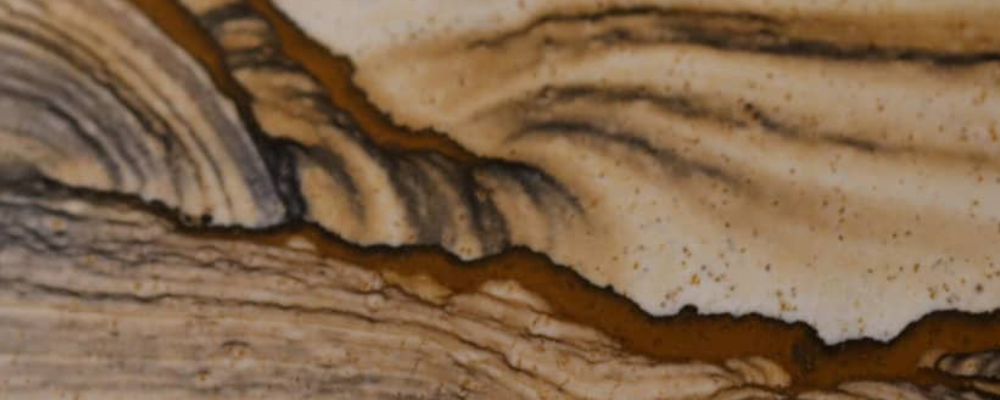
Landscape Jasper seems to open a window in stone. Its lines become horizons, its dendrites take the form of trees, and its ochre patches suggest hills or deserts. The material provides the traces; the gaze composes the scene. Its symbolic power lies in this encounter.
Figurative stones fascinated European collectors and cabinets of curiosities. Modern Landscape Jasper continues this taste for images that nature leaves open to interpretation. The Moon governs imagination, Mercury the reading of signs, the Earth provides the material, and Air opens the perspective.
To place this stone among related minerals, compare it with Jasper, Orbicular Jasper, and Dragon's Blood Jasper.
A Landscape Born from the Gaze
Landscape Jasper is a descriptive name given to stones whose patterns evoke a scene. The name selects a visual effect, not a separate mineral composition.
Cutting and polishing play a decisive role. The lapidary chooses an orientation that makes a horizon line, landform, or silhouette appear. A nearby slice from the same block may offer a different scene.
Iron, Lines, and Dendrites
The material belongs to the broad family of siliceous jasper or, in some deposits, silicified rhyolite. Iron oxides produce the reds, yellows, and browns; clays add cream or gray tones.
The black branching patterns may be dendrites of manganese oxides deposited in fine fractures. Their plant-like outline is not a fossil plant: it results from mineral growth.
The Figurative Stones of Cabinets of Curiosities
In the 16th and 17th centuries, cabinets of curiosities brought together minerals, shells, artworks, and rare objects. A Smithsonian study of these collections shows their role in the history of museums.
Picture stones held a special place: nature seemed to rival the painter. The Landscape Jasper sold today does not constitute a stable ancient variety, but it continues this documented fascination with scenes revealed by the material.
Seeing an image does not oblige you to take it for a message. The landscape can become a divinatory or meditative medium when description and interpretation remain separate.
Moon, Mercury, Earth, and Air
The Moon corresponds to images, imagination, and forms recognized in ambiguity. Mercury reads, compares, and translates signs. Earth provides the real lines; Air opens the distance that allows them to be assembled.
Monday is suitable for contemplation and Wednesday for interpretation. Ochre, brown, cream, and gray make up its palette. A card, an empty frame, and a feather can accompany the stone.
Vision, Interpretation, and Guidance
Landscape Jasper supports the search for direction. It helps you examine the terrain before choosing a route, recognize projections, and make room for imagination without confusing it with fact.
In a divinatory practice, it can serve as a medium for free contemplation. The perceived figure becomes a question addressed to the querent, not a prediction contained in the rock.
The Card and the Horizon
Place the Jasper at the center of a sheet of paper. First describe five material elements: a line, color, spot, direction, or contrast. Then draw the landscape these elements suggest to you.
Place an empty frame around the drawing and say: “I distinguish the terrain from the image I project onto it. My gaze opens a path, and my judgment chooses the direction.” Note one decision based on facts and one inspiration offered by the image.
Correspondences and references
| Reference | Correspondence |
|---|---|
| Nature | Jasper or silicified rock with figurative patterns |
| Celestial bodies | Moon and Mercury |
| Elements | Earth and Air |
| Days | Monday and Wednesday |
| Ritual colors | Ochre, brown, cream, gray |
| Areas | Vision, interpretation, guidance, divination |
| Associated objects | Card, empty frame, feather |
| Gesture | Separate the description from the perceived image |










