















































































































































































































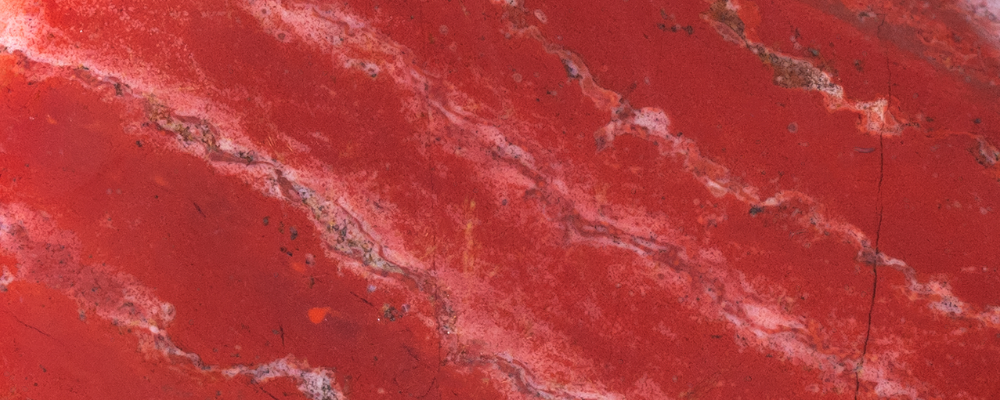
Jasper is a stone of sealing, defense, and earthly presence. Its opacity receives engraved images with clarity; its reds, greens, and browns have fostered distinct uses, from warrior protection to counsel, and from sleep to stability.
Speaking of Jasper in the singular conceals this richness. Red corresponds to Mars and Fire; green aligns with Venus and Earth; brown belongs to Saturn; mixed varieties may be associated with Mercury. Ritual selection therefore begins with the stone’s color and its actual pattern.
To place this stone among related minerals, compare it with Orbicular Jasper, Dragon's Blood Jasper, and Ocean Jasper.
An Opaque Silica with a Thousand Landscapes
Jasper is an opaque siliceous rock related to chalcedonies, whose iron oxides and other inclusions create reds, yellows, browns, greens, and blacks. Its patterns may form bands, spots, orbicules, or landscapes.
The Mindat mineralogical entry reminds us that the term encompasses a very broad group. Commercial names describe a color, pattern, or location. They are useful for choosing a stone, provided they are not mistaken for separate mineral species.
Seals, Scarabs, and Authority
Its fine grain makes it suitable for engraving. In Mesopotamia, Jaspers and related stones were carved into cylinder seals; rolled across clay, they left an image that identified a person, validated a transaction, or protected a deposit. A cylinder seal held by the Metropolitan Museum of Art shows this connection between stone, image, and authority.
In Egypt, Jasper was used for amulets and scarabs. The Metropolitan Museum’s red Jasper scarab reminds us that color, shape, and inscription worked together. An unengraved stone did not automatically serve the same function as an object consecrated by its image.
Counsel, victory, and protection
In The Magic and Science of Jewels and Stones, Isidore Kozminsky compiles an extensive dossier devoted to Jasper. He reports Babylonian seals, engraved amulets, the reputation of green Jasper as a stone of counsel for commerce, as well as associations with victory and peace of mind.
These accounts come from different periods and authors. What they have in common is the act of fixing: the seal fixes a decision in clay, the image fixes a function in stone, and the amulet fixes protection beside its wearer.
Jasper requires a verb. Defend, endure, decide, conclude: its magic grows stronger when given a precise action. The color sets the tone; the seal provides the direction.
A planet for each color
In his 1988 encyclopedia, Scott Cunningham distinguishes Jaspers by their color. He assigns red to Mars and Fire; green to Venus and Earth; brown to Saturn and Earth; and mottled Jasper to Mercury and Air.
These associations make it possible to choose without conflating everything. Red supports courage and defense. Green accompanies harmony, rest, and growth. Brown helps bring you back to the concrete. Mottled patterns suit travel and problems that require adaptability.
Courage, stability, and good counsel
Keep a Red Jasper with the equipment for a difficult task: a briefcase, work clothes, or a travel bag. Consecrate it to disciplined courage—the kind that protects without provoking conflict.
Brown Jasper is suitable when the mind is scattered. Place it on a list reduced to three tasks and do not begin the next one until you have completed the first. Saturn provides the boundary and order here.
For a business decision, choose Green Jasper. Place it on the contract and reread the terms, deadlines, and possible exits. The “sound advice” passed down by lapidaries never exempts you from understanding what you are signing.
The Rite of the Earthly Seal
Draw a simple sign representing the chosen action: a closed door for defense, a straight line for constancy, two hands for an agreement. Place the Jasper on this sign, then light a candle of the corresponding color.
Say the verb three times. Then press the stone onto a small disk of soft clay, even if it leaves only a faint imprint. Let the clay dry and keep it with the project. The stone may be worn; the imprint remains at the place where the action must be supported.
Correspondences and references
| Reference | Correspondence |
|---|---|
| Nature | Opaque siliceous rock related to chalcedonies |
| Red Jasper | Mars, Fire, courage, and defense |
| Green Jasper | Venus, Earth, harmony, and sound advice |
| Brown Jasper | Saturn, Earth, stability, and boundaries |
| Mottled Jasper | Mercury, Air, adaptation, and movement |
| Areas | Protection, courage, decision, stability, and commerce |
| Ritual image | The seal that fixes an intention |
| Ritual gesture | Pairing a color, a verb, and an imprint |










