















































































































































































































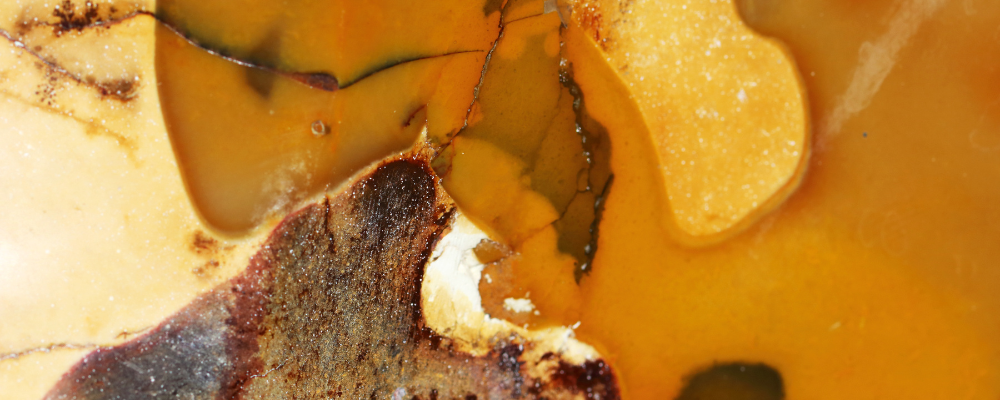
Mookaite brings together cream, ochre, red, and purple like a dry landscape crossed by light. Beneath its polish lies the memory of an ancient sea: tiny siliceous organisms deposited in the sediments and then transformed into a compact rock.
Its name comes from Mooka Creek in Western Australia. No solid source attributes an ancient Indigenous ritual use to it; its esoteric associations belong to contemporary practice. The Earth gives it stability, the Sun drive and visibility, and Fire the iron reds. It supports choice, adaptation, and prepared travel.
To place this stone among related minerals, compare it with Jasper, Orbicular Jasper, and Dragon's Blood Jasper.
The landscape in the stone
Mookaite is not a mineral species with a fixed formula. It is a local and commercial name given to a silicified rock from the Windalia Formation. Depending on the area examined, its material may be described as radiolarite, porcelanite, chert, opal, or chalcedony.
Mindat defines it as a silicified type of radiolarite. This composite nature explains the variety of its patterns: a cross-section reveals clouds, bands, and color boundaries that are never exactly repeated.
The memory of an ancient sea
The Windalia Formation was deposited in a sea during the Early Cretaceous. Marine microorganisms, including radiolarians with siliceous skeletons, contributed to the accumulation of the sediments. Silica-rich fluids then consolidated and transformed the rock.
A petrographic study describes this origin and the siliceous phases of Mookaite. The reds and yellows come largely from iron compounds: the ancient sea becomes a terrestrial landscape through a long succession of transformations.
Mooka Creek without an added legend
The name comes from Mooka Creek, near the Kennedy Ranges, in the Carnarvon Basin. The Gascoyne Junction Museum connects the rock to this watercourse and presents the descriptions used by geologists.
This provenance deserves to be named without inventing “ancestral wisdom.” An isolated translation of the place name or Australian origin alone proves neither ceremony, healing, nor Indigenous transmission associated with the stone.
Respecting a place means not speaking for it. Mookaite has a striking geological history and a rich contemporary imaginary. Distinguishing the two pays tribute to the real landscape instead of adding an unsourced tradition to it.
Sun, Earth, and Fire
The Sun governs clarity of choice, momentum, and confidence in setting out. Earth corresponds to territory, experience, and the stability carried with you. Fire answers to the red hues and the decision set in motion.
Sunday suits direction, while Tuesday suits the first step. Ochre, cream, red, and purple make up its palette. A small map, a travel cord, or three pebbles placed as markers can accompany its rites.
Choice, adaptation, and departure
Mookaite accompanies crossroads where several paths remain possible. It helps you choose without demanding certainty, then adapt the route when the terrain changes. Its grounding is not immobility: it is the ability to carry a stable foundation with you.
It is suited to travel, moving house, new roles, and projects that require leaving a familiar method behind. Its colors recall that several answers can belong to the same story.
The Map of the Three Paths
Draw three paths starting from the same point. Name each option and write down the first cost, the first benefit, and the first action it requires. Place the Mookaite at the starting point.
Move it successively along the three lines, then bring it back to the center. Say: “I choose with the earth beneath my feet and the light before me.” Mark the chosen path with a circle and take its first step before the next sunset.
Correspondences and markers
| Marker | Correspondence |
|---|---|
| Nature | Silicified radiolarite with a local and commercial name |
| Location | Mooka Creek, Western Australia |
| Suggested celestial body | Sun |
| Suggested elements | Earth and Fire |
| Days | Sunday and Tuesday |
| Areas | Choice, adaptation, travel, departure, confidence |
| Associated objects | Card, cord, stone markers |
| Gesture | Choosing a path and taking its first step |










