














































































































































































































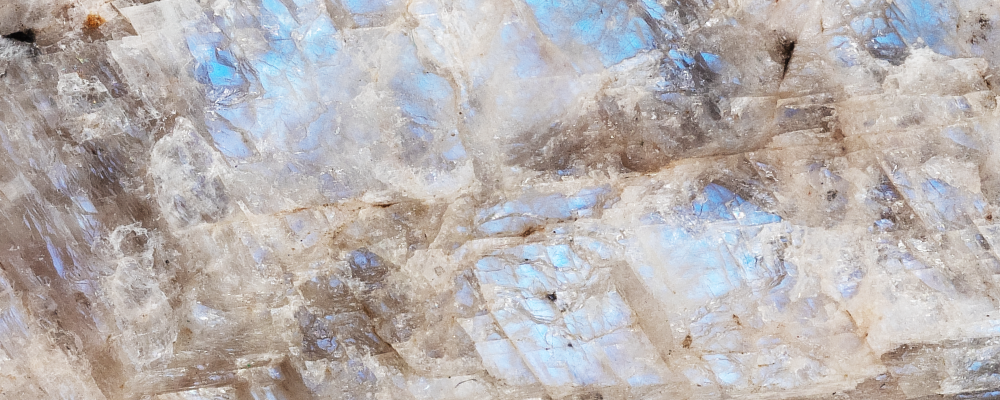
Belomorite bears a blue glow that appears when the stone meets the right angle. Its name comes from the White Sea and the landscapes of Karelia, where Alexandre Fersman observed this iridescent feldspar in the early 20th century. It becomes a stone of perspective, remembrance of place, and orientation during periods when the path remains veiled.
The Moon responds to its shifting brightness, Air to the change in viewpoint, and Water to the sea inscribed in its name. Its talismanic language is contemporary: it draws on iridescence, territory, and the discovery narrative.
To place this stone among related minerals, compare it with Feldspar, Albite, and Labradorite.
The feldspar with sea-like reflections
Belomorite is a regional and commercial name given to an iridescent plagioclase, close to Albite or Oligoclase. The Mindat entry links it to peristerites from pegmatites in northern Karelia, in the White Sea region.
The stone is white, light gray, or slightly bluish. Its blue, violet, or green reflection is not distributed like a uniform color: it arises from fine internal structures and shifts with the orientation. The light thus reveals a facet of the material that a frontal view cannot perceive.
Fersman and the White Sea
Alexandre Fersman gave this feldspar the name Belomorite in 1925. The word refers to Beloye More, the White Sea, and to the resemblance between the stone’s reflections and the pale waters of the North. The mineralogist recounted this encounter in his Memories of Stone.
The name therefore preserves a landscape: a cold shore, clear skies, white pegmatite, and blue light. This geographical memory informs its ritual use. Belomorite helps maintain a sense of direction when the surroundings look the same in every direction and only a change in light makes it possible to recognize the way.
Light that changes with the angle
The Handbook of Mineralogy entry on Oligoclase describes feldspars that may be opalescent or iridescent. In Belomorite, very fine internal lamellae make the glow appear when the stone, the light, and the eye align in a precise relationship.
The effect disappears as soon as the angle changes, but the stone does not lose its structure. This property offers a lesson in discernment: what remains invisible from one position may become clear from another, without all interpretations being given equal value.
Moon, Air, Water, and the route of the North
The Moon corresponds to indirect light, cycles, memory, and nighttime orientation. Air corresponds to shifting one’s gaze and reading signs. Water relates to the White Sea, reflections, and the continuity of the journey.
The North represents bearing, reserve, and returning to a stable direction. Monday is suitable for work involving memory, dreams, and inner listening. These correspondences form a modern interpretation based on the stone’s name, provenance, and optical effect.
Perspective, memory, and orientation
Bélomorite supports decisions blocked by an overly narrow framework. It invites you to examine a question from three positions: what you see now, what another person may see, and what remains true when the angle changes.
Near a map, itinerary, or notebook, it represents the bearing to maintain. In memory work, it helps distinguish fact, emotion, and reconstructed narrative. Its gleam does not reveal a hidden truth: it reminds us that clarity requires proper orientation.
The lunar compass ritual
On a Monday, draw a cross oriented toward the four cardinal points. Write your goal in the North, the information to seek in the East, the available action in the South, and what must be left behind in the West. Place the Bélomorite at the center.
Turn the stone until you see its reflection, then read the four phrases clockwise. Choose an action that maintains the purpose of the North and complete it before the following Monday. The ritual transforms iridescence into a compass: change your angle without losing your bearing.
Correspondences and reference points
| Domain | Correspondence | Reading |
|---|---|---|
| Planet | Moon | Indirect light, memory, cycle, and orientation. |
| Elements | Air and Water | Point of view, reading, reflection, and continuity. |
| Direction | North | Bearing, reserve, stability, and returning to the axis. |
| Day | Monday | Memory, dream, listening, and reorientation. |
| Figures | Compass, wave, crescent | Direction, movement, and changing light. |
| Verbs | Turn, observe, orient | The talismanic method of Bélomorite. |
Bélomorite combines the mobility of a reflection with the faithfulness of a bearing. It teaches you to shift your gaze, gather what appears, and return to the chosen direction.










