


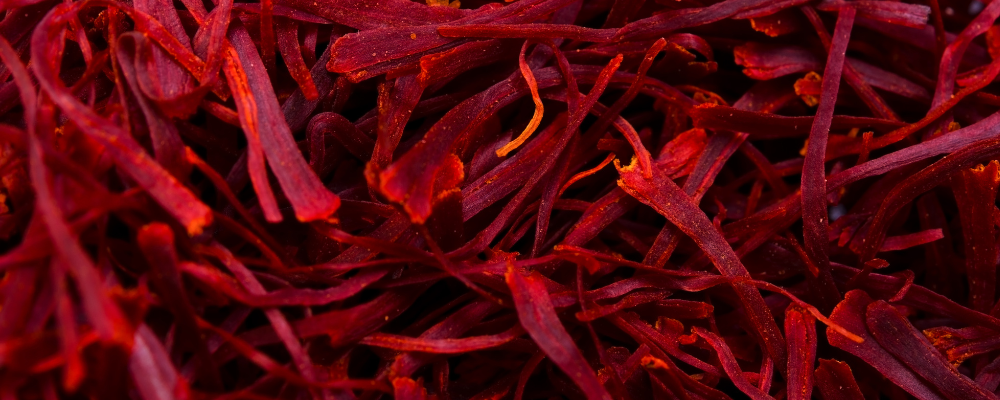
Saffron is a red thread that becomes gold. Each violet flower bears only three stigmas, picked by hand and then dried. In the Middle Ages, this costly material colored foods, textiles, and manuscripts. In the 17th century, Culpeper placed the crocus under the Sun and the Lion. Its historical magic unites rarity, light, measure, and the transformation of color, without needing an added legend.
True Saffron comes from Crocus sativus L., a cultivated sterile Iridaceae. The plant grows from an underground corm, flowers in autumn, and produces narrow leaves. It bears no viable seeds and reproduces by division of the corms.
The word saffron can refer to the plant, the spice, or its color. This triple identity explains its symbolic richness: a rare plant organ, a measured commodity, and material light. The ritual benefits from keeping these states separate and never confusing the saffron crocus with the poisonous autumn crocus.
Three Stigmas and a Sterile Lineage
Crocus sativus bears a mauve flower with six tepals. Three yellow stamens surround a style that divides into three orange-red stigmas. These tips, not the stamens, make up Saffron.
Kew accepts the species as a sterile cultigen originating in Greece. Kew, Crocus sativus. Its survival depends on the human propagation of corms, generation after generation.
This sterility transforms the plant’s magical significance. Continuity does not pass through the seed, but through the sharing of an underground organ. Saffron speaks of cultivated lineage, repeated action, and trust among those who preserve the line.
The Value Held in Three Threads
Each flower yields only three stigmas. It therefore takes very many flowers and considerable manual labor to obtain a small dry mass. The value of Saffron comes from an accumulation of brief tasks carried out during a short flowering period.
The Metropolitan Museum describes autumn cultivation, hand harvesting, and the use of Crocus sativus as a dye in medieval arts. Metropolitan Museum, Saffron and Color.
The wealth magic suited to it is therefore not that of a sudden gain. It measures the sum of minute tasks hidden in a filament. Three stigmas become an account: material, labor, and time must all be included in any fair estimation.
Saffron seems light on the scales because the weight of the work lies before the weighing.
The Vegetable Gold of Manuscripts
Medieval artists used saffron to produce a transparent yellow, enrich other colors, and imitate the gleam of gold. The hue was luminous but sensitive to air and light, which limited its permanence.
The Cloisters garden presents this history under the title “vegetable gold.” Metropolitan Museum, Saffron and Medieval Illumination. The pigment connects flower, workshop, manuscript, and metallic illusion.
This color teaches a useful distinction: resembling gold is not being gold. A saffron ritual can work with visibility, prestige, and bringing things to light, while marking the difference between real value, a sign of value, and an expensive appearance.
Saffron under the Sun
Culpeper places crocus under the Sun and Leo in his 17th-century herbal. The spice’s fiery color, price, and cordial reputation contribute to this medical astrological attribution.
The passage appears in The Complete Herbal. Project Gutenberg, Culpeper and Saffron. The text offers a clear historical source for solar correspondence, but its prescriptions do not constitute current health advice.
The Sun of Saffron is the Sun of manifestation: the red thread releases a brilliant yellow and colors a material far larger than itself. Power is therefore not measured by the talisman’s volume, but by its ability to make a concentrated quality visible.
Counting the three threads of value
Draw a Crocus flower and extend its center with three red threads. Name them material, labor, and time. Beneath each, write the amount actually committed to a project you wish to make visible.
Add a golden square around the flower. On its four sides, write the cost, the asking price, the recipient, and proof of delivery. Any blank box indicates an agreement to complete before beginning.
Date the page and place it with the relevant quotation, contract, or budget. Do not use physical Saffron. The drawing preserves the solar correspondence and the value of the three stigmas without exposure, ingestion, or botanical confusion.
Historical correspondences
| Reference | Correspondence |
|---|---|
| Botanical name | Crocus sativus L. |
| Family | Iridaceae |
| Part used | Three dried stigmas per flower |
| Historical planet | Sun according to Culpeper |
| Magical domains | Value, light, measure, and manifestation |
| Safe form | Three threads drawn on paper |