Browse here our incenses sorted by types to make your choices easier during your practices: religious incense, sabbath incense, monastic incense, Japanese incense, Indian incense, and more. One of the largest selections of incense to discover in our esoteric shop.
The origins of incense date back thousands of years, with deep roots in the ancient civilizations of Egypt, India, and China. Initially used for religious and spiritual rituals, incense was burned in Egyptian temples as early as 2500 BCE to honor the gods and accompany funerary rites. In India, the use of incense is documented in the Vedas, sacred texts dating from around 1500 BCE, where it played a crucial role in Hindu ceremonies. In China, from the Han dynasty (206 BCE – 220 CE), incense was used in Buddhist and Taoist temples to purify the air and aid meditation. These traditions later traveled along trade routes, spreading the use of incense worldwide, where it continues to enrich spiritual and daily practices.
Incense is an ancient tradition that originates in India, where it is still widely used for its purifying and soothing virtues. Among the many types of Indian incense, Nag Champa stands out as one of the most famous and appreciated worldwide. This unique blend, often made by the renowned brand Satya, is composed of champaca flowers, sandalwood, and a variety of other natural herbs. Nag Champa is especially valued for its calming properties, promoting meditation and relaxation.
Masala incense, another important category of Indian incense, is made from a mixture of wood powder, natural resins, essential oils, and honey. Unlike charcoal-based incense, masalas burn longer and release richer, more complex aromas. They are ideal for creating a serene atmosphere and purifying living spaces.
The elegance of Japanese incense
Incense, used for millennia for its purifying and soothing properties, takes on a particularly refined dimension with Japanese incense. Known for their purity and delicacy, Japanese incense is often made without bamboo sticks, allowing for a cleaner burn and an aroma free of impurities. These incense sticks stand out for their subtle and harmonious fragrances, created from natural ingredients such as sandalwood, cedar, and various aromatic herbs.
Japanese incense sticks are perfect for meditation and relaxation practices, offering a unique sensory experience that helps calm the mind and purify the environment. Their artisanal production, respecting ancient traditions, ensures exceptional quality and a balanced, soothing aroma diffusion. Using Japanese incense sticks allows you to transform your space into a sanctuary of tranquility and serenity.
The connection with religious incense
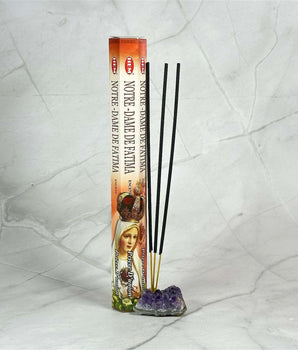
The religious incense, by honoring sacred figures, creates an atmosphere conducive to prayer and meditation. Among the most popular, Virgin Mary incense is often burned to seek protection and divine grace, bringing an ambiance of peace and serenity.
Saint Expedit incense, known for its virtues of swift intercession, is used to request urgent solutions and immediate help in times of need. It is especially appreciated for its ability to assist in desperate situations. Likewise, Mary who unties knots incense is dedicated to the Virgin Mary under the invocation of the one who helps untangle complex problems and difficult life situations. Burning this incense is a powerful way to seek solutions and regain spiritual clarity.
The spiritual incense of Tibet
The Tibetan incense, renowned for its spiritual and therapeutic virtues, holds a special place in religious and meditative practices. Made according to traditional recipes passed down from generation to generation, Tibetan incense is composed of natural ingredients such as herbs, spices, and precious resins. These unique blends create deep and soothing aromas that purify the environment and promote relaxation.
Tibetan incense is often used in Buddhist monasteries to accompany rituals and prayers. Its soft and enveloping smoke helps calm the mind, thus facilitating meditation and spiritual connection. Moreover, it is commonly used in healing practices, its natural ingredients being known for their beneficial properties on the body and mind.
A question?
We have the answers.
How to choose the right ingredients for your apothecary?
The choice depends on the intention and experience. Some plants are suited for protection, like rue or mugwort, while others, like rose or lavender, accompany healing and soothing rituals. Spiritual powders act as catalysts, magical oils amplify intentions, and ritual salts mark boundaries. The important thing is to listen to each ingredient, to feel its place.
Can multiple ingredients be mixed in the same bottle?
Yes, if the intention is consistent. A blend of rosemary, salt, and protective powder can strengthen a defensive work. However, some herbs do not mix well, such as St. John's wort and mugwort, which have very distinct energies. It is better to respect natural associations.
Should an ingredient be purified before use?
Not always. Some powders and resins are already charged, while others, like dried herbs, can benefit from a light purification before use. Ritual salts and consecrated waters are rarely purified, as they are already charged by their nature. The important thing is to connect with the ingredient, to feel it, to touch it.
Can an ingredient be stored indefinitely?
No. Dried plants lose their potency over time, magical oils can go rancid, and ritual waters can evaporate. It’s better to regularly renew your supplies, recharge your ingredients, or replace them when their energy seems to fade. An apothecary is alive; it doesn’t remain static.
Can the ingredients of an apothecary be consumed?
Not all. Some remain toxic. It is better to check before ingesting anything. Caution remains a golden rule in magical herbalism. That is why we indicate on each product sheet whether consumption is possible or not.
How are the products prepared?
All products listed as in stock are prepared within 24 hours from order confirmation (excluding weekends and holidays).
Our packages are prepared by our own team with care to ensure the protection of your products.
What are the delivery methods?
We currently offer delivery via Mondial Relay or Colissimo. Find more information here.
What is the delivery time?
The delivery time starts from the shipment of your package, and we indicate the average times observed by our carriers at the time of order. You can check our delivery methods and rates directly here.
To which countries do you ship?
We ship orders to France, Belgium, Switzerland, Monaco, and Luxembourg.
Aeternum is first and foremost a small, passionate French team that selects, packs, and ships more than 2,500 items dedicated to spiritual paths from around the world. Far from clichés, we value traditional practices and source our products as close as possible to local communities, offering ritualized, charged, and authentic products. We ship everywhere in France, Belgium, Switzerland, Luxembourg, Monaco, Réunion, French Guiana, Guadeloupe, Martinique, Mayotte, Saint Barthélemy, Saint Martin, New Caledonia, Italy, Spain, Portugal, Germany, the Netherlands, Canada, and the United States within 24 to 48 hours, and we remain available to answer your questions, whether you are preparing an altar, purifying a space, or simply looking for the right product. Our commitment is simple: to offer sincere, meaningful objects and support you with kindness on your own path. Whether out of curiosity or conviction, come and discover our esoteric bookshop, our incense, our ritual candles, our crystals, or our magical apothecary!