










































































































































































































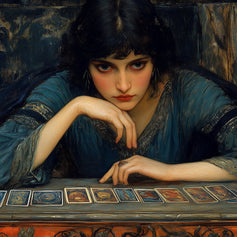




His real name was Gérard Encausse, but he was better known by the pseudonym Papus. He embodied one of the most prominent figures in French occultism at the end of the 19th century and the beginning of the 20th century. At once a physician, prolific writer, and spiritual teacher, he left his mark on his era through his bold approach, seeking to unite science, medicine, and esotericism. But who was this multifaceted man really? How did he shape the esoteric thought of his time, and what legacy did he leave behind? This portrait looks back at the life of this extraordinary figure, at the crossroads between science and mysticism.
The youth of Gérard Encausse
Gérard Anaclet Vincent Encausse was born on July 13, 1865, in La Coruña, Spain. His father, a chemist of French origin, and his Spanish mother provided their son with a multicultural education. When Gérard was very young, the family moved to Paris, where he grew up in a European capital in the midst of great upheaval, shaped by the scientific, intellectual, and spiritual revolutions of the era. Paris, with its occult circles and literary salons, quickly became fertile ground for his first esoteric interests to flourish.
From adolescence onward, Gérard showed a keen interest in science and the unseen. Fascinated by the writings of figures such as Paracelsus and Éliphas Lévi, he explored the mysteries of the Kabbalah, theurgy, and alchemy. Alongside his occult interests, he studied medicine at the Paris School of Medicine. There, he began to understand the complex relationship between the body, mind, and soul—a quest that would shape his later work. It was also during this period that he adopted the pseudonym Papus, a name taken from a healing spirit mentioned in an ancient Neoplatonic treatise.
A medical and esoteric career
After graduating in medicine in 1894, Papus distinguished himself through his desire to reconcile his medical knowledge with his occult practices. As a physician, he took an interest in alternative medicine and holistic practices, seeking to reconcile modern theories of health with mystical traditions. He was convinced that a person could not be properly healed without understanding the spiritual essence within them. His practice, which he opened in the 9th arrondissement, became a consultation space where he sought to heal not only the body but also the mind, applying his medical knowledge to methods such as massage and fumigation.

Papus thus became a true scholar of sacred texts and mystical doctrines, immersing himself in the esoteric teachings of ancient Egypt, Greece, Persia, and the East, as well as theosophy and alchemy, under the guidance of his mentor Éliphas Lévi.
Transmission as a mission
Passionate about sharing his knowledge, he founded the journal L'Initiation in 1889, a publication devoted to occult sciences and esoteric philosophies. The journal played a major role in spreading occultism at a time when these practices were still largely marginalized. L'Initiation attracted a wide circle of initiates, as well as curious readers eager to understand these mystical disciplines. Through his writings and lectures, Papus became one of the leading popularizers of esoteric thought in France.


The creation of the Martinist Order
In 1884, Papus took a major step in his initiatory journey by co-founding the Martinist Order with Augustin Chaboseau , an esoteric secret society based on the teachings of Louis-Claude de Saint-Martin, an 18th-century French mystic. Martinism, as reinterpreted by Papus, is an initiatory tradition seeking to restore the lost harmony between humanity and the divine. In this quest, people must rediscover their original spiritual nature by rising above material limitations and the illusions of everyday life.

Papus saw Martinism as a reconciliation between science and esotericism, two fields he regarded as complementary. In his view, science should be enriched by a spiritual dimension, while occultism should be studied with the same rigor as any other scientific discipline. One of the fundamental aims of Martinism is to unite modern rational thought with the eternal truths of mystical wisdom. Under his leadership, the Martinist Order spread rapidly throughout France and then across Europe, attracting many intellectuals, physicians, and mystics. The journal founded earlier became the official publication of the Martinist Order.
His affiliation with numerous organizations
Throughout his life, Papus became involved in numerous initiatory organizations. In 1887, he joined the Theosophical Society founded by Helena Blavatsky, an American-Russian occultist. The following year, he became a member of the Kabbalistic Order of the Rose-Croix. Later, he affiliated with Jules Doinel's Gnostic Church of France, and in 1895 he joined the Hermetic Order of the Golden Dawn. He also entered Freemasonry, where he was elected Grand Master in 1901. Papus continued to expand his affiliations, joining the Memphis-Misraïm Rite in 1908 as well as the Ordo Templi Orientis. However, his relationships with certain so-called “regular” Masonic lodges were sometimes strained.

In addition, Papus founded the Independent Group for Esoteric Studies (GIEE) in December 1889, organizing research, courses, and lectures on various aspects of Western esotericism. The group later became the external structure of the Martinist Order and was renamed the Free Faculty of Hermetic Sciences in 1897. Its teachings were rich and varied, with around a dozen monthly courses covering subjects such as the Kabbalah, alchemy, divination tarot, and the history of Hermetic philosophy.
The impact of the First World War
At the age of 49, Papus enlisted as a military physician, setting aside his work in secret societies and his role as a spiritual leader to devote himself entirely to caring for wounded soldiers. His experience as a physician, acquired through years of practice, enabled him to provide valuable assistance in field hospitals.
Amid the chaos of the trenches and makeshift hospitals, Papus distinguished himself through his unwavering dedication to the soldiers. He displayed remarkable energy, providing not only physical care but also moral support to those suffering from the horrors of war. His knowledge of conventional medicine, combined with his interest in alternative medicine and spirituality, made him a respected physician among the troops, who saw him as a kind and reassuring presence. Faithful to his holistic vision of medicine, Papus strove to heal not only wounded bodies but also minds tormented by the violence of the conflict.
Throughout his military service, Papus continued corresponding with his disciples and supporting the esoteric societies he had founded. Despite the horrors of war, he remained convinced that spiritual elevation was possible even in times of crisis, and encouraged his peers to persevere in their spiritual practices. However, the war placed immense strain on his already fragile health. The physical and psychological exhaustion of long days spent treating soldiers, combined with the difficult conditions at the front, gradually weakened him.
His death and legacy
In October 1916, exhausted by his tireless efforts and weakened by ongoing health problems, Papus contracted tuberculosis, a common illness at the time. He died in Paris on October 25, 1916, leaving an immense void in the esoteric world.
Papus's death marked the end of an era for French occultism. However, his influence endured long after his death. As the founder of the Martinist Order, which still exists today, a prolific author, and a teacher of the occult sciences, he left behind a considerable spiritual legacy.

His grave is located in the famous Père Lachaise Cemetery, in the 93rd division, under the name Encausse Family Grave, on which the following is engraved:
Here lies
Gérard Encausse
"Papus"
physician, philosopher, writer
Grand Master of the Martinist Order
disincarnated
on October 23, 1916
at the age of 51
Every year, the Cercle des Amis de Papus pays tribute to him at the site.
Papus's major works
As mentioned above, Papus was a very prolific writer, and it would be difficult to provide a complete list of his writings. Here are therefore those considered the most significant of his works.
Methodical Treatise on Practical Magic (1891)
Among his most important writings, Methodical Treatise on Practical Magic (1891) is considered an essential reference. This book, a true compendium of esoteric knowledge, explores subjects such as the Kabbalah, magic, alchemy, and astrology in depth. Its methodical, almost scientific approach enabled Papus to popularize complex mystical concepts, making them accessible to a broader audience than the traditional esoteric circles. It was an ambitious attempt to synthesize esotericism into a coherent system suited to the modern spirit of the era.
The Kabbalah (1903)
Another key work is The Kabbalah (1903), in which Papus presents this Jewish esoteric tradition from a philosophical and symbolic perspective. He breaks down the mystical and numerological aspects of the Kabbalah to show how they fit into a broader framework for understanding the universe and humanity. This book highlights his talent for clarifying sometimes abstract mystical concepts while preserving their spiritual depth.
The Tarot of the Bohemians (1889)
In this work, Papus examines the symbolism of the tarot, particularly its connection with the Kabbalah and Hermetic mysteries. The book is regarded as a reference for those interested in the esoteric interpretation of the tarot, which he considered not only a divination tool but also a means of gaining profound knowledge of the cosmos.
The Science of the Magi (1900)
In this work, Papus explores the study of magic and Christian mysticism in greater depth. It is a reflection on the sacred science of the Magi, in which he proposes a method for understanding the hidden mysteries of the universe through magic and spirituality.







un très grand personnage.