










































































































































































































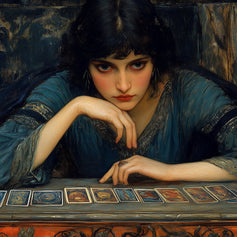




Madame Fraya, whose real name was Valentine Dencausse, was a famous French fortune-teller and palm reader of the Belle Époque and the interwar period. Considered by some occultists to be “the greatest fortune-teller of the century,” she distinguished herself through her astonishingly precise predictions, addressed both to the general public and to the political elites of her time. During a career spanning from the late 19th century to the 1950s, Madame Fraya gained international renown by reading the future in the lines of the hand and in handwriting, guided above all by her intuition rather than by traditional palmistry manuals. A portrait.
Youth and the discovery of her gift for clairvoyance
Valentine Marie Dencausse was born on May 21, 1871, in Villeneuve-de-Marsan, in the Landes region, into a bourgeois family. Her father, a senior civil servant at the Ministry of Finance, is said to have occasionally displayed a gift for premonition, even accurately predicting the date and time of his own death. During her adolescence, young Valentine received a refined education and developed a passion for music. Her parents steered her toward a career as a pianist, but fate decided otherwise. In 1887, at the age of 16, she married Louis-Erembert Delmas, a high-school teacher living in Pau, with whom she had a daughter. However, during her honeymoon, Valentine was struck by an extraordinary experience: she had a sudden vision of her own future, seeing herself established in Paris, receiving crowds of people and reading astonishing revelations in their hands. Convinced that she had discovered a genuine gift for clairvoyance within herself, the young woman decided to change her life. She separated from her husband a few years after their marriage—the divorce was granted in 1891—to follow the path that seemed destined for her. From then on, Valentine Dencausse avidly immersed herself in books on palmistry and occultism in order to cultivate her gift, although she later admitted that these readings taught her little compared with the lessons drawn from observing “life” and the hands themselves. During this formative period, she practiced her art privately and refined her technique by examining numerous anonymous hands before facing the general public. These early experiences in her native province quickly earned her the nickname “the Landes Nostradamus,” such an impression did her local predictions make on those around her.
Beginnings in Paris and the birth of “Madame Fraya”
Armed with her new convictions, Valentine moved to Paris at the very end of the 19th century to try her luck as a professional card reader and palm reader. She then benefited from the support of a famous Parisian occultist, Gérard Encausse—better known as Papus—who took her under his protection and introduced her to prominent Parisian salons. It was at this time that she adopted the pseudonym Madame Fraya, suggested to her by the journalist Séverine as a reference to the Norse goddess Freyja. Under this enigmatic name, Madame Fraya began attracting attention throughout Belle Époque Paris. She established herself as a fortune-teller and palm reader in a salon on Rue d’Édimbourg in Paris, where a fashionable clientele soon flocked to test her gift. From the beginning of the 1900s, her reputation grew thanks to several sensational predictions. The accidental reading of a simple palmistry manual may have been enough to spark her vocation, but it was her natural talent that quickly set her apart from her competitors. She herself stated that she did not follow classical palmistry doctrines to the letter, preferring to rely on her keen instinct to interpret the signs in palms and the features of handwriting. This intuitive approach, combined with a lively and cultivated mind, appealed to an increasingly broad audience. Even before the First World War, Madame Fraya had thus acquired considerable fame in the capital. She did not hesitate to make bold announcements that propelled her to the forefront of Paris’s esoteric scene.
Prophecies during the Great War
On the eve of the First World War, Madame Fraya made a powerful impression by announcing a conflict of global proportions caused by Germany, which would nevertheless end in its defeat. She also predicted that the defeated Emperor Wilhelm II would end his days in exile—a prediction that would prove correct a few years later, in 1918, when the Kaiser abdicated and fled to the Netherlands. According to some accounts, this prophecy was delivered directly to Wilhelm II’s sister, Princess Charlotte of Prussia, who had come to consult the fortune-teller shortly before the war. Skeptical, the princess is said to have refused to believe these dark omens, but five months later Europe was indeed engulfed in flames in August 1914.


When the Great War broke out, Madame Fraya became a reassuring figure for part of French public opinion, which was shaken by events. Her “great period” came precisely during the darkest hours of the 1914–1918 conflict. In September 1914, as the German armies were dangerously approaching Paris, the fortune-teller was urgently summoned by the French government. Amid panic over the enemy advance, she was called to the Ministry of War on Rue Saint-Dominique to give her intuition about the fate of the capital. Before anxious ministers such as Aristide Briand, Albert Sarraut, and Théophile Delcassé, Madame Fraya calmly and confidently predicted that the German troops would not enter Paris, that their offensive would fail, and that around September 10 they would retreat north of the Aisne River, marking the collapse of their rapid invasion plan. Her inspired words astonished the audience, since the military situation appeared critical—the enemy advance guards occupied Compiègne, Senlis and Creil were in flames, and thousands of frightened Parisians were fleeing toward Bordeaux. Yet subsequent events would prove her right: beginning on September 5, the decisive counteroffensive launched by Generals Joffre and Gallieni during the Battle of the Marne pushed back the invader by roughly a hundred kilometers in just a few days. By September 12, 1914, the Kaiser’s troops were retreating and entrenched themselves along the Aisne, destroying any hope of a lightning victory. Madame Fraya’s prediction came true almost word for word, helping to forge her legend.
The fortune-teller’s prophetic exploits did not end there during the war. In 1916, she made another astonishing announcement to one of her illustrious visitors to Paris, Prince Felix Yusupov. She told him that he would “murder someone with his own hands while feeling that he was carrying out a good deed.” Two years later, in December 1916, Yusupov was one of the conspirators who murdered the monk Rasputin in Saint Petersburg—an act he would later confess to having genuinely considered beneficial for Russia. Years afterward, exiled in France, Prince Yusupov remembered Madame Fraya’s prediction and confirmed its accuracy. Thanks to such supernatural exploits, Madame Fraya’s reputation emerged enhanced from the Great War: the postwar press readily nicknamed her the “new Madame de Thèbes,” after a famous Parisian fortune-teller who died during the conflict and whose mantle Fraya was said to have taken up in the popular imagination.
At the service of the powerful and famous
In the aftermath of the First World War, Madame Fraya’s fame reached its peak. From a figure of curiosity, she became an unofficial adviser sought out by the great figures of the world. Her achievements in 1914 earned her the respectful attention of numerous political leaders, including some of the most rational-minded. Thus, President of the Republic Raymond Poincaré, known for his skepticism, received her several times at the Élysée between 1917 and 1920, and even continued consulting her after his term ended, during private visits to her salon on Rue d’Édimbourg. Veteran statesman Georges Clemenceau, who had little patience for occult “nonsense,” also wished to meet the famous seer after the war. He arranged several informal meetings with Madame Fraya at his home, intrigued by her predictions. During an interview in the spring of 1920, Clemenceau asked her, for example, to analyze the handwriting of his political rival Paul Deschanel, who had recently been elected president of the Republic in his place. After examining Deschanel’s signature, Madame Fraya gave an unflattering psychological and physical portrait of the man: an intelligent and cultivated person but lacking great strength of character, nervous and in fragile health, “prone to small, bizarre accidents.” She even expressed doubts about Deschanel’s ability to complete his seven-year term. Once again, subsequent events proved her right: a few months later, in September 1920, President Deschanel resigned for health reasons after a series of strange incidents, including his famous fall from a train in his pajamas. Clemenceau, impressed, reportedly told her, “Bravo, Madame, you saw correctly…”.
Alongside these consultations with leaders, Madame Fraya continued receiving a growing number of figures from the worlds of art, literature, and the aristocracy. From the Belle Époque through the Roaring Twenties, nearly every celebrity passed through her elegant salon. Her prestigious clientele included foreign queens and princesses—Natalie of Serbia, Marie of Romania, Amélie of Portugal, and Princess of Saxe-Meiningen, the sister of Wilhelm II—as well as France’s elite. Leading politicians such as Jean Jaurès, Aristide Briand, Albert Sarraut, and Louis Barthou were among those who discreetly sought her advice. Writers and artists were not left out: Pierre Loti, Anatole France, Colette, the poet Anna de Noailles, and playwright Sacha Guitry numbered among her friends or regular clients. All the great actresses of the period, from Sarah Bernhardt to Cécile Sorel and Marguerite Moreno, also came to have her “read their palms.” Madame Fraya was thus the confidante of crowned heads as well as theater stars. She particularly impressed high society with her simple elegance and reassuring confidence, receiving visitors seated in an Empire-style armchair and equipped with a mother-of-pearl-handled magnifying glass given to her by a queen, methodically scrutinizing the lines of the palms of those who came to see her. Among her famous predictions was one made to a writer still unknown to the general public, Marcel Proust: in the 1910s, when Proust was struggling to get his writings published, Madame Fraya assured him that he would achieve resounding success—which came true a few years later with the publication of In Search of Lost Time and the author’s literary acclaim. Similarly, she is said to have encouraged actress Mary Marquet by predicting a successful stage career for her when she was just starting out. Thanks to this illustrious clientele and the publicity inadvertently generated by her renowned clients, the fortune-teller of Rue d’Édimbourg saw her prestige extend beyond France’s borders. Between 1914 and 1930, her salon was constantly busy, and mail poured in from around the world seeking her insights. In Paris, her appearances caused a sensation, and every prediction reported by the press added further to her aura as a modern-day sibyl.
Her final years
Despite her fame, Madame Fraya did not escape criticism or failure. Her gift for clairvoyance, however impressive it appeared to many, was put to the test by more rational investigators, particularly as the Second World War approached. In 1938–1939, convinced that the specter of a new world war would not immediately become reality, she publicly declared “there will be no war in 1939.” This assurance—which was then shared by part of the pacifist public—was unfortunately proven false the following year with the outbreak of the Second World War. Nevertheless, this major setback did not seriously undermine the confidence that many continued to place in her, and Madame Fraya made it through the Second World War without losing her popularity. Researchers in parapsychology and doctors nevertheless sought to objectively verify the extent of her abilities. As early as 1913, Dr. Eugène Osty had studied her case and praised “her highly advanced brain” after conducting tests of extrasensory perception. In any case, the figure of Madame Fraya continued to fascinate long after her death, inspiring both admiration for her successes and doubts about the limits of her gift.
After the Second World War, Madame Fraya continued practicing as a fortune-teller for a time, although more discreetly. In November 1946, at more than 75 years of age, she still gave an interview to the daily newspaper Paris-Presse, in which she shared her impressions of the future of the Fourth Republic. She predicted for metropolitan France “very dark things, but only economically,” adding optimistically, “I see neither war nor revolution… France will emerge from the confusion, even if the general situation is bad.” These words perhaps reflected the wisdom she had acquired after decades of upheaval. Madame Fraya died a few years later, on February 16, 1954, struck down by an attack of arteritis in her apartment in Paris’s Auteuil district. She was 82 years old. In accordance with her wishes, the woman known as “the fortune-teller of the Élysée” was buried in the Parisian cemetery of Bagneux, in the 28th division, where her grave bears the simple epitaph of a woman who devoted her life to reading that of others.
Thus, by combining an undeniable sense of showmanship, sharp intuition, and a deep cultural background, Madame Fraya established herself as one of the most notable fortune-tellers of the early 20th century. Accounts consistently portray her as intelligent, warm, and self-assured, capable of inspiring hope and reflection in entire generations of clients. The records of her career ensure Madame Fraya a legacy befitting her predictions: intriguing and unforgettable.




Super récit , bien détaillé et très instructif !
Merci à vous.
Grand merci pour ce très bel article, fort intéressant.