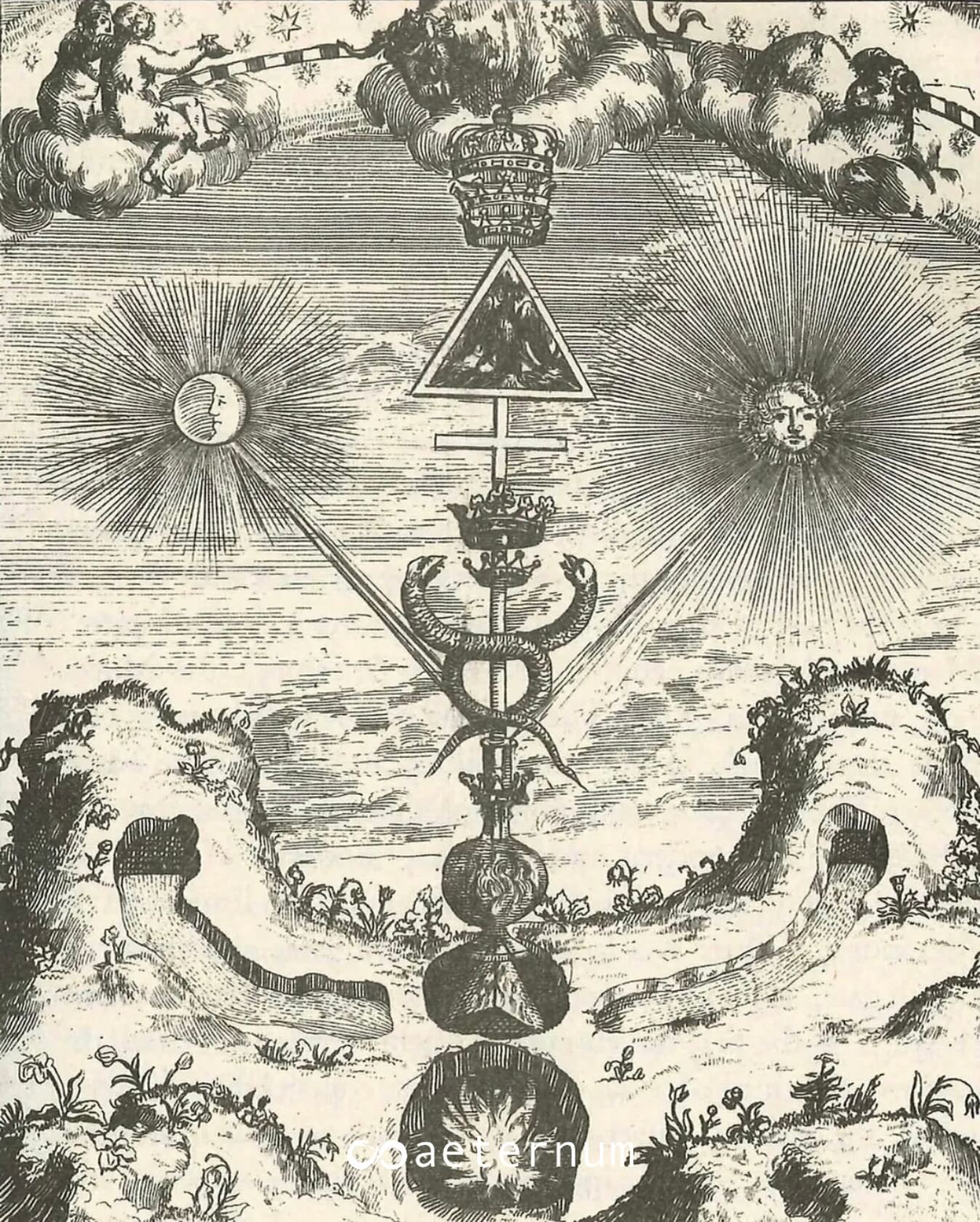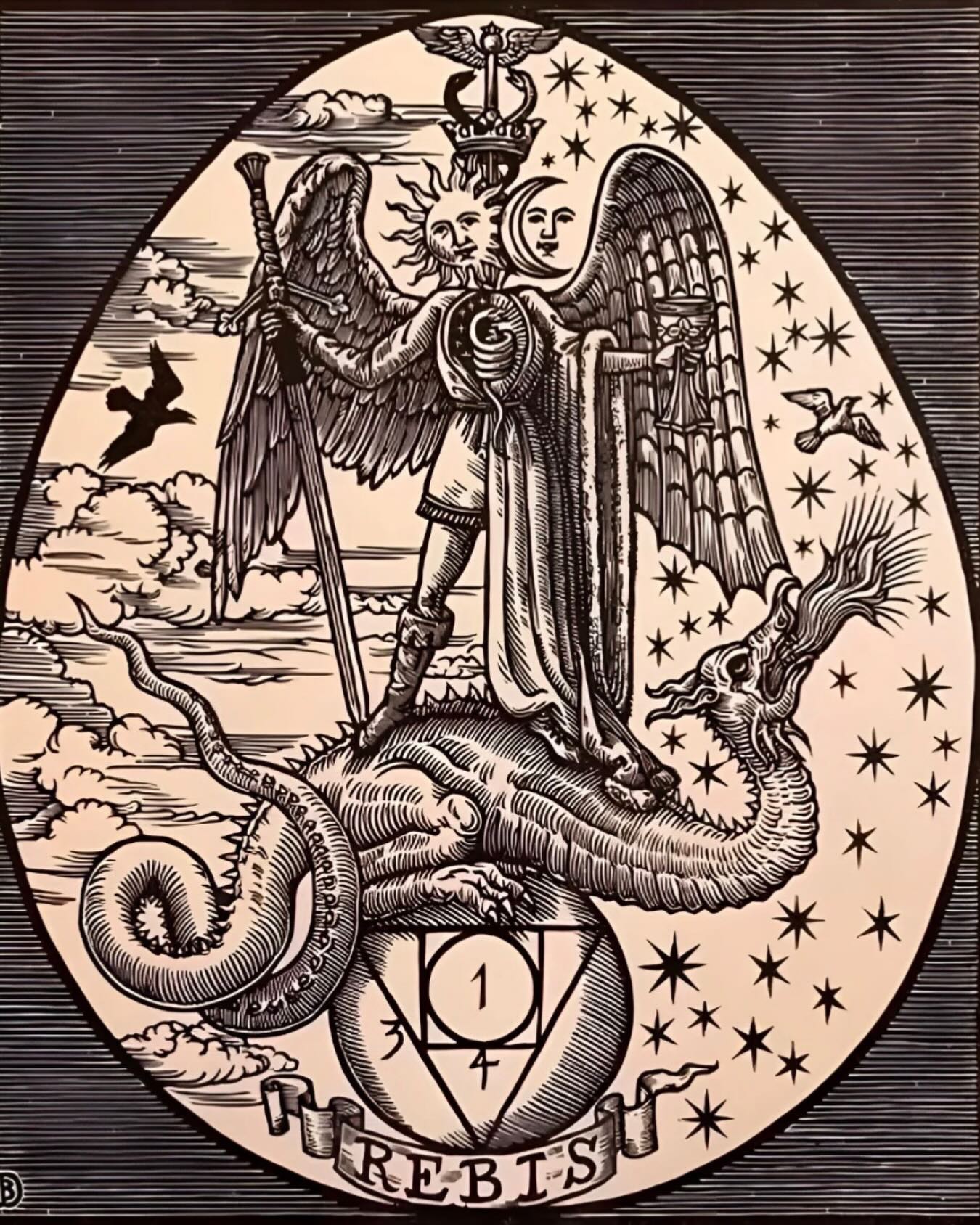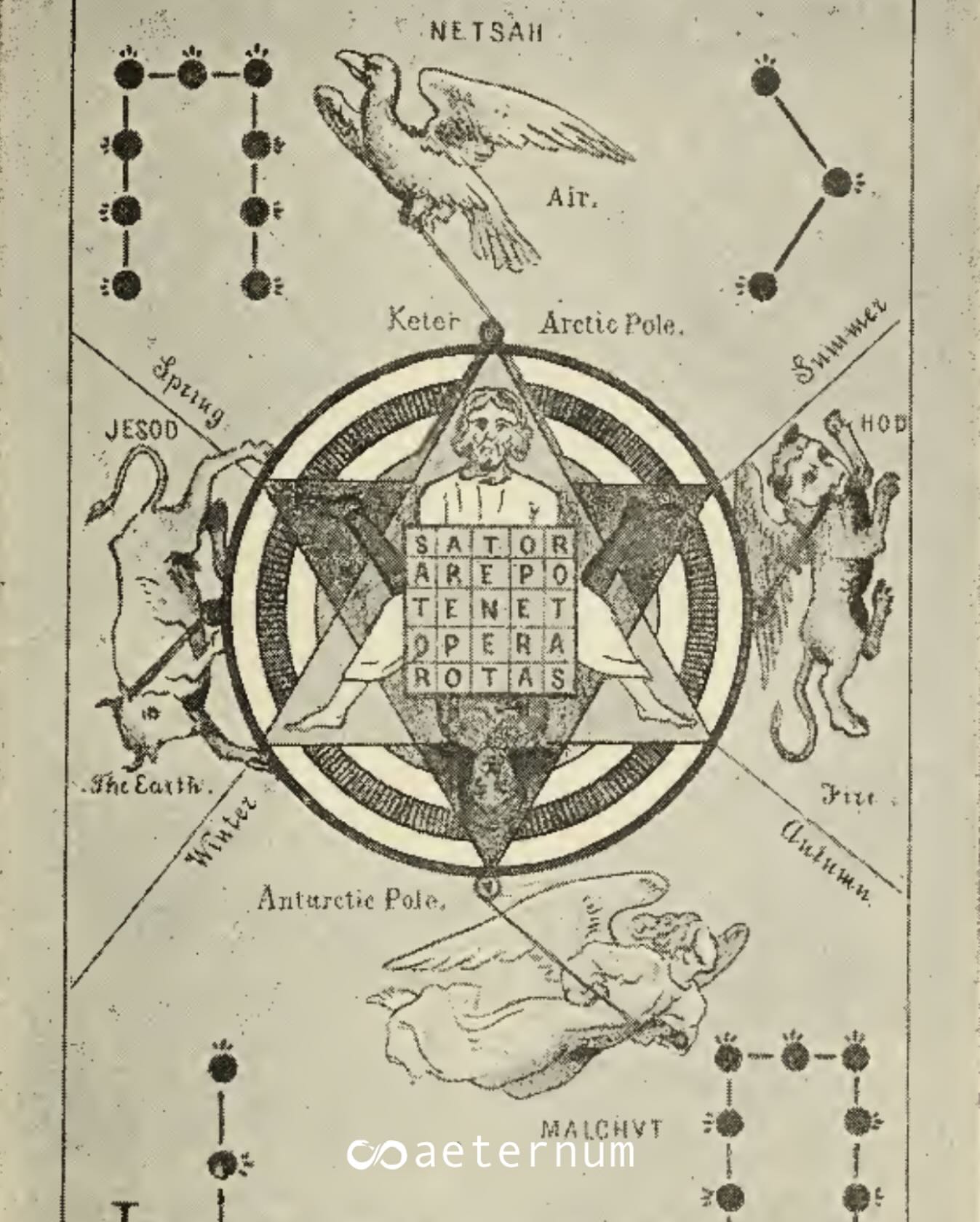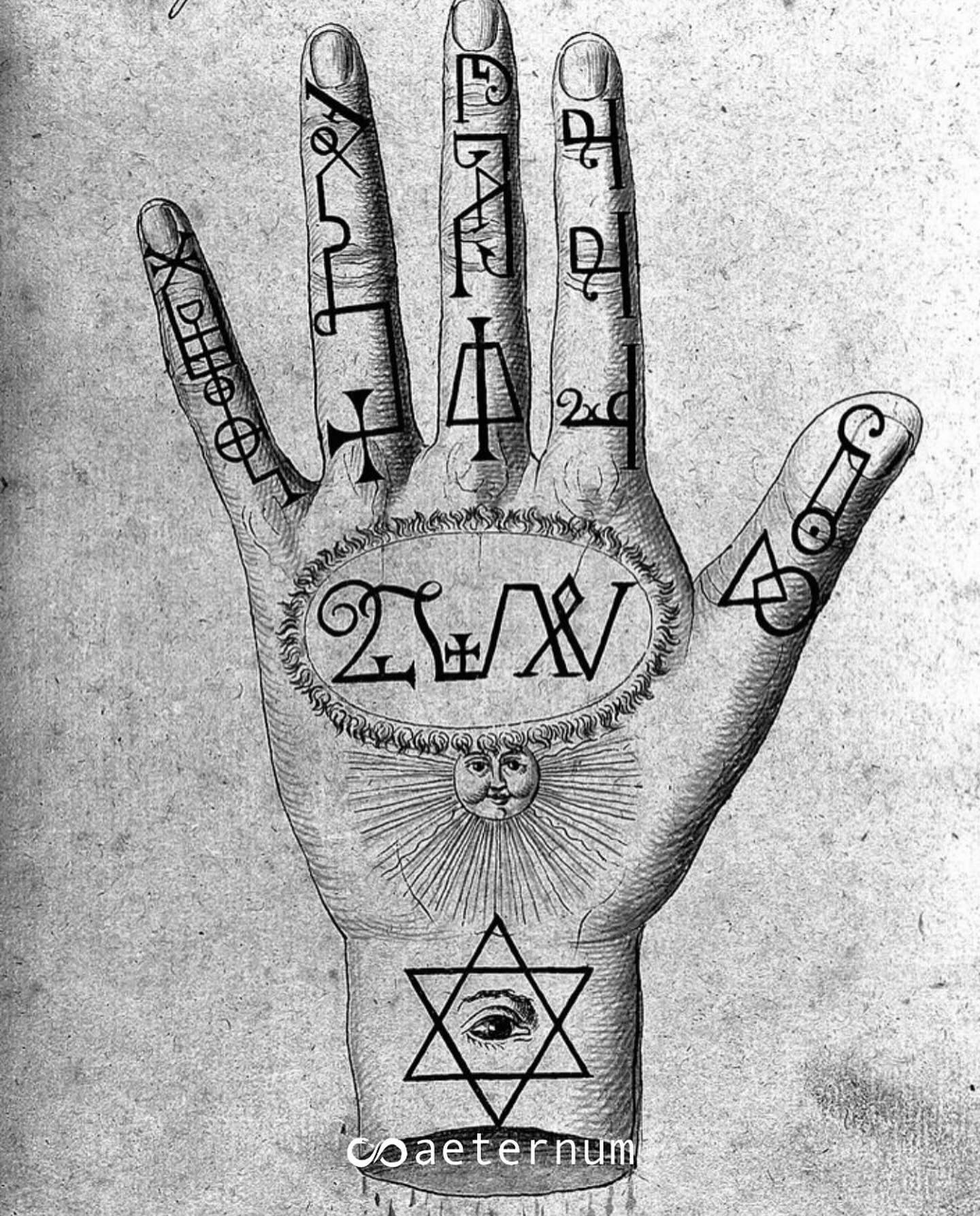



















































































































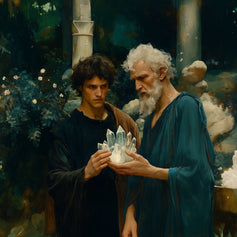


Hermeticism refers to a philosophical and esoteric school of thought that emerged in Greco-Egyptian antiquity, whose writings are attributed to a legendary figure, Hermes Trismegistus. Associated with the Greek god Hermes and the Egyptian god Thoth, Hermes Trismegistus was revered as a sage who had received a primordial revelation and was capable of bringing spiritual salvation to his disciples. The Hermetic tradition has since had a considerable influence on the magical arts. An overview.
The Origins of Hermeticism in Greco-Egyptian Antiquity
Hermes Trismegistus, whose name means “Hermes, three times greatest,” appears in the context of Hellenistic and Roman Egypt as the syncretism of the Greek god Hermes—the divine messenger and guide of souls—and the Egyptian god Thoth—master of knowledge and writing. Ancient authors regarded Hermes Trismegistus not as a historically attested individual, but as the legendary embodiment of an ancient wisdom. From the 3rd century BCE onward, mystical and technical writings circulated in Alexandria under his authority. These early texts—known as popular Hermeticism—dealt mainly with astrology, alchemy, magic, and occult disciplines, bearing witness to the encounter between Egyptian knowledge and Greek philosophy.


Alongside the occult writings, a philosophical learned Hermeticism developed from the 1st century CE onward. It consisted of a collection of religious and cosmological dialogues written in Greek, in which Hermes instructs his disciples about God, the cosmos, and the soul. The main collection of these treatises is known as the Corpus Hermeticum, consisting of around ten short dialogues probably written between the 1st and 3rd centuries CE. To this were added the famous Asclepius—a Latin-language Hermetic text—as well as fragments reported by later authors, such as the Anthology of Stobaeus around 490, and several writings discovered in Coptic at Nag Hammadi in 1945. Taken together, these works present Hermes Trismegistus’ theology and cosmology as deeply syncretic: they contain Platonic influences, particularly from Plato’s Timaeus, Stoic influences, and even Jewish or Persian reminiscences. The Hermetic treatises describe the world as a creation ordered by one supreme God, the source of all things, and humanity as an intellect arising from divine intelligence. In certain Hermetic dialogues, such as the Poimandres and the Perfect Discourse, Hermes teaches the existence of a transcendent God who created the world through thought and urges the human soul to purify itself in order to return to the divine. These ideas bear striking similarities to the emerging Neoplatonic philosophy. Indeed, the Neoplatonic philosophers of late antiquity were familiar with the Hermetic writings: Iamblichus in the 4th century and Proclus in the 5th century referred to them in their works, indicating that Hermetic thought had become part of the intellectual landscape of the period.
Beyond pagan philosophical circles, Christian authors of the early centuries also took an interest in Hermes Trismegistus. Some viewed him as a monotheistic pagan sage whose writings could anticipate Christian truths. Around 300, the apologist Lactantius described the “Egyptian Hermes” as a very ancient scholar “filled with all wisdom” and claimed that Hermes had proclaimed in his books the majesty of the one supreme God, whom he called “God the Father.” In his Divine Institutes, Lactantius even quoted a passage from the Asclepius in which Hermes refers to a “Son of God” who created the world, interpreting it as a veiled prophecy of Christ. Although Saint Augustine criticized these texts, seeing them as demonic deceptions in The City of God, the idea of Hermes Trismegistus as the bearer of a premise of Christian revelation helped preserve certain Hermetic writings within Latin culture. In particular, the Perfect Discourse, or Asclepius—a theological Hermetic dialogue—was translated into Latin early, perhaps as early as late antiquity, and widely copied throughout the Middle Ages. For centuries, this Asclepius was the main source of knowledge about philosophical Hermeticism in the West, even as most of the Greek texts of the Corpus Hermeticum faded into obscurity.
Hermeticism in Late Antiquity and Its Transmission to the Middle Ages
During late antiquity, Hermeticism suffered from the decline of paganism but found unexpected channels of transmission. As Christianity took hold in the Roman Empire, pagan Hermetic circles disappeared, but their writings were partially preserved by learned Christian readers. We have seen that Lactantius and Augustine quoted excerpts from them. Others, such as Thierry of Chartres in the 12th century, continued to comment on the Asclepius, bearing witness to the survival of this tradition in medieval monasteries and schools. Moreover, Hermeticism enjoyed a remarkable afterlife outside the Christian Empire, in the emerging Islamic world.
Hermeticism in the Medieval Arab-Muslim World
With the advent of Islam in the 7th century, the figure of Hermes Trismegistus was reinterpreted within a monotheistic framework. Muslim scholars, seeking to integrate the philosophical heritage of antiquity, identified Hermes with a prophet from pre-Islamic antiquity. According to the tradition reported by the Persian astronomer Abu Ma`shar (Albumasar) in the 9th century, there were in fact three successive Hermeses. The first Hermes, identified with the biblical prophet Enoch, called Idrîs in the Quran, supposedly lived before the Flood and built the monuments of ancient Egypt, including, according to legend, the pyramids, to preserve his knowledge before the catastrophe. The second Hermes supposedly lived after the Flood in Babylonia and transmitted knowledge of medicine, astronomy, and philosophy; the third Hermes supposedly returned to Egypt and invented alchemy. Of the three, it was Hermes-Idrîs—the antediluvian Hermes—whom Muslim authors regarded as a true prophet inspired by God. Although no sacred writing was attributed to him, it was believed that this Hermes had transmitted the primordial arts and sciences to humanity. This Islamic appropriation of the figure of Hermes formed part of a broader medieval Egyptomania among Arab-Muslim authors, who viewed ancient Egypt as a venerable source of wisdom.
During the first centuries of Islam, a particular group—the Sabians of Harran in Mesopotamia—explicitly claimed Hermes Trismegistus as their own. Hellenized pagans threatened by Islamic expansion, the Harranians sought to have their religion recognized as “monotheistic” by presenting Hermes not as a polytheistic god but as an ancestral prophet. They produced writings claiming to have been revealed by Hermes himself, including a Letter on the Soul attributed to Hermes. The scholar-astrologer Thābit ibn Qurra, who died in 901 and came from this community, wrote the Institutes of Hermes in Syriac, a work now lost, and translated it into Arabic. These Muslim Hermetic works, although tinged with pagan esotericism, circulated in Islamic intellectual circles, particularly among certain Shiite Neoplatonic philosophers. As the Islamologist Henry Corbin noted, Shiism was more receptive to Hermeticism because its theology allowed for the existence of wise, non-legislating prophets such as Hermes, while its gnosis valued inner revelations accessible to initiates, the awliyâ’, beyond canonical prophecy. Orthodox Sunni Islam, by contrast, viewed Hermeticism with suspicion. Hermetic doctrines such as animating idols through the “divine essence” by means of prayers, or the idea that the soul could ascend to God without prophetic revelation, contradicted Sunni theology and prevented Hermeticism from being officially integrated into the Muslim religion.
Despite these reservations, Hermetic thought deeply permeated the occult sciences in the Muslim world. Numerous treatises attributed to Hermes were translated into Arabic, covering astrology, the art of talismans, and especially alchemy. The bibliographer Ibn al-Nadîm, in his Fihrist around 987, listed 22 Hermetic works in Arabic, including 5 on astrology, 4 on talismanic magic, and 13 on alchemy. Some of these writings have survived in full or in fragments—for example, the Kitâb al-Isṭamākhīs and the Kitâb al-Malâṭîs, alchemical treatises attributed to Hermes. Medieval Muslim scholar-alchemists, such as the legendary Jâbir ibn Hayyân, or Geber, and the pseudo-Majrîtî, frequently referred to Hermes in their works. A highly popular astrological and magical grimoire, the Ghâyat al-Hakîm, or “The Aim of the Sage,” compiled in the 10th century and later attributed to Majrîtî, incorporated numerous Hermetic elements. Translated into Latin in the 13th century under the title Picatrix, this text had a major influence on the medieval West. Likewise, the famous Emerald Tablet, or Tabula Smaragdina—a short Arabic Hermetic text proclaiming the principle “As above, so below”—first appeared in a 9th-century treatise, the Kitâb sirr al-khalîqa, or “Book of the Secret of Creation.” Translated into Latin as early as the 12th century, this alchemical text attributed to Hermes became a cornerstone of Western alchemy. Finally, several prestigious Muslim philosophers mentioned Hermes with respect: the philosopher al-Kindî in the 9th century admired the way Hermes had expressed the ineffable transcendence of God, admitting that “a Muslim like [himself] could not have expressed it better.” Later, theosophers such as Suhrawardî in the 12th century and the Andalusian mystic Ibn Sab‘în explicitly claimed Hermes’ heritage in their quest for wisdom. Throughout medieval Islamic civilization, Hermeticism thus served as a bridge between science, magic, and philosophy, preserving the memory of Hermes Trismegistus as the mythical founder of occult knowledge.
The Reception of Hermeticism among Medieval Jewish Thinkers
The Jewish communities of the Middle Ages, particularly in Islamic lands and southern Europe, were also exposed to Hermetic ideas through Arabic transmission. Scientific and astrological works stemming from the Hermetic tradition were translated from Arabic into Hebrew between the 12th and 14th centuries. One of the most prominent medieval Jewish intellectuals, Abraham Ibn Ezra (1089–1164), an astronomer and biblical exegete from Spain, incorporated elements of Hermetic astrology into his writings. Ibn Ezra, who wrote extensively on the Pentateuch, also composed astrological treatises in Hebrew in which he cited the teachings of “Hermes” several times, demonstrating the prestige of this name as a source of ancient wisdom in the study of the stars. He believed that certain doctrines attributed to Hermes could shed light on the interpretation of the Bible while remaining consistent with monotheism. However, this attempt to combine Hermetic knowledge with Jewish thought drew criticism from other Jewish authorities. The most famous Jewish philosopher of the Middle Ages, Moses Maimonides (1138–1204), a staunch advocate of Aristotle and rationality, firmly denounced astrology and the superstitions he believed had been introduced by authors such as Ibn Ezra. Maimonides rejected the idea that the stars or talismans could exert a mystical influence over human destinies, and he advised Jews not to study the occult writings attributed to Hermes or other pagans. This debate illustrates the ambivalent reception of Hermeticism in Jewish thought: on the one hand, a fascination with a philosophia perennis predating the Bible, of which Hermes was supposedly a pagan witness; on the other, the distrust of rationalist currents toward these esoteric contributions. In any event, by the end of the Middle Ages, the Hermetic heritage had penetrated esoteric Jewish literature—echoes of it can be found in certain works of the emerging Kabbalah—while remaining on the margins of rabbinic orthodoxy.
Hermeticism in the Medieval Christian West
In medieval Latin Europe, philosophical Hermeticism was less well known than in Islamic lands because the original Greek texts had been lost. The Corpus Hermeticum itself remained unknown in the West until the Renaissance. However, medieval scholars had access to two major sources associated with Hermes Trismegistus: on the one hand, the Latin Asclepius, and on the other, a series of occult and alchemical treatises claiming his authority. The Asclepius—which was believed to have been translated from Greek by Apuleius of Madaura—was read by certain scholastic theologians. Saint Augustine had quoted excerpts from it, and passages from it were commented on by 12th-century thinkers such as Thierry of Chartres and Alain of Lille. Nevertheless, it should be emphasized that the direct influence of Hermeticism on medieval philosophy was limited—it was often discussed secondhand through the Church Fathers.
By contrast, the esoteric impact of the figure of Hermes in the medieval West was considerable. Numerous Latin grimoires and alchemy treatises circulated under the name of Hermes Trismegistus, perpetuating his aura as master of nature’s secrets. Texts such as the Liber de secretis naturae and the Tractatus aureus, or Golden Treatise on the Secret of the Philosopher’s Stone, were attributed to him and highly prized by alchemists. A collection of astrological magic recipes, the Liber imaginum, or Book of Images, also attributed to Hermes, was known to scholars such as Albert the Great in the 13th century. This manual taught how to make talismans by engraving figures during the different phases of the Moon in order to produce occult effects, such as destroying crops or inspiring love. The prestige of Hermes’ name thus served as an endorsement for an entire body of medieval magical literature. Among the pseudo-Hermetic works of this period, one stands out: the Liber XXIV philosophorum, or Book of the 24 Philosophers. Written in Latin by an anonymous author in the 12th or 13th century, this short treatise offers 24 cryptic definitions of God, including the famous formula: “God is an intelligible sphere whose center is everywhere and whose circumference is nowhere.” These metaphysical aphorisms profoundly influenced mystical theology—they were quoted by thinkers such as Alain of Lille and Thomas Aquinas, and later by Renaissance authors such as Nicholas of Cusa and writers such as Pascal. Although the Liber XXIV philosophorum does not explicitly mention Hermes, tradition associated it with Hermeticism because of its esoteric character and oracular style of expression. All these elements show that during the Middle Ages, Hermeticism survived in the West primarily as an occult tradition—in alchemy, astrology, and magic—rather than as an open philosophy. Hermes Trismegistus appeared there as a mythical sage, patron of alchemists, and symbol of esoteric knowledge transmitted only to initiates. This is also where the modern French meaning of the word “hermetic” originated, describing an impenetrable secret or an obscure text reserved for “very few initiates.”
The Renaissance: The Rediscovery and Apex of the Hermetic Tradition
Marsilio Ficino, Pico della Mirandola, and the Revival of Hermeticism
It was during the Renaissance, in the 15th century, that Hermeticism made a triumphant return to European thought. In 1460, a monk from Macedonia brought to Florence a Greek manuscript containing fourteen Hermetic treatises previously unknown in the West. The patron Cosimo de’ Medici, fascinated by the texts of late antiquity, immediately entrusted the translation of this treasure to his young protégé, Marsilio Ficino—even before Ficino had finished translating Plato. In less than three years, Ficino completed the Latin translation of the entire collection, which he titled Pimander, or Poimandres, after the first treatise. Published in 1471, this translation of the Corpus Hermeticum was a resounding success and sparked enthusiasm for the wisdom of Hermes Trismegistus throughout learned Europe.
In the preface to his translation, Ficino himself expressed the intellectual euphoria caused by this rediscovery. Drawing on the authority of Saint Augustine, he proclaimed Hermes Trismegistus the “first theologian” of humanity—the most ancient sage to have contemplated divine truths. According to Ficino, Hermes lived in the time of Moses or shortly afterward and transmitted his sacred doctrine to the Greeks. He thus imagined a chain of wisdom running from Hermes to Orpheus, then to Pythagoras, and finally to Plato. This idea formed part of the humanist concept of the prisca theologia, the “primordial theology” revealed by God to the first humans, of which all subsequent philosophies were merely reflections. For Ficino, Hermeticism offered proof that the ancient Egyptians had known a form of pre-Christian divine truth. He was all the more exalted because he read prophecies of Christianity in the Hermetic writings: Hermes supposedly announced the end of the old idolatrous religion, the coming of a new monotheistic faith, and even the incarnation of the divine Word. Indeed, a passage in the Asclepius symbolically evokes a savior who is the son of God, a passage already cited by Lactantius. Ficino emphasized that Hermes “had supposedly predicted the birth of Christ, the Last Judgment, and the resurrection.” These providential correspondences reinforced the idea of harmony between ancient wisdom and Christian truth, making Hermeticism even more attractive to Renaissance thinkers.
Other humanists soon became enthusiastic about Hermes Trismegistus. Giovanni Pico della Mirandola, philosopher and Kabbalist, regarded the Hermetic revelations as complementary to the Hebrew Kabbalah in accessing universal truth. In 1486, in his famous 900 Theses, Pico proposed ten theses “according to the ancient doctrine of the Egyptian Mercury Trismegistus,” which he intended to defend publicly. His celebrated Oration on the Dignity of Man, a manifesto of Platonic humanism, opens with a quotation from the Asclepius. In Pico’s view, Hermes and Moses, the Kabbalah and Hermeticism, converged toward the same perennial wisdom willed by God—an idea at the heart of his project to reconcile all traditions. The enthusiasm was such that representations of Hermes Trismegistus began to appear in Renaissance Christian art. A striking example can be found in Tuscany: in 1488, a large mosaic depicting Hermes Trismegistus teaching was inlaid into the pavement of Siena Cathedral, with an inscription presenting him as a “contemporary of Moses.” This work, attributed to Giovanni di Stefano, symbolically welcomed the faithful at the cathedral entrance, suggesting that the wisdom of the Ancients—embodied by Hermes—somehow led to the threshold of Christian revelation.
Other Florentine and Italian scholars continued Ficino’s work. Lodovico Lazzarelli, a Hermetic poet and philosopher, embraced Hermes’ doctrine to such an extent that he considered himself his direct disciple. In 1494, Lazzarelli composed the Crater Hermetis, or “The Cup of Hermes,” an allegorical account of an initiation in which a master transmits an experience of Hermetic spiritual regeneration to his disciple. Lazzarelli also translated an additional Greek Hermetic treatise into Latin—the Definitions of Asclepius to King Ammon—published in 1507. Meanwhile, in France, the scholar Lefèvre d’Étaples published a commented edition of Ficino’s Pimander in 1505, accompanied by the Asclepius. Lefèvre saw Hermes as an asset to Christian apologetics, also emphasizing the Hermetic prophecies of Christ, but took care to condemn the corpus’s elements of pagan magic in order to remain within orthodoxy. Throughout the 16th century, Hermetic texts were edited and disseminated across Europe. A Greek printed edition of the Corpus Hermeticum was produced in Paris in 1554 by Adrien Turnèbe, followed by a new French translation in 1574 by François de Foix, Lord of Candale. In his preface, the latter emphasized Hermeticism’s affinity with Pythagoreanism and claimed that Hermes had lived before Moses, possessing knowledge of divine realities superior to that of the Hebrew prophets. Even leading Christian thinkers incorporated Hermes into their philosophical debates: Cardinal Nicholas of Cusa in the 15th century and the philosopher Francesco Patrizi in the 16th invoked the authority of the Trismegistus to support a Platonic vision against Aristotelianism. In 1591, in his work Nova de universis philosophia, Patrizi went so far as to compile all known Hermetic fragments in order to construct a universal philosophy that departed from Aristotle.
The influence of Hermeticism during the Renaissance was not limited to theology and academic philosophy—it also permeated the learned occultism of the period. Figures such as Cornelius Agrippa (1486–1535), author of De occulta philosophia, and Paracelsus (1493–1541), a reformer of medicine, claimed the Hermetic tradition as their own. Agrippa cited Hermes Trismegistus as an authoritative source in his presentation of the occult sciences, while Paracelsus described his own approach to medicine as a “Hermetic philosophy,” referring to alchemy and the hidden correspondences between humanity, the microcosm, and the universe, the macrocosm. Hermeticism also nourished literary creation: the English writer Philip Sidney alluded to Hermetic ideas, and the Italian poet Giordano Bruno (1548–1600), best known for his infinite cosmology, was deeply influenced by Hermeticism. In his Italian dialogues, Bruno exalted Hermes Trismegistus and Egyptian magic, combining them with his own pantheistic vision of the universe and developing the idea of an animated world spirit—a concept partly inherited from the Hermetic texts. Bruno had read Ficino and the Asclepius avidly. The modern historian Frances Yates went so far as to call Bruno a “champion of the Hermetic tradition” and to view Hermeticism as one of the cornerstones of the intellectual revolution of the Renaissance.
Thus, for a little over a century, from approximately 1460 to 1600, Hermeticism enjoyed extraordinary prestige in Europe. It was perceived as the oldest theology, the Egyptian source of the wisdom of Pythagoras and Plato, and a missing link between pagan wisdom and Christianity. Its influence was felt in the most diverse circles: esoteric and astrological groups, Neoplatonic philosophical academies, Christian theologians, both Catholic figures such as Lefèvre d’Étaples and certain Reformed thinkers, as well as artists and poets. One may speak of a genuine Hermetic Renaissance: Egyptian symbols flooded art and architecture, including obelisks and apocryphal hieroglyphs, while Hermes appeared alongside Moses and Orpheus in frescoes celebrating the harmony of the sages of all ages.
From the Classical Age to the 19th Century: Survival and Occult Revival
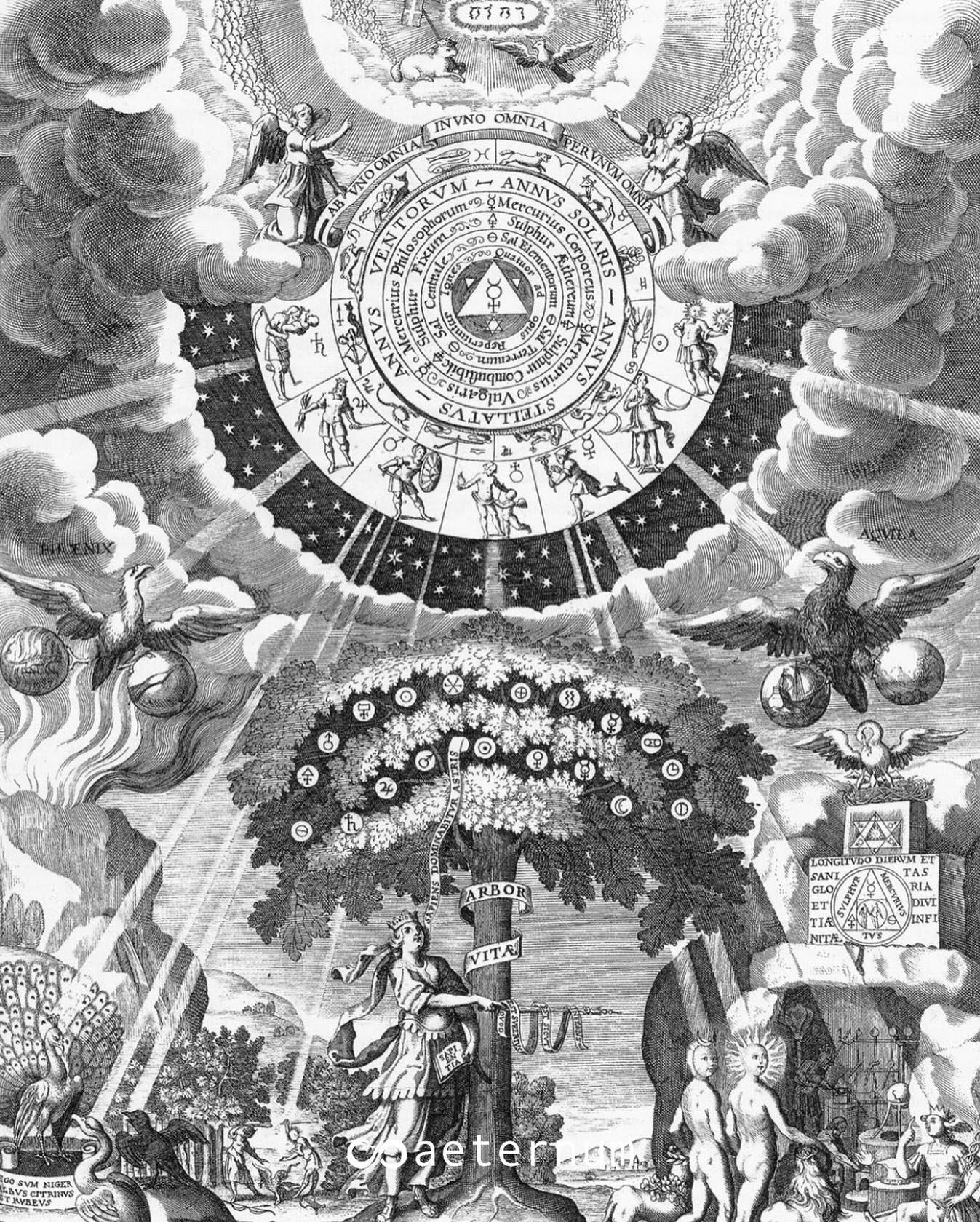
After the Renaissance, Hermeticism continued to influence European thought, but in a more subterranean manner. The 17th century saw the development of alchemy and what would later be called the Hermetic sciences. It is no coincidence that the alchemy of this period was described as “Hermetic”: the alchemists of the Grand Siècle, such as Michael Maier, Robert Fludd, and Thomas Vaughan, claimed an intellectual lineage from Hermes Trismegistus in opposition to the official science inherited from Aristotle and Galen. Hermes became almost synonymous with alchemist. The Corpus Hermeticum itself, now recognized as more recent, was no longer emphasized, but the Hermetic spirit—the search for hidden correspondences and the spiritual transformation of humanity—permeated alchemical treatises. Seventeenth-century alchemical theories called themselves Hermetic precisely to signal their attachment to a mythical tradition whose founder was supposedly Hermes, independently of scholastic science. It should be noted that, for these authors, claiming Hermes as their authority was as much symbolic as it was a matter of genuine lineage: they saw Hermes as the patron of the occult knowledge they sought to defend as an integral part of understanding the world. Although emerging modern science eventually eclipsed alchemy, it is striking that several great scholars of the period remained fascinated by Hermeticism. Isaac Newton himself practiced alchemy intensely and annotated Hermetic-alchemical texts throughout his life, seeking in matter and ancient doctrines the secret of the unity of nature—a testament to the enduring appeal of the Hermetic ideal of a sacred science of nature.
At the same time, Hermeticism fueled the esoteric myths of secret societies. At the very beginning of the 17th century, the manifestos of the Rosicrucians emerged in Germany, from 1614 to 1616, recounting the discovery of the tomb of the mystic Christian Rosenkreutz and the revelation of his teachings. These manifestos, although originally parodic, drew on Hermetic themes: the renewal of human knowledge through an occult wisdom from the East and the call to “unknown philosophers” bearing a hidden light. Hermes Trismegistus was implicitly present as the archetype of the sage who possessed pre-Christian secrets. Authors such as Michael Maier (1568–1622), an alchemist and disseminator of Rosicrucian ideas, published treatises combining Hermetic allegories with Rosicrucian references. Likewise, the speculative Freemasonry that emerged in the 18th century developed founding legends encompassing Hermes. In his Discourse of 1736 to the Masonic lodges of Paris, Chevalier Andrew Michael Ramsay traced Freemasonry back to the ancient mysteries, citing the wisdom of Hermes and Pythagoras. An allegorical novel he wrote even featured Hermes Trismegistus guiding a hero along the path of knowledge. This reference demonstrates the continuing prestige of Hermes as a symbol of hidden initiation, even at the dawn of the Enlightenment.
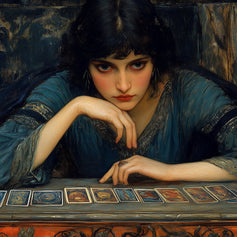
In the 18th century, Enlightenment Europe oscillated between attraction to and rejection of Hermeticism. On the one hand, the rationalist and critical spirit distrusted these occult legacies: Enlightenment philosophers classified alchemy and astrology as superstitions from a bygone age. Voltaire and Diderot gently mocked the Hermetic mysteries. On the other hand, a current of historical and philosophical scholarship sought to understand these traditions. Scholars began writing histories of alchemy and Hermeticism: in 1742, Lenglet Du Fresnoy published Histoire de la philosophie hermétique, one of the first attempts at a synthesis on the subject. The great German historian Johann Jakob Brucker, in his Historia Critica Philosophiae (1742–1744), devoted a substantial chapter to Hermes Trismegistus and “Hermetic philosophy,” placing it within the history of thought. Meanwhile, interest in the emerging field of Egyptology and in occultism persisted in certain enlightened circles: the movement known as Illuminism, associated with Saint-Martin and others, as well as mystical Freemasons, kept interest in Hermetic-Kabbalistic symbolism alive. Around 1770, the French occultist Antoine Court de Gébelin claimed to decipher the Egyptian origins of the Tarot in his work Le Monde primitif, and his disciple Etteilla, or Jean-Baptiste Alliette, published an “Egyptian” Tarot, claiming it was the restored Book of Thoth-Hermes. Thus, on the eve of the 19th century, Hermeticism remained an active esoteric current, present on the margins of official culture and ready to resurface.
It was precisely in the 19th century that a major occult revival took place, with Hermes Trismegistus once again serving as one of its emblematic figures. As positivist sciences triumphed, an esoteric reaction organized itself, claiming the heritage of ancient traditions. The leading occultists of the period turned decisively toward Hermeticism for legitimacy and inspiration. In France, Éliphas Lévi, whose real name was Alphonse-Louis Constant (1810–1875), a central figure in modern occultism, titled one of his works The Key to the Great Mysteries According to Enoch, Abraham, Hermes Trismegistus, and Solomon (1859), placing Hermes alongside biblical figures as a possessor of the secrets of the “High Science.” In the United States, the esotericist Paschal Beverly Randolph published an adapted translation of Hermes’ Divine Pymander in 1851, titled Hermes Mercurius Trismegistus: His Divine Pymander, helping to spread Hermetic spirituality within American spiritualist and Rosicrucian circles. In England, Hermetic influence reached its height with the founding of initiatory societies explicitly described as Hermetic. The mysterious Hermetic Order of Luxor, active around 1884, claimed to transmit occult teachings derived from ancient Hermetic Egypt. Above all, the famous Hermetic Order of the Golden Dawn, founded in London in 1888, placed Hermeticism at the heart of its symbolic and ritual system. The Golden Dawn’s rituals invoked Hermes and Thoth, while the study of the Corpus Hermeticum, Kabbalah, astrology, and the Tarot, known as the “Thoth Tarot,” held an important place. This flourishing context shows that by the end of the 19th century, Hermeticism had once again become synonymous with the Western esoteric tradition par excellence. The term “Hermeticism” itself came to designate the entire Western esoteric corpus, to the point of being used almost synonymously with “occultism” or “esotericism.”
It is significant that the scientific study of these subjects emerged at the same time, from the late 19th to the early 20th century. Researchers such as Louis Ménard and Gustave Parthey edited the Hermetic texts in Greek and Latin, while the historian A.-J. Festugière later published, between 1944 and 1954, a monumental four-volume study, The Revelation of Hermes Trismegistus, which remains authoritative. Hermeticism thus passed from the status of a living esoteric tradition to that of an object of historical and philosophical study.
The myth of Hermes has had a performative power throughout the history of thought: it inspired the creation of entire libraries of texts, stimulated intellectual movements, and generated an esoteric imaginary that still endures. In this sense, Hermeticism, born from the encounter between Egypt and Greece, became a constitutive element of Western culture. But did it truly reveal its secrets?