










































































































































































































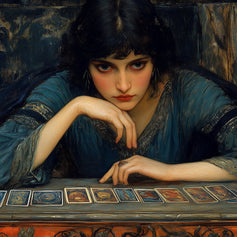




The courtroom has always been a theater where the Invisible could make an appearance, all the more so amid the many intense prayers, hopes, and egregores. Since time immemorial, those who risked their lives or honor before the law have secretly invoked other forces to tip the scales. This is known as judicial magic, a form of influence magic.
Rituals to Sway the Verdict
Influencing a judgment may involve an offensive curse or a persuasive charm. On the one hand, the practitioner may seek to hinder their opponents—this is the tradition of binding spells. The objective is clear: to silence a hostile witness, paralyze opposing counsel, or confuse the minds of the jurors. In ancient Rome, people inscribed on tablets: “May [Nom]’s tongue become knotted, and may their arguments vanish before the judge.” By burying them beneath the courthouse or in the fresh grave of a dead person, they entrusted the infernal gods with carrying out this vengeance. These courtroom malefices, though secretly employed, testify to the belief that, through a properly directed rite, official truth can be twisted.
On the other hand, judicial magic also makes use of influence charms, on the borderline between bewitchment and prayer, to soften judges’ hearts and guide their decisions. Here there is no curse, but rather subtle work upon emotions and benevolence. Western practitioners have passed down “sweetening” rituals—this is what such sugar- or honey-based enchantments are called, intended to “sweeten” the judge’s attitude. A small jar of honey is prepared, into which the magistrate’s name is placed along with herbs of clemency such as lemon balm and violet, while words of harmony are recited. The intention is to draw an aura of understanding and pity over the decision-maker. Hoodoo adopted the principle of the honey jar to sweeten various aspects of everyday life.


This idea of touching the judge’s soul through magic also has religious roots. People prayed to Saint Catherine or Saint Jude to enlighten the jurors, and wore blessed medals. A famous example is the Prayer of the Just Judge, which invokes Christ as the supreme judge so that he may inspire earthly justice. Through fervent words—“O Just Judge, You whose throne is equity, cover me with Your mantle before the court of men”—the defendant requested divine protection that would turn the hearts of the powerful away from all unjust severity. Although apparently Christian, these prayers are incorporated into the judicial mage’s repertoire. They are found copied in grimoires alongside more esoteric formulas.
Occult Protections Against Trial
When a summons arrives or an accusation threatens, the practitioner’s first reaction is to protect themselves. Before even trying to influence others, one must guard against the visible and invisible attacks of the trial. Protection against a trial often begins with a purification ritual: fear and injustice are swept away from the self, and at dawn on the day of the hearing one ritually washes with lustral water infused with basil (a protective herb) and blessed salt. Through this symbolic washing, the accused “removes” the malefices that might surround them and presents themselves purified before human justice.
Next comes the time for the amulet. Wearing a talisman during a hearing is a constant feature of Western occult practices. In the tradition of country wise people, defendants were advised to slip into their pocket a small leather pouch containing plants and symbols of justice. In popular grimoires from the 19th century, we read that simply carrying a stone consecrated to Jupiter “makes you win your lawsuits.” Jupiter, the planet of law and authority, imbues the gem with its influence; the talisman, held against the heart, grants confidence, perceived integrity, and alignment with judicial good fortune. Likewise, traditions of so-called “white” magic recommend gently chewing a piece of galangal—a root called Chewing John by African American practitioners—just before speaking in court. This rhizome, reputed to give weight to one’s words, serves to make testimony more convincing and to bind the tongue of the opposition.
Occult protection also targets the energetic attacks one might suffer in court. A defendant may feel psychically assaulted by the prosecutor’s gaze or the hostility of the crowd. To remedy this, some carry the mirror of a small talisman that reflects the evil eye. Others draw the Kabbalistic sign of Perfect Silence on their skin, in invisible ink (lemon juice or oak-gall water), just before the hearing: a triangle crossed by a horizontal bar. This sign, originating in hermetic manuscripts, is supposed to deflect slander and protect against the “arrows” of false accusations. Thus armored, the defendant approaches the witness stand with the quiet confidence of one who has surrounded themselves with their own invisible guardians.
Diverting a Judgment Through Occult Art
If subtle protection and influence fail, a more radical and perilous path remains: diverting a judgment through an act of high magic. This means attempting to deflect the normal course of justice, either by provoking an unforeseen event that cancels or delays the trial, or by resorting to illusion to deceive the judges’ senses. This practice flirts with the idea of the mage presenting themselves as a forger of destiny, ready to defy the established order.
One traditional way of diverting a judgment is to resort to illusion magic. This involves enchantments in which the accused assumes, for the duration of the hearing, the appearance of an innocent old man or a sickly victim, arousing pity instead of anger. Behind the image lies a real practice: the use of illusion powders. A 17th-century grimoire suggests preparing a fine powder with dried mandrake root and club moss (an inflammable powder), to be discreetly blown into the courtroom. The smoke thus created would disturb the minds of those present, veiling the truth for a moment. Of course, such attempts are risky and skirt the edge of black magic—manipulating perceptions can easily be seen as a diabolical pact.
Certain rituals intended to make evidence disappear likewise resemble a diversion of justice. In a late-medieval manuscript, one finds a recipe to “extinguish the written truth”: the parchment bearing the indictment is coated with a mixture of squid ink and ox gall while invoking the angel of forgetfulness. It is claimed that the text will fade from the eyes of whoever reads it, becoming illegible or appearing innocuous. Imagine for a moment the astonishment of a clerk discovering that the case’s crucial piece of evidence has become a blank vellum...
Finally, diverting a judgment may mean delaying the outcome indefinitely until it becomes moot. Here again, magic has its stratagems: a sorcerer could bury a blackened crystal ball at the foot of the courthouse wall, symbolizing the obscuring of justice’s clairvoyance. As long as the ball remained buried and active, the judges would spin around in endless discussions without ever reaching a conclusion. This verdict-freezing ritual is mentioned in certain chronicles, which recount inexplicably prolonged trials that continued until a purification of the site finally allowed a decision to be made.
The Judge’s Clemency and Occult Rites of Supplication
Obtaining the judge’s clemency is generally the ultimate goal sought by the judicial mage when they know they are at fault or fear too severe a sentence. Rather than forcing the decision or deceiving justice, the aim here is to temper the severity of the verdict and awaken in the judge an unexpected impulse of mercy. Grimoires are filled with occult supplication rituals that accompany, or even reinforce, conventional legal petitions for clemency.
One of the central principles of these rituals involves emotional correspondence: one seeks within oneself the vibration of pity in order to amplify it and project it toward the decision-maker. The accused is advised to meditate on the eve of judgment upon a memory in which they themselves forgave someone. At the height of this emotion, they must lift a white veil before a candle and recite an incantation in a humble voice. The incantation may vary, but one well-known formula begins: “May the heart of the one who judges me be tinged with the same clarity as this flame,” calling upon the archangel Raphael, spirit of healing, to heal the judge’s harshness. The white veil serves as a channel, supposedly carrying this feeling of forgiveness into the magistrate’s heart at the crucial moment.
Other, more concrete rituals invoke the magic of divine names. A Kabbalistic tradition recommends writing the judge’s name on parchment, in square Hebrew letters, just beneath a Sacred Name such as El Rahim (“God of Mercy”). The parchment is enclosed in a sky-blue silk pouch (the color of clemency) with three dried rose petals. On the morning of the judgment, the practitioner wears the pouch on their chest, beneath their shirt, so that it rests near the heart when they face the judge. It is said that this simple proximity of the divine Name and the judge’s name, placed together over the accused’s heart, invisibly inclines the magistrate’s soul toward compassion. Many mages claim to have avoided the worst in this way, seeing their ordinarily inflexible judge suddenly grant a reprieve or a reduced sentence without quite knowing why.
The clemency sought may also be supported by invoking the patron saints of desperate causes—notably Saint Expeditus, invoked in doubtful legal cases. An old prayer, recited in Latin, said: “Sancte Expeditus, you who know the urgency of justice, obtain from the Most High that the judge show humanity.” Recited on one’s knees on the courthouse steps just before the hearing, this prayer was accompanied by lighting a small green candle (the color of hope), which was discreetly left to burn on the spot. At that point, attracting the judge’s clemency became a genuine sacred rite, joining popular Catholic faith with esoteric knowledge.
Grimoires of the Dungeons and the Sorcery of Imprisonment
Judicial magic does not stop at the prison threshold—quite the contrary, confinement has generated its own occult practices. In the magical West, dungeons have sometimes echoed with incantatory words at night, and their walls have sheltered secret grimoires copied by hand. The existence of grimoires written or recopied in prison is attested by anecdotes and surprising discoveries. Judicial archives, for example, report the case of Gracien Detcheverry, a famous 18th-century Basque sorcerer. Arrested in 1733, Detcheverry possessed a forbidden manuscript entitled Agripa Negra. Armed with this grimoire, he boasted that he could find hidden treasures and even “open the doors of prisons” whenever he pleased. Alarmed by such powers, the Bayonne court had the seized book translated and copied in full before publicly burning it. Detcheverry’s prison manuscript, preserved as evidence, reveals a composite body of esoteric knowledge: it contains conjurations for treasure and spirit evocation (including passages recognizable as excerpts from the Grimoire of Pope Honorius), and likely the famous recipes for breaking locks and padlocks through the sacred word.
Beyond books, there are occult practices associated with confinement. A famous account from the late Middle Ages tells of an imprisoned witch who, every night, managed to escape her cell to attend the sabbat before returning to her chains at dawn—to the great terror of her jailers. They took to binding prisoners accused of witchcraft with special restraints, tying their thumbs and big toes together for fear that they might transform into creatures able to slip through the keyhole. Here legend meets a very real precaution: fear of occult power forced justice itself to work around rituals. A plaque engraved with the name of God or an excerpt from a psalm was sometimes nailed to the dungeon threshold, supposedly neutralizing any attempt to bewitch the lock.
Some prisoners, far from resigning themselves, orchestrated daring rituals to escape. A Creole grimoire seized in Haiti in the 1920s—during the American occupation—contained “a prayer against bullets, a charm against torture, and a spell to ensure one’s release from prison.” One of these rituals, later transcribed by an ethnographer, is striking in its simplicity: “At midnight, recite: ‘Sesame, Sesame, permit yourself and open yourself,’ and the irons will fall from your wrists. When leaving, say: ‘Sesame, close yourself again.’ Upon reaching the door, if the gate is locked, pronounce: ‘Pastoo, Vidoo, Agrimento. Agrippa, deliver me from this lion that seeks to take my life. Everything yields to Your Name; all knees bend before You. Mane Thecel of the three Maries—Agrippina, Mariannie, and Farres—be my guides and conductors. Amen.’”. Here, the mixture of biblical references (the Mane Thecel of the writing on the wall in the Bible) and esoteric words of power (Agrippa, echoing the great occultist) aptly illustrates the syncretic creativity of prison magic. Alone in the dark, the prisoner invokes both the magical word from Ali Baba’s cave (“Sesame, open yourself”) and a personal litany of protective names. What matters is the unshakable faith invested in the act: local accounts tell that some initiates actually saw their chains come loose and found their dungeon open at daybreak.
The sorcery of imprisonment is also expressed through small daily gestures. An occult prisoner may feed a familiar insect, spider, or rat, regarded as their spiritual messenger: they entrust it with words to carry outside, or send it out as a scout.
Thus, behind the judge’s gavel, other forces may be at work...









1 comment on Judicial Magic and Prison Grimoires