



Contents...
|
1. The origins of the Ankh in ancient Egypt |
The Ankh (or Ânkh), often called the key of life, the Nile cross, or the life cross, is one of the most recognizable and powerful symbols of ancient Egypt, accompanying many deities. Its shape, a cross with a loop at the top, represents a depth of spiritual and philosophical meanings, which remains surrounded by mysteries and uncertainties. Let’s discover together the meaning of this mysterious symbol.
1. The origins of the Ankh in ancient Egypt
The oldest representations of the Ankh date back to the third millennium BCE, as early as the First Dynasty, symbolizing life and immortality. Through the Pyramid Texts of the Old Kingdom (which follows the First Dynasty), the Ankh was already firmly rooted in Egyptian cosmology, associated both with earthly life and existence in the afterlife, and gaining increasing visibility.
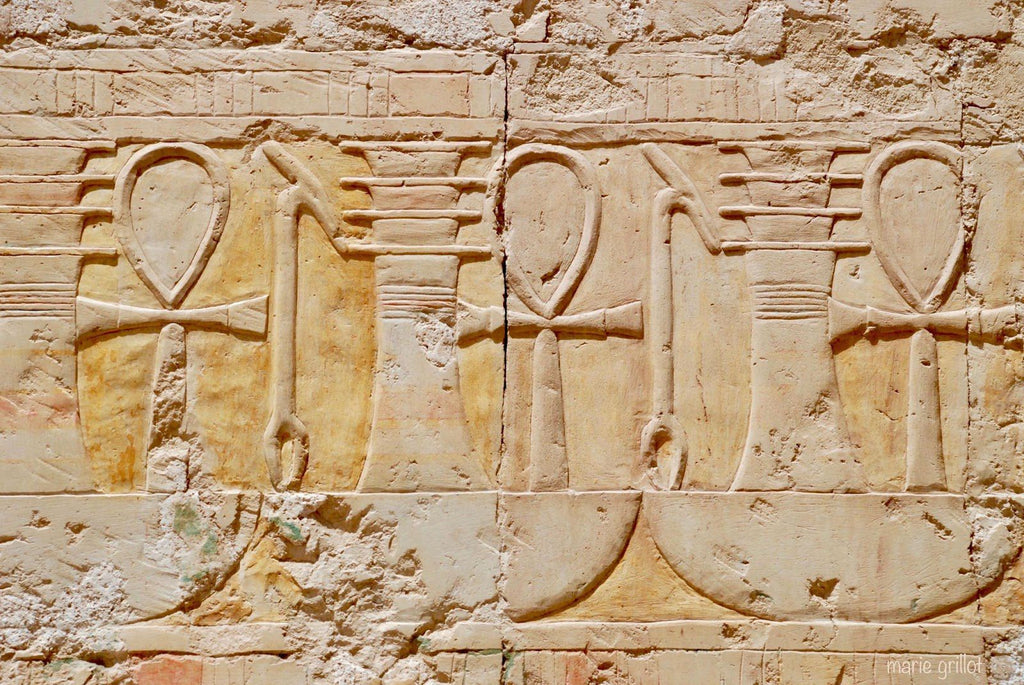
The importance of the Ankh increased during the Middle Kingdom (c. 2055 - 1650 BCE) and the New Kingdom (c. 1550 - 1070 BCE), periods marked by territorial expansion, economic prosperity, and cultural development. During these eras, the Ankh became a symbol of protection and well-being, widely used in art, amulets, and even daily life. The Ptolemaic period (323 - 30 BCE) saw a fusion of Greek and Egyptian cultures, during which the Ankh continued to be an important symbol, linking ancient Egyptian traditions to new Hellenistic influences.
2. An origin still undetermined
Many historians and Egyptologists have explored the meaning of the Ankh without reaching unanimous agreement. Among them, E.A. Wallis Budge studied Egyptian symbolism and mythology, including the Ankh. He interpreted it as a symbol of eternity, suggesting that its shape could be that of a key, evoking a "key of life" or a "key to the mysteries" of the universe, opening the doors to the afterlife.
James Henry Breasted, for his part, saw the Ankh as a symbol of life and fertility, in line with the traditional Egyptian conception of this sign as a representation of eternal life and the cycle of rebirth.
Zahi Hawass, known for his extensive explorations of Egyptian tombs and monuments, did not propose a new theory about the Ankh, but his field discoveries highlighted its importance as a universal symbol of life, protection, and spiritual power in ancient Egypt.
Finally, Christian Jacq has studied the religious and mythological dimensions of Egypt, including the Ankh. He has frequently described this symbol as a central element of Egyptian cosmology, illustrating the belief in the afterlife and the power of regeneration.
3. The Ankh and Egyptian Deities
Representations of deities holding the Ankh abound throughout Egyptian history, embodying their divine power to give life and to rule over the afterlife. The Ankh thus becomes a symbol of the connection between the divine and the mortal, a key to understanding the Egyptian vision of the universe, where death is simply a transition to another form of existence.
In the art and artifacts of ancient Egypt, the statue of the god Ptah, worshiped in Memphis as one of the primordial deities, stands out by its depiction holding a unique scepter. This scepter incorporates the powerful symbols of the Ankh, representing life, the Was, evoking power, and the Djed, symbol of stability. Together, these elements illustrate Ptah's sovereignty over creation and his gift of offering eternal life. Furthermore, delicate figurines depicting the goddess Isis nursing her son Horus enrich this divine iconography. In some of these works, Isis is seen bringing an Ankh to Horus's mouth, a strong symbolic gesture marking the gift of life and the transmission of divine nourishment.
4. Meaning and Symbolism
Since there is still debate among historians about the true meaning of this symbol, the following points should be considered as sometimes adopted theories.
4.1. The Ankh as a Symbol of Life
The core meaning of the Ankh lies in its association with life. For the ancient Egyptians, the Ankh did not only represent physical life but encompassed a broader dimension of existence: eternal life, life after death, and the immortality of the soul. It should be understood that mortal life was seen only as a passage to a much larger existence.
The very shape of the Ankh, which combines an oval (symbolizing the feminine) and a vertical cross (symbolizing the masculine), could suggest unified fertility and creation, representing life in its most fundamental essence. Some researchers see in the upper loop a representation of the rising sun on the horizon, linked to rebirth and the eternal cycle of life.
4.2. The Ankh as the Key to Life
The Ankh is often considered a "key"—sometimes called the "key of life" or "the key of mysteries." In this context, it symbolizes knowledge and access to hidden secrets, opening the door to mystical and esoteric understandings of the world. It represents the key that unlocks the doors to unknown realms, suggesting that holding the Ankh offers wisdom and understanding beyond material life.
Moreover, Aleister Crowley used the Ankh as a symbol of life and spiritual light, in line with its interpretation in ancient Egypt as representing life and immortality. In Thelemic philosophy, which is based on the principle of pursuing the True Will of the individual as the ultimate act of spirituality, the Ankh can symbolize the key to this personal and spiritual realization.
Also, the Ankh found a particular resonance with Christian teachings on the immortality of the soul and the promise of eternal life through the resurrection of Jesus Christ. Coptic Christians, heirs of Pharaonic Egypt, adopted the Ankh as a symbol of their faith, seeing it as a representation of the Christian promise of life after death.
4.3. The Ankh as a Symbol of Balance and Harmony
4.4. The Ankh as a Symbol of Protection and Healing
Beyond its role as a symbol of balance and harmony, the Ankh was revered in ancient Egypt as an extremely powerful protective talisman and a healing instrument. Its representation was believed to repel negative forces, evil, and disease, thus offering a protective barrier around those who wore it or placed it in their environment. This belief in its ability to preserve from adversity and purify the atmosphere of harmful influences made the Ankh a sought-after symbol for safety and well-being.
In the context of Egyptian healing practices, the Ankh played a central role. It was often used during rituals intended to restore health, symbolizing regeneration, the renewal of life, and the maintenance of vital balance. Healers could rely on the Ankh to serve as an intermediary between the physical and spiritual worlds, channeling healing energies through it. This practice was based on the deep belief that health was not just the absence of illness, but a state of total harmony between body, mind, and soul, which the Ankh helped to achieve.
The image of the Ankh was also incorporated into many amulets and ritual objects, designed to protect the individual in life and in death. The Egyptians believed that, as a talisman, the Ankh had the power to secure the soul’s passage into the afterlife, ensuring continuous protection against spiritual dangers and guaranteeing the benevolence of the deities.
4.5. The Ankh as a symbol of fertility and rebirth
The association of the Ankh with life, a fundamental concept in Egyptian mythology and cosmology, naturally extends to areas as essential as fertility and rebirth. The Ankh, with its distinctive loop above a cross, visually encapsulates powerful metaphors of creation and the cycle of life. The loop, resembling a rounded womb, symbolizes gestation, the potential for life, and birth, evoking the image of motherhood and the creation of life. This oval shape is interpreted as the lap from which life emerges, a sacred space for conception and the protection of new existence.
The cross beneath the loop, with its vertical and horizontal bar, represents life on earth, establishing a link between heaven and earth, the spiritual and the material. It symbolizes stability and grounding, reminding us that life, although inspired by celestial forces, unfolds on the earthly plane where the physical and spiritual meet and interact. In this, the Ankh not only symbolizes life but also the intersection point between different planes of existence, emphasizing the continuity between heaven and earth, the divine and the mortal.
4.6. The Ankh as a symbol of passage and transition
In the rich symbolism of the Ankh, its ability to represent the passage from one state to another holds a particularly deep and significant place. This transition can be between life and death, or between different states of consciousness, making the Ankh a spiritual guide for the soul on its journey beyond the earthly world. This facet of the symbol highlights not only the continuity between phases of existence but also the transformation necessary for the soul's progression.
The Ankh, in this context, is seen as a key that opens doors between worlds, facilitating the transformation and passage of the soul to the afterlife or to its new form of existence. It embodies the idea that death is not an end in itself, but rather a stage in an eternal cycle of rebirth and regeneration. Thus, the Ankh symbolizes the promise of life after death, offering comfort and assurance that the spirit continues its journey, transcending physical death to reach a higher state of being.
4.7. The Ankh as a symbol of the unity of existence
The Ankh, in its form and symbolism, transcends simple representations of life, death, and rebirth to embrace a broader conception of existence. It stands as a symbol of the fundamental unity of all that is, illustrating the intrinsically cyclical nature of the universe and the seamless continuity that connects all forms of life. This aspect of the Ankh highlights the deep interconnection between individuals, nature, and the cosmos, proposing a holistic perspective where every element of the universe is considered an integral part of a unified and harmonious whole.
This unified vision embodied by the Ankh resonates with the principles of Egyptian cosmology, where the universe is seen as a living, interconnected organism in which gods, humans, and all forms of life share a common essence and participate in a balanced cosmic order. By reminding that life and death are only phases of an eternal cycle, the Ankh encourages an understanding of existence that goes beyond binary oppositions and recognizes the importance of each stage in maintaining universal balance.
5. The uses of the Ankh
In ancient Egypt, amulets and jewelry embodying the Ankh were worn for their power to protect and promote health. Personal ornaments, including necklaces, bracelets, and earrings, were often adorned with this symbol, marking a quest for life and a defense against harmful forces.
The Ankh also decorated ritual objects such as libation vases and mirrors, highlighting their importance in religious ceremonies and sacred rites. Through these various uses, the Ankh revealed itself as a symbol of protection and health deeply integrated into the spiritual and material life of ancient Egyptian civilization.
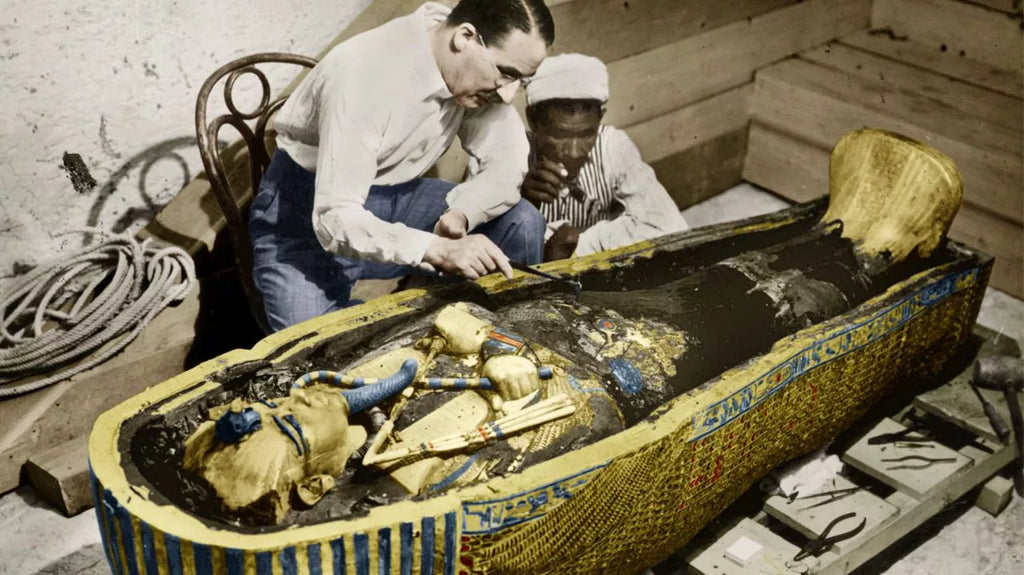
In the tomb of Tutankhamun, a young pharaoh of ancient Egypt, archaeologists discovered a collection of priceless treasures, among which stands out a sumptuous pectoral. This jewel, inlaid with semi-precious stones, displays the symbol of the Ankh repeatedly, notably positioned between the legs of a scarab. This detail is not accidental: in Egyptian culture, the scarab is a powerful symbol of rebirth and regeneration. Thus, the association of the Ankh with the scarab on this pectoral emphasizes the theme of life after death and the promise of rebirth, reflecting the deep beliefs that permeated ancient Egyptian society.
Within the Karnak temple, a vast religious complex located in Thebes and dedicated to the worship of the god Amon, the walls are adorned with captivating frescoes. These sacred artworks show deities holding Ankhs, the ancient symbol of life, in their hands. By this gesture, they seem to grant eternal life not only to the reigning pharaohs but also to the souls of the deceased, thus illustrating the deep belief in immortality and divine power over life after death.
Moreover, the tomb of Queen Nefertari, revered wife of Ramses II, houses reliefs of exceptional beauty, where deities can be seen presenting an Ankh to the queen. These images testify to the respect and veneration given to Nefertari, attributing to her a quasi-divine status in the afterlife. Through these representations, Nefertari's tomb becomes a place where the notions of divinity, death, and passage to eternity meet, highlighting the queen's prominent place in the mythology and religious beliefs of ancient Egypt.
In general, the symbol of the Ankh has also been found on "everyday" objects such as furniture or tableware.
6. A celestial artifact?
The legend of the Ankh as a celestial artifact still intrigues today. According to this legend, the origin of the Ankh would not be earthly but rather extraterrestrial, brought to our planet by visitors from elsewhere. This theory, which belongs more to myth than to classical Egyptology, suggests that the Ankh could be an object of immeasurable power, endowed with technologies or knowledge beyond our current understanding.
Thus, the Ankh, with its unique shape combining a loop and a cross, could symbolize a universal key or an instrument capable of opening portals to other dimensions or manipulating vital energies. Well, this is more of an anecdote than a proven fact, as you have understood.
I hope you enjoyed this note on the Ankh and see you soon on the Carnets d'Aeternum for more esoteric culture!
[bloctwist]