















































































































































































































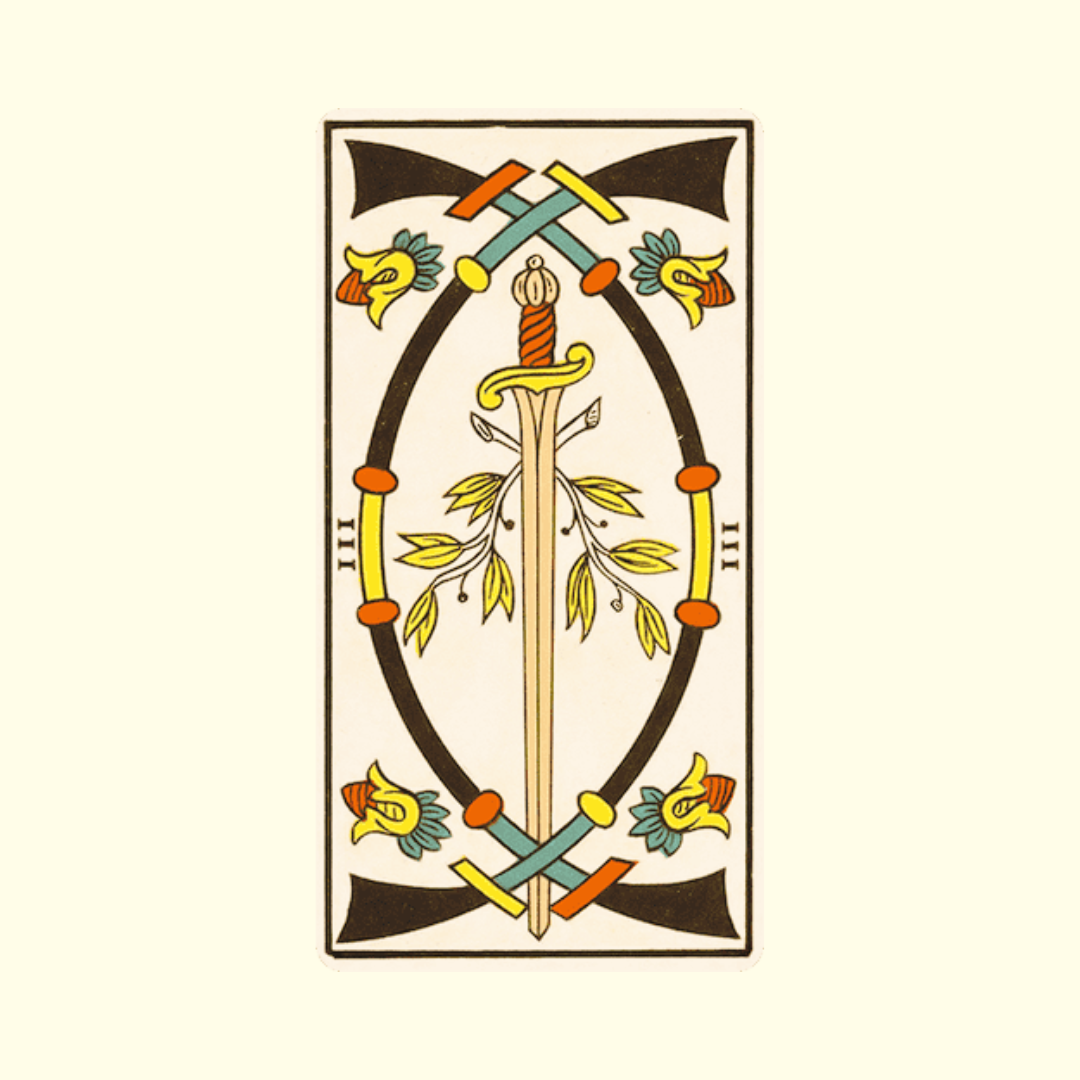

A third blade breaks the balance of the first two. In the Tarot de Marseille, it crosses the enclosure formed by the curved swords and imposes an axis amid the ornaments. In the Waite-Smith, three swords pierce a heart beneath the rain. The Three of Swords depicts separation, rupture, and the sorrow that accompanies a difficult truth: not a condemnation to suffer, but the moment when what was united can no longer be understood as before.
This card has a severe reputation because Smith’s image conveys pain without detour. The ancient texts confirm separation, distance, quarrel, and rupture, but they do not justify automatic predictions of infidelity, bereavement, or illness. The Three describes a division in the area established by the question. The other cards show its cause, extent, and the possibility of repair.
The pain of the Three is not necessarily a new event. The card may name a wound already known, a distance that is finally becoming visible, a word that can no longer be taken back, or the need to separate two entangled matters. Its most accurate function is to make the division legible so that it does not act in secret.
From the Divided Rose to the Heart in the Rain
In French tarot decks, two curved swords form an enclosure and a third straight blade crosses it vertically. Flowers or leaves occupy the open spaces. The composition gives the third sword a function of separation and axis. No heart is depicted; therefore, nothing limits the card to love or romantic sorrow.
In the Golden Dawn model, the central blade splits the rose placed at the crossing of the Two’s swords. Smith replaces this rose with a red heart pierced by three blades. Gray clouds fill the sky and rain falls. Waite considers the image clear enough not to multiply the explanations: he cites distance, absence, delay, division, rupture, and dispersal. The visual invention thus condenses several legacies into a scene that has become emblematic.
Iconographic reference. The stylized anatomical heart, rain, and three straight blades belong to the Waite-Smith. Marseille presents a geometric construction with a central sword. Reading every appearance of the Three as a broken heart amounts to imposing the English scene on decks that do not depict it.
Divinatory transmission
Mathers attributes to the Three of Swords a nun, separation, distance, rupture, and quarrel. Reversed, he cites error, confusion, bad administration, and disorder; he adds that this position may indicate something lost or misplaced for a time. The nun’s presence refers to withdrawal and separation from the world in cartomantic lists, not to a universal religious correspondence.
Book T calls the card “Lord of Sorrow” and assigns it Saturn in Libra. Three hands hold three upright swords; the central blade separates the other two and cuts the five-petaled rose, which falls without radiating. The text retains interruption, separation, quarrel, discord, sorrow, and tears. It also mentions fidelity to promises and honesty in business, a useful reminder against an entirely negative reading.
Waite develops themes of distance, absence, delay, division, rupture, and dispersion. Reversed, the card takes on mental alienation, error, loss, distraction, disorder, and confusion. Its text does not automatically indicate romantic betrayal, adultery, or medical catastrophe. The image’s power comes from its simplicity; the reader’s rigor consists in not filling that simplicity with the querent’s fear.
Meaning in a spread
In a favorable reading
The Three can make a necessary separation understandable. A boundary is finally set, an ambiguous situation is given a name, a person acknowledges their pain, or two problems are distinguished so they can be addressed. The card supports speaking precisely about what hurts, without requiring immediate reconciliation or premature consolation.
Its constructive side appears when division protects, clarifies, or ends confusion. Leaving an unfair agreement, interrupting a discussion that has become violent, acknowledging an incompatibility, or accepting a temporary distance can open a more honest path. The pain remains real; it is not artificially transformed into a gift.
In a reading about tension
The separation may continue as rumination, cruel words, conflict fueled by intermediaries, or the repetition of a wound that is never examined. The card then shows the risk of treating every disagreement as a betrayal, keeping the blade in the wound, or reducing a person to the act that broke trust.
The Three calls for a fair sense of scale. A setback is not a catastrophe; serious pain must not be minimized in the name of a lesson. The useful question becomes: what has actually been separated, what fact confirms it, and what protection is needed while the situation is addressed?
Love, work, and finances
The Three introduces a break, delay, or absence. On its own, it does not predict a definitive breakup, dismissal, financial loss, or medical harm. The area addressed by the question and the neighboring cards determine the division’s true extent.
| Area | Favorable reading | Tension aspect | Question to ask |
|---|---|---|---|
| Love | Acknowledged truth, protective boundary, necessary separation, or pain finally expressed. | Sudden breakup, humiliating remark, suspicion of infidelity without proof, lingering hurt. | What specific fact broke the trust? |
| Work | End of a collaboration that has become impossible, isolated problem, disagreement acknowledged. | Exclusion, team conflict, delay that divides responsibilities, hurtful message. | What needs to be separated to address the problem properly? |
| Finances | Abandonment of an unfavorable commitment, acknowledgment of a limited loss. | Painful expense, disagreement over money, loss magnified by panic. | Is the loss confirmed, likely, or merely feared? |
| Friendship | Protective distance, disagreement expressed, end of a bond that no longer respects both people. | Rumor, opposing side, words repeated out of context, prolonged quarrel. | Who heard the facts firsthand? |
| Decision | Ability to accept the real cost of a choice and give up one option. | Cruel choice, endless guilt, confusion between firmness and punishment. | What loss truly belongs to this decision? |
Reading associations
The Three shows the cut or the pain. The associated card clarifies its cause, the context in which it occurs, and how the querent can protect what follows without denying what happened.
| Association | Possible dynamic | Point of caution |
|---|---|---|
| Three of Swords + Ace of Swords | A truth, decision, or statement causes the separation. | Use precision without turning honesty into cruelty. |
| Three of Swords + Four of Swords | Necessary withdrawal after the breakup, time for rest and distance. | The pause should protect, not trap you in isolation. |
| Three of Swords + Five of Cups | Acknowledged pain, emotional loss, and symbolic grieving. | Do not forget what remains available or force yourself to move on. |
| Three of Swords + Justice | Structured separation, official decision, consequence of a rule or contract. | The law does not erase the human cost. |
| Three of Swords + Devil | Hurtful bond, attachment to pain, conflict fueled by dependency or control. | Seek outside support if coercive control or violence is real. |
| Three of Swords + Star | The pain can be acknowledged in a calmer space, with a gradual rebuilding of trust. | Calming does not erase either the facts or the necessary boundaries. |
Correspondences according to the schools
The old table mixed Saturn, winter, obsidian, cypress, and Gimel. Saturn in Libra does indeed belong to the Golden Dawn. The other attributions do not form a shared tradition, and Gimel corresponds to the High Priestess in this school rather than the Three of Swords.
| Reference | Attribution | Historical scope |
|---|---|---|
| Family | Minor Arcana, Three of Swords | Third numbered card of the suit. |
| Marseille Tarot | Two curved blades crossed by a central sword, with botanical ornaments | Pip card without heart or rain. |
| Mathers, 1888 | Separation, estrangement, rupture, quarrel | Reversed: error, confusion, disorder, misplaced object. |
| Golden Dawn | Lord of Sorrow | Title from Book T. |
| Element | Air | Occult attribution to the suit of Swords. |
| Astrology | Saturn in Libra | Second decan of Libra in the Golden Dawn grid. |
| Waite-Smith | Red heart pierced by three swords, clouds, and rain | Composition published in 1909. |
| Hebrew letter | No letter specific to the card | Gimel is assigned to the High Priestess in the Golden Dawn system. |
| Stone, plant, season | No shared historical agreement | Recent associations should be presented as such. |
| Reading words | Separation, sorrow, delay, rupture, painful truth | Context determines what is being severed and the severity of the break. |
Reading advice
Before interpreting, name the exact domain of the separation. Is it a person, a contract, an expectation, a habit, a team, or an idea of oneself? Then look for the facts that support this reading. The pierced heart is powerful, but it provides neither the identity of someone responsible nor the duration of the pain.
Do not promise a quick cure or announce a betrayal without converging evidence. If the reading touches on a situation involving violence, distress, or health, direct the person to appropriate support. Tarot can offer words to organize the story; it should not keep someone trapped in an alarming reading.
Sources and reference texts
For the history of decks and suits: Victoria and Albert Museum, A History of Tarot Cards; British Museum, reproduction of Nicolas Conver’s Tarot of Marseilles.
For divinatory and occult texts: S. L. MacGregor Mathers, The Tarot, 1888, card meanings; Liber LXXVIII, “The Lord of Sorrow,” publication of material from Book T; Arthur Edward Waite and Pamela Colman Smith, The Pictorial Key to the Tarot, Three of Swords, 1911.










