















































































































































































































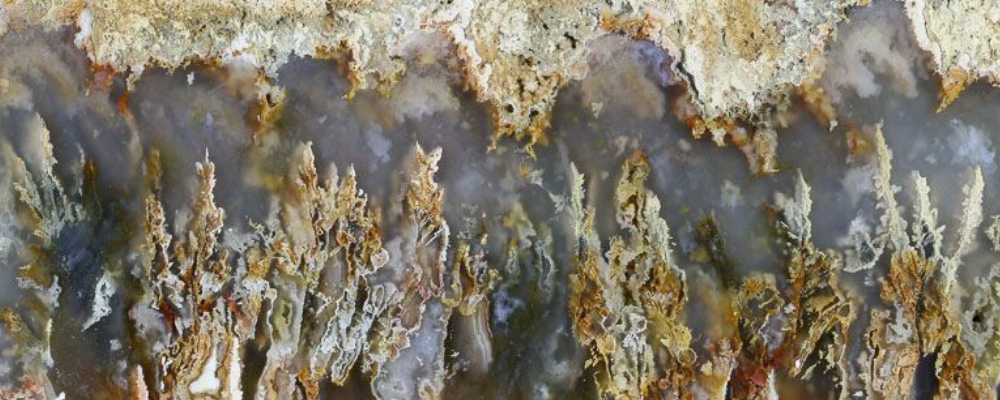
Plume Agate encloses plumes, branches, and filaments that seem to float in the Chalcedony. Some resemble a feather, others moss, smoke, or a miniature landscape.
These images are not captured plants. They are the work of mineral growth and inclusions. Their visual lightness nevertheless gives the stone a beautiful affinity with messaging, writing, and a change in perspective.
To place this stone among related minerals, compare it with Agate, Blue Agate, and Dendritic Agate.
Plumes in Chalcedony
Plume Agate is translucent Chalcedony traversed by branching or feathery inclusions. These forms develop in three dimensions before or during silica deposits. Iron oxides, manganese oxides, and other minerals can give them red, yellow, brown, black, or green hues.
The Mindat entry classifies it among inclusion Agates. An article in Gems & Gemology illustrates the variety of internal patterns that Chalcedony can preserve.
Neither Feather nor Plant
The word “feather” describes a resemblance, not an animal inclusion. Likewise, fern, tree, or moss silhouettes do not prove the presence of a plant. They result from the geometry of mineral growth.
A synthesis published in Minerals shows that Agate textures arise from complex formation histories. This reality broadens our perspective: matter can produce images that the imagination recognizes without anyone having drawn them.
The Winged Image and Ancient Agate
Agates belong to the ancient history of stones, but Plume Agate as a visual category does not possess an autonomous magical lineage in ancient texts. Its current symbolism draws on the general heritage of Agate and the image of the feather.
The feather can evoke the message, lightness, and an elevated point of view. These associations span several civilizations and should not be confused with the specific sacred uses of feathers in certain cultures. Here, the mineral motif serves as a support for a personal practice of speaking and writing.
Mercury, Jupiter, Air and Earth
Mercury governs writing, signs, and the passage of a message. Jupiter broadens the framework and supports publication or teaching. Air corresponds to light forms; Earth reminds us that these plumes exist within dense matter.
Wednesday is suitable for writing and exchanges, while Thursday is suited to texts intended for a wider audience. A found feather, an inkwell, a blank page, or a yellow candle can accompany the stone.
Writing, conveying, gaining perspective
Feather Agate accompanies the writing of a difficult letter, speech preparation, learning, and publishing projects. It helps you seek wording that remains light without becoming vague, precise without becoming harsh.
It can also be useful when you need to move beyond a viewpoint that is too narrow. Placed above a draft, it reminds you to consider the recipient, the context, and the actual effect of your words.
The Clear Letter Ritual
On a Wednesday, write the sentence you need to convey. Place the stone on the page and reread the text, removing anything accusatory, confusing, or repetitive. Keep only what states the facts, your position, and the request.
Say: “May my words find their form and their way.” Let the page rest for an hour, then read it aloud before sending it or deciding to keep it.
Correspondences and references
| Reference | Correspondence |
|---|---|
| Nature | Agate with feathery inclusions |
| Patterns | Three-dimensional mineral plumes |
| Celestial bodies | Mercury and Jupiter |
| Elements | Air and Earth |
| Days | Wednesday and Thursday |
| Ritual colors | Yellow, white, light blue |
| Areas | Writing, messaging, study, perspective |
| Ritual act | Refine a letter before sending it |










