


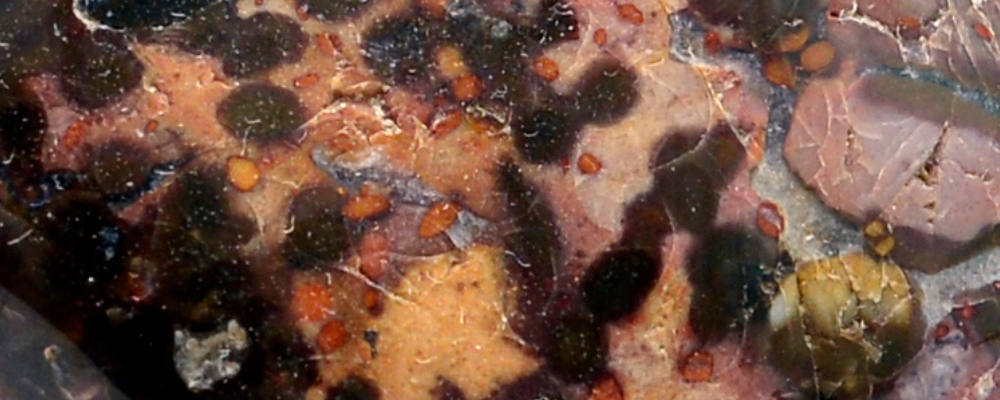
Snakeskin Agate bears a network of scales, cracks, or cells on its surface that evokes shedding. The pattern draws the hand as much as the eye: in it, one reads a covering, a boundary, and the trace of a change.
Its modern name opens up a powerful imaginary, but it must be handled precisely. The stone is not an ancient cult object of the snake; today, through resemblance, it becomes a support for renewal and the protection of boundaries.
To place this stone among related minerals, compare it with Agate, Blue Agate, and Dendritic Agate.
A Chalcedony with a scaly surface
Snakeskin Agate is a name given to Chalcedonies whose surface texture resembles scales. The pattern may come from a crust, a network of cracks, or the way the Chalcedony conformed to the cavity in which it formed.
The Mindat entry dedicated to Snakeskin Agate presents it as a descriptive variety. The entry on Chalcedony provides the general mineralogical framework.
A modern descriptive name
The name does not designate a mineral species and may cover fairly different appearances depending on the seller. It is therefore important to look at the actual material, texture, and provenance rather than expecting a perfectly identical pattern from one stone to another.
This flexibility in commercial vocabulary does not prevent a powerful reading. The image of skin places the covering in the foreground: what protects, what separates, and what must be abandoned when it no longer allows one to grow.
Shedding, protection, and discernment
The snake has different meanings across cultures. In ancient Egypt, the rearing cobra or uraeus could represent a protective power linked to royalty, as explained in the Metropolitan Museum of Art notice. Elsewhere, the snake may refer to healing, danger, the earth, or renewal.
None of these traditions should be directly attributed to this modern Agate. The correspondence here arises from the resemblance of its surface to skin. Shedding becomes an operative language: leaving behind an identity that has become too restrictive while retaining a protective boundary.
Mercury, Saturn, Earth, and Fire
Mercury corresponds to adaptation, passage, and the intelligence of movement. Saturn guards thresholds and defines boundaries. Earth connects the stone to the body and territory; Fire supports renewal.
Wednesday is suitable for changing a role or method, while Saturday is suitable for closing off access. A knotted cord, a key, a fallen piece of plant bark, or a dark candle can form a respectful altar.
Leaving an Old Shell Behind
Snake Skin Agate accompanies changes in identity, leaving a habit behind, protecting a space, and defining clear conditions. It can support the passage from an old role to a new one without requiring everything to be renounced.
It also invites you to check your boundaries: a healthy boundary lets in what nourishes you and keeps at a distance what exhausts you. Kept near a door or a transition journal, it materializes this choice.
The Rite of Chosen Shedding
On a Saturday, write on a strip of paper the role, habit, or fear you are leaving behind. Wrap it around the stone without tightening it. Say: “I thank the former shell and choose a boundary that suits me.”
Unroll the paper, tear it in two, and discard it. Clean the surface where the rite took place, then place the stone near the relevant threshold for seven days.
Correspondences and References
| Reference | Correspondence |
|---|---|
| Nature | Chalcedony with a Superficial Scaly Pattern |
| Name | Modern Descriptive Name |
| Celestial Bodies | Mercury and Saturn |
| Elements | Earth and Fire |
| Days | Wednesday and Saturday |
| Ritual Colors | Brown, Green, Black, Ochre |
| Areas | Shedding, Threshold, Boundary, Adaptation |
| Ritual Act | Remove a Strip Bearing the Former Form |