















































































































































































































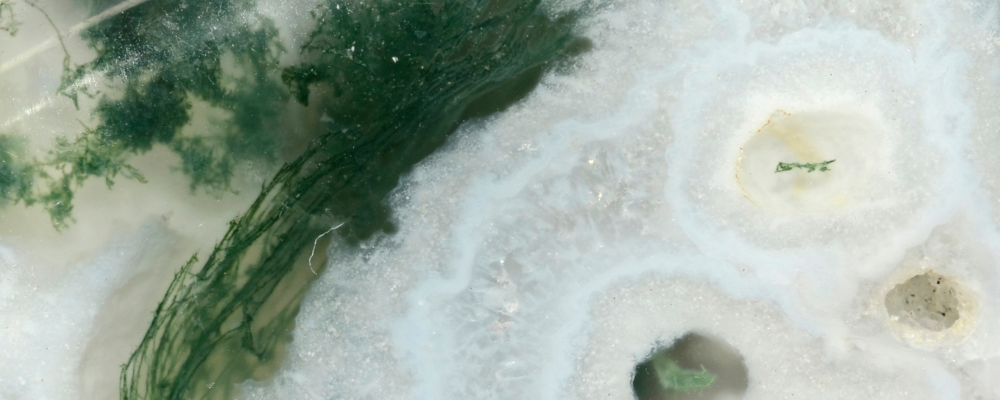
In Flower Agate, white forms seem to open like petals within pink, peach, or translucent Chalcedony. The eye recognizes a garden, while the stone is actually telling the story of mineral growth.
This resemblance is enough to nourish a fruitful symbolic practice: budding, a project taking shape, active gentleness, and care given to what is beginning. There is no need to turn its patterns into fossil flowers to understand this language.
To place this stone among related minerals, compare it with Agate, Blue Agate, and Dendritic Agate.
Silica blossoms
Flower Agate is a Chalcedony in which feathery or spherical aggregates create floral forms. The white areas are neither petals nor petrified plants: they are part of the growth of microcrystalline quartz and associated minerals.
The major review on the genesis of Agates published in \Minerals\ explains the growth mechanisms that produce bands, spherules, and textures. The \Mindat entry\ places Agate among the Chalcedonies.
A name born from the eye
“Flower Agate” is a recent commercial name, closely associated with materials from Madagascar. It describes a visual resemblance, not a separate species. Two pieces may bear this name while having very different proportions and patterns.
The name works like an image in a dream: it does not change the material, but directs attention. Here, it makes us read the growth, blossoming, and beauty of a form that took time to develop.
Ancient agate, modern variety
In the 4th century BCE, \Theophrastus\ already mentioned Agate and the Sicilian origin of its name. Flower Agate, as the trade calls it today, does not appear in these ancient sources.
\Its floral imagery is modern, but it rests on an ancient and widely shared symbol.\ The flower represents openness, fertility, and beauty arriving at its proper time. The stone may receive this association by analogy, provided it is not presented as an ancient talisman called Flower Agate.
Venus, Earth, and Friday
Venus governs harmony, attraction, art, and the ability to care. Earth corresponds to slow growth and support; a touch of Water complements receptivity. Friday is suited to intentions involving connection, creativity, and self-esteem.
Dried petals, a seed, a small pot of soil, or a pink candle make up a simple altar. Harvest plants sparingly, and preferably choose what has fallen or been cultivated.
Growing Without Rushing
Flower Agate accompanies fragile beginnings: a creative activity, a developing relationship, returning to oneself after a difficult period, or a project that requires regular care. It reminds us that lasting openness comes from a steady rhythm, not a forced push.
Placed near a seedling or a creative notebook, it serves as a witness to the work accomplished. It is also suitable for rites of passage that celebrate a stage of growth without requiring everything to be complete already.
The Rite of the First Bud
On a Friday, write the name of a project on a small square of paper. Draw a stem around it and leave the flower unfinished. Place the Flower Agate at the center of the drawing.
Say: “I give a place, time, and care to what wants to be born.” Add a petal to the drawing each time a concrete action is taken. When the flower is complete, date the sheet and file it with your work.
Correspondences and References
| Reference | Correspondence |
|---|---|
| Nature | Chalcedony with Feathery or Spherical Patterns |
| Name | Recent Commercial Name |
| Celestial Body | Venus |
| Elements | Earth and Water |
| Day | Friday |
| Ritual Colors | Pink, Peach, White, Soft Green |
| Areas | Blooming, Creation, Connection, Care, Growth |
| Ritual Act | Adding a Petal After Each Action |










