















































































































































































































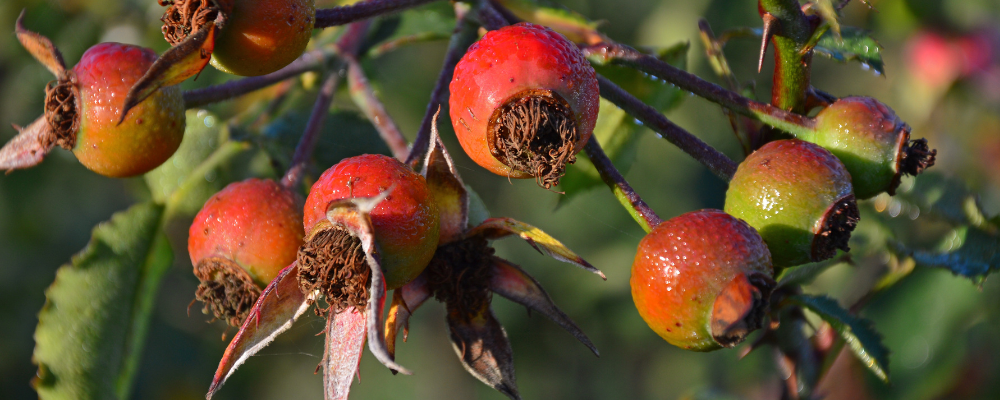
The Rose Hip bears the Greek name for the “dog rose.” Pliny recounts that a mother saw the root of a wild rose in a dream and asked her son, who had been bitten by a rabid dog, to use it as a remedy. The story belongs to Roman wonder medicine, but it left a lasting mystery in the name Rosa canina. The red fruit that remains after the petals becomes a sign of a memory capable of crossing injury, winter, and the time of the story.
The rose hip is not a species: it is the fleshy false fruit of several roses. This entry takes the Dog Rose, Rosa canina L., as its reference. The red part surrounds small dry fruits and fine irritating hairs.
Pliny’s dream concerns the root of the rose, not the rose hip consumed as food. Current practice therefore does not turn the fruit into an antidote. It works with the three stages contained in the story: recognized injury, received message, preserved memory. The product remains sealed, and no part of the rose is ingested or burned.
The False Fruit That Remains After the Flower
Rosa canina is a shrub with arching branches bearing curved prickles. Its five-petaled flowers, pink or white, produce a red receptacle after fertilization that becomes the rose hip.
Kew accepts the species and places its native range from Macaronesia and Europe to northwestern Africa, western and central Asia. Kew, Rosa canina.
The true fruits are the small achenes enclosed in the red cup. Around them are fine hairs capable of irritating the skin and mucous membranes. The beauty of the container therefore does not remove the need for caution regarding what lies inside.
The rose hip remains visible after the petals fall and can persist through winter. This longevity makes it an image of what flowering leaves behind: seeds, food for wildlife, and a red mark in the bare hedge.
The Mother’s Dream in Pliny
In Book 25 of Natural History, Pliny explains that some medical discoveries were attributed to chance or divine intervention. He then recounts the dream of a mother whose son served in the Praetorian Guard.
The mother sees that she must send him the root of the wild rose called cynorrhodon. A letter arrives as the soldier bitten by a dog begins to fear water. Pliny claims that the remedy saved him. Pliny, Natural History, Book 25, Chapter 6.
This story establishes no efficacy against rabies. It conveys a powerful narrative structure: an image noticed the previous day returns in a dream, crosses the distance in a letter, and encounters a crisis already underway.
The dream becomes a message because it is given an address. The mother does not keep the image to herself: she turns it into a letter and connects it to the danger her son experienced.
The dog rose and the memory of the name
The French “cynorrhodon” comes from Greek, formed from words for dog and rose. The name Rosa canina preserves this association as well. Medical history and etymology thus reinforced each other over the centuries.
A historical article in the Journal of Neurology, Neurosurgery & Psychiatry traces the place of Rosa canina in the history of rabies treatment. L. F. Haas, “Rosa canina (dog rose)”.
The name acts as a memory capsule. It does not prove the remedy, but preserves the trace of a major fear, a story of salvation, and a relationship between humans, dogs, and hedges.
In a magic faithful to this history, the dog rose hip accompanies messages of protection, stories of survival, and the passing on of a warning. It replaces neither vaccination, urgent care, nor medical advice.
The red that lasts through winter
The Cambridge Botanic Garden describes the dog rose's hips as a source of winter interest and recalls their historical use in syrup. It also points out the irritating hairs inside. Cambridge University Botanic Garden, Rosa canina.
This persistence is not a victory without a trace. The fruit comes after the flower and carries both the achenes and the irritating matter. Continuity preserves the consequences of what preceded it.
The visible red in the hedge forms a signal from a distance. It can mark what requires attention, what should be transmitted, and what deserves concrete protection during a difficult period.
The rose hip then becomes a memory beacon. It helps keep track of an event without repeating its danger, then guide the message to the person able to act.
Transforming a dream into a message
Draw a red rose hip in the center of a page and divide it into three rings. In the outer ring, describe the image or dream. In the second, write the fact it makes you think of. In the center, place the verifiable protective action.
Then draw a line to the recipient's name. Write the transmission channel, the date, and the exact sentence that must reach them. An image without an address remains in the first ring.
Add five small achenes drawn around the center. They represent the traces to preserve: time, place, witness, document, and response received.
Place the closed product to the left of the drawing. Send only a fact-based message, then note the response. The page preserves the story while the action reaches the real world.
Historical correspondences
| Reference | Correspondence |
|---|---|
| Botanical reference | Rosa canina L. |
| Nature of the rose hip | False fruit surrounding achenes and irritating hairs |
| Ancient account | Pliny, the mother's dream, and wild rose root |
| Mystery of the name | From the Greek “dog rose” to Rosa canina |
| Magical areas | Dream, warning, memory, and transmission |
| Safe form | Message written in three rings and product kept closed |










