

































































































































































Holy water, medals, crucifixes, and acts of blessing belong to Christian life, but they do not have the same status as the seven sacraments. To understand their role, we must recover the religious meaning of sacramentals and of the prayer that accompanies them.
What a Sacramental Is
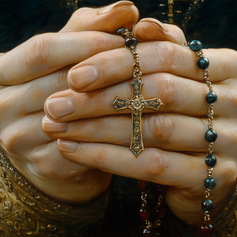
Sacramentals are sacred signs instituted by the Church, such as blessings. They prepare people to receive grace and to sanctify the circumstances of life. They are distinct from the seven sacraments. A medal, cross, rosary, or scapular can support a relationship of prayer; the object itself is not an autonomous source of power.
Blessing and Use
A blessing is a prayer of praise and petition addressed to God. Liturgical books specify the forms and ministers. Some blessings may be conducted by laypeople, while others are reserved for ordained ministers. Buying an object presented as religious does not mean that it has received a blessing.
Water, Light, Incense, and Oils
Holy water notably recalls baptism. Light accompanies prayer and evokes Christ. Incense may express prayer rising upward and the honor offered during the celebration. Holy oils are prepared and used within a precise liturgical context; a commercially scented oil does not become chrism because of its name or fragrance.
The Place of Images and Relics
Veneration is directed toward the person represented or recalled, not toward matter as though it were a deity. A relic requires reliable provenance and identification; a reproduction of an image or a souvenir object cannot be sold as an authentic relic without a basis. The dignity of people and respect for human remains take precedence over curiosity.
Avoiding Superstition
Attributing automatic effectiveness independent of faith and inner disposition to a prayer or object constitutes superstition in Catholic teaching. There is no mandatory price, wax quality, or stone required in order to be heard by God. The use of an object remains free in personal prayer.
Blessed Objects, Images, and Acts of Prayer
A medal may bear the name of a saint or inscriptions, an icon may represent Christ or Mary, and a crucifix may recall the Passion. The blessing places these objects within a religious practice directed toward God. Their forms have multiplied according to regions and eras: the Medal of Saint Benedict, scapulars, and blessed palms did not arise in the same context or at the same time.
The life of Saint Benedict helps clarify the difference between the life of a saint and the later history of a medal bearing his name. In Catholic doctrine, sacramentals prepare people to receive grace and invite them to prayer; they are not objects capable of imposing a material effect. This distinction is essential to the study of Christian practices of protection and blessing.
The Remembrance of Baptism in Holy Water
Holy water is among the most familiar Catholic practices. When entering a church, the faithful make the sign of the cross with water to recall their baptism. The same water may be used in certain blessings of people and places. This connection to baptismal water gives it its Christian meaning, even though it is not itself the sacrament of baptism.
Holy-water fonts and small domestic fountains constitute an ancient material heritage. Some are carved from stone, while others are made of ceramic or metal. Their presence at the entrance of churches marks a passage into the space of prayer. In homes, they recall family faith and the habit of beginning the day with a religious gesture.
Catholic doctrine does not attribute material effectiveness independent of blessing and prayer to holy water. This distinction makes it possible to understand the gesture without reducing it to a simple decorative custom.
The Cross, Medals, and Worn Objects
The crucifix represents Christ in his Passion. It may be placed in a church, worn, or kept in a home. Medals of saints and Marian images serve another function: they recall a Christian witness and accompany a request for intercession. Their symbols and inscriptions vary according to the era, shrine, and tradition.
The Miraculous Medal, associated with Catherine Labouré's experiences in Paris in 1830, brings together images of the Immaculate Conception, the Passion, and the twelve stars. The Medal of Saint Benedict belongs to a different history, linked to the spread of Benedictine inscriptions and signs in the modern era.
These objects cannot be studied as a set of talismans possessing the same properties. Their iconography and place in devotion are specific to each tradition.
Incense, Candles, and Liturgical Light
Incense is used in the liturgy as a sign of prayer and honor offered to Christ, the altar, the Gospel book, and people according to the rites. Psalm 140 compares prayer to the smoke of incense rising upward. Thuribles, incense boats, and fragrances used in churches bear witness to a long history of artisanal techniques and ceremonies.
The candle recalls the light of Christ, particularly during the Easter Vigil and baptism. Votive candles placed in a shrine extend the presence of an intention. Their flame should not be interpreted as a reliable indicator of whether a prayer has been accepted or rejected.
The place of light and fragrances reveals a sensory dimension of liturgical life, in which gestures accompany words. The necessary material precautions when using fire or smoke obviously remain important.
Blessing a Home or Workplace
Blessings may accompany a home, workplace, activity, or object intended for religious use. The prayer asks God to support the people who live there or use it. The Church provides texts for certain circumstances, whose use depends on the ministers and applicable liturgical rules.
A blessed home does not become a space materially inaccessible to accidents or dangers. The blessing invites its inhabitants to seek peace, hospitality, and responsibility. The religious act does not exempt anyone from maintaining a building or taking the measures necessary for safety.
The scope of the blessing is therefore linked to people's lives and their relationship with God, rather than to the magical transformation of an object or place.
Sacramentals and the Limits of Superstition
The Catechism distinguishes sacramentals from superstition, which notably consists in attributing automatic effectiveness to religious gestures independently of their meaning. The blessing of a medal is not a promise of financial gain, and wearing a sacred object does not authorize anyone to neglect justice or care for others.
It is also necessary to distinguish blessings from rites of exorcism, which are subject to precise rules in the Catholic Church. A major exorcism cannot be improvised by a believer in the name of a poorly identified tradition. Requests for spiritual support should be addressed to competent people, with respect for people's health and dignity.
This prudence strengthens the value of devotional objects rather than diminishing it. It reminds us that their function is to support prayer and lead to a Christian life.
Sources and References
Catechism — sacramentals, nos. 1667–1676
Catechism — superstition and divinatory practices, nos. 2110–2117
Illustration: JASpencer, Actual Blessing of Candles at Candlemas (2014 photograph), authentic photograph, licensed under CC BY-SA 3.0; hosted on Shopify without modifying the subject.










