















































































































































































































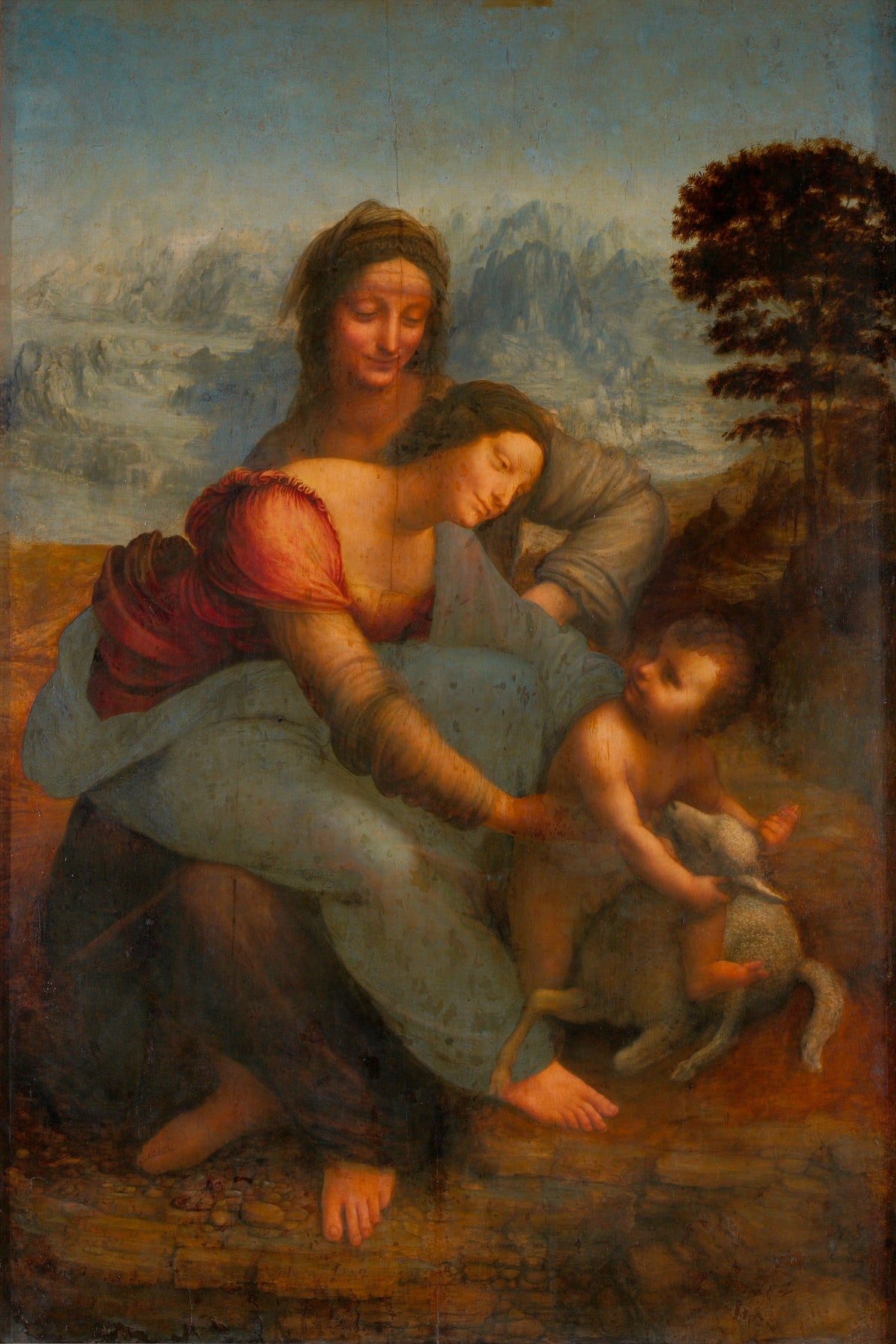
Saint Anne is honored by Christians as the mother of the Virgin Mary and the grandmother of Jesus. She holds an important place in family devotion, pilgrimages, and art, although the canonical Gospels do not give the names of Mary’s parents. Her story is transmitted notably through the Protoevangelium of James, an ancient Christian text that recounts the trials of Anne and Joachim, followed by the birth of their daughter. Reading these traditions helps explain the saint’s place without confusing the Gospel account with later developments in Christian memory.
| Period | Figure transmitted by ancient Christian traditions |
|---|---|
| Family | Mother of Mary, wife of Joachim according to tradition |
| Ancient source | Protoevangelium of James, 2nd century |
| Attributes | Book, young Mary, robe, and cloak |
| Patronage | Families, grandparents, and mothers |
| Feast day | July 26, with Saint Joachim |
The Gospels do not name Mary’s parents
Matthew and Luke recount events surrounding the birth of Jesus and give Mary a major role. However, they provide no biography of her parents and do not indicate their names. Anne’s figure therefore belongs to the history of Christian traditions that developed after the Gospels were written. This situation is not exceptional: the lives of biblical figures inspired accounts intended to answer questions left open by the canonical texts.
The absence of a biblical account does not mean that Anne’s memory is a recent invention. Ancient narratives exerted considerable influence on liturgy, painting, and the way believers represented Mary’s childhood. But they do not have the same status as the four Gospels. They can be studied as testimonies to the piety and religious culture of the early centuries, while recognizing their genre and purpose.
The Protoevangelium of James and Anne and Joachim
The Protoevangelium of James, generally dated to the 2nd century, tells the story of a couple for whom childlessness becomes a source of suffering. Joachim and Anne experience the social weight of this situation in a world where descendants held great family and religious importance. They pray separately and then receive the announcement of a birth. Their daughter Mary is welcomed as the answer to their longing.
The narrative takes up several major biblical themes: couples long deprived of children, waiting, prayer, and an announced birth. Echoes can be recognized of the story of Anne, mother of the prophet Samuel, in the First Book of Samuel. This interplay of correspondences belongs to the ancient Christian way of recounting the events that prepare for the Incarnation.
The account continues with Mary’s presentation at the Temple. This episode gave rise to a liturgical feast and numerous works of art. The text should not be read as a contemporary family record of Mary’s youth; its value lies in its testimony to the religious traditions that developed around her.
Mary’s education and images of Saint Anne
Painters depict Anne holding an open book before the young Mary, whom she guides in learning. This scene, common in Western art, symbolizes the transmission of faith within a family. The Gospels do not recount a lesson given by Anne to Mary; the image rests on a tradition that placed great importance on the religious education of Jesus’s mother.
Other works show the saint with Mary and the Christ Child. This composition is known in art history as Saint Anne Trinity: it brings together three generations of Jesus’s family without representing the three persons of the divine Trinity. The iconographic name given to the group must be distinguished from the Christian doctrine of the Holy Trinity.
Anne generally wears the robe of a mature woman, a cloak, and sometimes a veil. The book, the little girl, and the Christ Child are her clearest identifying attributes. These attributes express transmission, motherhood, and family continuity rather than a historical event detailed in the Gospels.
How devotion to Anne developed in East and West
Veneration of Joachim and Anne developed in the Eastern Churches, particularly through traditions devoted to the birth of Mary. Sanctuaries, celebrations, and homilies make it possible to trace the gradual spread of their cult. The West later adopted these feasts and developed its own iconography, often centered on Anne as an educator.
During the Middle Ages, the memory of Jesus’s relatives gained considerable influence. Artists depicted the Holy Kinship, a broader family group in which Anne occupies a central place. These compositions reflect a desire to connect salvation history with human relationships that believers could understand: birth, marriage, education, and the transmission of faith.
This development should not lead us to treat every late genealogy as established information about Mary’s family. Traditions contain variations; historians examine them according to the regions and periods in which they were written. Their diversity is itself evidence of Anne’s growing place in Christian life.
Sainte-Anne-d’Auray and Breton devotion
In Brittany, Sainte-Anne-d’Auray remains one of the major Catholic pilgrimage sites. Local devotion is associated with the 17th century and the events reported by Yvon Nicolazic, followed by the construction of a sanctuary. Anne holds a special place there as the patron and protector of Brittany in the region’s religious and cultural memory.
The pilgrimage’s influence shows how an ancient figure encounters the history of a territory. Processions, pardons, and family prayers connect devotion to the saint with generations of believers. In Breton images, Anne appears with the child Mary or with a book, signs of the transmission of faith through the ages.
The events reported in the 17th century belong to the history of the Auray sanctuary itself. They should not be confused with the account of the Protoevangelium of James or with the canonical Gospels. They constitute another chapter in the Christian reception of Anne.
July 26, the memorial of Anne and Joachim
In the Roman calendar, Anne and Joachim are celebrated together on July 26. Their memorial unites Mary’s two parents and emphasizes the generations that preceded the birth of Christ. Catholic piety associates Anne with mothers, families, and grandparents. These patronages derive their meaning from the place attributed to the saint in Mary’s family.
Prayer to Saint Anne is a request for intercession and support. It may accompany family life and the concern with passing on faith, but it is not presented as a means of guaranteeing a birth or automatically resolving personal difficulties. To understand her representations, reading ancient accounts and discovering the sanctuaries provide a more illuminating framework than a simple list of virtues.
Anne’s figure ultimately reminds us that Christian history has been expressed through different narrative, liturgical, and artistic forms. Her place in tradition can be fully recognized while distinguishing what the Gospels say about Mary from what communities later recounted about her family.
The traditions concerning Anne shed light on how Christian communities developed the family memory of Mary. The doctrine of Mary, Mother of God, however, belongs to another history, founded on the Incarnation and the debates of the early councils.
Historical sources and references
Protoevangelium of James, an ancient Christian account devoted to Mary’s parents and childhood, to be read as an extra-canonical text from the 2nd century.
Vatican News, July 26 entry on Saints Joachim and Anne, origins of the traditions and liturgical memorial.
Nominis, entry and calendar for Joachim and Anne.
Illustration: Leonardo da Vinci, The Virgin and Child with Saint Anne (1503–1519), ancient public-domain work.










