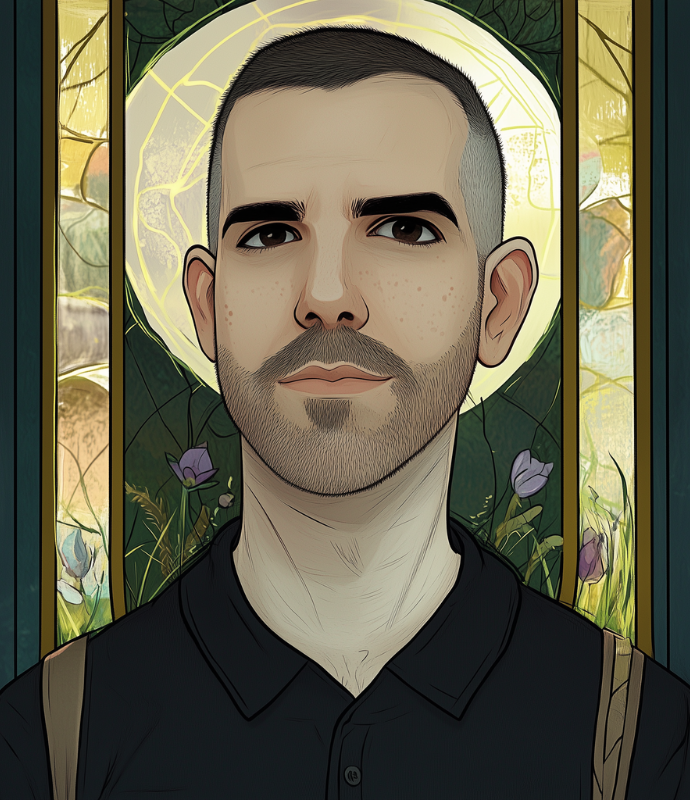




Oswald Wirth is a major figure in the occult and symbolist revival at the end of the 19th century in France. Born in German-speaking Switzerland, he settled in Paris and distinguished himself through his work combining esotericism, freemasonry, and the study of symbols. A disciple and secretary of the occultist Stanislas de Guaita from 1887, he created with him an esoteric tarot deck, later republished under the name Wirth Tarot. A scholarly freemason, Wirth also devoted numerous writings to the Royal Art (freemasonry) and the interpretation of universal symbols. Portrait.
Youth and Education
Joseph Paul Oswald Wirth was born on August 5, 1860, in Brienz, Switzerland, into a modest family. As a child, he received a religious education: he entered the seminary at the age of eight, then continued his studies at the Catholic college Saint-Michel in Fribourg. At the same time, he developed an early passion for the sciences of magnetism and mesmerism. At just thirteen, he experimented with the power of magnetic fluid by relieving the pain of a friend stung by an insect. This interest in magnetism later led him to join the Magnetic Society of France, led by Baron Du Potet, where he deepened his study of hypnotic phenomena.
At 19, Wirth spent some time in London, working as a clerk while broadening his spiritual horizons. He was introduced to the theosophical and occult ideas circulating in the British capital and also discovered freemasonry – which he was unable to join there due to insufficient contacts. In 1880, Wirth settled in France and found in Paris a thriving intellectual environment conducive to his aspirations. He devoured the available esoteric literature, attended occult conferences, and frequented spiritualist and magnetist circles. On January 28, 1884, at the age of 23, he was initiated into freemasonry at the La Bienfaisance Châlonnaise lodge of the Grand Orient of France. This entry into the Royal Art marked the beginning of his involvement in initiatory societies that would shape his thinking.
Stanislas de Guaita, a Decisive Encounter
In 1887, Oswald Wirth met the man who would play a pivotal role in his spiritual life: Marquis Stanislas de Guaita. A poet and occult scholar, Guaita noticed the young Wirth and offered him the position of his personal secretary. This meeting was, by Wirth’s own admission, a “crucial event” in his journey. The young Swiss became Guaita’s friend, confidant, and disciple, gaining free access to his vast library and teachings. “He made me his friend, his secretary, and his collaborator. His library was at my disposal and, benefiting from his conversation, I had in him a teacher of Qabbalah, high metaphysics, as well as the French language,” Wirth later wrote, highlighting the richness of this mentorship. Under his elder’s guidance, he refined his literary style in French and deeply studied kabbalah and the arcana of occult metaphysics.


The collaboration between Wirth and Guaita quickly bore fruit. Guaita, who co-founded in 1888 the Kabbalistic Order of the Rose-Cross – an esoteric society gathering prominent Parisian occultists – closely involved Wirth in his projects. Having become Guaita’s and the Order’s official secretary, Oswald Wirth worked in his mentor’s shadow while developing his own skills. Until Stanislas de Guaita’s premature death in 1897, the two men remained inseparable, united by the same quest for hermetic knowledge. Wirth acknowledged owing his intellectual and esoteric training to Guaita, eventually equaling – even surpassing – his master in symbolism. Indeed, it was during these formative years that he created some of his major works that would become references in Western occultism.
The Kabbalistic Order of the Rose-Cross and the Birth of the Wirth Tarot
The late 1880s saw the rise of occult organizations in Europe, and in France, Stanislas de Guaita worked to revive the Rosicrucian spirit. Around him gathered a circle of esoteric researchers including notably Papus (Gérard Encausse), Augustin Chaboseau, Joséphin Péladan, and François-Charles Barlet. It was in this context that the Kabbalistic Order of the Rose-Cross was founded in 1888, dedicated to the study of kabbalah and occult sciences. Wirth, then in his twenties, was among the first members of the Order and actively participated in its work. One of his most notable contributions was the creation of an original Tarot deck intended as a teaching tool within the Order.
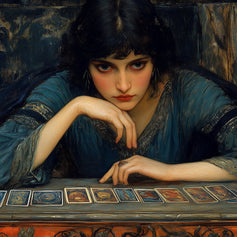
From 1887, at Guaita’s express request, Oswald Wirth began designing an “idealized” tarot in line with the esoteric principles of the emerging Rose-Cross. He based it on the traditional Marseille Tarot model, while incorporating occult symbols from kabbalah, alchemy, and astrology to give the cards a new initiatory dimension. A first version of the 22 major arcana was ready in 1888, but it only partially met the high expectations of the Order’s founders. Wirth then revised his work to refine it, resulting in 1889 in a completed Tarot known as the Kabbalistic Tarot. This deck, composed solely of the 22 richly illuminated major cards, is remarkable in several ways: it is the first “occult” tarot explicitly designed as a tool both divinatory, symbolic, and initiatory.
The Tarot created by Wirth and Guaita marks a key milestone in the history of esoteric cartomancy. It inaugurated a lineage of hermetic tarots that would inspire many occultists in the 20th century, long before the decks popularized by the New Age movement. Far from being a mere divinatory amusement, the Wirth Tarot is conceived as a “book” of symbols whose progressive study elevates the spirit. Each card – from the Magician to the World – is carefully redrawn and loaded with allegorical details aimed at illuminating universal laws and soul archetypes. This innovative work earned Oswald Wirth recognition as a leading “tarologist” of his time, alongside other European esoteric authors.
After Guaita’s death, Wirth did not abandon the tarot; on the contrary, he continued to deepen his symbolic research for several decades. In 1926, drawing on forty years of reflection, he published a new enriched edition of his tarot – this time integrating detailed correspondences between the tarot arcana, astrological signs, Hebrew letters of the kabbalah, and hermetic principles. The following year, in 1927, he released his most famous work: The Tarot of the Medieval Imagiers. In this book, conceived as a didactic compendium, Wirth explains the symbolic meaning of each major arcana and shows how the tarot synthesizes the esoteric wisdom of the past. The richly illustrated work also proposes an original cross spread method for divinatory interpretation – a method invented by Wirth. Upon its release, The Tarot of the Medieval Imagiers became a classic for tarot students and remains an essential reference today.
Freemasonry and Symbolic Studies
While Oswald Wirth was initiated into mysticism by the Rose-Cross, it was in freemasonry that he found the most lasting framework for his symbolic work. Unlike his master Guaita, more attracted to Rosicrucian paths, Wirth increasingly invested himself in the Royal Art over the years. After his 1884 initiation, he joined in Paris the lodge Les Amis Triomphants, then in 1889 the lodge Le Travail et les Vrais Amis Fidèles under the Grande Loge Symbolique Écossaise. He served several times as worshipful master, a sign of the esteem he enjoyed among his peers. Wirth was also open to progressive developments within the institution: he participated in debates on ritual reform, campaigned for a return to authentic initiatory symbolism, and even supported the mixed initiation of women in the Masonic Order, ahead of his time.
Concerned with transmitting initiatory heritage, Oswald Wirth undertook a vast pedagogical work for freemasons. Between 1893 and 1907, he published a trilogy titled Freemasonry Made Understandable to Its Adepts, comprising successively The Apprentice’s Book, The Companion’s Book, and The Master’s Book. In these instructional manuals, he explained to initiates of each degree the meaning of symbols, rites, and lodge legends with rigor and clarity that quickly became authoritative. A fourth volume, The Mysteries of the Royal Art, was published in 1932 to crown this series. Through these works, Wirth ensured for over forty years a true magisterium on Masonic symbolic studies in France. His writings, blending historical erudition and esoteric interpretation, helped revitalize French freemasonry in its initiatory and universal dimension, at a time when it sometimes risked sinking into excessive positivism.
In 1912, Oswald Wirth founded his own monthly magazine, Le Symbolisme, which became an essential forum for enthusiasts of symbolic science. For more than twenty years, this magazine featured articles on the hidden meaning of myths, alchemy, astrology, cathedral arcana, and kabbalah, reflecting Wirth’s very broad conception of traditional symbolism. He published many of his researches there and opened its pages to collaborators sharing the same passion for esoteric knowledge. Through Le Symbolisme, Wirth forged a link between spiritualist freemasons, hermeticists, and “scientific” occultists of his time, creating a true French school of symbolic study.
Among his other activities, Wirth was also a member of the Société des Philalèthes (a circle of spiritualist scholars) and involved in the Martinist movement led by Papus, which promoted an initiatory Christian esotericism. He associated with thinkers like Pierre Piobb and Francis Warrain, with whom he shared a taste for rational and structured esoteric research. These occultists, including Wirth, willingly called themselves “scientific” in their approach, as they favored rigorous study of symbolic and metaphysical laws, in opposition to more mystical or dogmatic currents embodied for example by René Guénon. This intellectual stance gave Wirth a unique role: that of a bridge between esoteric tradition and modernity, seeking to reconcile occultism with reason and knowledge.
Occultism as a Path to Knowledge
Oswald Wirth viewed occultism not as a collection of supernatural practices, but as an initiatory path to knowledge. For him, spiritual truths are revealed through the language of symbols rather than extraordinary phenomena. In his writings, he emphasized the need for enlightened understanding free from personal ambition. “Does occultism enlighten in this sense? Probably, but only if well understood. Unfortunately, its followers are dazzled by petty ambitions. The pursuit of occult powers drives them to extravagances…” he wrote, lamenting that many get lost in the quest for miraculous powers instead of deepening the true meaning of Tradition. Wirth condemned those who see in the Great Work of alchemy only a material recipe – “the kitchen of the blowers” – and urged them to take the path of authentic initiation instead. In his eyes, freemasonry and traditional esoteric disciplines contain a treasure of wisdom from which the spirit can extract “the purest philosophical gold”, that is, a high knowledge of man and the universe.
This vision of occultism as a rational and universal gnosis guided all of Wirth’s work. Rather than multiplying spectacular occult experiments, he preferred to patiently decipher the multi-century-old symbols bequeathed by civilizations: those of legends, religious myths, Tarot arcana, initiatory rites, or stars. He saw in them a coherent system of correspondences capable of guiding the individual on the path of inner evolution. In Hermetic Symbolism in Its Relations with Alchemy and Freemasonry (1910), for example, he analyzed alchemical symbols and showed how they appear in Masonic rituals, building bridges between different esoteric traditions. Similarly, in Astrological Symbolism (1928), Wirth explored the language of stars and constellations to extract lessons of initiatory philosophy applicable to human life. His approach, both analytical and synthetic, illustrates the idea that well-understood occultism is nothing other than a science of universal correspondences – a path of knowledge awakening consciousness to broader realities.
Until his death in 1943, Oswald Wirth devoted his life to exploring and transmitting symbolic knowledge. He embodied a demanding esoteric tradition, freed from superstitions and oriented toward the quest for truth.