



In ancient Egypt, magic (heka in Egyptian) was omnipresent and inseparable from religion and daily life. The Egyptians believed that magic had existed since the creation of the world—it was even the operative force behind the act of creation. The term heka refers simultaneously to a deity (the god Heka), the concept of magical power, and the practice of magic itself. This primordial force, personified by the god Heka, was perceived as the sacred energy that the gods themselves used to create and maintain the universe. Thus, magic was not mere “folklore” but a fundamental component of order in Egypt.
Magic and Religion in Pharaonic Egypt
Egyptian religion, medicine, and magic formed an integrated whole. Priest-physicians treated people as much with remedies as with incantations and talismans. Likewise, temple priests performed rituals and prayers charged with magical power, invoking Heka and other gods to protect the country or heal the faithful. Although these practices were carried out by specialists (priests or literate magicians), magic remained accessible to everyone: ordinary people commonly used protective amulets (a scarab worn as a pendant or a small Eye of Horus) and inscribed formulas on household stelae to communicate with the gods or the dead. Magic could be benevolent—ensuring health, fertility, and protection—or malevolent, through spells and enchantments aimed at enemies. It was also used to contact the souls of the dead, whether to implore their help or, on the contrary, to appease them if one believed they were suffering their wrath.

A remarkable aspect of Egyptian magic is the power attributed to words and written symbols. Hieroglyphic writing, being figurative in nature, was considered intrinsically magical. Sacred texts—such as the Pyramid Texts engraved in the royal tombs of the Old Kingdom—were conceived as true collections of spells guaranteeing the pharaoh’s survival and deification in the afterlife. These funerary texts also invoked the authority of Heka, “the god whose power makes the texts true.” The Egyptians believed that naming something or representing it in writing made it possible to affect it directly in the real world. Consequently, precautions can be found in tombs such as deliberately “mutilated” hieroglyphs (such as the stylized image of a snake cut in two), intended to prevent the mere act of writing them from bringing harmful forces to life. This conception reflects the idea that the creative word (embodied by the god Hu) and the written image possess genuine magical efficacy.
Among the divine figures associated with magic, Thoth and Isis appear alongside Heka. Thoth, the ibis-headed lunar god, was the patron of scribes and master of magical formulas and knowledge, and inspired many European occultists. He was known as the “Lord of Divine Words,” and was said to have invented writing and numerous occult arts. The Greeks later identified him with Hermes and named him Hermes Trismegistus, reflecting the esteem accorded to the esoteric wisdom Thoth represented. Isis, meanwhile, was revered as a powerful magician: in the myths, she resurrects her husband Osiris and protects her son Horus through her spells. Her role as the “Great Enchantress” is so significant that she is described as a goddess of magic in the Egyptian tradition. Numerous amulets and enchanting formulas invoke Isis, since no spell could withstand her maternal and protective powers.
The practitioners of magic in Egypt were literate priests, sometimes called “lector priests” (kheri-heb), who could read formulas and conduct rituals on behalf of an individual or the state. These priest-magicians served in various contexts: state rituals to protect the pharaoh and the kingdom, execration ceremonies in which figurines of enemies were destroyed to symbolically annihilate their powers, and complex funerary rites to ensure the deceased’s rebirth. Mummification itself was as much a technical procedure as a magical operation, with each gesture accompanied by incantations to guide the deceased toward immortality.
Symbols and Talismans of Ancient Egypt
Several emblematic symbols of pharaonic Egypt have nourished the esoteric imagination. Among them, three deserve particular attention.
The Ankh
Also called the ankh cross or “key of life,” the ankh is a hieroglyph representing the word “life.” The Egyptians viewed their earthly existence as one stage of a greater eternal life, and the ankh symbolized the continuity of life after death. In funerary art, the gods are depicted holding an ankh cross near the nose of the deceased pharaoh, as if breathing into him the vital breath of rebirth. Held in the hands of deities (particularly Isis or Osiris), it signifies their power to give life. As an amulet, the cross of life granted protection and vitality to its wearer, and it is found painted on the walls of temples and tombs to ensure the imperishable vital force of the place or the deceased. A positive symbol par excellence, the ankh was adopted in many modern esoteric traditions as a sign of the soul’s immortality.
The Oudjat Eye (Eye of Horus)
Representing the eye of the divine falcon Horus, torn out and then healed according to myth, the oudjat is one of the most powerful talismans in Egyptian magic. It embodies restored completeness and protection against evil. The Egyptians wore it as an amulet to protect themselves from bad luck and illness, and painted the sacred eye on sarcophagi and jewelry to ensure the body’s integrity and magical vigilance over the deceased. During the mummification process, a faience oudjat eye was placed over the incision made for embalming, symbolically protecting this opening in the body. A symbol of health (Horus having regained his sight) and clairvoyance, the oudjat also served as a protective motif on boats: painted on the bows of ships, it gave them the power to “see” the route and stay on course, a custom that has continued to this day in the eastern Mediterranean. The Eye of Horus remains a popular esoteric symbol of psychic protection today.
The Scarab (Kheper)

This small beetle, which rolls balls of earth, fascinated the Egyptians to such an extent that it became a major symbol of rebirth and the solar cycle. Associated with the rising-sun god Khepri, the scarab emerging from the ground each morning illustrates the daily regeneration of the Sun. Scarab-shaped amulets were worn to encourage vitality and spiritual transformation. They were placed especially on the hearts of mummies (the “heart scarabs”), accompanied by formulas from the Book of the Dead, so that the deceased’s heart would not testify against them during the final judgment and they might be reborn into new life. In magic, the scarab embodies self-generated creative force—the Egyptians indeed believed that this insect was born spontaneously from the earth—and symbolizes the soul’s capacity for renewal. Many lucky scarabs bear inscriptions on their bases invoking good fortune, demonstrating the popularity of this talisman from the New Kingdom through the later periods. Its image, linked to cosmic cycles, inspired modern occultists as an allegory of reincarnation and awakening.
From Greco-Egyptian Syncretism to Hermetic Magic
Toward the end of the pharaonic era and under Greek and then Roman rule (the Hellenistic and imperial periods), the Egyptian magical tradition merged with the esoteric currents of the Mediterranean world, giving rise to new forms of hermetic magic and alchemy. This syncretism took place largely in Alexandria, a cultural melting pot where Egyptians, Greeks, Romans, Jews, and other peoples exchanged their sacred knowledge.
A striking example of religious fusion is the cult of Isis during the Greco-Roman period. Originally an Egyptian goddess, Isis became extremely popular outside Egypt: from the 4th century BC, her cult spread to Greece and Italy, carried by sailors and initiates. Isiac rites were then adapted to Greek sensibilities: the goddess’s iconography became Hellenized, and her mysteries took on a form comparable to those of Eleusis. Mysteries of Isis were thus celebrated throughout the Roman Empire—secret initiatory ceremonies in which devotees, after undergoing trials, were “regenerated” through the goddess’s grace. Isis became for the Romans a figure of salvation and sacred magic, with her cult promising protection in this life and immortality in the afterlife. This spread ensured the survival of her image well into later times: even after the disappearance of her cult in the 6th century, Greco-Roman authors transmitted an idealized vision of Isis as the possessor of mystical knowledge, a vision that would be revived during the Renaissance.


At the same time, hermetic knowledge developed during the Greco-Roman period, arising from the encounter between Egyptian wisdom and Greek philosophy. The Greeks identified the god Thoth with Hermes, divine messenger and guide of souls, thereby forging the syncretic figure of Hermes Trismegistus—“Hermes the Thrice-Great”—who was said to have written numerous treatises revealing the secrets of the cosmos. These esoteric writings, composed in Greek but imbued with Egyptian concepts, gave rise to the Corpus Hermeticum. These hermetic texts combine cosmic theology, Neoplatonic philosophical reflections, astrology, and magical recipes. They teach that the universe is alive and permeated by correspondences, and that the soul can rise to the divine through gnosis (initiatory knowledge). Here we find the legacy of Egyptian thought: Hermes Trismegistus is presented as an ancient Egyptian sage, possessor of a primordial theology later transmitted to Orpheus, Pythagoras, and Plato—an idea that would greatly appeal to later esotericists.
It was also in Alexandria that Western alchemy took shape, closely linked to hermetic magic. Egyptian artisans had long excelled in working with metals and pigments, and possessed techniques for imitating gold or producing alloys. Greek scholars, for their part, had developed the theory of a single matter and four transformable elements. Their encounter gave rise, around the beginning of our era, to the idea that one could recreate nature in accelerated form: transmute base metals into noble ones, or concoct elixirs granting health and longevity. According to modern historians, this Greco-Egyptian alchemy resulted from several factors: the expertise of Egyptian goldsmiths, Greek concepts (the unity of matter and cosmic sympathies), and the decline of rationalism in favor of more mystical visions of the world.
The oldest known alchemical master, Zosimos of Panopolis (3rd–4th century AD), was a native of Egypt and explicitly attests to alchemy’s Egyptian roots: he states that the alchemy of his time originated in ancient Egyptian cults and rituals. His writings—combining theory, dream symbols, and laboratory instructions—frequently refer to Egyptian mythology. One of the texts attributed to Zosimos is entitled The Letter of Isis to Horus, presented as a revelation from the goddess to her son concerning alchemical processes. Although this text is probably apocryphal, it illustrates the tendency of Alexandrian alchemists to claim a direct lineage from the Egyptian gods, guarantors of primordial occult knowledge.
Finally, this period saw the composition of highly syncretic collections of practical magic, known as the Greek Magical Papyri. Discovered in Thebes and elsewhere, these papyri (dating from between the 2nd century BC and the 5th century AD) bring together hundreds of formulas, incantations, and rites for various purposes: love, protection, divination, curses,... They bear witness to a remarkable blend of influences: Egyptian gods (Osiris, Isis, Anubis), Greek gods (Hecate, Zeus), and Jewish names (Iaô, Adonai) are invoked together, reflecting Alexandria’s cosmopolitan atmosphere. For example, they contain “love charms” invoking the goddess Isis and the Greek demon Eros, as well as execration rituals in which wax figurines are pierced and accompanied by names written in hieroglyphs and the Greek alphabet. These papyri played a decisive role in transmitting Egyptian magic: through them, many Egyptian practices (curse rituals, amulets, sacred formulas) passed into later traditions, including medieval European grimoires and even certain biblical exorcism formulas inherited from antiquity.
Egyptian Legacies in Neoplatonism and the Later Mysteries
As Christianity gradually triumphed throughout the Roman Empire, Egypt’s esoteric legacy found refuge in philosophical and religious currents, particularly late Neoplatonism. Neoplatonic philosophers of the 3rd and 4th centuries, such as Plotinus, Porphyry, Iamblichus, and later Proclus, sought to reconcile Plato’s philosophy with the spirituality of mystery cults. In this context, Egypt—symbol of ancient wisdom—exerted a particular fascination.
Plotinus (205–270), founder of Neoplatonism, was himself born in Egypt (at Lycopolis) and studied in Alexandria. Although he remained a philosopher rather than a miracle worker, his teachings exalted the soul’s ecstatic union with the divine One, an idea probably inspired by Egyptian mysticism. The historian Franz Cumont emphasized that Egypt was, par excellence, the “land of mysticism” in antiquity: the cult of Isis had spread devotion aimed at union with God, preparing the ground for exalted speculation. Plotinus himself seems to have recognized the efficacy of Egyptian rites—Porphyry recounts in the Life of Plotinus that an Egyptian priest passing through Rome demonstrated a theurgical ritual for him by summoning his “demon” (protective spirit) in the form of a god, proof of his high degree of spiritual purity. This anecdote illustrates the prestige enjoyed by Egyptian magical-religious practices among the intellectual elites of the period.
With Iamblichus of Chalcis (c. 250–330), a disciple of Porphyry, Egyptian influence became explicit. A Neoplatonic philosopher and Syrian priest, Iamblichus wrote a celebrated treatise entitled The Egyptian Mysteries (De Mysteriis Aegyptiorum), which takes the form of an ardent defense of theurgy—that is, ritual magic intended to unite with the gods. He presents Egypt as the supreme center of sacred mysteries and responds point by point to Porphyry’s objections to the use of “material” rites (statues, symbols, incantations) to elevate the soul. For Iamblichus, the gods had entrusted the Egyptians, from the dawn of time, with effective rites (prayers in a sacred language, the consecration of objects,...) capable of attracting their presence. Thus, practicing theurgy according to the Egyptian rite meant following a legitimate path toward the soul’s liberation. Iamblichus’s contribution is significant: he rehabilitated ceremonial magic within philosophy, legitimizing the use of hymns, signs, and figurines to bridge the sensible and intelligible worlds. In his writings, the ancient Egyptian priest-magician became almost the ideal sage, and the Egyptian Mysteries a perfect synthesis of theology and practice. It is worth noting that Iamblichus even placed the origin of Neoplatonism in Egypt: he recalled that Plotinus’s teacher, Ammonius Saccas, was from Alexandria, emphasizing the Egyptian origin of this philosophical lineage.
After Iamblichus, other Neoplatonists continued along this esoteric path. In the 5th century, the schools of Athens and Alexandria incorporated mystical elements, probably derived from Eastern traditions including Egypt, into their commentaries on Plato. Proclus (412–485) described rituals for consecrating statues and oracles that clearly recalled Egyptian temple practices. Even in a Christian context, magical Egypt persisted in the background: alchemical texts in Coptic and Christian Greek have been found in which Mary, the child of Salome, reveals secrets of metallic dyes, demonstrating the persistence of hermetic ideas in Byzantine Egypt.
Moreover, the Jewish esoteric tradition, the Kabbalah, may have been indirectly influenced by the Egyptian legacy through Hellenism. Kabbalah developed in the Middle Ages (12th–13th centuries) within Jewish communities, but Kabbalists in Spain and Provence sometimes read Hermetic-Pythagorean writings transmitted through Arab-Andalusian culture, in which Egyptian inspiration was apparent. Some legends made Moses an heir to Egyptian wisdom—after all, according to the Bible, Moses was “instructed in all the wisdom of the Egyptians” in his youth. Renaissance authors would later suggest that Kabbalah was another, specifically Hebrew, facet of the precious primordial Tradition originating in ancient Egypt. Without overstating these connections (Kabbalah remains fundamentally rooted in Judaism), it can be noted that in Western esotericism, Egyptians, Hermeticists, and Kabbalists were brought together within a single symbolic lineage. The idea of an unbroken “golden chain” of esoteric transmission, from pharaonic Egypt to medieval sages, indeed left its mark on modern occultism.
The Hermetic Rediscovery of Egypt during the Renaissance
After an eclipse during the Early Middle Ages in Europe (when knowledge of the Egyptian world was reduced to a few biblical allusions and accounts by Greco-Roman authors), Egypt made a triumphant return to Western thought during the Renaissance. This revival owed much to 15th-century Florentine humanism, and particularly to Marsilio Ficino (1433–1499). In 1460, a monk brought a Greek manuscript containing part of the Corpus Hermeticum to Florence. Cosimo de’ Medici immediately asked Ficino to translate it into Latin—even before translating Plato—such was the enthusiasm for this text, which was believed to be of very ancient Egyptian origin. In 1463, Marsilio Ficino completed his translation of the Corpus Hermeticum (published under the title Poimandres), convinced that its legendary author, Hermes Trismegistus, was a contemporary of Moses or even older. In his preface, Ficino described Hermes Trismegistus as “the first of the theologians,” a source of wisdom who inspired Orpheus, then Pythagoras, then Plato. This vision of a primordial Egyptian revelation, called prisca theologia, became firmly established in Renaissance thought.
Ficino’s translation, printed in 1471, sparked extraordinary enthusiasm and marked the beginning of a true Hermetic Renaissance. Throughout Europe, philosophers, magicians, and Christian scholars became fascinated by Hermes the Egyptian. Giovanni Pico della Mirandola notably incorporated Hermetic theses (alongside Kabbalistic ones) into his famous Conclusion of 1486, celebrating humanity as a being of infinite dignity capable of rising to God—an idea reinforced, in his view, by the writings of Hermes Trismegistus, which he cited at the beginning of his Oratio. Images of Hermes Trismegistus even adorned churches: in 1488, a mosaic depicting Hermes/Mercury Trismegistus was installed in the pavement of Siena Cathedral alongside biblical figures, signaling Hermes’s assimilation into the revered heritage of wisdom. Thus, Hermeticized Egypt became an integral part of Renaissance scholarly culture.
Following in the footsteps of Ficino and Pico, other great thinkers explored the Egyptian connection: Johannes Reuchlin in Germany studied Kabbalah, which he linked to Mosaic and Hermetic mysteries; Athanasius Kircher, a 17th-century Jesuit, attempted to decipher hieroglyphs (unsuccessfully, as his system was fanciful) in his Œdipus Aegyptiacus (1652), but his work, blending scholarship and esoteric intuition, helped perpetuate the aura of secrecy surrounding Egyptian symbols. Kircher was convinced that hieroglyphs conveyed universal mystical truths, and he attempted to establish correspondences between Kabbalistic Hebrew and ancient Egyptian, convinced that a single sacred language of origins had existed. This quest for an original language aligned with the idea, widespread among Hermeticists, that Egyptian was the primordial language revealed by Hermes—a myth taken up by the French philologist Court de Gébelin in 1781, when he claimed that the Tarot came from an Egyptian “Book of Thoth.”
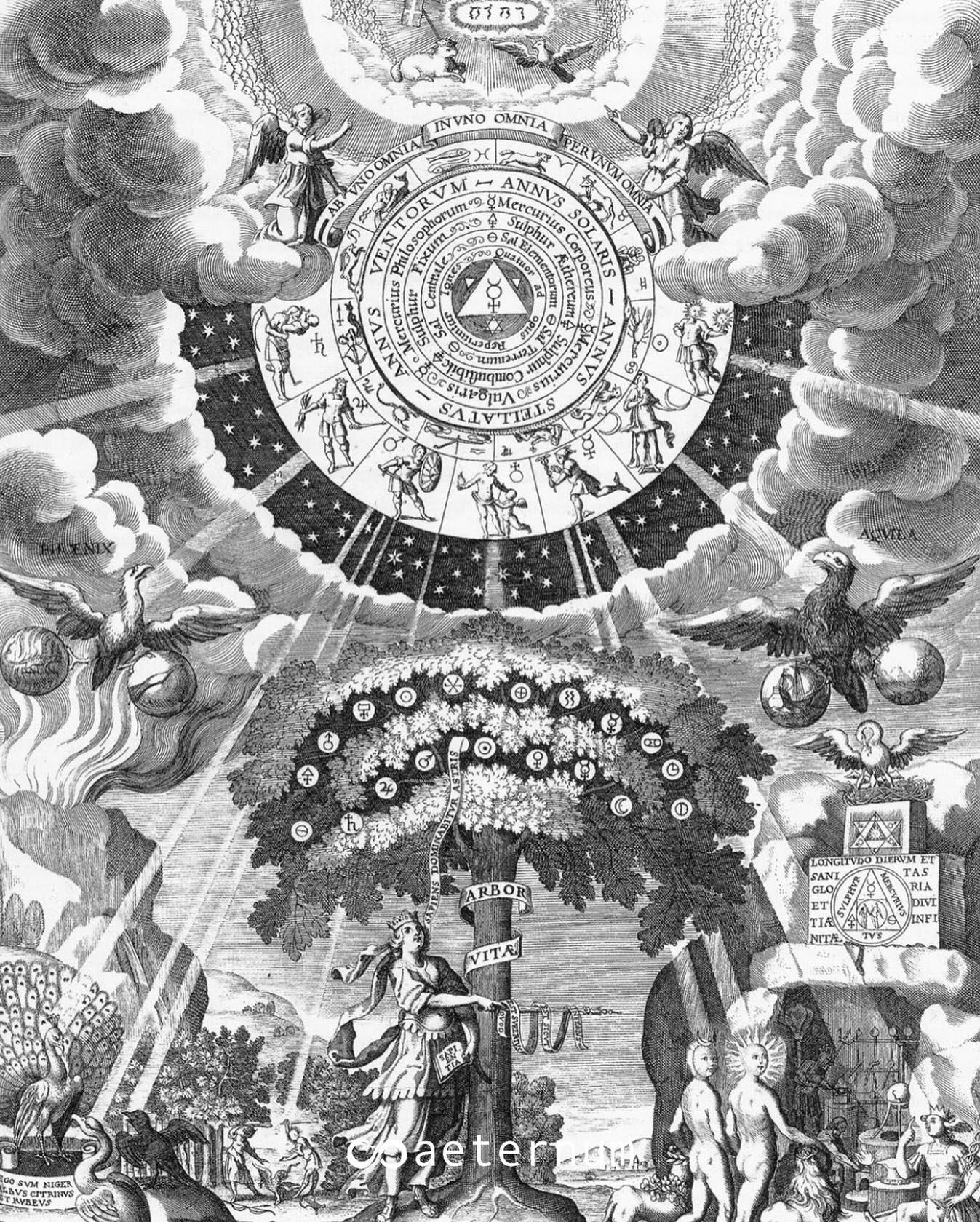
From the 15th to the 17th century, Egypt stood at the heart of the philosophia perennis cherished by esoterically minded humanists: it was seen as the ancient source of all wisdoms (Platonic, Pythagorean, and Kabbalistic). Renaissance European alchemy also claimed Hermes—hence the expression “Hermetic art”—and numerous alchemical figures borrowed from Egyptian iconography (the phoenix equated with the Bennu, the ouroboros compared to the serpent Mehen,...). Emerging esoteric circles such as the Rosicrucians even presented themselves in their early 17th-century manifestos as holders of ancient knowledge of Eastern origin. Legend held that Christian Rosenkreuz, the mythical founder of the Rosicrucians, had traveled to the East (perhaps as far as Egypt) to draw upon its hidden wisdom, combining the magic of the Arabs, the Kabbalah of the Jews, and the Hermeticism of the Egyptians. A century later, this idea would be stated explicitly: “The Rosicrucian Order is presented as the custodian of the Knowledge of Antiquity, itself derived from the teachings of ancient Egypt.” Modern esotericists would thus see the Rosicrucians as a missing link between the medieval Templars and Freemasonry, preserving an unbroken initiatory lineage from Egypt and Solomon to the present day.
Freemasonry, Occultism, and Esoteric Egyptomania in the 18th Century
In the 18th century, Europe was swept by a genuine Egyptomania, stimulated by archaeological discoveries and travel. This fascination was reflected even in the initiatory societies of the period, particularly the emerging Freemasonry (institutionalized in 1717). Freemasons, seeking roots in a prestigious ancient tradition, incorporated Egyptian symbols and myths into their rites. By the end of the 18th century, so-called “Egyptian” high Masonic degrees appeared—the Rite of Misraïm and the Rite of Memphis, which claimed to draw their origins from the mysteries of ancient Egypt. Masonic lodges were decorated with papyrus columns, guardian sphinxes, and mottos in pseudo-hieroglyphic writing to impress initiates. Figures such as the Count of Cagliostro even proposed an “Egyptian Rite” of Freemasonry around 1770, in which Isis and Osiris were invoked during ceremonies.

The figure of Isis, in particular, haunted the Masonic and Illuminist imagination of the Enlightenment. Some philosophers and Freemasons enamored of esotericism explicitly attempted to reinvent the Mysteries of Isis within their lodges. In Paris, the Masonic writer Jean Terrasson published Sethos in 1731, an initiatory novel set in pharaonic Egypt that describes in detail the initiation of a young priest in the underground chambers of an Isis temple. This account, blending fiction and scholarship, exerted a lasting influence on esoteric circles: people wanted to see in it an authentic reflection of ancient Egyptian rites. Later, Mozart’s opera The Magic Flute (1791), steeped in Masonic symbolism, depicted an initiatory trial in a temple of Isis and Osiris, popularizing the idea that Freemasonry perpetuated the Egyptian mysteries of Light against darkness.
In the 19th century, following Napoleon’s campaign in Egypt (1798) and Champollion’s decipherment of the hieroglyphs (1822), ancient Egypt became an object of Egyptological study. But alongside this academic approach, the 19th century also saw the flourishing of a Romantic occultism in which magical Egypt occupied a prominent place. Writers and occultists proclaimed the need to recover humanity’s “forgotten” sacred knowledge by exploring the grimoires and esoteric traditions of the past. In this “reappropriation of the past,” characteristic of the second half of the 19th century, Egypt appeared as a treasure trove of mystical archaisms waiting to be unearthed.
Thus, the French occultist Éliphas Lévi (Alphonse-Louis Constant, 1810–1875) asserted in his work History of Magic (1859) that a universal occult science had been transmitted since antiquity and buried beneath the catastrophes of history, and that he himself sought to reconstruct it. In his writings, Lévi referred to Egyptian doctrines: he saw the Hebrew Tetragrammaton (YHVH) as a legacy of the Egyptian solar cult, and also maintained that the Tarot was a continuation of the sacred hieroglyphs (what he called the universal hieroglyphic language of the ancients). His celebrated Dogma and Ritual of High Magic (1854) claimed to reveal the arcana hidden beneath the symbols, blending Hebrew Kabbalah with Hermetic theories; Lévi presented the hexagram (six-pointed star) as the symbol of the synthesis of opposites, placing it in parallel with two Egyptian triangles (white and black)—thus symbolically connecting Solomon’s wisdom with that of Hermes. Éliphas Lévi was regarded as the “pope” of French occultism, and it was significantly to him that many magicians of the next generation looked for inspiration.
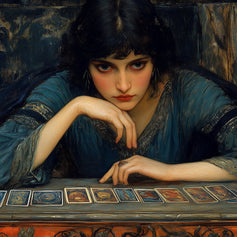
In England and the United States, the fin-de-siècle occultist movement also became enamored with Egyptian references. The Theosophical Society, founded in 1875 by Helena Blavatsky, chose Isis Unveiled (1877) as its first major work, an explicit claim that the veiled goddess of Sais (symbol of occult Wisdom) would reveal her mysteries. Blavatsky claimed access to a synthesis of ancient religions through “Masters” from the East, and viewed pharaonic Egypt as one of the great centers of the primordial Tradition. Her syncretic work blended esoteric Buddhism, Gnosticism, and Hermeticism; Isis was presented as the archetype of esoteric truth veiled by dogma. At the same time in France, esotericists such as Gérard de Nerval (in his novella History of the Caliph Hakem, 1848) and later the occultist Paul-Christian (in The History of Magic, 1870) fueled the myth that Tarot cards originated from the Book of Thoth, a collection of Hermes’s teachings once engraved on the walls of an Egyptian temple. Although historically unfounded, this idea permanently associated the Tarot with Egyptian imagery (the “Egyptian” Tarot deck was highly fashionable among 19th-century occultists).
Toward the end of the 19th century, in London, the initiatory fraternity of the Golden Dawn (“Golden Dawn”) incorporated numerous Egyptian elements into its ceremonial magic rituals. Golden Dawn members invoked Egyptian formulas (based on Hermetic passwords), used an Egyptianized Tarot (created by S. L. MacGregor Mathers) called the Book of Thoth, and dedicated a higher grade to the “Adepti of Isis-Urania.” The invocation of the four great gods of the cardinal points (Thoth, Osiris, Isis, Horus) formed part of their consecration ceremonies. One of the founders, William Wynn Westcott, was passionate about Egyptian mythology and sought to link the Golden Dawn to a Rosicrucian-Egyptian lineage. His successor, Aleister Crowley, although active mainly in the early 20th century, would take this identification to an extreme: after receiving a vision in Cairo in 1904, he proclaimed himself the prophet of a New Æon of Horus and chose The Book of Thoth (dealing with the Tarot) as the title of one of his major books.
Without falling into the pitfalls of fantasy, it can be said that Egypt offered the esoteric world an inexhaustible reservoir of powerful symbols and archetypes: the image of the magical mother goddess (Isis), the sage who possesses the divine word (Thoth), the ruler in communion with the invisible (the magician-pharaoh), and the cycle of death and resurrection (Osiris and the scarab). These archetypes nourished occultist thought because they respond to universal aspirations of the human soul—the desire for protection, knowledge of the mysteries of life and death, and spiritual elevation.