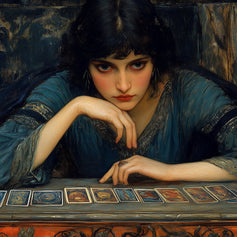




For centuries, magic did not live in grimoires. It walked through the fields, slipped into the stables, and was passed down between stone walls and dirt paths. It spoke the language of the seasons, the body, and plants. It was called witchcraft, sometimes wrongly, sometimes with fear. But it was part of the landscape. Today, it is forgotten or caricatured. Yet behind the cliché of superstition, there was something else: precise gestures, measured words, knowledge kept in response to phenomena that even science struggles to explain. A dive into the history of rural magic.
Note that this is an introduction to the history of rural witchcraft, not a collection of rituals. For that, see our collection of magic books in our online esoteric bookstore.
1. Between Peasant Traditions and Christian Demonization
Since the Middle Ages, magical practices have existed in European villages. Peasants preserved ancient pagan traditions mixed with Christian rites, invoking the forces of nature to protect crops and livestock. Healers and midwives used herbs, prayers, and charms to treat people and animals. These practitioners, called seers or secret makers, were tolerated as long as they stayed in the shadow of the Church. The clergy viewed them with suspicion, denouncing rural "superstitions" without always punishing them. However, by the end of the Middle Ages, attitudes changed: the Church and scholars developed the concept of "demonic witchcraft." In 1486, the treatise Malleus Maleficarum (the Hammer of Witches) portrayed the witch as the Devil’s ally, justifying her extermination. From then on, all popular magical acts – from spells to heal a cow to curses born of resentment – risked being reinterpreted as satanic pacts. The figure of the witch became the perfect scapegoat for the era’s misfortunes: famines, epidemics, destructive storms. Driven by religious elites, the countryside became the nighttime stage for the witches’ sabbath, gatherings where peasant women supposedly flew on brooms to worship the Devil around cauldrons. But the reality was quite different.
Medieval peasants did not live in a constantly phantasmagoric world – they mainly sought to ward off misfortune with practical and concrete means, or to put it plainly, "hands-on" methods. Thus, the cunning folk or "wise healers" in English embody this pragmatic magic: curing a fever with an ointment, finding a stolen object through a prayer, or diverting a harmful spell. Across Europe, traces of these village magicians can be found: the Finnish tietäjä, the German hexenmeister, or the Italian benandanti. Their practices belong to everyday rural life, without any satanic dimension for those who use them.
In 16th century Italy, peasants calling themselves benandanti ("those who walk for good") claimed to travel in spirit at night to fight evil witches threatening the crops. They saw themselves as defenders of fertility, and by no means as worshippers of the Devil. And quite objectively, they recognized the existence of good and bad witches, simply.
However, the inquisitors of the time equated these stories with the witchcraft they feared, eventually prosecuting the benandanti themselves. This gap between practiced witchcraft and perceived witchcraft appears from this period: peasant magical gestures, benevolent or neutral, are reinterpreted by authority as demonic crimes. Moreover, the very word "witchcraft" is equated with Evil.
2. Witch Hunts: the Great Trial of Rural Witchcraft
From the 15th to the 17th century, fear of witchcraft intensified in Europe, leading to the infamous witch hunts. This grim dynamic hit the countryside hard. Historians estimate that about 100,000 people were prosecuted for witchcraft in Europe between 1400 and 1775, mainly during the period 1550-1650. Why such a frenzy of trials especially in villages? On one hand, the mentality of the time associated witches with rural life: influential "demonologists," such as Nicolas Rémy in Lorraine (who was rather a fanatical magistrate claiming to have accused more than 900 people of witchcraft), asserted that ignorant peasants were easy prey for Satan. On the other hand, the village context fostered mutual suspicions: in small communities where everyone knew each other, the slightest neighborhood conflict or unfortunate event could lead to an accusation.

Public Trial during the Inquisition
In rural areas, trials often arise from an inexplicable misfortune. Sudden death of a dairy cow, hail devastating a field the day before harvest, a child wasting away without apparent cause. Witchcraft offers an immediate explanation – "someone cast a spell." A sideways glance or an old quarrel resurfaces, and the finger points to the village witch, often a marginalized woman, widow, or solitary healer who knows remedies. Authorities, civil or ecclesiastical, zealously relay these accusations. Under torture, the accused confess to everything expected of them. Extravagant tales of nocturnal thefts, transformations into animals, or ritual infanticides then circulate in depositions. In reality, many victims are innocent people wrongly accused, trapped by collective fear just for mastering energies and knowledge few understand. The justice of the time paid little attention to the distinction between real practices and fantasies: a well-meaning herbalist could end up on the stake just like a malevolent enchantress. Yet, the villagers themselves knew how to distinguish a useful healer from a true evil sorcerer. Unfortunately, Christian madness disrupted all the landmarks.
In France, these persecutions reach their peak around 1600, then decline under the influence of the emerging rationalist spirit. Louis XIV finally put a legal end to them in 1682, abolishing the crime of witchcraft and ordering punishment only for proven cases of fraud or poisoning. Elsewhere in Europe, the hunt persisted locally a little longer – in Switzerland or Poland, some burnings still occurred at the beginning of the 18th century. But overall, the era of trials came to a close, leaving behind a lasting trauma in rural life.
3. Rituals and Figures of Peasant Witchcraft
But what were rural magical practices really like? Country witchcraft is characterized by simple rituals, passed down orally, which makes it difficult to find complete traces. The village remedies and curses use elements at hand: local plants, household objects, formulas borrowing sometimes from the Christian register (prayers, invoked saints), sometimes from a more pagan symbolism (ritual gestures, markings in ash or salt).
Some examples: to protect a stable from thunder, a piece of blessed boxwood is buried at the four corners of the building. To cure a cow’s "soured milk," the healer whispers a formula into the animal’s ear while making it swallow a plantain herbal tea. If a mysterious illness strikes the household, a spell is suspected: one might then consult what is called (but little known) a désorceleur who will identify the source of the trouble. This person might recommend burning a suspicious object found under the doorstep (a blackened egg, a rag doll) or reciting a particular psalm three nights in a row. Each region has its own recipes and symbols. In the French countryside, a nailed owl on the door is believed to ward off evil, while in Eastern Europe, cribs are marked with a cross sign in charcoal against the striga (vampire witches).
The figures of rural witchcraft are multiple and sometimes ambivalent. First, there is the malevolent sorcerer: a man or woman capable of casting a destructive spell out of envy or revenge, but who mostly acts in the shadows. On the other hand, other magical actors hold a recognized place in the community. The bone-setter, for example, is a healer specialized in resetting dislocated bones and treating wounds: they use their gift, skillfully massaging and manipulating the body. The healer knows the plants and healing prayers. In many villages, it is the same individual who combines these roles – a farmer of a certain age, endowed with a reputation for occult knowledge passed down from generation to generation. They are approached with some caution, because although they mostly do good, they can also use these abilities if upset... They thus occupy a special social position, which later fuels the myth of the witch outside the village.
A 19th-century Norman saying went: “There is the witch who heals and the witch who harms”. In other words, the people distinguish the benevolent healer from the one who casts bad spells. Historians confirm this distinction: the European “cunning folk” (men or women of knowledge) were appreciated for their folk medicine and divination services, and were rarely accused in court. Surprisingly, only a minority of them were targeted during witch hunts.

Warning of distrust towards witches in the Douai countryside (1806)
On the other hand, those accused of witchcraft — those who were put on trial, sometimes even burned at the stake — were generally marginalized people or considered malevolent: they were accused of causing illness, the death of a child, or the loss of a harvest. The distinction was therefore not based on the magical practices themselves, but on the supposed intention of the person using them. “White” or “protective” magic was tolerated, “black” magic was punished. For a witch of the time, it was better to be integrated and well regarded by the village rather than outside it.
That said, the boundaries between the two were fluid. A respected healer could, in case of conflict, be accused of witchcraft. A "favored" practitioner could fall into the camp of reviled witches if a tragic event occurred in the village and they were deemed responsible.
4. Pacts and commitments: a magic of exchange and connection
Folk witchcraft is based on a principle of exchange, a pact that binds the practitioner to an invisible force, an entity, or a symbolic commitment. This pact does not always take a spectacular form but there are indeed rituals of agreement, contract, or gift for gift.
In some villages, it is said that the gift of healing is only passed on on the condition of “giving something in return” — a silence, isolation, a kept promise. The future disenchanter must sometimes undergo a trial or observe a strict taboo. There is a tacit pact with the forces they will manipulate. Other stories speak of solitary figures who “made a deal” with familiar spirits, unnamed entities. They talk about hens that never die, tireless horses, spells cast effortlessly… but at a price. As with all magic, the pact implies a debt.
The Church transformed these pact rituals into pacts with the Devil. But let us not forget that the witch is by nature pagan: she does not recognize gods of good and evil, but entities and energies. No, the pact does not take the form of a diabolical contract, but there are still ideas of gift exchanged for power. This gift is not abstract: it can be a price paid by the body, by solitude, by transmission. In this context, the price paid is not always material, but it can be heavy: an unstable emotional life, isolation, or hypersensitivity. Some traditions also speak of hereditary bad luck, passed on to those who refuse to honor the pact or to pass it on in turn. It is essential to understand one key point in rural magic, and in magic in general: knowledge belongs to no one, the witch or wizard is only the temporary holder, so the mission is to find the one who will be worthy to transmit it.
This pact is based on three things so that the "word is bound":
-
Secrecy: the knowledge must not be disclosed carelessly, nor transmitted in writing, nor used lightly (so a witch simply seeking revenge can do so, but will suffer the consequences of this imbalance).
-
Rigor: the gesture, the formula, the remedy must be done within a precise framework. Not respecting this framework is betraying the agreement.
-
Transmission: dying without having "passed on the gift" leads to the extinction of the magical lineage, and the force returns to the earth.
In this pact, we are not talking about an entity in the modern sense (as in new age), but about an active force that exists as long as a human carries, respects, and continues it. One could almost speak of "living knowledge," with its own demands. The pact is therefore less an alliance with an external consciousness than a commitment to the continuity of a power considered older than the person, the family, or even the village itself.
5. Knowledge, practices, and silent transmissions
Reducing rural witchcraft to a collection of collective fears or archaic reflexes would miss its true reality. In many villages, as we have seen, certain magical figures were recognized for their skills. This magic was not a matter of chance, improvisation, or invention, but of rigorous and technical knowledge, sometimes confidential.

Representation of field witches. Source: Open Edition
Healers, far from being mere “believers,” had a fine knowledge of local plants, their effects on the body, and the interactions between remedies and seasons. Gathering was not done at just any time: some herbs had to be picked at dawn, others during the waning moon, sometimes in silence, walking backward. The formulas set the intention, paced the gesture, and linked the plant to the treated body.
Peasant magic also includes a part of sacred geometry of the territory. Some paths were avoided. Certain stones, trees, or springs were considered charged, beneficial, or dangerous. Specific places hosted rituals of healing, protection, or isolation of evil. This implies a symbolic reading of the landscape, an invisible map passed down through experience. It is easy to make the connection with dolmens or menhirs that escape our perhaps too down-to-earth understanding.
Handwritten notebooks have been found, containing recipes, incantations, and symbols, kept hidden from view for decades. This knowledge, far from the image of a charlatan, testifies to a discreet but rigorous rural tradition, where magic followed transmitted rules, sometimes as demanding as those of an initiatory brotherhood.
6. Social function of witchcraft
If magic has survived through the centuries in the countryside, it is not because it simply served to explain the inexplicable or to reassure in the face of adversity. It endured because it worked – in its own way, within its framework, according to its rules. Peasants did not use it out of weakness or ignorance, but because they knew it was effective. It was part of the concrete fabric of rural life, just like the harvests, the seasons, or the animals.
In this peasant world, not everything was visible, but nothing was free. If a person suffered, there was a cause. If something improved, it was because someone had worked on it. Magic allowed restoring balance where words, the doctor, or the priest remained powerless. It was not a matter of belief, it was a matter of relationship to reality. An ailment could come, and a remedy could exist.
The ethnologist Jeanne Favret-Saada, who conducted a remarkable investigation in the Bocage in the 1970s, discovered not only magical thinking in action but also a useful role of justice and well-being in rural society.
That is why it resisted for so long. Neither the burnings, nor the sermons, nor the school, nor rural exodus erased it all at once. As Favret-Saada writes, declaring that rural witchcraft disappeared after the end of the burnings is historically false: reports from bishops in the 18th century, prefect investigations in the 19th, or press news items in the 20th, on the contrary testify to the persistence of peasant magic. There is indeed a reason for this...
7. Survivals of Village Witchcraft
From the 19th century onwards, European rural areas began their transformation under the influence of industrialization, modern science, and compulsory education. Rural witchcraft, without disappearing, gradually receded. Press headlines also gave it a very "country folk versus city scholars" aura: a farmer murdered because he was suspected of casting spells on his neighbors, or a trial against a charlatan selling potions against “bad luck.”
However, it surprisingly survives in certain regions. Rural magic remains discreet. After World War II, rural exodus and agricultural modernization completed the transformation of mentalities. Younger generations, uprooted from their native villages, hardly continue grandmother’s tales. Rural witchcraft falls into silence, relegated to the status of superstition from another era. In the 1960s-1970s, some ethnologists still managed to uncover its last strongholds. Favret-Saada revealed that witchcraft remained a very much alive social language, even if it no longer showed itself openly. Across Europe, similar investigations in Italy, Hungary, or Ireland found traces of popular magical practices well into the 20th century. Is this a sign that rural witchcraft is gradually dying out, or rather that it is becoming discreet, which is its very nature? The answer remains open.
Today, it would be reductive to see this witchcraft as merely a remnant of superstitions. It also represents a form of experiential knowledge, passed down orally, structured around an intimate relationship with the body, the earth, and cycles. Reading these practices through history is to do justice to their coherence and symbolic effectiveness. For those who wish to continue this exploration, the book La Sorcellerie des campagnes by Charles Lancelin offers a valuable perspective on these practices.

Additional Sources: