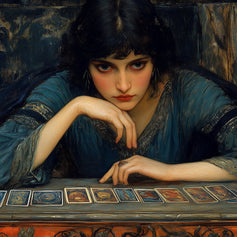




Why do certain numbers seem to follow us through the important events of our lives? Why does the number 7 appear so often in religious traditions, or the number 3 in symbolic stories? Since Antiquity, thinkers, mystics, and sages have seen in numbers more than just a measuring tool: a language, a key, sometimes even a reflection of the order of the world. Numerology has been shaped over the centuries in Greece, China, India, the Hebrew tradition, and in the philosophical circles of the Renaissance. Sometimes esoteric, sometimes philosophical, it fascinates and provokes questions. History.


1. From Mesopotamia to Egypt
The earliest traces of numerological thought appear in the ancient Near East. The ancient Babylonian and Egyptian civilizations already attributed a sacred dimension to numbers. As early as the 1st millennium BCE (around 800-400 BCE), these societies perceived a connection between the celestial and terrestrial worlds, with numbers serving as a symbolic bridge between these two planes. Numerical systems were linked to their gods and mythologies: each number had its own spiritual vibration and sacred meaning.
In Mesopotamia, priest-astrologers used numbers alongside astronomy to interpret the will of the gods. The Babylonian tradition – later associated with the name "Chaldean numerology" – assigned numerical values to the letters of the Akkadian alphabet and considered that each number carried a mystical essence related to the planets. A remarkable example comes from Assyria: in the 8th century BCE, King Sargon II had the walls of his capital built to a length of 16,283 cubits so that the measurement corresponded to the numerical value of his name. This inscription shows that associating a number with a name to derive meaning was already practiced in the ancient East.
In ancient Egypt, although the numbering system differs, numbers also played a symbolic role in religion and mythology. For example, the number three expresses the idea of plurality or completeness (three great gods, three phases of the sun: rising, zenith, setting), while seven evokes perfection or magical efficacy (seven scorpions protecting Isis, seven houses of the underworld, etc.). The Egyptians saw certain numerical repetitions as signs of protection or cosmic principles. Overall, for these ancient civilizations, numbers were not mere counting tools: they were living principles structuring the universe, and knowledge of them allowed one to uncover the mysteries of the world.
2. The Pythagorean Tradition in Ancient Greece
In the Greek world, it is the figure of Pythagoras of Samos (6th century BCE) who is traditionally associated with the emergence of a true "philosophy of numbers." Yes, he is the same one known for the famous theorem taught in schools, but what is less known is that Pythagoras' theorem is only a tiny part of his legacy—and probably not the most important in his eyes. Indeed, Pythagoras and his disciples, based in Croton, taught that "everything is number" and that numerical principles govern the harmony of the cosmos. Unlike modern mathematicians, the Pythagoreans did not limit themselves to arithmetic abstraction: they attributed quasi-personal properties to numbers, masculine or feminine, beneficial or harmful, and saw in them the very essence of reality. Among the most representative of the Pythagorean symbolism of the first numbers:
-
1: source of unity and creation (the starting point of all other numbers).
-
2: feminine principle (passive and divisible).
-
3: masculine principle (active).
-
2 + 3 = 5: Five symbolizes the marriage or union of the feminine and masculine principles.
-
10: the most perfect number, sum of the first four (1+2+3+4) forming the Tetractys, symbol of universal harmony.
The Pythagoreans especially revered the ten: they considered it the figure of totality and represented this number by the Tetractys, a triangle showing four rows of points totaling 10 (a sacred image on which they swore oaths). Pythagoras also taught that musical harmony was based on simple numerical ratios, reinforcing the idea that numbers dictate the order of the world. This vision later influenced Kepler's concept of the "music of the spheres" in the 17th century (the stars also produce a form of celestial music, imperceptible to the human ear but perfectly regulated by numerical ratios).

Moreover, the Greeks developed a system of isopsephy (from the Greek iso - "equal" and psephos "pebble used for counting"), in which the letters of the alphabet are used as numbers. Each word can thus be converted into a numerical sum, opening the way to playful interpretations. Aristotle testifies that the Pythagorean tradition already practiced this letter-number correspondence. Thus, in the Greek system, the name Iêsous (Jesus) numerically equals 888, a number interpreted by some early Christians as symbolizing the perfect Christ (as opposed to the 666 of the Beast) – an example of the influence of Greco-Hellenistic numerology on emerging theology.
Pythagoras' ideas about the hidden meaning of numbers were taken up by Plato, then transmitted through the neo-Pythagorean and Neoplatonic schools to Renaissance scholars.
3. Gematria, Hebrew Numerology
In the Jewish mystical tradition, notably the Kabbalah, a numerological system called gematria (from the Greek geometria, probably via Aramaic) was developed, based on the numerical value of the letters of the Hebrew alphabet. Ancient Hebrew did not have Arabic numerals, so the letters from Aleph (1) to Tav (400) also served as numbers. Early on, sages exploited this dual function of letters to interpret sacred texts: numerical values of words and phrases were compared to reveal hidden correspondences between verses or ideas. In rabbinic literature, if two different words have the same numerical sum, it is seen as a meaningful link or divine indication. A famous case concerns the word "Chai" ("living," formed by the letters ח = 8 and י = 10) whose value is 18: this number is considered beneficial in Jewish culture, and it is customary to give gifts in multiples of 18 to symbolize life and luck.
Over time, gematria became a pillar of medieval Jewish esotericism. In the Sefer Yetsirah (Book of Formation) and especially in the Zohar (central Kabbalistic text, 13th century), Kabbalists multiply symbolic calculations. They link the ten Sefirot (divine emanations) to the numbers 1 to 10, explore the 22 paths of the Tree of Life echoing the 22 Hebrew letters, and draw mystical teachings from each number. Gematria thus serves to decode the Torah: it is read that the first verse of Genesis has a value of 2701, a "perfect" triangular number that would hide the Creator's signature. Although these numerological speculations are complex, they reflect the conviction that divine language is mathematically ordered.
Note that this taste for sacred numerology is not isolated. In late Antiquity, Jewish culture coexisted with Hellenistic Greek culture: many Jews also used Greek (see the Septuagint Bible). Exchanges may therefore have occurred between Hebrew gematria and Greek isopsephy. Moreover, the term gematria itself likely derives from the Greek geometria, suggesting a terminological borrowing. Thus, Hebrew numerology fits into a broader context of number symbolism around the turn of the Common Era, alongside Greek, Gnostic, and early Christian numerological practices.
4. Numerology in China
In the Far East, the Chinese tradition independently developed its own symbolic associations of numbers. Chinese numerology draws its roots from Chinese cosmology and linguistics, attributing meanings of good or bad omen largely based on homophony plays. Indeed, many Chinese words are monosyllabic, so numbers sharing their pronunciation inherit their connotations. The 8 (ba) evokes prosperity because it sounds like the word "to get rich" (fa) in Mandarin, while the 4 (si) is feared because it sounds like the word "death." Thus, eight is considered extremely lucky – the Beijing Olympics even opened on 8/8/2008 at 8:08 – while buildings skip the fourth floor, just as in the West the 13th floor is sometimes avoided (this is called tetraphobia, fear of the number 4).

Beyond these readings, Chinese thought also associates numbers with fundamental principles: two represents the Yin/Yang couple (complementary duality), five corresponds to the five elements (Wood, Fire, Earth, Metal, Water) of Chinese cosmology, eight also symbolizes cosmic balance via the eight trigrams of the Yi Jing (Book of Changes), and nine is imperial (nine ranks of officials, nine dragons adorn the wall of the Forbidden City, etc.). From the oracle text of the Yi Jing (composed around the 11th century BCE), we see the emergence of divination based on numbers (6 and 9 governing the broken or solid lines of the hexagrams). Later, under the Han dynasty, the legendary Lo Shu diagram – a magic square 3×3 revealed by a mystical turtle – became an important numerological symbol, used in feng shui to arrange space in harmony with Qi (vital energy).
Numerology still widely permeates Chinese society. Today, it is common to choose a numerically auspicious date for a wedding or business launch, or to pay more for a phone number ending in 888.
5. The Indian Tradition
India also has a rich tradition of interpreting numbers, although less systematized in ancient texts than Jewish Kabbalah or Greek Pythagoreanism. Its roots are attributed to the philosophical system Sankhya (whose name itself means "enumeration"), but more tangibly, Indian culture includes a discipline called Anka Shastra (literally "science of numbers") that deals with the esoteric properties of digits. The basic principles of Indian numerology align with those of other traditions: numbers from 1 to 9 have vibrations that influence personality and destiny. It is believed that a birth date can reveal a psychic number (linked to intimate personality) and a destiny number (resulting from the full sum of the birth date, reflecting the life path). Likewise, each sound emitted by the letters of a name has a frequency converted into a number to determine a name number – a practice similar to Greco-Latin onomancy or gematria.
A notable feature is the traditional association between the first nine numbers and the nine planets of Hindu astrology (Navagraha). 1 is linked to the Sun (Surya), 2 to the Moon (Chandra), 3 to Jupiter (Guru), up to 9 corresponding to Ketu (descending lunar node). This astrological correspondence led to the creation of magic squares associated with each planet (classic Yantras bear specific number grids). Popular usage holds that one can balance astral influences by wearing a talisman bearing the appropriate numbers.
Historically, mystical virtues of numbers appear in some late Sanskrit texts (the Parashara and other astrology or Ayurvedic medicine treatises), but it is mainly in modern times that Indian numerology formalized, in dialogue with Western currents. In the early 20th century, English-speaking authors popularized two main variants: "Chaldean" numerology, derived from ancient Babylonia but adopted by many Indians, and "Vedic" numerology, presented as indigenous (though the term is an anachronism, as the Vedas have no explicit numerology treatise). In any case, these practices remain alive in contemporary India: it is not uncommon for celebrities to even change the spelling of their name on a numerologist's advice, or for parents to consult birth numbers to choose a "harmonious" name for their child.
6. Numerology and the Mysticism of Numbers in the Islamic World
Medieval Islamic civilization also cultivated a form of numerology, though integrated differently depending on currents. The Arabic alphabet has a traditional numerical value for letters, called abjad: thus, Alif = 1, Ba = 2, …, Ya = 10, Kaf = 20, up to Ghayn = 1000. This numbering of letters (partly inherited from Greek and Hebrew systems) was used not only to number chapters or record dates as words but also for esoteric purposes, notably in Sufi mysticism and Arabic astrology. Medieval Muslim scholars spoke of the science of letters (‘ilm al-ḥurūf), a discipline encompassing Arabic gematria (called hisâb al-jummal) and other Kabbalistic speculations.
A remarkable example is the great alchemist Jâbir ibn Hayyân (around the 8th century, known in the West as Geber). In his writings, Jâbir developed a whole numerical system to classify substances and plan transmutations: he assigned each ingredient a coded name whose numerical value determined its role in the reaction. This scientific use of numbers illustrates the influence of numerological thought on Islamic proto-chemistry and magic. Moreover, some Sufi orders were fascinated by numerical combinations drawn from the Quranic text. The most famous is probably the 19 conjecture: the Quran mentions in surah 74 that "19" angels guard the Fire, and in the 20th century researchers (like Rashad Khalifa) claimed to discover in the sacred text a whole network of mathematical structures based on the number 19. Without going as far as these controversial modern theories, it is established that many medieval exegeses already sought hidden meanings through numerology, notably in the value of key Quranic words. The 99 Names of God (asma’ al-husna) have been linked to the first 99 integers, each meditated upon with its particular symbolism. Likewise, the famous 786 seen at the top of documents in the Indo-Pakistani world is nothing other than the sum of the abjad values of the phrase Bismillâh al-Rahmân al-Rahîm ("In the name of God, the Compassionate, the Merciful"), used as a lucky number.
In Islamic esotericism, letters and numbers are thus intimately linked. The mystical treatise Ikhwan al-Safa’ (10th century) devotes pages to the symbolism of numbers, and authors like Al-Bûnî (13th century) wrote about making talismanic squares combining Quranic verses and magic squares of numbers. These famous magic squares (imported from Indian mathematics) took on a talismanic dimension in the Muslim world: the 3×3 square, sum 15, was associated with Saturn and engraved on lead against the evil eye, while other squares served for healing or protection, as codified by Cornelius Agrippa in Europe. As we see, numerology in the Islamic world mainly flourished in the secret scholarly alcoves, at the boundary between orthodox faith (which mistrusted these practices as witchcraft) and occult sciences prized by some initiates. Nevertheless, its influence was felt from architecture (numerological proportions of certain monuments, decorative use of the number 8 and the octagonal star to represent the Divine Throne) to literature (coded poetic rebuses, hidden numerical values in key words to suggest a date or name).
7. Renaissance and Digital Esotericism in the West
After the Middle Ages, interest in the symbolism of numbers experienced a notable revival during the Renaissance, in the context of Hermeticism and the rediscovery of ancient knowledge. During the Christian Middle Ages, reflections on numbers were mainly expressed in a theological framework: medieval clerics saw in certain numerical constants of the Bible a divine message. Saint Augustine, in the 4th century, wrote a treatise On the Meaning of Numbers, commenting on biblical numbers to draw spiritual lessons. This Christian arithmology remained allegorical rather than divinatory: it was not about predicting the future through numbers but celebrating the divine order they reflect.
In the Renaissance (15th-16th centuries), the perspective changed with the rise of esoteric humanism. Scholars like Marsilio Ficino, Pico della Mirandola, or Cornelius Agrippa reread the Pythagorean and Kabbalistic tradition in light of the new ideals of the time. The Christian Kabbalah integrated Hebrew gematria into a broader theological framework, while neo-Pythagorean arithmology fascinated many literati. Agrippa, in his De occulta philosophia (1533), devotes a chapter to the occult meanings of numbers: according to him, 2 symbolizes man but also duality and sin (because the second day of Genesis is the only one where God does not say "it was good"); 3 is divine and celestial; 4 represents sublunar matter; 7 is the quintessential number of totality (planets, days of the week) corresponding to the celestial Jerusalem with its 7×7 attributes, and so on. This kind of scholarly speculation freely mixes ancient, biblical, and medieval sources. The work Numerorum mysteria by the Italian monk Pietro Bongo (1585) illustrates this effervescence: it is a thick volume compiling the symbolism of every number from 1 to 1000, invoking Pythagoras, the Kabbalah, the Church Fathers, and Greco-Roman mythology alike.

At the same time, divinatory practices using numbers reappeared. The term arithmancy (or arithmomancy), inherited from Antiquity, was commonly used. Renaissance astrologers proposed methods to calculate a person's number from their Latinized name, or magic squares attributed to planets to make numerical talismans. Magic squares also fascinated mathematicians of the time: Jerome Cardan and Agrippa created them in all sizes with occult virtues. The esoteric cosmology of the Renaissance, visible for example in John Dee (Elizabethan astrologer), is saturated with numerological considerations – whether deciphering the apocalyptic date hidden in the Apocalypse of Saint John or determining the ideal numerical configuration of a ritual. Thus, numerology, integrated with alchemy, astrology, and ceremonial magic, was fully part of Renaissance occult knowledge.
With the 17th century and the progressive triumph of rational science, these approaches declined in official circles. The Classical Age relegated numerology to the status of an archaic curiosity: numbers were now praised for their mathematical utility, not their "mysteries." Philosophers like Descartes or Leibniz (both keen mathematicians) paid little attention to symbolic speculations on numbers – except for 0 and infinity, which raised metaphysical and theological questions, but that is another subject. Nevertheless, the numerological flame was not extinguished: it smoldered in secret societies and underground esoteric currents. The freemasons, officially appearing in the 18th century, attach symbolic importance to numbers: the 3 (triangle) structures their rites, and 33 crowns the degrees, perpetuating discreet numerical symbolism in Western alternative spirituality.
8. From Fin-de-Siècle Occultism to Contemporary Numerology
It was not until the late 19th century that the term numerology was revived and spread to the general public. The emerging occult and New Age movement (Theosophy, Spiritualism, etc.) embraced numerology by simplifying it and presenting it as a universal method of self-knowledge. It is at this time that the word "numerology" is said to have been coined (according to English sources, the term numerology does not appear before 1907 and was popularized by a certain Dr. Julian Stenton, who introduced it into popular culture). Esoteric authors like the American L. Dow Balliett (aka Sarah Balliet) published works on the "philosophy of numbers" as early as 1903, mixing Pythagoreanism, the Bible, and emerging psychology. Balliett and her successors proposed accessible methods to calculate one's life path from the birth date or expression number from the name, claiming to reveal the main lines of personality and destiny. These approaches, though unscientific, found wide resonance among the English-speaking public of the early 20th century, eager for personal development techniques.
Contemporary numerology presents itself more as a tool of psychospiritual self-analysis than as rigorous occult knowledge. It incorporates elements of psychology (interpreting personality through archetypal numbers, somewhat like personality test types) and remains associated with other popular divinatory arts such as astrology or tarot. The discourse has modernized: less emphasis is placed on invisible astral influences and more on the personal "vibration" of the client, playing on the symbolic resonance numbers can have in the unconscious. Despite this, the basic methods remain those inherited from Pythagoras and Kabbalah, proof of numerology's historical continuity.
Today, numerology is practiced worldwide, mainly in private or para-spiritual contexts. In the West, it is often relegated to horoscope pages and New Age literature (and its unfortunate excesses), with the scientific community unsurprisingly classifying it among pseudosciences. Nevertheless, it continues to attract an audience seeking meaning, although outside the Western world, the influence of lucky numbers remains very concrete.
The history of numerology testifies to a universal human fascination with numbers and their mystery. From the Babylonian ziggurat built to a "symbolic" length to New Age calculations, through the speculations of Greek philosophers and medieval Kabbalists, numbers have always been invested with significant power. A discipline straddling religion, philosophy, and esotericism, it remains to be seen whether it has truly revealed all its secrets...