








































































































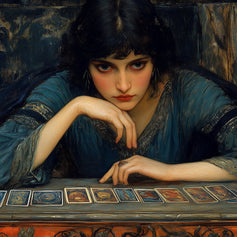




At the end of the 19th century, in an England passionate about occult sciences and secret societies, a small circle of initiates gave birth to the Hermetic Order of the Golden Dawn, a school of magic that would profoundly change the history of Western esotericism. At the crossroads of the Rosicrucian tradition and emerging modernity, through Kabbalah, alchemy, ceremonial magic, but also ego conflicts, the story of a school that structured the study of magic.
1. The historical context of the late 19th century
The end of the 19th century in Europe, especially in Victorian England, was marked by a true occult revival. Esoteric circles, secret societies, and movements flourished, fueled by interest in occult sciences, spiritualism, and esoteric philosophies from both the East and the West. This Victorian occult "revival" drew from both the Hermetic tradition of the Renaissance and archaeological discoveries about Egypt and pagan Antiquity, sparking enthusiasm for alchemy, Kabbalah, ceremonial magic, and other esoteric knowledge once reserved for a few scholars. Thus, a small elite of initiates – members of high society and the educated middle class – began founding new mystical societies to explore these esoteric teachings in a structured and initiatory way.


Among notable predecessors are the Theosophical Society founded in 1875 by Helena Blavatsky (who popularized a syncretic, Orientalist esotericism) and the Societas Rosicruciana in Anglia (SRIA) founded in 1867, reserved for Freemasons and dedicated to the study of Rosicrucian symbolism. It is in this intellectual and spiritual ferment that the Hermetic Order of the Golden Dawn was born. The future founders of the Golden Dawn were themselves trained in this environment: they were scholars passionate about occultism, high-ranking Freemasons, seeking to systematize and practice esoteric doctrines. They relied on emblematic authors of the Western esoteric tradition, such as the Renaissance mage Cornelius Agrippa (1486-1535), whose theories of universal analogy between microcosm and macrocosm laid the foundations of ceremonial magic, as well as the Elizabethan scholar John Dee (1527-1608) and his famous Enochian angelic communication system. The era also saw the rediscovery and translation of ancient grimoires (such as the Key of Solomon) and foundational Rosicrucian texts (such as the 17th-century Fama and Confessio Fraternitatis), which nourished the formation of the teachings of these new mystical orders.
Thus, the Hermetic Order of the Golden Dawn fits into the broader movement of the revival of occult sciences. As historian R.A. Gilbert would later describe, the Golden Dawn represents "the last and most brilliant flowering of the Victorian occult revival", gathering and synthesizing multiple esoteric currents within itself to transform them into a coherent system of initiatory study and practice.
2. The founding of the Golden Dawn
The Hermetic Order of the Golden Dawn (Hermetic Order of the Golden Dawn) was founded in London in the late 1880s, under rather mysterious, even legendary circumstances. Three men were behind it: Dr. William Wynn Westcott (1848-1925), a civil servant and occult scholar, Dr. William Robert Woodman (1828-1891), a physician and Rosicrucian, and Samuel Liddell Mathers (1854-1918), an esoteric scholar who later added MacGregor to his name to claim Scottish ancestry. All three were high-ranking Freemasons and prominent members of the Societas Rosicruciana in Anglia (Westcott was its Grand Secretary General). According to the traditional account reported by Westcott, it all began in 1887 with the accidental discovery of mysterious coded manuscripts.
According to Westcott, these esoteric documents – written in English with a coded script attributed to Abbot Trithemius – came from the library of a deceased occultist and had passed through a certain Reverend A.F.A. Woodford, a friend of Westcott. Intrigued, Westcott managed to decipher the manuscripts in 1887 and discovered sketches of initiatory rituals as well as a contact address leading abroad. Indeed, among these pages was the name of a German Rosicrucian lady, Fräulein Anna Sprengel, affiliated with a mysterious organization called Die Goldene Dämmerung (“The Golden Dawn”). Westcott decided to correspond with this adept. In October 1887, he wrote to her to request her help and information about the rituals. To his great joy, he received a positive response: Anna Sprengel authorized him to found an English branch of her Rosicrucian order and granted him an official charter to establish a “Golden Dawn” in England.

Potential coded manuscripts. Source: Freemasonry Museum (London)
Armed with this authorization (whose authenticity would later be questioned by historians), Westcott partnered with Samuel Mathers to bring the order to life. Westcott provided the deciphered texts and his kabbalistic knowledge, Mathers shaped the rituals and completed the drafts with his magical scholarship. Dr. Woodman, their elder and friend, agreed to join them as co-founder. From March 1888, the first Golden Dawn temple was inaugurated in London under the name Isis-Urania, designated as Temple No. 3 to feign the existence of two earlier temples in Germany linked to Anna Sprengel. Westcott, Mathers, and Woodman took the lead of the organization as supreme chiefs. Mathers was appointed Imperator of the temple, Westcott Cancellarius, and Woodman Praemonstrator, forming a collegiate leadership.
The new fraternity immediately distinguished itself from its predecessors by two essential points. On the one hand, the Order was open to both men and women, without distinction – an exceptional fact for the time in an initiatory environment often reserved for men only. Unlike the SRIA or Freemasonry, the Golden Dawn welcomed female initiates on equal terms with their male counterparts. Several women, including Moina Bergson (sister of the philosopher Henri Bergson and future wife of Mathers), were among the founding members – Moina was actually the first person initiated in the Isis-Urania temple in March 1888. On the other hand, the Golden Dawn aimed above all to be a practical esoteric school: it offered a structured and graded teaching of occult sciences. The five initiatory grades of the "Outer Order" (detailed later) were established according to the instructions of the ciphered manuscripts, and it was within this rigorous framework that members studied Kabbalah, Hermeticism, astrology, etc., then practiced ceremonial magic.
In a short time, the order attracted many followers, recruited from London Masonic or Theosophical circles. From 1888 to 1896, the Golden Dawn experienced notable growth: secondary temples were founded in several British cities and even abroad. Lodges were established in Weston-super-Mare (Temple Osiris), Bradford (Temple Horus), Edinburgh (Temple Amen-Ra in 1893, led by Dr. William Ayton then J.W. Brodie-Innes), and Mathers himself established a temple in Paris in 1894 (Ahathoor, where he settled with Moina). The Golden Dawn Order then seemed to concretely realize the ideal of a modern Rosicrucian fraternity: an international initiatory network dedicated to the in-depth study of occultism and the spiritual transformation of its members.
Note: The historical reality of the correspondence with Anna Sprengel and the German lineage of the Golden Dawn remains debated. Later research – notably by Ellic Howe and R.A. Gilbert – suggests that Anna Sprengel may have been a fictional figure created by Westcott to legitimize the order. In any case, the founders of the Golden Dawn acted as if this spiritual authority were real, placing the Order within a broader Rosicrucian lineage, which strongly influenced the symbolic imagination of the Golden Dawn.
3. The Rose Cross of the Order, a radiant symbol
Within the Hermetic Order of the Golden Dawn, the pectoral Rose-Cross held fundamental value. It represented a true symbolic map of the universe and the human soul. Intended for members of the Second Order (the Adeptus Minor), it served both as a constant reminder of initiatory teachings and as a support for meditation and magical work.

Pectoral Rose Cross of the Order
The Golden Dawn Rose-Cross is structured around a traditional Latin cross, on which rests an open rose with twenty-two petals. Each part of the symbol has a precise and thoughtful meaning.
The cross itself represents the four fundamental elements of the Hermetic tradition: fire, air, water, and earth. Each of the four arms of the cross is associated with one of these elements. The upper arm is assigned to fire, the lower arm to earth, the right arm to air, and the left arm to water. This association expresses that the human being, as a microcosm, is composed of the balance of these elemental forces. The cross also expresses the idea of spiritual incarnation in the material world: the spirit descends into matter to carry out its work of elevation and transmutation.
The rose at the center of the cross symbolizes the individual soul. Its twenty-two petals correspond to the twenty-two letters of the Hebrew alphabet, which, in Kabbalah, are seen as the primordial vibrations that served to create the universe. These twenty-two letters are also linked to the twenty-two paths of the Kabbalistic Tree of Life, which connect the ten spheres or sephiroth. The rose thus represents the progressive development of the soul which, through learning and initiation, travels these paths toward divine knowledge. It also evokes the concept of a spiritual evolution cycle: by unfolding its petals, the soul realizes its full divine potential.
The colors of the cross are not left to chance. Each arm carries a specific color linked to its element: red for fire, yellow for air, blue for water, black for earth. These colors correspond to the elemental vibrations taught in the Golden Dawn rituals. They reinforce the idea that the initiate must learn to balance within themselves the forces of the natural world to access a higher understanding.
Around the rose are also Precise astrological and alchemical symbols. The astrological signs of the twelve zodiac constellations are inscribed in certain representations, reflecting the influence of cosmic cycles on the human being. Each point of the cross also bears alchemical glyphs corresponding to the traditional elements and planets, affirming that the initiate acts not only on their own inner world but also in harmony with celestial powers.
The Hebrew letters arranged around the cross form sacred names of God. For example, the Tetragrammatons Yod-Heh-Vav-Heh are used to establish direct connections with divine forces in the universe. The integration of these letters is not decorative: it aims to constantly remind the adept that all true magic must rely on the vibrational structure of the divine Word.
The very shape of the symbol embodies a teaching. The cross fixes the directions of the material world, while the rose, alive and central, shows that it is through inner evolution that the human being transcends their earthly condition. The Rose Cross thus functions as a synthesis: the initiate is invited to embody the union of heaven and earth, the visible and the invisible, spirit and matter.
Worn on the chest during the Second Order rituals, the pectoral Rose Cross serves not only as a protective talisman but also as an active tool to focus magical intention. It reminds that every true magical act proceeds from the conscious balance of natural and spiritual forces. Through this symbol, the Hermetic Order of the Golden Dawn taught that the path of initiation was not an escape from the world, but a process of enlightened mastery of the world, in service to the divine Light.
4. Rituals, grades, and teachings of the Order
The Golden Dawn is characterized by a highly elaborate initiatory system, combining symbolism, theatrical rituals, and an in-depth esoteric study program. From its foundation, the Order established a hierarchy of initiatory grades inspired by the Hermetic Kabbalah and the structure of Masonic orders, but adapted to the occult goals of the fraternity. Each initiatory level corresponds to a level of knowledge and practice, accompanied by specific ritual ceremonies and a study curriculum. The whole forms a progressive path aimed at the spiritual elevation of the candidate, from layperson to accomplished adept.
To mark belonging and the degree of progress, each initiate adopts a Latin motto – Sapere Aude ("Dare to know") for Westcott, or Deo Duce Comite Ferro ("God as guide, the sword as companion") for Mathers – and wears symbolic insignia. One of the most important emblems is the pectoral Rose Cross, a cross adorned with colors, Hebrew letters, astrological and alchemical symbols, which the adepts of the second order wear on their chest. This cross alone summarizes the synthesis of Kabbalistic, Rosicrucian, and Hermetic elements that the Golden Dawn integrates into its system. The Order's temples are decorated with Egyptian symbols (columns, altars, statues or images of gods) and figures borrowed from Kabbalah and alchemy, immersing the candidate in a sacred atmosphere conducive to "inner transformation" during rituals. Every detail of the decor and ritual has a precise meaning: colors associated with the elements, pentagrams and hexagrams drawn during invocations, magical tools (wand, sword, chalice, pentacle) corresponding to the four elements, etc. The emphasis is on symbolic visualization and the active participation of the candidate's imagination, in order to bring about lasting psychic and spiritual changes within them.

Temple of Râ in New Zealand. Source: Teara
In practice, the Golden Dawn was subdivided into three hierarchical orders:
-
The First Order, called the Outer Order (the Golden Dawn proper), included the initial grades of the curriculum, dedicated to the theoretical teaching of the basics of esotericism. This first order comprised five successive grades symbolically corresponding to the lower sephiroth of the Kabbalistic Tree of Life. These grades were, in ascending order: Neophyte (0=0), Zelator (1=10), Theoricus (2=9), Practicus (3=8), and Philosophus (4=7). Each grade advancement involved a solemn initiatory ceremony, rich in allegories, during which the candidate had to swear an oath of silence and was exposed to symbolic teachings (the Neophyte ritual made him "reborn" into the light after wandering in darkness, following a motif of symbolic death and resurrection). During his progress in the First Order, the initiate studied a vast program: Hermetic Kabbalah, esoteric philosophy, symbolism of the four elements of magic, notions of astrology and geomancy, basics of Occult Tarot and theoretical alchemy. The goal was to provide a solid intellectual training, a philosophical and ethical framework, before approaching practical magic. Note that at this stage, the rituals taught were mainly purification and meditation exercises (the Lesser Banishing Ritual of the Pentagram for energetic harmonization or visualization techniques of symbols), but not yet operative "high magic" – this was reserved for the inner order.
- The Second Order, called Ordo Rosae Rubae et Aureae Crucis ("Order of the Red Rose and the Golden Cross"), constituted the inner Order of the Golden Dawn. It brought together members who had completed the entire curriculum of the first order and distinguished themselves by their abilities. They received the grade of Adeptus Minor (5=6) – considered the rank of "accomplished initiate" of the Golden Dawn – during an impressive initiation ceremony into the Chamber of the Adepts (a seven-sided initiatory room called Vault of the Adepti). The grade of Adeptus Minor was itself subdivided into honorary sub-grades (Zelator Adeptus Minor, Theoricus Adeptus Minor, etc.), then above were the ranks of Adeptus Major (6=5) and Adeptus Exemptus (7=4). Within the Second Order, the focus was on advanced ceremonial magic and spiritual practice. The curriculum notably included learning astral travel (consciousness projection into subtle planes), spiritual vision (scrying in mirrors or crystals to communicate with entities), angelic invocation and evocation of archetypal forces, mastery of complex rituals (such as the Hexagram Ritual or planetary rituals), as well as practical study of alchemy and advanced Kabbalah. It was within this inner circle that all decisions regarding teachings, rituals, and the direction of the Order were made. Members of the Second Order were bound by an even stronger commitment and truly formed the operational heart of the Golden Dawn.
-
The Third Order: This was a purely theoretical and invisible level, meant to group the highest spiritual authorities of the brotherhood. Called the Secret Chiefs (Secret Chiefs), these supreme occult masters had reached the esoteric grades of 8=3, 9=2, and 10=1 (with evocative titles such as Magister Templi, Magus, and Ipsissimus). In the mythology of the Order, these Secret Chiefs remained hidden and were not embodied in ordinary assemblies: they guided the leaders of the Second Order through inspiration or spiritual communication, thus ensuring that the Golden Dawn remained connected to a higher tradition. Initially, Anna Sprengel acted as a mediator with these hidden entities. After the "loss of contact" with her in 1890, Mathers later claimed to enter into direct astral communication with new Secret Chiefs to legitimize his doctrinal innovations. In any case, this Third Order represents the regulatory ideal and the mystical source of authority of the Golden Dawn, giving the organization a mythological depth (and discipline, as members of the Second Order had to obey directives coming from above).
The Golden Dawn developed an unprecedented esoteric syncretism, embracing Hermetic Kabbalah, Christian-Rosicrucian Hermeticism, angelic (Enochian) magic, tarot, astrology, Neoplatonic theurgy, and integrating them into a rigorous initiatory framework. Its graduated teaching curriculum included both theory (occult philosophy, symbolic correspondences, sacred alphabets, mythology) and practice (ceremonial magic rituals, meditations, spiritual exercises). Such a synthesis allowed its members to acquire vast esoteric scholarship and to experience intense mystical experiences through initiations. Many authors emphasize that the Golden Dawn, within about fifteen years, touched on all areas of occultism, both Western and Eastern, creating a gigantic synthesis of sometimes disparate knowledge, and laid the foundations for almost all forms of ceremonial magic that we know and practice today.
5. The key personalities of the Golden Dawn
The history of the Golden Dawn is closely linked to the personalities of its prominent members. Here are the most notable figures of the Order's classical period and an overview of their roles.
5.1. William Wynn Westcott (1848–1925)
British forensic doctor and esotericist, Westcott is the main founder of the Golden Dawn. A high-ranking Freemason and Grand Secretary General of the SRIA, he set the process in motion by decoding the encrypted manuscripts in 1887 and obtaining Anna Sprengel's charter. During the early years (1888-1897), Westcott managed the administrative governance of the Order and contributed to doctrinal writings, particularly on Kabbalah and Rosicrucian philosophy (he wrote numerous monographs for member instruction). His initiatory motto is Sapere Aude ("Dare to know"), a phrase borrowed from Kant that became emblematic of the Golden Dawn's spirit. Westcott embodied a pillar of stability and moderation within the founding triumvirate.

However, in 1897, he had to abruptly withdraw from the Golden Dawn following an incident: compromising occult documents were reportedly found in a public cab, revealing his involvement in the Order. As a state official, Westcott was ordered to choose between his public career and his esoteric activities. He therefore resigned from the Golden Dawn in 1897, creating a power vacuum. Subsequently, Westcott devoted himself to the SRIA and Freemasonry, while maintaining correspondence with some former disciples. He would publish a historical account of the Order a few years later (where he downplays the Sprengel episode to protect the fraternity's reputation). Despite his withdrawal, Westcott remained respected as co-founder of the Golden Dawn – many members continued to correspond with him, and he was consulted unofficially. However, his departure marked the beginning of internal troubles.
5.2. Samuel Liddell MacGregor Mathers (1854–1918)
Central figure of the Golden Dawn, Mathers was its main theorist and ritual mastermind. Coming from a modest family and a self-taught enthusiast of esotericism, he brought to the young order his exceptional scholarship in ceremonial magic. It was Mathers who developed most of the initiation rituals based on the drafts of the ciphered manuscripts, and who designed the complete grade curriculum, notably the Second Order system. Married in 1890 to Moina Bergson (under the guidance of Reverend Ayton, a member of the Order), he formed with her a charismatic couple of "hierophants" – Moina assisted him in rituals and even led the Paris temple for a time. Mathers took the title of Lesser Chief and assumed the spiritual leadership of the Order, especially after Westcott's withdrawal. He did not hesitate to introduce new practices, under the guidance of the Secret Chiefs. Notably, he was the one who integrated Enochian magic (invoking the angels and spirits of John Dee's system) into the secret teachings of the Golden Dawn.

In 1892, Mathers moved to Paris where he founded the Ahathoor temple and tried to spread the Golden Dawn on the continent. He lived modestly thanks to the patronage of one of his followers, Annie Horniman, and surrounded himself with a small circle of loyalists. Mathers is described by his contemporaries as a flamboyant character: he loved theatrical staging (even officiating in Egyptian-inspired costume during some public rituals) and willingly considered himself a legitimate mage heir of a Rosicrucian lineage. However, his growing authoritarianism and doctrinal rigidity contributed to the Order's crises (he clashed with many followers from the late 1890s). After the 1900 split, Mathers founded a dissident branch called the Alpha and Omega Order and continued teaching magic, presenting himself as the sole guarantor of the "true" Golden Dawn. He died in 1918 in Paris, probably taken by the flu pandemic, without having returned to England. Despite these upheavals, Mathers' contribution is immense: he is responsible for the translation and publication of major occult texts (the first English edition of the Key of Solomon in 1889, and the Book of the Sacred Magic of Abramelin in 1898, among others) which have permanently enriched the Western esoteric library. His name remains inseparable from the ritual heritage of the Golden Dawn.
5.3. William Robert Woodman (1828–1891)
Less known to the general public, Dr. Woodman was nevertheless the third co-founder of the Golden Dawn. A renowned physician and botanist, he was especially the Grand Master of the Societas Rosicruciana in Anglia when Westcott invited him to participate in the creation of the Order. His Masonic and Rosicrucian prestige brought credibility to the early days of the Golden Dawn. Woodman officially held the position of Supreme Master alongside Westcott and Mathers, although he was probably less involved than them in the practical development of the rituals (due to age and fragile health). However, he attended the first initiations in 1888. His motto was Magna est Veritas ("Great is the Truth"). Woodman died as early as 1891, which did not allow him to see the Order's developments. His passing left Westcott and Mathers alone in charge. Out of respect, the Golden Dawn kept Woodman's name among its founders until the end, and some ritual documents pay tribute to him as an "illustrious Rosicrucian passed to the stars."
5.4. Florence Farr (1860–1917)
Leading female figure of the Golden Dawn, Florence Farr was a British actress, writer, and occultist who joined the Order in 1890. Intelligent and charismatic, she quickly rose through the ranks to become in 1896 the Head of the Isis-Urania Temple in London (titles of Imperatrix and Praemonstratrix). She thus played a leading role in the administration and teaching of the Outer Order during the crucial years when Mathers was in Paris. Florence Farr was particularly devoted to Egyptian theurgy: she led rituals invoking deities of ancient Egypt and even claimed to receive instruction from an astral entity named "Saya," sometimes called her "black mummy". These experiences reflect Farr's spiritual boldness and the atmosphere of exotic syncretism that prevailed within the Golden Dawn. She was also close to several prominent members, notably the poet W.B. Yeats (with whom she collaborated at the Hermetic Theatre). During the 1900 crisis, Florence Farr took charge of the London rebellion: she received the famous letter from Mathers accusing Westcott of secret scheming, and after unsuccessfully asking Westcott for explanations, revealed the letter to the members of the Second Order. She then chaired the Adept committee that decided to depose Mathers. However, worn out by these disputes and differences in vision, Florence Farr eventually resigned her positions in 1902 and left the Golden Dawn shortly after. She moved to Ceylon (Sri Lanka) where she devoted herself to the study of Buddhism until her death. Her legacy within the Order is significant: she demonstrated the active role that occultist women of her time could play and contributed to ritual richness (for example, she composed invocations and adapted chants for ceremonies).
5.5. Aleister Crowley (1875–1947)
Undoubtedly the most famous – and controversial – member to come from the Golden Dawn, Aleister Crowley nevertheless holds a tumultuous place there. A young English poet from Cambridge, Crowley was initiated into the Golden Dawn in November 1898 at the age of 23, taking the esoteric motto Perdurabo ("I will endure until the end"). Very talented and eager to progress, he absorbed the teachings of the first order in a few months and reached the grade of Adeptus Minor in early 1900, after a swift initiation led by Mathers himself at the Ahathoor temple in Paris. Crowley admired Mathers and initially sided with him during the conflict with the London adepts – especially since some figures, like Yeats and Farr, viewed this young man with a decadent lifestyle unfavorably. Indeed, Crowley shocked with his nonconformity: an occultist without taboos, openly bisexual, provocative, he delighted in transgressing Victorian morality. Within the Golden Dawn, his reputation as a "black magician" began to cause concern. In 1900, when the revolt against Mathers broke out, Crowley presented himself as his emissary: according to legend, he tried to force his way into the London Temple dressed in Scottish attire and armed with a magical sword but was confronted by guardians loyal to the adepts' committee (an episode sometimes called the "Battle of Blythe Road"). Mathers and Crowley are even said to have engaged in an occult duel, exchanging curses and remote attack rituals against the rebels – a dramatic episode illustrating the excess of their confrontation. Ultimately, Crowley was expelled from the Golden Dawn by the London faction in 1900. He also broke with Mathers a few years later after feeling betrayed (Mathers allegedly refused to recognize some of Crowley’s initiations). Leaving the Golden Dawn, Aleister Crowley went on to spread his magical legacy further: in 1907, he founded his own initiatory order, the Astrum Argentum (A∴A∴), then took leadership of the Ordo Templi Orientis (O.T.O.) incorporating his doctrines. Nicknamed “the Great Beast 666,” he developed the Thelemic religion from 1904 and reformulated the Golden Dawn corpus in his own way through numerous works and ritual systems. While his scandalous persona long overshadowed the significance of his work, historians now recognize Crowley as one of the main channels through which the Golden Dawn’s legacy – especially its sexual magic, invocation rituals, and Kabbalistic esotericism – passed into the modern world. He died in 1947, leaving behind a vast body of esoteric writings and having inspired more than one generation of later occultists.
5.6. Arthur Edward Waite (1857–1942)
British author and occultist, A.E. Waite was a member of the Golden Dawn who, although lacking Crowley's flamboyance, nevertheless played a crucial role in the Order's evolution (and split). Initiated in 1891, Waite was a mystical Catholic scholar, more drawn to spiritual contemplation and the quest for divine wisdom than to operational magic. After the 1900 crisis, he led a dissident faction of the organization. Judging the theurgic practices too reckless, Waite redirected the group toward a purified Christian esoteric mysticism free of magic – in 1903 he created the Independent and Rectified Rite (or Holy Order of the Golden Dawn), where esoteric study became more meditative and alchemical, without spirit invocations. Waite is best known to the general public for having, in 1910, designed with artist Pamela Colman Smith the famous Rider-Waite Tarot, largely based on the symbolic teachings of the Golden Dawn. This Tarot, rich in visual archetypes, differs from the one taught in the Order by a softened and mystical iconography (the minor arcana are illustrated with scenes, reflecting Waite's more psychological approach). His deck and explanatory book had a considerable influence on the development of cartomancy in the 20th century. Although Waite distanced himself from the original Golden Dawn – which he considered "imperfect" – he preserved and transmitted its heritage in a transformed form, favoring prayer and inner experience over ceremonial magic. He dissolved his order in 1914, considering his mission accomplished, and remains in history as a bridge between the Golden Dawn and a more inward Christian esotericism.
5.7. Dion Fortune (1890–1946)
Born Violet Mary Firth, she joined the Golden Dawn only after its classical period, but she is counted among its most important "heirs." A trained psychologist and passionate about occultism, Dion Fortune was initiated in 1919 into the Stella Matutina order (the branch derived from the Golden Dawn, see below), at the Alpha-Omega temple in London. She took the motto Deo Non Fortuna (meaning her "fortune" comes from God, the origin of her literary pseudonym). A brilliant student, she trained in the techniques of the Golden Dawn and then, in 1924, founded her own esoteric organization, the Fraternity of the Inner Light, which she led until her death. Through her writings – notably her major work The Mystical Qabalah (1935, translated into French as La Kabbale Mystique) – Dion Fortune widely spread the kabbalistic and magical principles of the Golden Dawn to the English-speaking public.

She emphasizes the psychological and spiritual dimension of the teachings, laying the foundations of what would later become "esoteric psychology." A talented esoteric novelist, she illustrates in her initiatory novels (such as The Dark Lord or The Priestess of the Moon) fictional scenes inspired by the Golden Dawn, thus helping to forge a mythology around the Order. Dion Fortune links the original Golden Dawn to mid-20th century occultism: her influence is found both in the emerging Wicca of the 1950s (Gerald Gardner knew and appreciated her books) and in esoteric schools like the Society of the Inner Light (a direct heir to her work). She perpetuated the spirit of the Golden Dawn by making it accessible to a wider audience and emphasizing the personal development and psychic protection aspects of magic.
6. The disagreements and the fall of the Order
Despite its apparent success, the Hermetic Order of the Golden Dawn was soon shaken by internal power struggles. At the turn of the century, a series of disagreements opposed the leaders and threatened the unity of the fraternity, ultimately leading to its breakup in the early 20th century.
Several underlying causes explain these troubles. On one hand, the very structure of the Order – with a Second Order of adepts who had gained strong expertise – led some members to desire autonomy from the authority they saw as autocratic in Mathers. On the other hand, differences in vision emerged: should the path of ambitious theurgic magic be pursued (the position of Mathers and Crowley) or should a more cautious approach be taken, even returning to a mystical-inner approach (the position of Waite and others)? Added to this were personality conflicts and ego disputes.
The first major blow came in 1897 with the forced departure of William Westcott. As mentioned above, Westcott left leadership after a leak revealed his occult role to the authorities. Officially, he resigned for “personal reasons,” but privately, Mathers hinted that Westcott had fabricated the correspondence with Anna Sprengel – a serious accusation that undermined the legitimacy of the Order’s foundations. Deprived of Westcott, the London temples came under Mathers’ direct influence, now the sole official leader. Based in Paris, he delegated some responsibilities locally (Florence Farr administered Isis-Urania), but intended to remain the decision-maker for the entire direction of the Order. His authoritarian and distant style displeased many adepts. In 1899, a latent tension prevailed: Mathers had harshly expelled Annie Horniman, his benefactor, for “indiscretion”; he demanded total obedience to directives from the Secret Chiefs; and he had alienated other influential members.
The crisis erupted openly in the early 1900s. Florence Farr and other senior adepts in London, dissatisfied, questioned Mathers' authority and sought to verify the reality of the Secret Chiefs. The precise breaking point was the famous letter sent by Mathers on February 16, 1900, from Paris to Florence Farr. In this scathing missive, Mathers accused the London dissenters of conspiring under the occult influence of Westcott and ordered them to cease all schism under threat of exclusion. Stunned, Farr consulted Westcott – who denied any scheming on his part – then decided to make the letter public to the Second Order. The effect was explosive: the London adepts united against Mathers. On March 3, 1900, they formed a “Committee of Seven” (including Florence Farr, W.B. Yeats, A.E. Waite, and others) tasked with holding Mathers accountable and, in practice, temporarily managing the Order without him. Informed, Mathers refused to submit: he claimed that without him and the authority of the Secret Chiefs, the Golden Dawn was no longer valid.
This led to an unprecedented power struggle in the history of occult societies. Mathers tried to regain control of the London temple by various means. He sent Aleister Crowley as an emissary (or even as a “henchman”) to seize the ritual documents and the Isis-Urania temple, but access was denied to him. A legal battle was even initiated: Mathers sued the committee to recover Order property, but his complaint was dismissed (the British court declaring itself incompetent to rule on internal matters of an unregistered secret society). On the occult level, legend has it that Mathers and Crowley cast spells and curses on their former brothers, while the Londoners retaliated with protective rituals – an event later dramatized under the name of a “magical duel”. If we separate myth from reality, it mainly appears that Mathers’ authority was definitively rejected by the vast majority of members in England around 1900. Mathers was effectively excommunicated from the organization he had co-founded.
From that point on, the unified Golden Dawn no longer existed. Between 1900 and 1903, several distinct factions emerged from the ruins of the original Order, each claiming the legitimate heritage:
-
In London, the committee of adepts led by William Brodie-Innes and Dr. Robert Felkin took control of the Isis-Urania temple. In 1903, Felkin made a strong symbolic gesture: during a ritual, he “struck down the name” of Golden Dawn and officially renamed the group Stella Matutina (the “Morning Star”). This new order aimed to be the regular successor of the Golden Dawn, but purified of Mathers’ influence. Stella Matutina preserved the same teachings and rituals while developing its own spiritual contacts (Felkin even undertook a trip to Germany to try to find genuine Rosicrucians). It is under the name Stella Matutina that occultists like Dion Fortune or Israel Regardie would later be initiated. Felkin founded temples outside London, notably in New Zealand (the famous “Whare Ra” temple in 1912), ensuring the continuity of this branch until the 1940s.
-
At the same time, A.E. Waite, disagreeing with Felkin on magical practice, left Stella Matutina in 1903 to form his own branch, the Order of the Golden Dawn, Independent and Rectified Rite. This group, with a mystic-Christian orientation, abandoned evocative magic considered too risky. Waite refocused study on sacramental symbolism, spiritual alchemy, and prayer. This Rectified Rite, also called Waite’s Golden Dawn, had only modest success and was dissolved in 1914, but it illustrates the other possible path the Order could have taken: that of a contemplative esoteric society rather than a magical one.
-
Meanwhile, Samuel Mathers persisted and asserted: from 1900 he considered that the Golden Dawn was himself. Excluded from Isis-Urania, he activated his Parisian temple Ahathoor and created others under a new banner, the Order Alpha and Omega. Mathers attracted a few loyal followers (such as his former Jesuit secretary Marcus Worsley Blackden, or his friend Dr. Berridge) and initiated new members in France and Great Britain. Alpha and Omega thus functioned as a Golden Dawn “second version”, led by Mathers and Moina. Dion Fortune was briefly affiliated before separating from it. After Mathers’ death in 1918, Moina Mathers kept the Order Alpha and Omega active in Paris until the early 1920s.
Thus, between 1900 and 1903, the cohesion of the original Golden Dawn broke apart. The different branches born from the split all claimed the lineage of the Order, but none could alone embody the universality of the Golden Dawn of 1890. For historian Ellic Howe, “by 1903, the old Golden Dawn was broken”, and its influence survived only through its fragments and the aura of mystery surrounding it. Ironically, it was these very divisions that allowed the tradition to endure: Stella Matutina, Alpha and Omega, and later other groups and authors, passed the torch through the 20th century.
7. Heritage and influence in contemporary esoteric currents
Despite its dissolution as a unified organization, the Hermetic Order of the Golden Dawn exerted an immense and lasting influence on Western occultism of the 20th century. Its legacy is evident both in the doctrines and magical techniques transmitted, and in the impact it had on the formation of new esoteric movements (modern ceremonial magic, neopaganism, ...).
First of all, the Golden Dawn served as a true initiatory crucible from which several of the most influential occultists of the century emerged. Furthermore, many ritual concepts popularized in the 20th century come from the Golden Dawn. As historian R. Gilbert notes, “many current concepts of ritual and magic, central to contemporary traditions like Wicca or Thelema, were inspired by the Golden Dawn”, which became “one of the greatest individual influences on Western occultism of the 20th century.” Gerald Gardner’s Wicca (which appeared in the 1950s) borrows from the Golden Dawn’s teachings the system of magical tools associated with the elements (the pentacle, the athame, the cup, the wand), the calling of the four cardinal points in the magic circle, as well as the use of Kabbalistic formulas in certain rituals. Gardner himself corresponded with Aleister Crowley and knew members from the Stella Matutina, which facilitated the transmission of these elements. Similarly, the Chaos Magic movement (emerged in the 1970s in England) – although aiming to be iconoclastic – owes much to the conceptual ecosystem established by the Golden Dawn: chaos magicians freely use sigils, entities, and occult alphabets, and these materials largely come from the grids of correspondences and magical discoveries systematized by the Golden Dawn and its successors (notably through Crowley). Moreover, the Golden Dawn formed the basic framework for other initiatory orders of the 20th century: for example, the Builders of the Adytum (B.O.T.A.) founded in 1922 by Paul Foster Case (a former member of Stella Matutina), which teach Kabbalah and tarot according to the Order’s line, or the Society of the Inner Light of Dion Fortune, already mentioned.
Beyond organized movements, the influence of the Golden Dawn is measured by the omnipresence of its methods and symbols in contemporary esoteric culture. Its system of correspondences (relationships between planets, signs, elements, sephiroth, Tarot arcana,...) has become a common language in occultism. Thus, every modern magic practitioner works, often without explicitly knowing it, with tools defined by the Golden Dawn. One example is the pentagram – an essential ritual figure – used within the framework set by the Order: specific orientation of the lines for evocation or banishment, assignment of elements to each point, and so on. The banishing and consecration rituals used today in countless wiccan covens, magical lodges, or energy meditation circles are often just adaptations of the Lesser Banishing Ritual of the Pentagram or other practices codified by the Golden Dawn. A French analysis points out in this regard that "all magic books have plundered [the] rites and correspondences [of the Golden Dawn], whether they admit it or not. Every five-pointed star drawn nowadays draws its current meaning from the Golden Dawn, and every use of this figure stems from its rituals." Similarly, the resurgence of kabbalistic esotericism in the first half of the 20th century – through authors like Papus, Éliphas Lévi, or later Paul Case – was filtered through the Golden Dawn, which systematized the study of the so-called kabbalistic Tarot and the ten sephiroth like never before.
Another area where the influence of the Golden Dawn is evident is Tarot. Before the Golden Dawn, esoteric Tarot was in its infancy. The members of the Order, especially Mathers, Westcott, Case, and Waite, deeply reflected on the iconography and structure of Tarot, producing documents (such as the famous Book T circulated internally) that associate each arcana with paths of the Tree of Life, Hebrew letters, elements, etc. The Rider-Waite Tarot (1910) and Aleister Crowley’s Thoth Tarot (drawn by Lady Frieda Harris in the 1940s) are two major decks directly stemming from this tradition: Waite, as we have seen, veiled the magical dimension to emphasize mystical symbolism, while Crowley intensified the occult and astral aspects. These decks, and the multitude of Tarots inspired by them, have spread worldwide the "golden-dawnian" vision of Tarot as a book of universal wisdom (Liber Mutus) and a tool for self-work. Every time a modern Tarot illustrates the minor arcana with evocative scenes or incorporates Kabbalistic symbolism, it bears the mark of the Golden Dawn.
Finally, the legacy of the Golden Dawn continues through the publication of its own documents. For a long time, the Order remained secret and its teachings were accessible only to initiates. But in 1937, Israel Regardie – former secretary to Crowley and initiate of Stella Matutina – made the bold decision to publish almost all the rituals and theoretical texts of the Golden Dawn in a four-volume work (The Golden Dawn). By doing so, he "opened the doors" of the Golden Dawn to a much wider audience. From then on, anyone motivated could study and practice according to the Golden Dawn system. This publication had a catalytic effect after World War II: it inspired the creation of occult groups claiming the Golden Dawn in the United States and Europe (many trying to reconstruct the Order from Regardie's documents) and it solidified the Golden Dawn’s place as an essential reference for ceremonial magic. Even today, there are contemporary orders presenting themselves as revivals of the Golden Dawn (among others, the Hermetic Order of the Golden Dawn, Inc. founded by occultists Chic and Tabatha Cicero in the United States in the 1980s, or other branches in Europe). These groups, although without direct initiatory links to the original Order, show that the "Golden Dawn brand" retains its appeal more than a century after its creation.
The Hermetic Order of the Golden Dawn, originally active from 1887 to 1903, had a brief but exceptionally fruitful existence. Historically, it fits into the context of the fin-de-siècle occult revival and represents its peak through the breadth of its esoteric synthesis. Its founding story, blending scholarship and mythology (the mysterious coded manuscripts, the Rosicrucian Sprengel), illustrates the tension between the need for traditional lineage and the invention of a new magical path suited to its time. Doctrinally, the Golden Dawn built a structured body of rituals, grades, and teachings that redefined the practice of ceremonial magic in the West. On a human level, it brought together extraordinary personalities – visionaries, mystics, poets, magicians – whose interactions were both creative and conflictual, reflecting the forces they manipulated. Although the organization itself did not survive intact beyond the early 20th century, its spirit and techniques spread far beyond: the Golden Dawn became the matrix from which most modern esoteric currents explicitly or implicitly derive. By taking seriously the symbolic and spiritual dimensions of magic, combining intellectual rigor and experience, the Hermetic Order of the Golden Dawn has left a lasting mark on Western esoteric tradition and shaped today’s magical practices.