















































































































































































































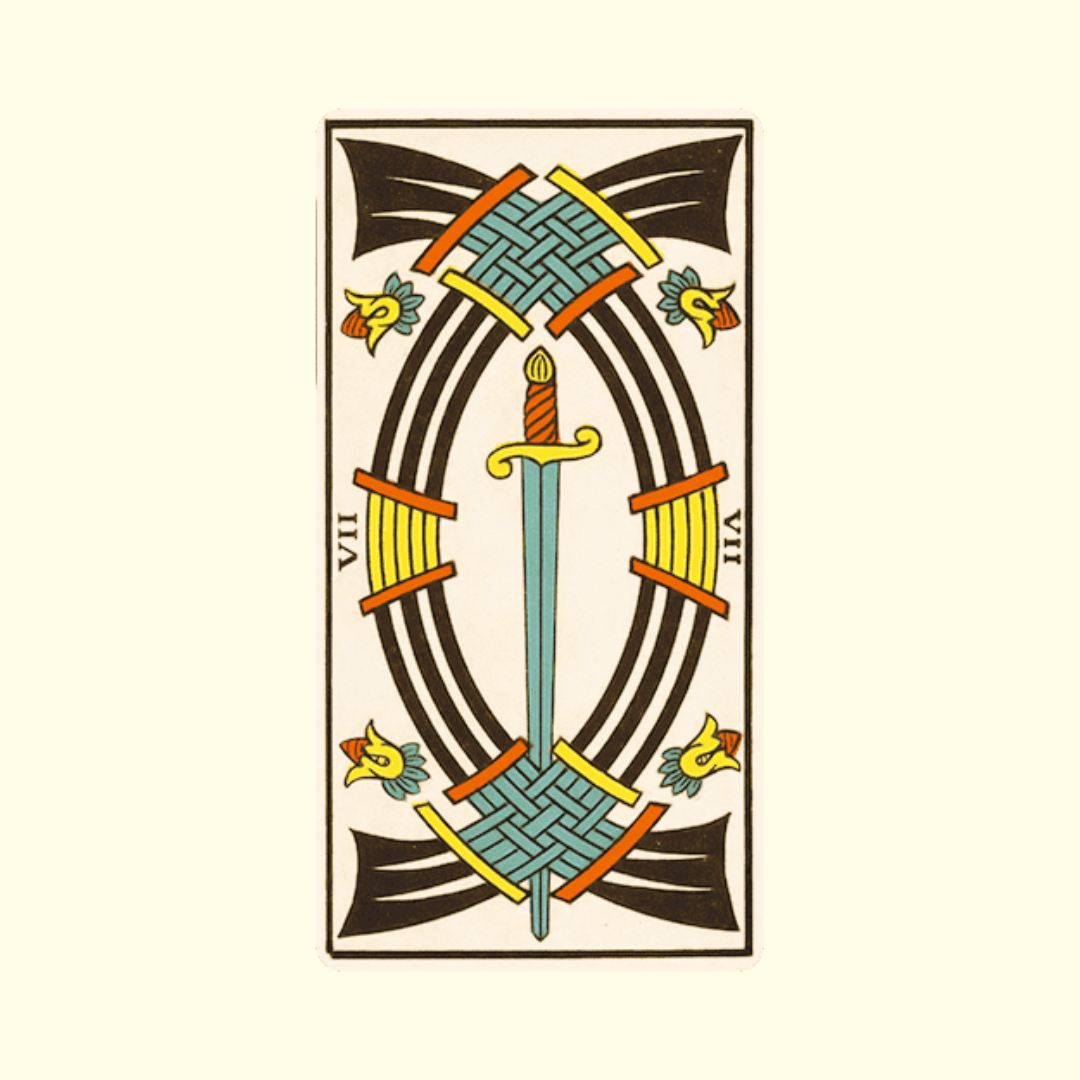

A seventh sword cuts through an almost enclosed structure. In the Tarot de Marseille, the central blade stands amid curved swords and ornaments. In the Waite-Smith, a man carries five weapons out of a camp and leaves two behind. The Seven of Swords speaks of a project, an attempt, and incomplete strategy before it speaks of theft: its ambiguity requires facts, because discretion can protect a plan just as it can conceal wrongdoing.
This card has been reduced to deception in many modern summaries. Yet the sources consulted give hope, confidence, desire, attempt, plan, advice, and unstable effort. Waite himself acknowledges that the meanings diverge. The Seven therefore does not allow one to accuse a person. It describes an action carried out indirectly, with partial means and an outcome that is still uncertain.
Two swords remain in the camp. This detail rules out speaking of complete mastery. The figure may carry away what he can bear, abandon part of the task, act without support, or believe that a clever maneuver will be enough. The central question is not only “who is lying?” but “what plan is being attempted, with what resources and what consequences?”
From the central blade to the camp strategy
In French tarot decks, six curved blades form an enclosure around a seventh straight sword. The vegetal motif is distributed throughout the structure. The central blade asserts a direction, but it remains contained by the architecture of the other weapons. No thief, camp, or escape appears on the card.
Smith shows a man walking away from a camp while carrying five swords by their blades. He looks back, while two weapons remain planted upright in the ground. Soldiers appear in the distance. His expression may suggest satisfaction, caution, or concern. Waite describes the gesture without explicitly calling it theft, then gives project, attempt, wish, hope, confidence, quarrel, a plan likely to fail, and vexation.
Iconographic reference. The camp, the furtive figure, and the five-plus-two arrangement belong to the Waite-Smith. Marseille presents a central blade within a construction of seven swords. An interpretation involving fraud should come from the question, the position, and other corroborating cards, not from the mere presence of the Seven.
Divinatory transmission
In 1888, Mathers attributed hope, confidence, desire, attempt, and wish to the Seven of Swords. Reversed, he listed wise counsel, good advice, wisdom, prudence, and circumspection. He specified that the following cards show whether the advice should be followed, while the preceding ones indicate its origin. This framework makes the Seven a card of strategy and assessment.
Book T calls it “Lord of Unstable Effort” and assigns it the Moon in Aquarius. Six swords converge without fully closing around a central blade, while a rose remains available to the hand holding it. The text speaks of partial success, abandonment when victory becomes attainable, exhausted reserves, indiscretion, and trust betrayed without persistent intent. The main flaw is effort that does not go all the way.
Waite revisits project, attempt, wish, hope, and confidence, then adds quarrel, a plan that may fail, and frustration. He writes that the design remains uncertain because its meanings are so far apart. Reversed, the card receives good advice, instruction, slander, and gossip. This historical hesitation should be preserved: the Seven is read as a discreet action whose value has not yet been established.
Meaning in a spread
In a favorable reading
The Seven of Swords can support a restrained strategy. The querent protects an idea before its launch, limits the information entrusted to a competitive environment, chooses an indirect route, or attempts a solution with few resources. Discretion then serves a clear objective, respects the rights of others, and has a deadline.
The card also favors examining an incomplete plan. Two resources are missing, a step was left behind, or the person cannot carry everything alone. Acknowledging this limitation makes it possible to ask for support, reduce the scope, or reclaim what was abandoned.
In a tension reading
The strategy can become concealment, indirect speech, appropriation of someone else’s work, or abandonment before the outcome. A person avoids confrontation at the expense of agreement, takes information that does not belong to them, or multiplies deceptions because they no longer believe it is possible to act openly. The card may also show a plan that is too complicated for the available resources.
No accusation should be made based on tarot alone. Look for contracts, access records, messages, witnesses, and verifiable discrepancies. The useful question becomes: which information must remain confidential, which should be shared, and what does the plan dangerously leave behind?
Love, work, and finances
The Seven describes an attempt, a strategy, or an action carried out away from public scrutiny. It proves neither infidelity, fraud, nor theft. The spread distinguishes legitimate discretion, an incomplete plan, and harmful concealment.
| Area | Favorable reading | Tension aspect | Question to ask |
|---|---|---|---|
| Love | Protection of an intimate project, search for the right time to speak, autonomy respected. | Secret that alters consent, double discourse, flight from a conversation. | Does this discretion protect the relationship or only the person acting? |
| Work | Lawful competitive strategy, protected prototype, solution outside established habits. | Appropriated idea, withheld information, abandoned task, displaced credit. | Who owns the rights to what is taken away? |
| Finances | Economy plan, discreet negotiation, prudent withdrawal from a commitment. | Hidden clause, incomplete calculation, suspected fraud without verification. | Which documents make it possible to control the plan? |
| Social life | Withdrawal from a talkative environment, boundary set around the circulation of confidences. | Rumor, indiscretion, hearsay, group manipulated through fragments. | Who received which version of the facts? |
| Decision | Relevant indirect route, limited trial, plan adapted to reduced means. | Abandonment before the final stage, overly complex strategy, scattered courage. | Which two resources have been left aside? |
Reading associations
The Seven brings the attempt, discretion, and partial effort. The neighboring card shows whether the plan serves a construction, conceals a conflict, or receives the advice it lacks.
| Association | Possible dynamic | Point of caution |
|---|---|---|
| Seven of Swords + Ace of Swords | Clarified strategy, decisive information, or a statement that reveals the plan. | Revelation may compromise an action that is still fragile. |
| Seven of Swords + Three of Pentacles | Discreet project entrusted to a competent team with defined roles. | Protect ownership of the work and the distribution of credit. |
| Seven of Swords + Five of Swords | Maneuver in a conflict, victory pursued through diversion or rumor. | Relational damage may outweigh the tactical gain. |
| Seven of Swords + Justice | Plan controlled by a contract, investigation, verification, or legal advice. | What appears skillful must remain lawful and traceable. |
| Seven of Swords + Moon | Difficult-to-read intention, fear, projection, and fragmentary information. | Suspend the accusation until facts are obtained. |
| Seven of Swords + Hierophant | Advice received from an authority, strategy placed within a rule or tradition. | Verify the competence and interest of the person giving advice. |
Correspondences according to the schools
The former table brought together the Moon, spring, sapphire, reed, and Zain. The Moon in Aquarius belongs to the Golden Dawn. The stone, plant, season, and letter do not form a common historical table with it.
| Reference | Attribution | Historical background |
|---|---|---|
| Family | Minor Arcana, Seven of Swords | Seventh numbered card of the suit. |
| Tarot de Marseille | Six curved blades surrounding a central sword and ornaments | Card without suits or figures. |
| Mathers, 1888 | Hope, confidence, desire, attempt, wish | Reversed: advice, wisdom, prudence, circumspection. |
| Golden Dawn | Lord of Unstable Effort | Title from Book T. |
| Element | Air | Occult attribution to the suit of Swords. |
| Astrology | Moon in Aquarius | Third decan of Aquarius in the Golden Dawn grid. |
| Waite-Smith | Man carrying five swords, two left in a camp | Scene published in 1909. |
| Hebrew letter | No letter specific to the card | Zain belongs to the Lovers in the Golden Dawn system. |
| Stone, plant, season | No common historical agreement | These recent lists should remain distinct from dated correspondences. |
| Reading keywords | Project, attempt, strategy, discretion, partial effort, advice | Facts distinguish skill, incompletion, and deception. |
Reading advice
Describe the plan without attributing moral intent to it. What is the character taking, what is he leaving behind, where is he going, and who is watching his departure? Then look for the rights attached to the objects, information, or work concerned. This reading distinguishes legitimate confidentiality from appropriation.
If fraud, infidelity, or theft is feared, tarot does not replace verification. Ask for the facts and avoid feeding suspicion without evidence. The best use of the Seven is to test the soundness of a strategy, protect what needs protecting, and resume abandoned steps before they compromise the result.
Reference sources and texts
For the history of decks and suits: Victoria and Albert Museum, A History of Tarot Cards; British Museum, reproduction of Nicolas Conver’s Tarot of Marseille.
For divinatory and occult texts: S. L. MacGregor Mathers, The Tarot, 1888, card meanings; Liber LXXVIII, “The Lord of Unstable Effort,” publication of material from Book T; Arthur Edward Waite and Pamela Colman Smith, The Pictorial Key to the Tarot, Seven of Swords, 1911.










