















































































































































































































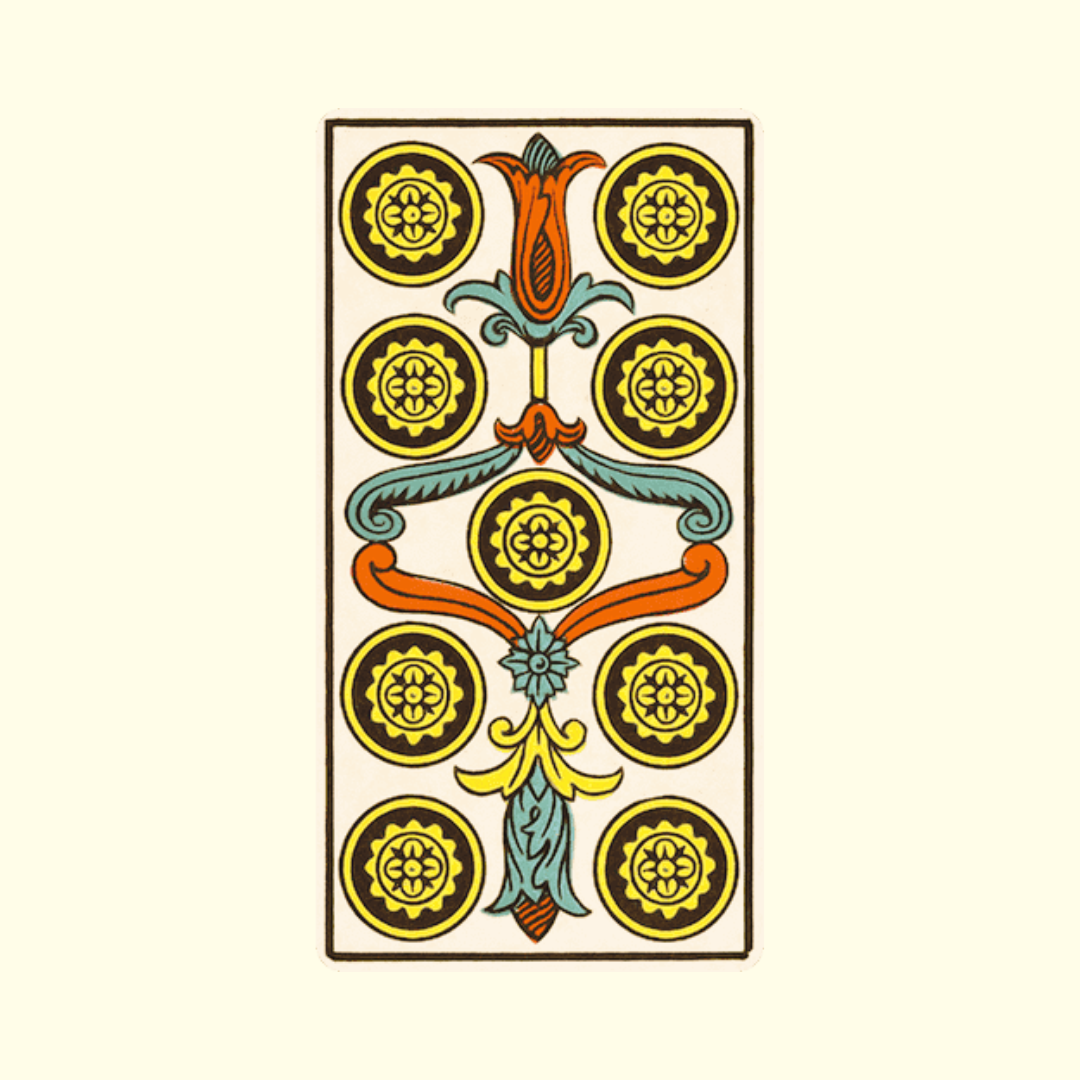

Nine coins approach completion without closing the sequence. In the Tarot de Marseille, they occupy almost the entire space and organize wealth that has become visible. In the Waite-Smith, a woman stands in a vineyard, a bird perched on her hand, before an estate whose grounds appear established. The Nine of Coins speaks of gain, prudence, and mastery of resources; it also asks what one protects, what one shares, and the price of this autonomy.
The earlier article reduced the card to financial security achieved through discipline. The sources give it a more precise scope. Mathers emphasizes discretion, circumspection, and discernment. The Golden Dawn calls it the “Lord of Material Gain” and associates it with inheritance, an increase in possessions, and the possibility of miserly possession. Waite takes up prudence, security, accomplishment, and certainty, with deception and a canceled project in the reversed aspect.
The card therefore promises neither fortune nor absolute independence. It describes a material result mature enough to be managed, protected, and assessed. This result may take the form of income, a skill, a home, a reserve, a clientele, or time that has become available. The central question concerns how the gain is used and the conditions that allow it to be preserved without becoming trapped in it.
From the nine coins to the guarded estate
In a Tarot de Marseille, the nine coins are distributed among stylized branches, leaves, and flowers. Their arrangement varies by workshop. No character owns the garden, and no falcon conveys independence. The image first presents an almost complete number, a monetary suit, and an order that still needs the Ten to reach its end.
Smith places a richly dressed woman amid vines laden with grapes. A hooded bird rests on her glove, and a large estate closes off the background. Waite speaks of a vast domain that suggests abundance and considers that it may belong to the figure. The garden is cultivated, bounded, and inhabited: the visible comfort results from a maintained space, but the scene does not tell us who worked, inherited, or paid to establish it.
Iconographic marker. The vineyard, estate, and bird belong to the Waite-Smith. They direct the reading toward possession, mastery, and a protected setting. Marseille remains a pip card: its Nine may signal concentration, abundance, or an advanced result without imposing the story of an independent person in her garden.
Divinatory transmission
In 1888, Mathers assigned the Nine of Pentacles discretion, circumspection, prudence, and discernment. Reversed, he cited deception, bad faith, trickery, and deceit. This list speaks neither of deserved luxury nor of happy solitude. It connects material value to a faculty of judgment: knowing what one possesses is not enough; one must also recognize the conditions, risks, and intentions at play.
Book T assigns the Nine the title “Lord of Material Gain” and the correspondence Venus in Virgo. Nine pentacles are touched by nine roses, with other buds on the branches. The text describes the accomplishment of gain, possessions, wealth, and inheritance, then adds covetousness, hoarding, and even theft depending on the neighboring cards. The gain is real in this system, but its moral value and duration remain open.
Waite describes the woman amid an abundant estate and assigns prudence, safety, success, accomplishment, certainty, and discernment. The reversed meaning includes bad faith, deception, and a plan rendered void. The modern reading of autonomy largely comes from Smith’s scene. It can be fruitful if it remains connected to the facts: what resources does the person actually have, and who depends on their management?
Meaning in a spread
In a favorable reading
The Nine indicates a consolidated position. A job provides a margin, a skill makes it possible to act without constant assistance, a place becomes habitable, or a reserve protects against an unexpected event. The card favors clear-eyed assessment, discretion in negotiations, and the ability to enjoy a result without squandering it.
Success does not need to be spectacular. It may consist of a balanced budget, a controlled schedule, an owned rather than rented tool, or a decision that no longer depends on outside approval. The neighboring cards show whether this gain opens up freedom, prepares a bequest, or remains isolated within an overly narrow enclosure.
In a tension reading
Protection becomes closure, caution becomes mistrust, and possession becomes proof of personal worth. Someone keeps all the information, refuses useful help, accumulates without a plan, or maintains an image of success that the accounts do not support. Deception and bad faith may also point to an overvalued asset, an unsecured promise, or comfort obtained at someone else’s expense.
The Nine proves neither fraud nor hidden wealth. In a financial or property-related question, check documents, ownership, liabilities, taxes, and actual liquidity. A card may draw attention to a discrepancy; it does not replace verifying the paperwork.
Love, work, and finances
The Nine places a person face to an outcome they can manage. The reading examines the margin gained, the quality of discernment, and the boundary between autonomy and isolation.
| Area | Favorable reading | Tension aspect | Question to ask |
|---|---|---|---|
| Love | Two people maintain their autonomy and choose what they put in common. | Distance maintained out of fear of dependence, status, or comfort preferred to connection. | What can be shared without eliminating each person’s space? |
| Work | Recognized skill, well-managed assignment, activity carried out with room for decision-making. | Withholding information, solitary success, or a comfortable position that has become closed off. | Does control also benefit the collective project? |
| Finances | Accumulated reserve, assessed asset, prudent management, stabilized income. | Hoarding, an overvalued asset, opacity, or spending intended to display success. | What value remains available after expenses and commitments? |
| Home | Well-maintained place, domestic security, pleasure in having a space of one’s own. | A house used as a fortress, or maintenance costs that reduce all freedom. | Does the place serve life, or does it demand all available energy? |
| Decision | Choice based on experience, documentation, and an accurate assessment of risks. | Excessive caution, unnecessary secrecy, or trust placed in a prosperous appearance. | What fact makes it possible to distinguish genuine security from reassuring appearances? |
Reading associations
The Nine shows what has been acquired or is almost complete. The neighboring card indicates how this result was achieved, with whom it will be shared, and what threatens its preservation.
| Association | Possible dynamic | Point to watch |
|---|---|---|
| Nine of Pentacles + Hermit | Thoughtful autonomy, expertise exercised apart from others, resources managed with restraint. | Withdrawal can become isolation or a refusal to pass things on. |
| Nine of Pentacles + Empress | Productive field, profitable creation, comfort sustained by a fruitful activity. | The appearance of abundance must remain distinct from actual income. |
| Nine of Pentacles + Justice | Clarified assets, ownership rights, contract, or division assessed on the basis of documentation. | Have the legal and tax consequences reviewed. |
| Nine of Pentacles + Seven of Pentacles | Current gain, but the overall result is still pending. | Do not tie up more resources without a decision timeline. |
| Nine of Pentacles + Four of Pentacles | Strengthened protection of an acquired asset, reserve, or tightly controlled budget. | Security can turn into sterile accumulation. |
| Nine of Pentacles + Seven of Swords | Protected proprietary information, discreet strategy, or an asset that is difficult to verify. | Do not conclude that there has been deception without independent evidence. |
Correspondences according to different schools
Venus in Virgo belongs to the Golden Dawn system. The dwelling and the bird come from the Waite-Smith. Marseille conveys the number, the pentacles, and their composition, without a specific planet, plant, stone, or Hebrew letter.
| Reference point | Attribution | Historical scope |
|---|---|---|
| Family | Minor Arcana, Nine of Pentacles | Ninth numbered card of the suit. |
| Marseille Tarot | Nine pentacles and vegetal decoration | A suit-marked card with no owner or depicted domain. |
| Mathers, 1888 | Discretion, circumspection, prudence, discernment | Reversed: deception, bad faith, artifices. |
| Golden Dawn | Lord of Material Gain | Title from Book T. |
| Element | Earth | Occult attribution to the suit of Pentacles. |
| Astrology | Venus in Virgo | Second decan of Virgo in the Golden Dawn grid. |
| Waite-Smith | Woman, vineyard, estate, and bird on the glove | Scene published in 1909. |
| Hebrew letter | No letter specific to the card | Teth belongs to Strength in the Golden Dawn system. |
| Stone, plant, season | No common historical agreement | Emerald, oak, and autumn do not come from the cited sources. |
| Reading keywords | Gain, prudence, discernment, autonomy, reserve, preservation | The value must be verified and placed in context. |
Reading tips
First name what has been acquired: available funds, skill, time, housing, clientele, a tool, or reputation. Then assess what it costs to maintain and what portion still depends on a third party. This process distinguishes genuine autonomy from an impression of security sustained by invisible commitments.
If the card represents a person, avoid attributing wealth, celibacy, or selfishness to them based on the image alone. Instead, describe their role in the matter: they administer, protect, assess, or guard a resource. The next card will show whether this safeguarding prepares for the Ten, opens up sharing, or keeps the gain out of circulation.
Sources and reference texts
For the history of playing cards and suits: Victoria and Albert Museum, A History of Tarot Cards; British Museum, reproduction of Nicolas Conver’s Tarot of Marseille.
For divinatory and occult texts: S. L. MacGregor Mathers, The Tarot, 1888, card meanings; Liber LXXVIII, “The Lord of Material Gain,” publication of material from Book T; Arthur Edward Waite and Pamela Colman Smith, The Pictorial Key to the Tarot, Nine of Pentacles, 1911.










