















































































































































































































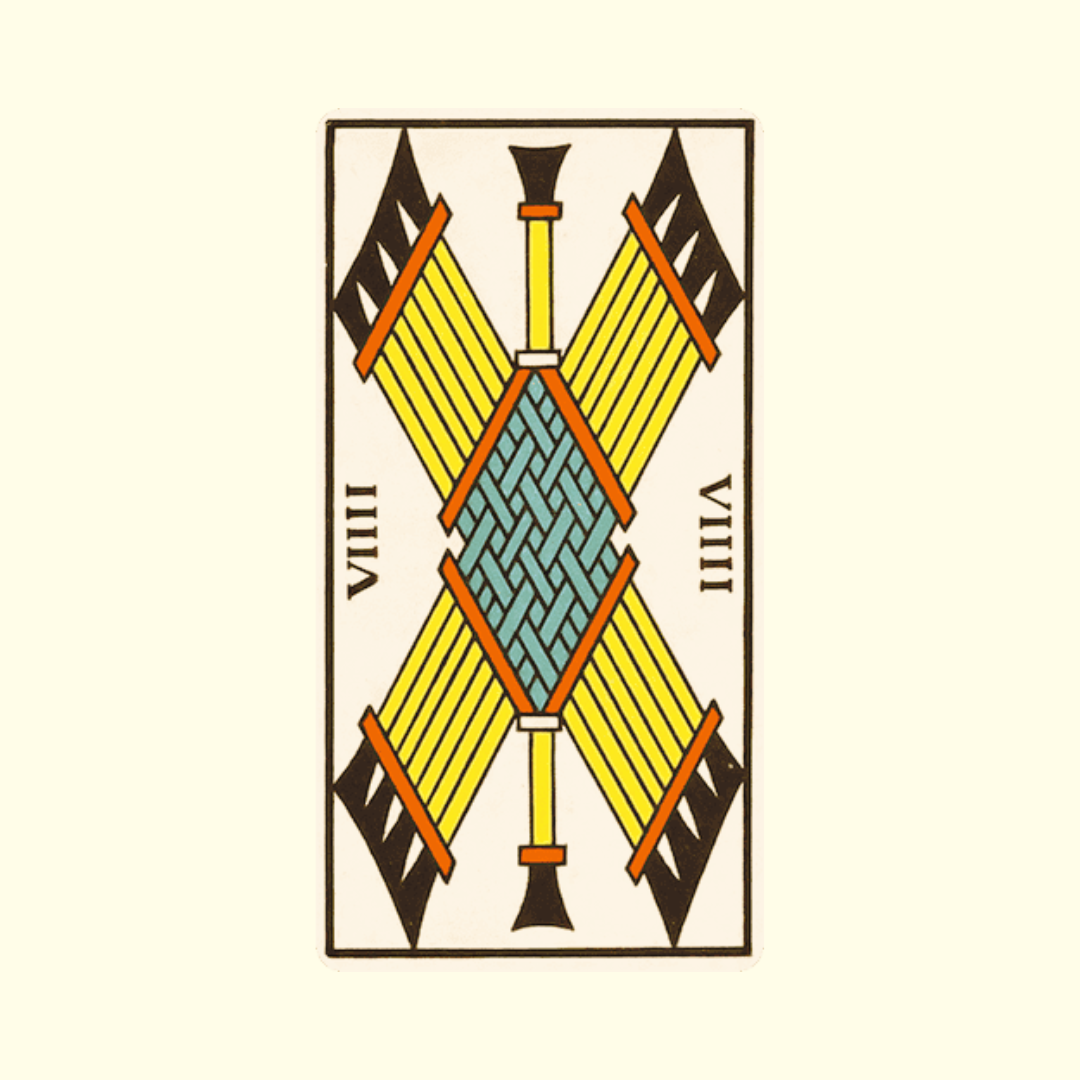

Nine wands carry the memory of ordeal. In the Tarot de Marseille, eight wands form a framework crossed by a ninth axis. In the Waite-Smith, a wounded man leans on his wand before a row of eight others, standing like a palisade. The Nine of Wands speaks of resistance, discipline, and vigilance: the person is still standing, but what they have been through changes how they await what comes next.
The Nine arrives after the Eight’s rush. Movement has stopped, the ground must be held, and the remaining forces must be assessed. The card may signal a final stage, a delay, an organized defense, or caution born of experience. It does not prove that a new attack will occur: Smith’s man is waiting for one, but the image shows no adversary.
The ancient sources give the Nine a vocabulary broader than mistrust. Mathers retains order, discipline, good disposition, and arrangement. The Golden Dawn names it the “Lord of Great Strength” and assigns it the Moon in Sagittarius. Waite brings together strength in opposition, waiting, suspension, and postponement. The card therefore describes power held in reserve as much as anxiety.
From the nine wands to the palisade
In a Tarot de Marseille, the ninth wand crosses vertically through the interweaving formed by the other eight. Vegetal ornaments occupy the sides. No figure appears tired or wounded. The additional axis gives the composition a point of stability: the force is no longer dispersed; it concentrates around a maintained line.
Smith places a standing man in front of eight aligned wands. A bandage encircles his head. He holds the ninth wand with both hands, his body turned to one side and his gaze toward the other. Waite describes someone waiting for an enemy and possessing the build necessary to respond firmly to an attack. The palisade protects, but it also confines the field of vision behind a repetition of defenses.
Iconographic reference. The wounded man, the waiting, and the palisade belong to the Waite-Smith. The Marseille shows an arrangement of wands without a past battle or future enemy. In both decks, the central axis may represent what remains standing; the wound and hypervigilance should not be projected onto a deck that does not show them.
Divinatory transmission
In The Tarot, published in 1888, Mathers assigns the Nine of Wands order, discipline, good organization, and disposition. Reversed, the card signifies obstacles, difficulties, delay, and displeasure. This list contrasts preparation and hindrance more than courage and weakness: the Nine holds when a structure is in place.
Book T gives it the title “Lord of Great Strength” and associates it with the Moon in Sagittarius. A ninth torch passes through eight crossed wands. The text describes considerable and stable strength, success achieved through struggle and energy, followed by victory preceded by apprehension and fear. Depending on the surrounding cards, it also adds curiosity, generosity, stubbornness, and resistance to constraint.
Waite shows strength in opposition. If the person is attacked, they will respond firmly; surrounding this main meaning are delay, suspension, and postponement. Reversed, the card becomes an obstacle, adversity, and misfortune. A current reading can therefore distinguish three situations: holding a boundary, waiting for a delayed decision, or remaining on alert when the danger is no longer present.
Meaning in a spread
In a favorable reading
The Nine of Wands indicates tested resilience. The querent now knows the project's weak points, the opponent's objections, or the warning signs of a difficulty. They can protect their work, prepare a response, maintain a boundary, and complete a stage without wasting their remaining strength.
The card favors discipline that simplifies defense: a familiar procedure, a realistic schedule, a backup, support, or a clear rule. It reminds us that endurance does not come solely from willpower. A palisade stands because several stakes share the load and a safe space allows one to catch one’s breath.
In a tension reading
Vigilance can become a permanent stance. The person interprets every delay as a threat, responds before being attacked, or refuses help because they fear losing control. The past then governs their reading of the present. The defense costs more than the actual risk.
The Nine can also show accumulated fatigue, a postponed matter, an open-ended wait, a difficult recovery after a conflict, or a determination to endure out of pride. The useful question becomes: what evidence shows that the danger is current, and which protection can be eased without exposing what matters?
Love, work, and finances
The Nine puts experience to work in service of a final stage. The area in question indicates what must remain protected, what can wait, and what strength is still available.
| Area | Favorable reading | Tension aspect | Question to ask |
|---|---|---|---|
| Love | A better-known boundary, a couple that withstands a challenge, caution after relational hurt. | Mistrust directed at someone who did not cause the original hurt, with dialogue experienced as an attack. | Does the boundary address the present or an already-ended conflict? |
| Work | File defended with experience, final review, team prepared for an objection. | Exhaustion, crisis culture, inability to delegate, or expectation of a permanent problem. | What backup or procedure prevents carrying everything alone? |
| Finances | Protected reserve, caution after a loss, verification before commitment. | Fear that blocks every decision, incessant monitoring, or disproportionate defensive spending. | What level of security is based on verified figures? |
| Project | Final effort, correction based on previous attempts, continuity despite a delay. | Defensive perfectionism, postponed launch, energy absorbed by secondary risks. | What must be finished before considering the stage complete? |
| Energy | Adapted pace, protection of rest, endurance built methodically. | Ignored fatigue, constant tension, the need to appear strong in front of everyone. | Which pause truly protects the ability to act? |
Reading associations
The Nine brings endurance, memory, and waiting. The neighboring card shows whether the defense will be useful, whether the delay will be resolved, or whether vigilance should be relaxed.
| Association | Possible dynamic | Point to watch |
|---|---|---|
| Nine of Wands + Ten of Wands | The final resistance turns into an excessive burden or reveals poorly distributed work. | Delegate before endurance becomes exhaustion. |
| Nine of Wands + Seven of Wands | A position remains under pressure and requires prolonged defense. | Choose which fronts to address instead of responding to everything. |
| Nine of Wands + Four of Swords | The defense must include a break, care, or an intentional suspension. | Rest is part of the strategy. |
| Nine of Wands + Justice | Prepared file, boundary upheld by a contract, piece of evidence, or rule. | Do not replace facts with suspicion alone. |
| Nine of Wands + Tower | Old protection is no longer enough in the face of a sudden change. | Secure people before rebuilding the defenses. |
| Nine of Wands + Star | After the ordeal, vigilance can gradually give way to trust. | Relaxation takes time and consistent actions. |
Correspondences according to the schools
The ninth vertical wand belongs to the structure of French-suited decks. The Moon in Sagittarius and the Great Strength come from the Golden Dawn. The wounded figure in front of the palisade is a composition by Smith commented on by Waite.
| Reference point | Attribution | Historical scope |
|---|---|---|
| Family | Minor Arcana, Nine of Wands | Ninth numbered card of the suit. |
| Marseille Tarot | Eight crossed wands pierced by a ninth | Number card with symbols and no wounded figure. |
| Mathers, 1888 | Order, discipline, good organization, arrangement | Reversed: obstacles, setbacks, delay, displeasure. |
| Golden Dawn | Lord of Great Strength | Title from Book T. |
| Element | Fire | Occult attribution to the suit of Wands. |
| Astrology | Moon in Sagittarius | Second decan of Sagittarius in the Golden Dawn system. |
| Waite-Smith | Bandaged man, one wand in hand, eight upright wands | Scene published in 1909. |
| Hebrew letter | No letter specific to the card | The numbered cards are not each assigned a letter in this system. |
| Stone and plant | No common historical agreement | Recent lists remain distinct from the cited sources. |
| Reading keywords | Endurance, vigilance, discipline, delay, limit, preparation | The context distinguishes caution from defense that has become reflexive. |
Reading advice
Begin by identifying what has already been endured. An experience, injury, or failure explains the posture, but does not prove that the same story will happen again. Then check the palisade: rule, contract, distance, backup, support, or budget. Protection without a clear purpose becomes a continual drain of energy.
Do not ask the querent to hold on indefinitely. Look for the reassessment date, possible handoff, and the sign that will permit relaxation. In a health-related question, the depicted injury is neither a diagnosis nor a prediction; actual fatigue deserves attention and, if necessary, qualified advice.
Sources and reference texts
For the history of decks and suits: Victoria and Albert Museum, A History of Tarot Cards; British Museum, reproduction of Nicolas Conver’s Tarot de Marseille.
For divinatory and occult texts: S. L. MacGregor Mathers, The Tarot, 1888, card meanings; Liber LXXVIII, “The Lord of Great Strength,” publication of material from Book T; Arthur Edward Waite and Pamela Colman Smith, The Pictorial Key to the Tarot, Nine of Wands, 1911.










