















































































































































































































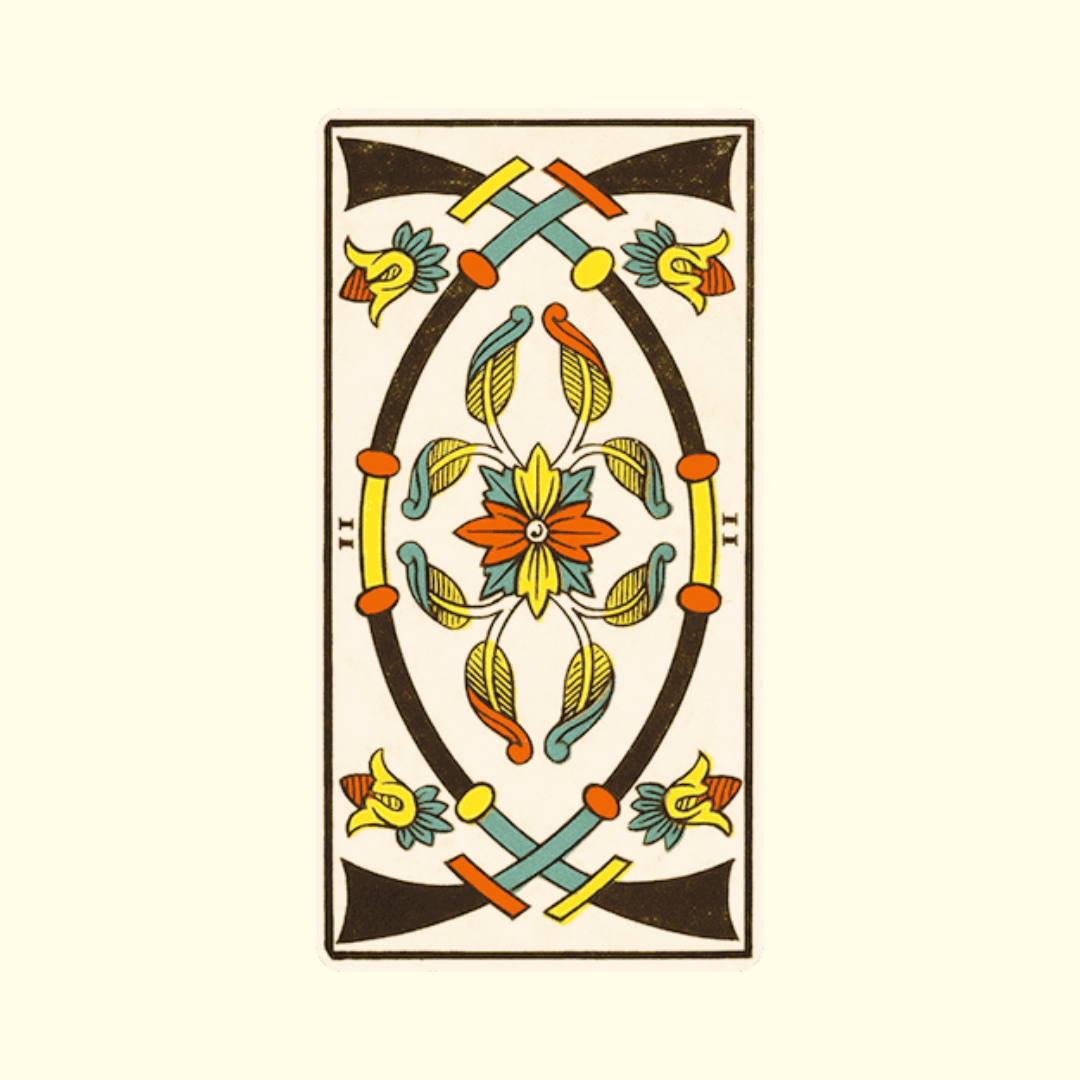

Two swords cross and hold back their blow. In the Tarot de Marseille, the curved blades draw an enclosure around a botanical motif. In the Waite-Smith, a blindfolded woman holds two swords on her shoulders, before the sea and a crescent moon. The Two of Swords does not merely describe indecision: it represents an armed peace, a balance maintained through effort, and the moment when a choice can no longer be separated from the information one is willing to look at.
The Two initially belongs to the vocabulary of concord, firmness, and courage in the old lists. The modern reading of blockage comes largely from Smith's blindfolded figure. The two approaches can meet: a truce protects the parties and gives them time, but it becomes immobility when no one seeks the conditions for a lasting agreement.
This card asks us to distinguish between the absence of a choice and refusing to choose too soon. A pause can be appropriate if it serves to gather a fact, calm an escalation, or ensure that each party can speak freely. It becomes costly if it keeps a conflict hidden, avoids responsibility, or treats two unequal options as though they were equivalent.
Crossed blades to a truce beneath the moon
In French tarot decks, the numbered Swords do not reproduce small, straight weapons arranged in a line. Two long, curved blades meet at the top and bottom to form an almond shape or enclosure, with a flower or shoot in the center. This geometry both closes off and protects. It may suggest a space held between two forces, without a figure to explain whether it represents an agreement, a suspended duel, or a defense.
Smith depicts a seated woman with her eyes covered by a blindfold and her arms crossed over her chest. She holds a sword in each hand. Behind her, the sea is dotted with rocks, and a crescent moon dominates the sky. Waite describes balance, conformity, courage, friendship, and concord "in a state of arms." The blindfold therefore does not prove total ignorance: it stages a balance achieved without yet looking at what might disrupt it.
Iconographic reference. The blindfold, seated woman, sea, rocks, and moon belong to the Waite-Smith. Marseille offers a construction of curved blades around a vegetal center. In both decks, symmetry matters; reading a person paralyzed before two options depends more on the English scene.
Divinatory transmission
In 1888, Mathers attributed friendship, valor, steadfastness, and courage to the Two of Swords. Reversed, he cites false friends, betrayal, and lies. He adds that neighboring cards may show friends who are of little help in the matter under examination. This source shifts the question: the querent is not necessarily alone before a dilemma; they may need to assess the strength of a support network or alliance.
Book T gives the card the title “Lord of Peace Restored” and the correspondence Moon in Libra. Two crossed swords bear a radiant rose. The text evokes strength born of suffering, arrangement, truce, sympathy, and a calmed quarrel that still leaves tension. It also mentions truth and countertruth, repeated wounds after forgiveness, and a lack of tact. Peace exists, but it still needs to be consolidated.
Waite retains balance, courage, friendship, and harmony under arms. He also mentions tenderness, affection, and intimacy, while warning that favorable meanings must be nuanced by the suit of Swords. Reversed, the card receives imposture, lies, duplicity, and disloyalty. The Two therefore does not merely say “I don't know”: it asks whether the visible symmetry rests on genuine agreement.
Meaning in a spread
In a favorable reading
The Two of Swords can signal a useful suspension. Two people stop escalating, a decision is postponed until a document is received, or a provisional limit prevents further harm. The card supports composure, restraint, and the ability not to respond under pressure. It favors an agreement that still acknowledges the disagreement.
Its favorable aspect does not require total certainty. It calls for a framework: a resumption date, information that is expected, a person responsible for verifying the facts, and planned consequences if the agreement fails. Restored peace then becomes a step in the work rather than an empty silence.
In a tension reading
Balance can become denial, superficial neutrality, or a refusal to hear an unsettling reality. The querent keeps two options open so as to give up neither, protects an agreement that has already been broken, or turns a blind eye to an imbalance of power. The card can also show an alliance based on omissions, double talk, or people around them who promise their help without taking action.
The blindfold should not lead to accusations without evidence. It invites you to seek the missing information and check whether it is truly inaccessible or merely being avoided. The useful question becomes: what does this truce protect, and from what point does its cost exceed its usefulness?
Love, work, and finances
The Two keeps two forces in a provisional balance. It does not automatically designate two romantic partners or two equivalent offers. The spread translates this suspension into verifiable criteria.
| Area | Favorable reading | Tension aspect | Question to ask |
|---|---|---|---|
| Love | Mutually agreed pause, calm dialogue, respect for reflection time, shared boundary. | Punitive silence, undefined relationship, double talk, or conflict maintained beneath the calm. | Have a date and a condition for resuming been named? |
| Work | Negotiation, mediation, choice deferred until the useful data is received. | Decision postponed to avoid responsibility, superficial alliance, information withheld. | Who has the information missing from the choice? |
| Finances | Prudent freezing of an expense, comparison of two options, waiting for a clear clause. | Costly immobility, false balance between two risks, self-interested advice. | What cost does the waiting itself create? |
| Friendship | Cautious reconciliation, loyalty put to the test, support without intrusion. | False friend, double-dealing, agreement that requires ignoring a repeated offense. | Does the support manifest itself in actions? |
| Decision | Ability to suspend action until a reliable criterion is available. | Paralysis, denial, or an attempt to preserve two incompatible choices. | What fact would make one option clearly preferable? |
Reading combinations
The Two establishes a truce or balance. The neighboring card shows what will make it possible to decide, what keeps the blindfold in place, or what threatens the still-fragile peace.
| Combination | Possible dynamic | Point of caution |
|---|---|---|
| Two of Swords + Ace of Swords | Information, a rule, or a decision can put an end to the waiting. | Check the facts before turning clarity into an ultimatum. |
| Two of Swords + Three of Swords | The truce gives way and reveals a separation, a painful statement or a breakup. | Do not confuse real pain with the need to dramatize. |
| Two of Swords + Justice | Mediation, provisional agreement, arbitration or choice subject to a rule. | A formal balance can conceal a concrete inequality. |
| Two of Swords + Lovers | Relationship choice or alliance that requires an explicit decision. | Attraction does not resolve unspoken incompatibilities. |
| Two of Swords + Moon | Unclear information, fear of looking, intuition mixed with projection. | Seek an external fact before accusing or concluding. |
| Two of Swords + Hanged Man | Prolonged suspension, impossible choice within the current framework, change of perspective. | Set the moment when waiting will no longer be fruitful. |
Correspondences by school
The old table associated the card with Air, the Moon, autumn, lapis lazuli, belladonna and Beth without distinguishing between schools. The Moon in Libra does belong to the Golden Dawn; the plant, stone, season and Beth do not form a common historical table with it.
| Reference | Attribution | Historical scope |
|---|---|---|
| Family | Minor Arcana, Two of Swords | Second pip card of the suit. |
| Tarot de Marseille | Two curved blades forming an enclosure around a plant motif | Suit card without a banner or a scene of choice. |
| Mathers, 1888 | Friendship, valor, steadfastness, courage | Reversed: false friends, betrayal, lies. |
| Golden Dawn | Lord of Peace Restored | Title of Book T. |
| Element | Air | Occultist attribution to the color of the Swords. |
| Astrology | Moon in Libra | First decan of Libra in the Golden Dawn system. |
| Waite-Smith | Blindfolded woman, crossed arms, two swords, sea, rocks and moon | Scene published in 1909. |
| Hebrew letter | No letter specific to the card | Beth belongs to the Magician in the Golden Dawn system. |
| Stone, plant, season | No common historical agreement | Contemporary lists must remain distinct from ancient sources. |
| Reading terms | Truce, balance, restraint, loyalty, missing information | The context distinguishes a useful pause from a refusal to decide. |
Reading guidance
Ask what the swords are preventing. Are they holding back an attack, protecting the heart, keeping two sides at a distance, or preventing hands from opening? Then look for the blindfold: what information is not being seen, who holds it, and by what means can it be verified? This method gives the card a practical function.
If the reading concerns a conflict, set the conditions of the truce and the date of the next meeting. If it concerns a decision, write down the criteria before examining the options. In love, do not infer a triangle or deception from the number two alone. The card calls for observing reciprocity, actions, and each person’s freedom.
Choosing a tarot deck to work with this card
To find this arcana in a complete deck, compare the Tarot de Marseille, the Rider-Waite-Smith, and our full range of divinatory tarot decks. If you are just starting, also see How to choose your first tarot deck?.
Sources and reference texts
For the history of the decks and suits: Victoria and Albert Museum, A History of Tarot Cards; British Museum, reproduction of Nicolas Conver’s Tarot de Marseille.
For divinatory and occult texts: S. L. MacGregor Mathers, The Tarot, 1888, card meanings; Liber LXXVIII, “The Lord of Peace Restored”, publication of the material from Book T; Arthur Edward Waite and Pamela Colman Smith, The Pictorial Key to the Tarot, Two of Swords, 1911.










