























































































































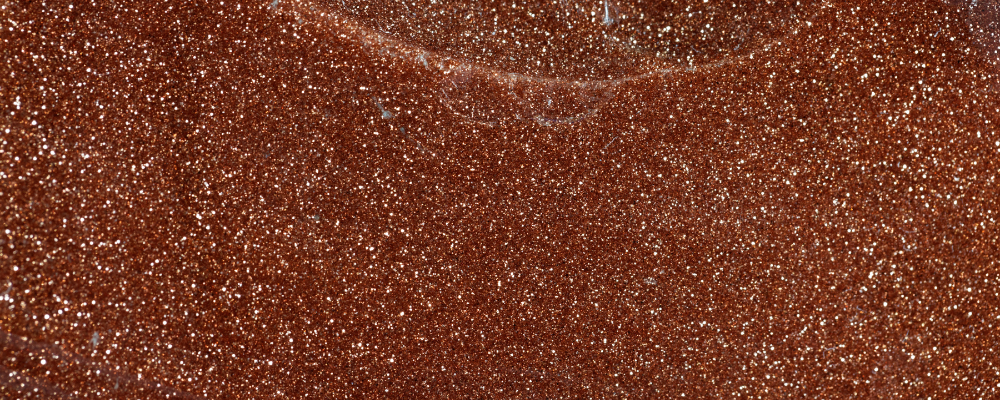
Goldstone resembles a copper-colored night filled with sparks. Its radiance does not come from geological chance, but from the art of the furnace: glass and metal are guided to the point where copper crystals appear within the mass. It celebrates worked material, controlled risk, and the light we create with our own hands.
This human origin does not impoverish its symbolism; it gives it its own path. The Sun governs radiance and visible success, Venus corresponds to copper and attraction, Fire to the furnace, and Earth to the craftsmanship that transforms an intention into an object.
To place this stone among related minerals, compare it with Obsidian, Snowflake Obsidian, and Obsidian Celestial Eye.
Glass Studded with Copper
Goldstone, or aventurine glass, is a glass material containing metallic crystals. In its classic reddish-brown form, copper produces the points of light that seem to float beneath the surface. It differs from natural Aventurine, a variety of quartz that sparkles thanks to its mineral inclusions.
The Metropolitan Museum of Art describes a Venetian bottle decorated with aventurine, whose copper crystals form during cooling. Goldstone therefore fully belongs to the history of decorative materials and glassmaking expertise.
The Work of the Furnace and Time
The formation of the sparkles requires precise control of the composition, heat, furnace atmosphere, and cooling. The particles are not simply spread across the surface: they take their place within the glass during the process.
The Corning Museum of Glass shows how copper crystallizes as the material cools. Each glint thus becomes the visible trace of a recipe, a temperature, and a period of waiting.
Venetian Venturina
The earliest known Venetian texts using the words venturina and stellaria date from the first quarter of the 17th century. The glass, difficult to produce and blow, was intended to be cut like a hard stone.
A study presented by the Corning Museum of Glass documents these materials. The name evokes the process’s adventure and good fortune, but the successful material is above all the result of transmitted knowledge.
Goldstone has a workshop lineage rather than a mineral lineage. Its magic does not come from a stone found intact in the earth, but from the alliance of material, hand, fire, and patience. It honors the intelligence that makes good fortune fruitful.
Sun, Venus, Fire, and Earth
The Sun corresponds to confidence, recognition, and the results on display. Venus relates to copper, charm, and exchange value. Fire transforms; Earth gives the work a stable form.
Sunday is suited to radiance, and Friday to commercial or artistic attraction. A piece of copper, a golden candle, and a work journal can accompany the Goldstone.
Ambition, commerce, and creation
Goldstone accompanies launches, creations, sales, and periods when a talent needs to become visible. It symbolically supports embodied ambition: not the wish to be noticed without effort, but the decision to produce, present, and improve.
It belongs near a workbench, an order book, or a portfolio. Its sparkle reminds us that success is made up of many tiny actions, repeated until they form a shared light.
The ritual of the spark record
In a journal, write down seven modest actions that have already advanced your work or activity. Place the Goldstone above the page, then circle the action that can be repeated today.
Say: “I recognize the action that creates light, I nurture the work and give it its place in the light of day.” Perform the action, then add a line to the record each evening for seven days.
Correspondences and references
| Reference | Correspondence |
|---|---|
| Nature | Human-made aventurine glass |
| Celestial bodies | Sun and Venus |
| Elements | Fire and Earth |
| Days | Sunday and Friday |
| Ritual colors | Copper, reddish brown, gold |
| Areas | Creation, ambition, commerce, visibility |
| Associated objects | Copper, journal, golden candle |
| Action | Recording and repeating a fruitful action |