















































































































































































































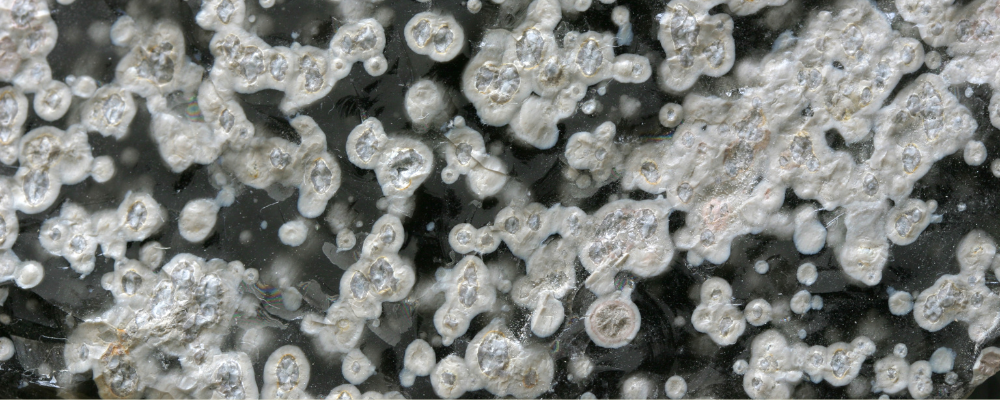
Snowflake Obsidian unites black volcanic glass with white rosettes born within its own material. Contemporary magic reads in it Obsidian’s protection, Saturn’s grounding, and an art of balance: recognizing, in a dark period, the points where a new form is already beginning to grow.
Its patterns do not promise to erase difficulties. They help identify recurring habits, sources of support that hold firm, and the core around which to rebuild.

To place this stone among related minerals, compare it with Obsidian, Obsidian Celestial Eye, and Silver Obsidian.
Rosettes in black glass
Obsidian forms when silica-rich lava cools so quickly that it becomes glass instead of forming a crystal lattice. In the Snowflake variety, white or gray spherulites develop within the dark matrix.
The Geological Survey of Utah describes these rosettes as Cristobalite needles arranged around a center. They show the devitrification of glass: the beginning of crystallization, visible as mineral flowers.
The ancient history of Obsidian
Long before the name “Snowflake” entered the lapidary trade, Obsidian was used to make blades, points, prestige objects, and mirrors. Its fracture produces remarkably sharp edges; when polished, it can form a reflective black surface.
Isidore Kozminsky brings these uses together in The Magic and Science of Jewels and Stones, published in 1922. He mentions the itztli of ancient Mexico, cutting tools, and objects crafted by Mediterranean cultures.
From protective black to a revealing pattern
Scott Cunningham assigns Obsidian to Saturn and Fire in his 1988 encyclopedia. He intended it for protection, grounding, divination, and peace.
The Snowflake variety adds a contemporary interpretation drawn from its pattern. The black represents protected space; the rosettes mark the points where order returns. It is therefore suited to restoring balance after a rupture, a confusing period, or an imposed change.
Form arises from within. The flakes did not fall into the glass: they grew from its material. In ritual, the stone reminds us that a new order can begin at the very heart of what seemed frozen.
Saturn, Fire, and Earth
Saturn governs structure, repetition, time, and boundaries. Fire recalls the volcanic origin. Earth, added through contemporary practice, suits the return to a stable and habitable form.
Saturday supports protection, the ends of cycles, and patient rebuilding. A white candle emphasizes the rosettes; a black candle consecrates closure and defense.
Protection, Balance, and New Beginnings
To protect a space, place the stone at the center of a circle of salt left in a small dish. Name what must remain stable, then remove the salt after the ritual without allowing it to come into direct contact with the stone.
To break out of a repetitive pattern, choose a single visible pattern on the stone and follow it with your eyes. Then write down the behavior that keeps recurring, its trigger, and the new response you want to establish.
For a new beginning, keep it near a calendar or notebook. Each rosette becomes a sign of support already present: a reliable person, a maintained habit, a safe place, or an available resource.
The white core in the night
On a Saturday evening, place the Snowflake Obsidian on a black cloth between a white candle and a small bowl of earth. Write down the situation that seems disordered, then circle the point that is still holding.
Say: “From this core, I give my path a new form.” Place the stone on the circled point and choose one repeatable action to carry out for seven days. On the final day, return the earth outdoors and keep the stone near the calendar.
Correspondences and References
| Reference | Correspondence |
|---|---|
| Nature | Partially devitrified Obsidian |
| Patterns | Light-colored spherulites rich in Cristobalite |
| Planet | Saturn for Obsidian according to Scott Cunningham |
| Elements | Fire due to its volcanic origin; Earth in contemporary practice |
| Day | Saturday |
| Areas | Protection, grounding, balance, repetition, and new beginnings |
| Ritual Image | The rosette growing in the black glass |
| Ritual Gesture | Choose a stable core and make it grow through repetition |










