Chrysoprase bears the green of a young leaf, luminous without being dazzling. Occult texts from the early 20th century describe it as a stone of happiness, friendship, eloquence, and enterprise. It does not act as a promise of easy gain: it opens relationships, nourishes the imagination, and invites us to recognize the opportunity worth seizing.
Its green connects Venus with Earth, while its former association with Cancer gives it a link to dreams, prudence, and travel. It is a stone for beginning without breaking with what sustains us.
To place this stone among related minerals, compare it with Agate, Blue Agate, and Dendritic Agate.
Nickel-bearing green Chalcedony
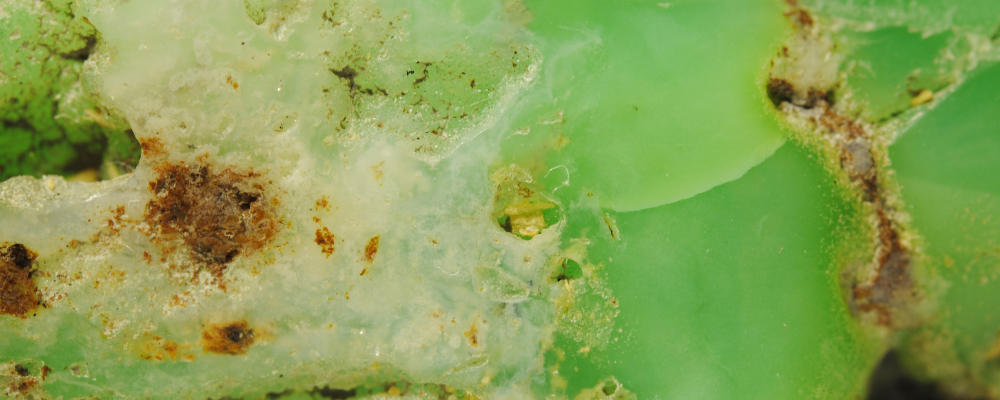
Chrysoprase is a Chalcedony, that is, microcrystalline Quartz. Its apple-green to deep green color comes from compounds containing Nickel, rather than Chromium as in several other green stones. It reaches approximately 6.5 to 7 on the Mohs scale.
A study by Gems & Gemology examines the origin of this coloration and distinguishes it from that of Prases. The slightly milky appearance of Chrysoprase gives its green a recognizable softness.
A sought-after green since antiquity
Its name combines Greek roots denoting gold and leek, an image of green tinged with yellow. Ancient sources speak of Chrysoprase, but the precise identification of stones named in antiquity remains difficult: classifications were not those of modern mineralogy.
Deposits in Silesia supplied the European lapidary arts, then Australia became a major source. The Gemmological Association of Great Britain places it among the Chalcedonies and recalls the range of colors in this family.
Happy dreams, eloquence, and enterprise
In 1922, Isidore Kozminsky presents Chrysoprase as a Cancer stone in The Magic and Science of Jewels and Stones. He attributes happy dreams, imagination, prudence, adaptability, travel, and successful ventures to it.
In 1988, Scott Cunningham places it under Venus and Earth, alongside Vesta. It gathers happiness, luck, friendship, protection, money, eloquence, and new ventures around it. Both authors make its green a force for social as well as material growth.
Luck calls for openness. In these texts, Chrysoprase does not fall from the sky as an arbitrary windfall. It makes you more receptive to a friend, an idea, and an opportunity, then calls for the prudence needed to help them grow.
Venus, Cancer, Earth, and Water
Venus governs accord, friendship, attraction, and prosperity. Earth supports enterprise and tangible growth. Cancer adds Water, dreams, protective memory, and the ability to sense the right moment. Vesta may accompany work devoted to the home or to an activity cultivated over time.
Friday favors friendship, love, and harmony; Monday suits dreams and household affairs. Soft green, copper, a fresh leaf, and a small household lamp create its ritual setting.
Friendship, luck, and new beginnings
To reconnect with someone, place the Chrysoprase near a letter. Write what you would like to share without demanding a response from the other person. Its domain is openness, not coercion.
For an enterprise, place it on the project's first document. Name the resource already available, the help to request, and the first measurable step. Venusian luck then becomes connection, flow, and a warm welcome.
For dreams, keep the stone near your journal. In the morning, hold on to the image that brings joy or a solution, then look for a way to honor it during the day.
The garden of happy enterprise
On a Friday, place the Chrysoprase at the center of a circle of three leaves. On the first, write the project; on the second, the ally or quality that can support it; and on the third, the act to be completed within seven days.
Light a green candle and say: “May what is right find its foundation, support, and time.” Put the leaves away with the project and carry out the announced act before asking for a new sign.
Correspondences and references
| Reference | Correspondence |
|---|---|
| Nature | Green chalcedony colored by nickel compounds |
| Hardness | Approximately 6.5 to 7 on the Mohs scale |
| Planet | Venus according to Scott Cunningham |
| Sign | Cancer according to Isidore Kozminsky |
| Elements | Earth and Water |
| Days | Friday and Monday |
| Areas | Friendship, happiness, luck, eloquence, dreams, and enterprise |
| Ritual gesture | Give the project a foundation, support, and a deadline |