














































































































































































































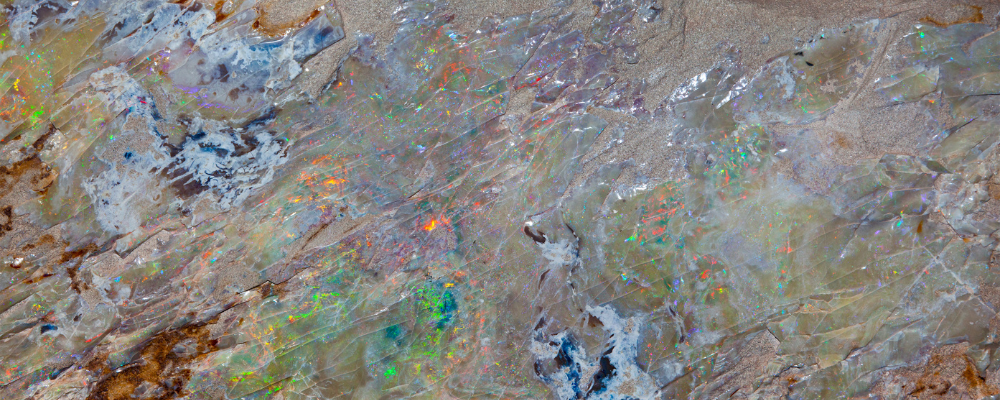
Opal seems to hold a changing sky beneath its surface. Its green, red, blue, or orange flashes appear with movement, then fade from another angle. This unstable light has linked it with vision, imagination, love, and luck, but also given it an unjust reputation for misfortune.
Its history does not contrast a fortunate stone in antiquity with a stone cursed forever. Rather, it shows how a fascinating optical phenomenon receives new interpretations according to the era. Opal is therefore suited to rites that seek to reveal, seduce, or transform without fixing the outcome.
To place this stone among related minerals, compare it with Ruby, Beryl, and Chrysoprase.
A light born from silica
Opal is hydrated silica without a regular crystal lattice. In precious Opal, tiny ordered silica spheres diffract light: their size and arrangement create the play of colors. Common Opal does not display this effect.
The GIA’s gemological overview also distinguishes light Opal, black Opal, fire Opal, and matrix Opal. These names describe a background color, an appearance, or a host rock; they do not constitute a magical hierarchy.
The queen of colors according to Pliny
In the 1st century, Pliny the Elder admired in Opal the fire of Ruby, the purple of Amethyst, the green of Emerald, and other colors brought together. His Natural History, Book 37, also recounts the senator Nonius, who preferred exile to surrendering an Opal coveted by Mark Antony.
This story gives the stone a value that exceeds its price: it represents an inner light that no powerful person can confiscate. The image suits workings focused on dignity, independence, and remaining true to one’s own choice.
Where does its reputation for misfortune come from?
The idea that the Opal brings bad luck is neither universal nor timeless. It developed mainly in Europe in the 19th century. Walter Scott’s novel Anne of Geierstein, published in 1829, depicts a stone whose radiance accompanies the death of a character. The book’s success fueled the popular imagination without creating the entire superstition on its own.
Commercial accounts later set the Opal against other gemstones. There is no reason to fear it. On the contrary, one can work with its reversed reputation: restore beauty, luck, and freedom to an image that has been unfairly burdened.
A color that does not obey. The Opal does not show the same light with every gaze. In ritual, it reminds us that a person cannot be reduced to a mood or to someone else’s opinion. Its changing radiance protects the right to become.
Sun, Venus, and planetary colors
In The Magic and Science of Jewels and Stones, published in 1922, Isidore Kozminsky links the Opal to the Sun, Venus, and Uranus, as well as to Leo, Libra, and Aquarius. He brings together beauty, love, hope, and fulfillment.
In 1988, Scott Cunningham attributed all the planets and elements to it, precisely because it brings together several colors. This modern interpretation makes the Opal a synthesis stone. For more focused work, however, choose a single direction: Friday for love and beauty, Sunday for confidence and success.
Vision, beauty, love, and luck
For vision work, slowly turn the Opal under a soft light and observe which color appears first. Give that color a word, then write what it invites you to look at in the present situation. This is a tool for reflection, not an infallible oracle.
For love, place it on a letter describing a bond founded on consent, joy, and reciprocity. For beauty, consecrate it in front of a mirror by naming what you wish to reveal rather than correct.
For luck, wear it at a moment of opportunity: a meeting, exhibition, interview, or launch. Its play of colors becomes a sign of the possibilities you are willing to see and seize.
The Mirror of Possible Colors
At dusk on a Friday, place the Opal in front of a mirror and light a white candle at a distance. Write down three possible paths for the same question. Watch the stone move in the reflection, then read each path aloud without looking for an omen in every flash.
Choose the action that best respects your desire, your boundaries, and those of others. Slip the paper under the mirror until the next day, then wear the Opal when you take the first step. The ritual transforms vision into decision.
Correspondences and References
| Reference | Correspondence |
|---|---|
| Nature | Hydrated silica, generally amorphous |
| Hardness | 5 to 6.5 on the Mohs scale |
| Planets | The Sun, Venus, and Uranus according to Isidore Kozminsky |
| Signs | Leo, Libra, and Aquarius according to Kozminsky |
| Elements | All the Elements according to Scott Cunningham |
| Days | Friday for Venus; Sunday for the Sun |
| Areas | Vision, Imagination, Beauty, Love, Luck, and Transformation |
| Ritual Act | Explore the Colors, Name the Possibilities, Then Choose |










