















































































































































































































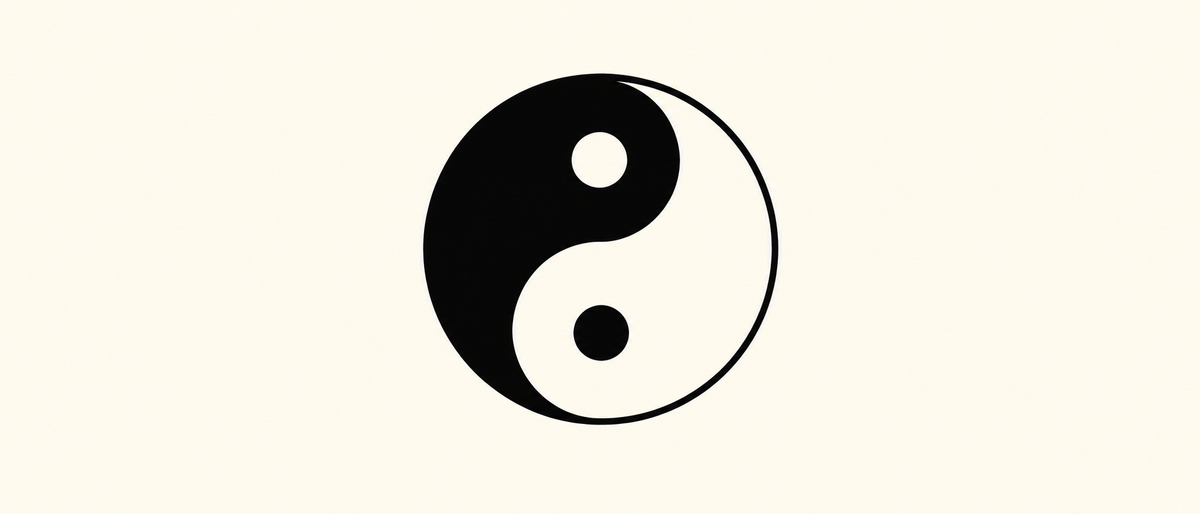
The Yin-Yang, represented today by a black-and-white circle whose each half contains a dot in the opposite color, is one of the best-known figures in Chinese thought. The drawing is called taijitu, “diagram of the Supreme Ultimate.” It expresses the dynamic relationship between yin and yang: two complementary aspects that define each other, transform, and contain each other. The symbol therefore does not represent the battle between good and evil. It depicts a world in which opposites function as polarities in motion.
| Name of the diagram | Taijitu |
|---|---|
| Concepts | Yin and yang, complementary polarities |
| Common form | Circle divided by a curve into two opposing fields, each containing an inverse dot |
| Central idea | Transformation, interdependence, and alternation |
| Major misconception | Yin is not “evil” and yang is not “good” |
What did yin and yang mean before the symbol?
Yin and yang are categories of relationship. Yin may be associated with shadow, cold, inwardness, or receptivity; yang with light, heat, outwardness, or activity. These correspondences are not isolated essences.
The same thing can be yin in relation to one thing and yang in a different relationship. The system is used to think about transformations, cycles, and balances rather than to definitively divide the world into two camps.
The concepts are ancient in Chinese thought and predate the black-and-white form that has become iconic today. The diagram visually condenses a philosophy that developed through many texts and schools.
How should the black-and-white taijitu be read?
The modern version shows a circle divided by an S-shaped curve. One half is dark and the other light. Each contains a small circle in the opposite color.
The curve avoids a rigid separation. The two fields seem to flow into each other, suggesting a continuous transition rather than a fixed boundary. The outer circle holds both within a single whole.
The Metropolitan Museum of Art holds a partitioned bowl from the Ming dynasty whose central medallion features a stylized form of taiji, or Yin-Yang. The museum describes it as a primordial force of the universe in Chinese philosophy.
Why does each half contain the other?
The light dot in the dark field and the dark dot in the light field show that each polarity carries the possibility of its opposite. No state is absolutely pure or permanently stable.
Day contains the movement toward night; winter contains the return of spring; a phase of expansion can prepare a movement of contraction. This logic of alternation explains the power of the taijitu as an image of transformation.
The symbol is similar to the ouroboros in its interest in the cycle, but their histories are unrelated. The circular serpent comes from Mediterranean and alchemical traditions; the taijitu belongs to Chinese thought.
Does the Yin-Yang oppose good and evil?
No. Equating yin with evil and yang with good translates the diagram into a moral logic foreign to its primary function. Yin and yang are necessary to each other.
Cold is not morally evil, any more than night is. Inwardness and receptivity are not flaws when set against activity. The system seeks to understand relationships and changes rather than assign reward and blame.
An imbalance can be problematic in certain medical or cosmological traditions, but this does not turn either of the two polarities into an evil principle. The goal is adjustment, not the total victory of yang over yin.
How does the symbol become global?
The taijitu has become an international emblem of complementarity, balance, and Chinese philosophy. It appears in martial arts, decoration, jewelry, and popular culture.
This spread encourages a simplified reading centered on “the balance of opposites.” The formula is useful if it preserves the idea of transformation and interdependence, less so if it freezes two halves as immobile identities.
The Sri Yantra and Om offer two other examples of Asian signs that have become global. Comparing them shows how international popularity can detach a form from its original philosophical or religious system.
Sources and historical context
The Metropolitan Museum of Art houses a cloisonné bowl from the Ming dynasty whose central medallion bears a taiji or Yin-Yang form, described in Chinese philosophy as a primal force of the universe. For the intellectual history of yin and yang, key works include Robin R. Wang, Yinyang: The Way of Heaven and Earth in Chinese Thought and Culture, Cambridge University Press.










