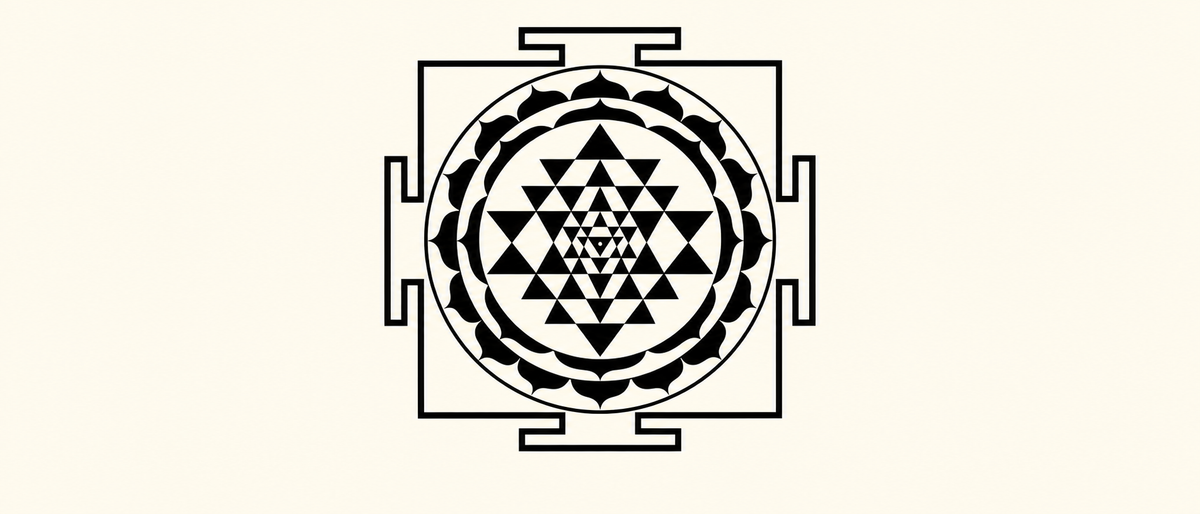
The Sri Yantra, also called Sri Chakra, is one of the most complex sacred diagrams in Tantric Hinduism. Its best-known form arranges nine interlaced triangles around a central point, the bindu, then surrounds them with lotus rings and a square enclosure opened by four gates. It belongs to the Sri Vidya tradition and is associated with the goddess Tripurasundari. Reduced today to an image of “sacred geometry,” it loses an essential part of its meaning: the Sri Yantra is at once a diagram, a ritual support, a cosmic representation, and a structure for meditation.
| Name | Sri Yantra / Sri Chakra / Śrīcakra |
|---|---|
| Central structure | Nine interlaced triangles around a bindu |
| Organization | Forty-three small triangles, lotus, circles, and a square enclosure in the complete form |
| Tradition | Sri Vidya, worship of the goddess Tripurasundari |
| Nature | Ritual and cosmological diagram, not merely a decorative motif |
What is a yantra in Indian traditions?
A yantra is a diagram used in religious and ritual contexts in South Asia. It may combine geometric shapes, letters, mantras, and images of deities. The British Museum aptly summarizes this logic by explaining that yantras combine the power of sacred words with that of drawings.
The term therefore does not refer to a single figure. There is a wide variety of yantras associated with distinct deities, rites, and traditions. The Sri Yantra is the most famous in the West, but it is one particular example within a much broader group.
This clarification avoids calling any composition of triangles or circles inspired by Indian art a “Sri Yantra.”
How is the Sri Chakra constructed?
The center of the diagram contains nine large triangles: four pointing upward and five downward. Their intersections produce forty-three small triangles arranged around the central point, the bindu.
Around this structure appear lotuses with eight and sixteen petals, circles, and a square enclosure pierced by four openings. The complete form is therefore much richer than the simple stacking of nine triangles reproduced in many pieces of jewelry.
The upward- and downward-pointing triangles are interpreted within Sri Vidya as divine polarities associated with Shiva and Shakti. Their meeting expresses a totality in which consciousness and power are not separate.
Comparison with the hexagram can be visually helpful, but the two diagrams belong to traditions with no direct historical continuity. A resemblance between opposing triangles does not establish a common origin.
What is the connection with Tripurasundari and Sri Vidya?
The Sri Chakra is central to the Sri Vidya tradition, a Hindu Tantric tradition devoted to the goddess in the form of Tripurasundari, “the Beauty of the three worlds.” The diagram does not represent merely an abstract space: it organizes the presence and powers of the goddess.
The different enclosures of the yantra are traversed as levels, from the outside toward the bindu. This movement can be ritual, meditative, and cosmological. The center corresponds to the supreme presence of the goddess.
The British Museum dates the development of Tantra in India to the first millennium CE and emphasizes the major role of feminine divine power in these traditions. The Sri Chakra belongs to this religious context and should not be detached from this history.
How is the diagram used?
The Sri Yantra can be drawn, painted, engraved on metal, or made in three dimensions. It is used in puja rituals, visualizations, and forms of meditation guided by religious transmission.
The diagram functions as an ordered map. The enclosures, petals, and triangles are not decorations added at random: they correspond to levels, deities, and powers in the texts and rituals of the tradition.
Om may appear in neighboring Indian ritual contexts, but it is a sound and a scriptural sign, not a yantra. The two can coexist without serving the same function.
Why isn't "sacred geometry" enough?
The contemporary vocabulary of "sacred geometry" highlights the mathematical complexity of the Sri Yantra. This approach can draw attention to the precision of the design, but it becomes reductive when it turns the diagram into a universal code independent of Hinduism.
The Sri Chakra belongs to a named tradition, with texts, deities, and rituals. Its meaning does not rest solely on the number of triangles or on proportions.
A respectful reading therefore begins with the form, then returns to Sri Vidya and Tripurasundari. Contemporary uses in decoration or free meditation represent a new reception of the diagram, not a complete definition of its historical role.
Sources and historical context
The British Museum presents an 18th-century Indian yantra and notes that these diagrams combine sacred forms and mantras in the worship of the goddess. For the historical context of Tantra and the rise of goddess worship, see its exhibition Tantra: enlightenment to revolution. For the Sri Chakra itself, André Padoux's work in Maṇḍalas and Yantras in the Hindu Traditions, edited by Gudrun Bühnemann, is a major academic reference.