















































































































































































































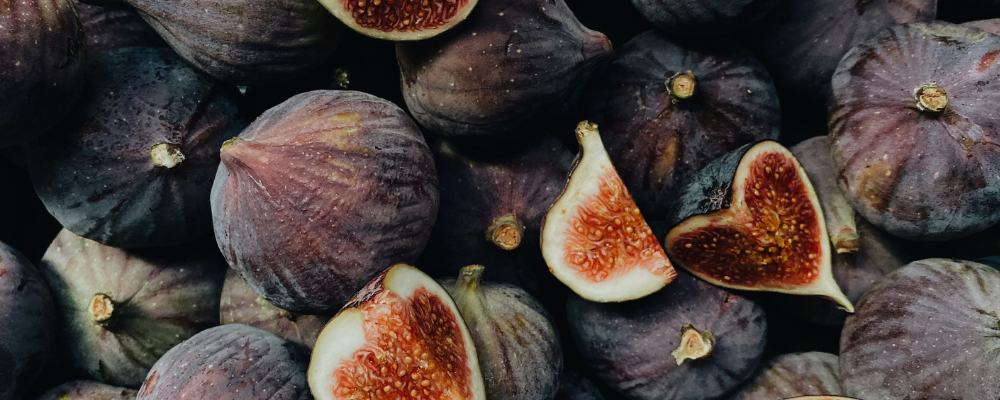
The Fig appears in the Bible as the fruit of an abundant land, then as an object of discernment in Jeremiah’s vision. Two baskets are placed before the Temple: one contains excellent figs, the other fruits that have become inedible. The sweet fruit therefore guarantees neither favor nor fruitfulness through its mere presence. It teaches us to look at the real condition of a harvest, separate its portions, and recognize what can still nourish an alliance.
The Fig is the fleshy false fruit of Ficus carica L., a tree in the Moraceae family. Its skin encloses a hollow receptacle lined with numerous small flowers, whose true fruits form the grains perceived under the teeth.
This inner architecture and the selected texts evoke a magic of maturity, hospitality, and judgment. The Fig is not conflated here with the entire tree, which is covered in another entry. The proposed work examines a symbolic harvest on paper and uses neither ritual fruit, latex, nor smoke.
A garden of flowers turned inward
The Fig develops from a fleshy receptacle called a syconium. Its cavity bears small flowers oriented inward. After fertilization or parthenocarpic development, depending on the variety, the whole structure becomes the fruit that is eaten.
Kew accepts Ficus carica and places its native range from the eastern Mediterranean to Central Asia and the western Himalayas. Kew, Ficus carica.
The visible flesh thus conceals a multitude of tiny flowers and fruits. The Fig offers an image of inner community: what appears to be a single unit gathers elements that have ripened together.
This form supports the work of harvesting, assembling, and sharing. Every grain matters, but none can replace the receptacle that holds them and makes their coming together possible.
The Fig among the fruits of the earth
In Deuteronomy, the Promised Land is described through its waters, terrain, and produce. Wheat, barley, grapevines, fig trees, pomegranates, olives, and honey form an image of food received in abundance.
The Fig thus belongs to the seven species associated with the land of Israel. The passage connects the harvest with gratitude and warns against forgetting when satiation arrives. Deuteronomy 8, Land and the Seven Species.
Prosperity is not an automatic effect of fruit. It is reflected in a habitable land, available food, and the memory of what made the journey possible.
Ripe fruit carries memory. Receiving a harvest requires naming the place, the labor, and the relationships that made it possible.
Jeremiah’s Two Baskets
Jeremiah 24 presents two baskets of Figs before the Temple after a deportation to Babylon. The first contains very good fruit, like the earliest ripe figs. The second contains fruit so bad that it cannot be eaten.
The vision becomes a judgment on groups and their future. The difference is neither cosmetic nor vague: the fruits are examined according to their condition. Jeremiah 24, the Two Baskets of Figs.
The Fig carries a magic of sorting here. A harvest may appear whole while bringing together incompatible parts. Separating them protects what can be planted, passed on, or shared.
The basket becomes a unit of responsibility. Whoever sorts it must name their criterion, take responsibility for what they discard, and plan the destination of each portion.
The Giving of the Fig Tree to Phytalus
Pausanias reports that in Attica, Phytalus welcomed Demeter into his home. In return, the goddess gave him the fig tree. A funerary inscription commemorated the sacred fruit and the lasting honor received by his lineage.
The account associates the Fig with rewarded hospitality and the transmission of a cultivated fruit. Pausanias, Description of Greece, 1.37.2.
The gift does not resemble a reward detached from the initial gesture. A house opens, a relationship is created, and then the tree and its fruit extend that encounter over time.
The fig is therefore suited to a magic of welcome that truly prepares a place: food, a seat, listening, time, and a boundary. The fruit reminds us that hospitality has consequences after the guest’s departure.
Sorting two harvest baskets
Draw two baskets. In the first, write down what can nourish the continuation of a project: reliable results, respected relationships, available resources, and upheld decisions.
In the second, place what can no longer be served: an expired gift, a broken promise, a damaged object, or a task without an owner. Add the precise reason for each classification.
Then draw an open fig between the baskets. In its small seeds, write down the people who contributed to the harvest. Next to each name, write the planned form of recognition.
Set a date to share the first basket and a procedure for handling the second. Close the page with a sentence of gratitude that mentions the place and the work completed.
Historical correspondences
| Reference | Correspondence |
|---|---|
| Species | Ficus carica L. |
| Family | Moraceae |
| Botanical nature | Fleshy syconium containing numerous small flowers and fruits |
| Sources | Deuteronomy 8, Jeremiah 24, and Pausanias 1.37.2 |
| Magical domains | Harvest, discernment, gratitude, and hospitality |
| Safe form | Two drawn baskets and an open fig |










