

Aeternum
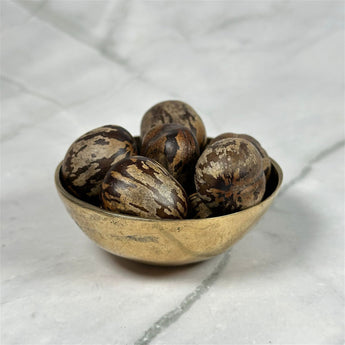
Obaluaiê Bean
4,90 €
/
In stock
Ships within 24 hours
Protection
Banishment
This bean is traditionally associated with Obaluaiê (orisha of death in Candomblé in Brazil, also called Babalu Aye in the Yoruba pantheon). It is a seed of Ricinus communis, a plant long considered a tool of black magic (and now used to obtain castor oil).
The Obaluaiê bean is therefore closely linked to these themes, representing both the ability to cause and heal ailments, and symbolizing the duality of destruction and regeneration.
You can use it to decorate an altar, or use it in a mojo as a powerful artifact of protection and banishment. In black magic, it should be used with caution and responsibility.
This bean is sold individually.
⸺ Note: for ritual use only, not for food or cosmetic use.
This purchase will earn you
+40 Aeters

Get notified when it is back in stock


Obaluaiê Bean
4,90 €
/
Couldn't load pickup availability
Information & features
- Weight: approximately 8g
Storage & preservation
Make sure to store it in a place protected from external energies.
A question?
We have created a Help Center for the most frequently asked questions. You can also contact us by email, or by phone & WhatsApp: 09 79 10 29 48 (Monday to Friday from 11 a.m. to 5 p.m.).
Secure payment
Fast delivery


Photo not generated by AI
This product was photographed by us without AI generation. You will receive the product you see.
Please note: stones and natural products may vary in appearance from one specimen to another.
Product information
Your satisfaction
Your order, prepared with care
Each item is packaged according to its fragility to ensure it arrives in the best possible condition.
Enhanced protection
Each product ordered is individually wrapped.
Responsible positioning
Recyclable packaging, tissue paper, and, when necessary, reused air cushions keep each product secure during transport.
Customer service available
Our team is available by email, chat, and phone from Monday to Saturday.
Ready to accompany you
Purified items.
Upon arrival at Aeternum, our products are cleansed of the energies accumulated during their journey.
Purification upon receipt
Each new delivery is purified according to our traditional method.
Suitable storage
The items remain in a clean, controlled environment before being shipped.
Before departure
We perform one final purification by fumigation while preparing your order.
A presence close to you
A French family business.
Our team and inventory are based in France, allowing us to serve you directly.
Team based in France
A family business that is easy to reach and close to its customers.
Products actually in stock
Every available item is physically present on our premises.
Fast dispatch
Your order generally arrives within 1 to 3 business days.
The Aeternum Circle
Make every purchase a reward.
Earn Aeters with every order, then redeem them for discounts on your next purchases.
This product
+40 Aeters
−€5
1,000 Aeters
−€20
4,000 Aeters
−€30
6,000 Aeters
−€50
10,000 Aeters
— Learn more.
Obaluaiê Bean: Symbol of Transition and Divine Power
The Obaluaiê bean, derived from Ricinus communis, represents the very essence of transformation. Associated with Obaluaiê, the orisha of death and healing in Candomblé, it carries the marks of illness, renewal, and life cycles. Obaluaiê, also called Babalu Aye in the Yoruba tradition, embodies the forces of decay as well as resurrection. The bean embodies this powerful duality, blending energies of destruction and rebirth in every ritual or spiritual use.
Sacred Tool of Purification and Regeneration
Placed on an altar, the Obaluaiê bean is used to honor the deity and channel its purifying energies. It acts as a link between the visible world and the spiritual forces charged with healing and protection. Incorporated into mojos, it forms a formidable talisman against harmful influences. This seed is used in regeneration rituals to support healing processes, stabilize emotional states, and promote inner renewal. It also supports banishing work, where it acts as a catalyst for spiritual cleansing.
Ritual Handling and Magical Ethics
Ricinus communis has real toxicity, and this characteristic has long fueled its use in occult practices related to black magic. The Obaluaiê bean must be handled with care, as it concentrates forces capable of acting on subtle and physical planes. Its use requires a strict ethical framework. It is not a trivial object but a vector of intention that demands awareness and respect. Any operation involving this bean must be guided by clear and just objectives, respecting the traditions that consecrated it.
| Names | Castor bean plant, castor bean; ewé lárá for the leaf in Afro-Brazilian traditions |
|---|---|
| Deity | Omolu / Obaluaiê |
| Traditions | Brazilian Candomblé and Afro-Brazilian ritual traditions |
| Documented ritual part | Primarily the leaf, notably used as a support for food during Olubajé |
| Areas | Illness and healing, health, longevity, and rites dedicated to Omolu / Obaluaiê |
| Scientific name | Ricinus communis L. |
|---|---|
| Other names | Obaluaiê bean, castor bean seed |
| Appearance | Hard, smooth, shiny seed, oval and slightly flattened, with a small light-colored protrusion at one end |
| Odor | Very faint to nonexistent when the seed is whole and dry |
| Color | Gray, brown, beige, or reddish, with marbling and darker spots that vary from seed to seed |
| Parts used | Whole and intact seed only, placed as a ritual object. It must never be opened, pierced, ground, burned, or incorporated into a preparation |
| Origins | Northeastern tropical Africa, mainly Ethiopia, Eritrea, and Somalia; the species is now widespread in many tropical and temperate regions |
| Toxicity level | Very high. The seed contains ricin, a powerful poison released when its shell is chewed, crushed, or broken. Never ingest or handle a damaged seed. Keep in a closed package, out of reach of children and animals. In case of ingestion or accidental damage, contact a poison control center immediately |
Here, we don’t judge.
No matter where you come from, what you believe in, or what you’re looking for: you belong here. You can be a beginner, curious, a casual practitioner, or a daily witch. What matters is sincere intention.
We believe in all forms of magic.
High magic and its rigorous rituals deserve as much respect as spells passed down in the countryside. We read grimoires, respect rites, listen to old stories. Everything practiced with faith deserves serious and curious attention.
We welcome all traditions.
We don’t put one path above another. We talk hoodoo, kabbalah, Christian prayers, elemental magic, folk rituals, Celtic symbols. What matters is respect. Not the label.
We work cleanly.
Each package is carefully prepared by us, here in France. Before shipping, it is purified so it arrives at your home cleansed and positively charged. We strive to use recyclable packaging and reduce our impact as much as possible.
We stay available.
Customer service is us. Not an AI, not a robot, not a call center. If you have a question, a doubt, a problem, you reach us—the same people who select the products, write the descriptions, and prepare the packages.
We stay human-sized.
We are a small passionate team with big ambitions, hands in the herbs, books, and boxes. And we want to keep it that way.

— You speak about it best.
A question?
We have the answers.
How are the products prepared?
All products listed as in stock are prepared within 24 hours from order confirmation (excluding weekends and holidays).
Our packages are prepared by our own team with care to ensure the protection of your products.
What are the delivery methods?
We currently offer delivery via Mondial Relay or Colissimo. Find more information here.
What is the delivery time?
The delivery time starts from the shipment of your package, and we indicate the average times observed by our carriers at the time of order. You can check our delivery methods and rates directly here.
To which countries do you ship?
We ship orders to France, Belgium, Monaco, Luxembourg, Réunion, Guadeloupe, Martinique, Mayotte, Saint Barthélemy, and Saint Martin.
Other destinations are regularly added.
I have other questions.
You can visit our Help Center here or contact us there.
— The Carnets d'Aeternum , practices and history of Magic.
A condensed collection of knowledge to feed your magical curiosity.