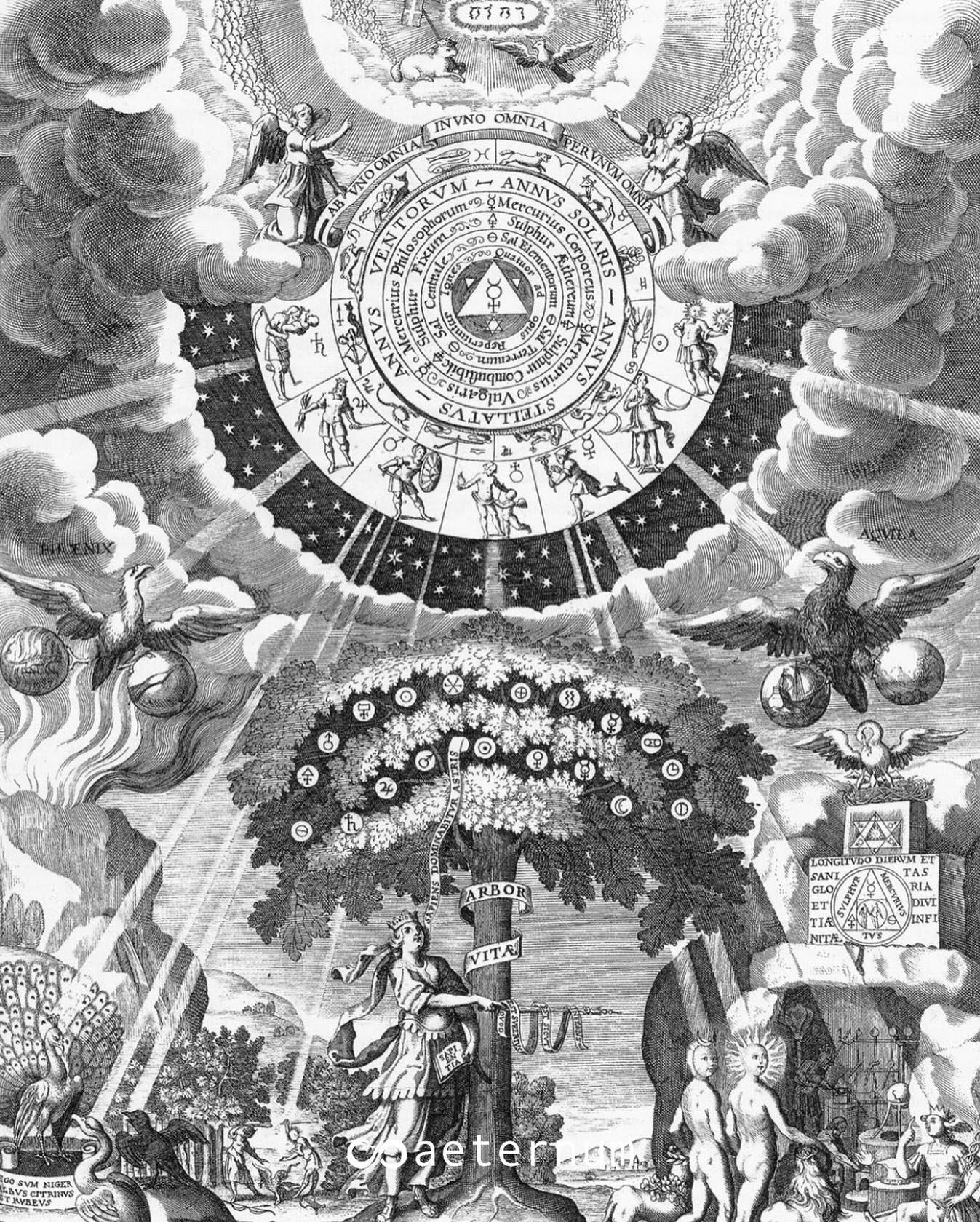




What if the God of the Bible were not the true God? What if the world we live in were nothing more than a prison created by mistake—or out of pride—by a lesser entity pretending to be the Almighty? Behind these radical ideas lies Gnosticism, a spiritual movement that emerged in Antiquity, was marginalized, opposed, and then almost forgotten. Yet its texts have resurfaced with undiminished power. They speak of a lost soul, forbidden knowledge, and inner liberation—so many themes that are strikingly relevant today... even though this movement emerged in the 2nd century. Here’s what you need to know.
The Historical Origins of Gnosticism
A Syncretic Context in the Greco-Eastern World of Antiquity
The exact origins of Gnosticism are debated, as this movement does not appear to derive from a single source, but rather to result from a fairly complex cultural and religious syncretism. What we do know is that it took root in the rich spiritual soil of Late Antiquity, where Eastern influences and Greek philosophies converged. According to some historians of religion, gnosis emerged from a blend of Eastern religions and Greek philosophy during the Hellenistic period, that is, after the conquests of Alexander the Great in the 4th century BCE. This hypothesis echoes the view expressed as early as the 3rd century by the Christian theologian Hippolytus of Rome: according to him, Gnostic doctrines did not originate in the sacred Scriptures, but borrowed their ideas from pagan Greek thought, Eastern mysteries, and astrological speculation. In this sense, Gnosticism can be seen as the heir to Platonic philosophical currents (the dualism of spirit and matter), imbued with Eastern mythologies (Persian or Babylonian ideas of a struggle between Light and Darkness) and Egyptian or Mesopotamian religious motifs.
At the same time, other scholars emphasize the role of Hellenistic Judaism and early Christianity in the emergence of Gnosticism. Indeed, it was in the troubled context of the late first century—after the destruction of the Temple of Jerusalem in 70 AD—that a profound crisis shook Judeo-Christian communities. Numerous dissident groups then emerged, blending Jewish traditions with new speculations: heterodox sects (meaning minority and dissident groups) began to appear, later described as “Gnostic,” such as those associated with figures like Simon Magus, Menander of Samaria, Cerinthus, Saturninus of Antioch, as well as the groups known as the Sethians and Barbeloites, and the disciples of Carpocrates or Basilides. These radical Judeo-Christian movements sought to reinterpret Genesis and biblical theology in the light of an esoteric revelation: they saw the fall of Adam and Eve not as original sin, but as a symbol of the divine soul fallen into matter, and the serpent of Eden as a salvific messenger rather than a tempter. Historians thus believe that Gnosticism, as a structured dualist movement, may have emerged between& 70 and 140 AD. within these marginal Judeo-Christian communities in crisis.
This dual origin—Greco-Eastern on the one hand, and Judeo-Christian on the other—explains the diversity of Gnostic myths and the difficulty of tracing a linear genesis of the movement. Rather than being a uniform “great nebula” of anticosmic and dualist ideas, ancient Gnosticism appears as a set of beliefs rooted in the society of Late Antiquity, sharing common tendencies (rejection of the material world, quest for salvation through knowledge,...) but each displaying distinctive features. In any event, it was in the great intellectual centers of the Greco-Roman world—notably the Roman province of Egypt (Alexandria) and Asia Minor (Syria, Anatolia)—that Gnosticism took shape and flourished from the beginning of the 2nd century.
On the fringes of Judaism and emerging Christianity
From the perspective of the established religions of the time, Gnosticism emerged as a dissident movement, developing a vision of the divine in A break with classical monotheism. Orthodox Jewish and Christian thinkers saw Gnostic teachings as a heretical threat. Thus, as early as the 2nd century, rabbis mentioned and condemned the doctrine of the “two Powers in Heaven,” that is, the idea that two competing supreme divine principles existed—a notion completely foreign to biblical Judaism. This reaction by Jewish sages probably targeted currents related to Gnosticism, which they conflated with the earliest Christian sects. Indeed, in the eyes of the scholars of the Law, asserting the existence of a God of Good opposed to the Creator God constituted a grave heresy—whether it was preached by Gnostics or by certain dualist Christians.
In the context of early Christianity, interactions with Gnosis were both direct and complex. Many Gnostics considered themselves Christians: they venerated the figure of Jesus Christ, but attributed to him a role different from the one assigned to him by the nascent Church. For the Gnostics, Jesus was less a redeemer through his sacrifice than the Revealer who came to transmit to the few elect the salvific knowledge hidden since the foundation of the world. Several Gnostic movements—such as the school of Valentinus and that of Basilides—developed within Christian communities themselves during the 2nd century, particularly in Alexandria and Rome, before being expelled from them. The historian of religion David Brakke reminds us that, according to ecclesiastical tradition, Gnosticism seriously threatened the unity of the early Church, which was shaped to a large extent in reaction against these doctrines deemed deviant. The struggle against Gnosis thus helped shape the nascent Catholic “Great Church,” forcing it to clarify its dogma—the affirmation of a single God who was both creator and good, in opposition to Gnostic dualism—and to define the canon of authorized Scriptures, excluding Gnostic gospels and revelations.
The Main Texts and Sources of Gnosis
For centuries, our knowledge of Gnosticism came primarily from works written against it by its Christian opponents. The Church Fathers—in particular Saint Irenaeus of Lyons in the 2nd century, followed by Hippolytus of Rome, Tertullian of Carthage, Origen of Alexandria, and Epiphanius of Salamis—left behind lengthy treatises refuting the “errors” of the Gnostics point by point. Through their Adversus haereses (“Against Heresies”), they passed down an overview—partial and often polemical by nature—of Gnostic myths and doctrines. These secondhand accounts long constituted the main source of information about ancient Gnosis. However, they were written from an apologetic perspective, sometimes caricaturing opposing positions; moreover, they quoted only excerpts from the original Gnostic gospels or treatises, without always reproducing them in full.
It was not until the 19th, and especially the 20th, century that original Gnostic texts were unearthed, transforming our understanding of this movement. A first turning point came in 1896, when Egyptian peasants uncovered a collection of manuscripts near Akhmim that were sold to antiquities dealers. The lot notably included a copy of the Gospel of Mary (a text attributed to Mary Magdalene), a Secret Book of John (also called the Apocryphon of John), and a Wisdom of Jesus Christ—three Gnostic treatises in the Coptic language that testified to a tradition that had until then been almost unknown. A few decades later, in December 1945, an even more decisive discovery was made: near the village of Nag Hammadi in Upper Egypt, peasants found a sealed jar containing thirteen papyrus codices. These manuscripts, dating from the 4th century (but copying works probably composed between the 1st and 3rd centuries), contained 52 treatises belonging to various Gnostic schools. Among them were writings that had previously been lost or were known only through the criticisms made of them by the Church Fathers: the Gospel according to Thomas, a collection of sayings attributed to Jesus distinct from the New Testament; the Gospel of Truth (probably of Valentinian origin); the Apocalypse of Adam; the previously mentioned Book of the Secrets of John; as well as properly Gnostic texts such as the Dialogue of the Savior, the Hypostasis of the Archons, and others. This Nag Hammadi library also contains works of a more classically Christian inspiration (such as apocryphal epistles) and even writings related to Hermeticism. It provides a true snapshot of Gnostic thought in Egypt around the 4th century. Specialists nevertheless emphasize that Gnostic texts often circulated in fluid collections, compiled and revised over time: the “photograph” provided by Nag Hammadi corresponds to the state of these traditions at a given date, rather than to a fixed form throughout their history.
In addition to the Nag Hammadi codices, other isolated manuscripts have enriched the available Gnostic corpus. The Gospel of Judas—probably a Sethian text in which the apostle Judas Iscariot is rehabilitated as the most enlightened disciple—was rediscovered in the 1970s (the Tchacos Codex) and published in 2006. Likewise, an important Coptic manuscript, the Codex Askewianus, acquired by the British Museum as early as 1785, contained a lengthy Gnostic treatise entitled Pistis Sophia. This work, probably written in the 3rd century, presents an esoteric dialogue between the risen Jesus and his disciples, during which he reveals the mysteries of the universe and salvation, notably the myth of the downfall and subsequent restoration of Sophia (Wisdom). Pistis Sophia was translated and published at the end of the 19th century, providing rare direct testimony to the doctrine of a Gnostic school influenced by Christianity and probably Valentinian.
Thus, the documentation available to us today on Gnosticism is twofold: on the one hand, the polemical writings of the Christian theologians who opposed it (an indispensable source for learning about certain sects whose own texts have not survived), and on the other, a now-rich body of authentic Gnostic texts recovered in Coptic translation (and, for some fragments, in Greek). The latter include, by way of illustration: the Gospel of Thomas, the Gospel of Philip, the Gospel of Mary, the Apocryphon of John, the Tripartite Tractate, the Holy Book of the Great Invisible Spirit (also called the Gospel of the Egyptians in the Nag Hammadi library), the Hypostasis of the Archons, and the Apocalypses of James, not to mention more philosophical writings such as the Hymn of the Pearl attributed to the Acts of Thomas, or Thunder, Perfect Mind (an allegorical monologue of divine Wisdom).
Fundamental Concepts and Central Doctrines
A Radical Dualism Between God and the World
At the heart of all ancient Gnostic doctrines lies a radical metaphysical dualism. Gnostics postulate the existence of two absolutely heterogeneous levels of reality: on the one hand, the supreme, immaterial, and perfect divine world, and on the other, the inferior material world, tainted by evil. They teach that at the origin of the universe there are two distinct divine entities: the True God, on the one hand, the principle of Good, completely transcendent, invisible, and unknowable, and on the other, an evil demiurge, creator of the material universe. According to the Gnostic myth, a primordial drama introduced this divide into the divine: it involves a fault or fall that occurred before the creation of the world, through which a portion of the divine strayed outside the heavenly Pleroma. This original fault—symbolized by the misfortune of Sophia (Wisdom)—gives rise to an inferior, imperfect emanation: the Demiurge. Cut off from the supreme God, whose very existence he does not even know, this arrogant Demiurge sets out to create his own universe ex nihilo, arranging it as he pleases while believing himself to be the only God. The material world in which we live is thus explained by the Gnostics as the work of an imperfect demiurge, a degraded reflection and caricature of the true spiritual world.

Representation of the Demiurge Ialdabaoth. Source
Gnostic cosmology describes the structure of these two levels of reality in detail. The higher divine realm is called the Pleroma (from the Greek plērōma, “fullness”). It is the complete totality of divine Being, comprising the supreme God and all of his emanations, called aeons. The aeons are divine entities that proceed from the unknowable God in masculine/feminine pairs (syzygies), each embodying an aspect of perfection (Truth, Wisdom, Life, Intelligence, ...). In many systems, it is the youngest of these emanations, Sophia (Wisdom), who is responsible for the disorder: whether through vanity (the proud desire to give birth alone, without her male counterpart) or through misdirected passion (love for the illusory reflection of the supreme God), Sophia violates the harmony of the Pleroma. From her rash act is born a formless and monstrous being, Ialdabaoth, the first archon of the lower world—that is, the leader of the fallen powers. Sophia, filled with remorse, hides this being outside the Pleroma, behind a veil that becomes the boundary between the spiritual and material worlds—this veil forming, in a sense, the heaven below the Pleroma. Ialdabaoth, exiled into the darkness beyond the Fullness, then takes himself for God; surrounded by a cohort of Archons whom he has begotten (presiding over the seven planets or the twelve signs of the zodiac, depending on astrotheological traditions), he fashions the material universe and humanity. Knowing nothing of the higher celestial sphere, Ialdabaoth proudly declares: “There is no other god but me”—a boastful statement that the Gnostics identify with the famous proclamation of the biblical God in the Book of Isaiah. For the followers of gnosis, this mythical scene reveals the true identity of the God of the Old Testament: not the supreme Principle, but a usurping demiurge, blinded by his ignorance and hatred of the Light.
Gnostics therefore describe the human condition as the result of this cosmic drama. Human beings are conceived in the image of Adam fashioned by the Demiurge and his Archons: imperfect material creatures, subject to astral fate and the sufferings of the corruptible world. However—and this is a crucial point—the human soul contains a spark of divinity: a fragment of the Light of the Pleroma, come from Above. According to the myth, this divine spark entered Adam almost despite the Demiurge: in certain Sethian accounts, the true God urges Ialdabaoth to breathe a spirit of life into humanity, allowing a luminous soul to enter Adam. Horrified by this intrusion of Good into their creation, the Archons try to imprison Adam’s spirit in the matter of Eden, and go so far as to forbid him access to the tree of knowledge. But the celestial powers, moved by compassion, then send a messenger to awaken the first human: in the form of a Serpent, the Savior from Above urges Adam and Eve to taste the forbidden fruit that contains gnosis and life. This bold reinterpretation of the account of Genesis—where the original transgression is transformed into an act of liberation—perfectly illustrates the Gnostic reversal of perspective: what the world calls Good (obedience to the Creator) is actually evil, and what it calls Evil (emancipatory disobedience) is a divine blessing.
Salvation through Knowledge and Spiritual Election
In the Gnostic vision, the fundamental problem is not moral (it is not primarily a matter of sin), but ontological: it is ignorance (agnôsia) that keeps the soul enslaved in the lower world. Through ignorance of its true origin, the divine spark in humanity mistakenly identifies itself with its corruptible bodily оболage. The soul’s salvation therefore consists in becoming aware of its noble provenance and remembering that it does not belong to this world. This inner illumination comes from gnosis: revealed knowledge of the divine mysteries. It is not intellectual knowledge accessible to everyone, but an esoteric revelation transmitted by a divine messenger (such as Christ) and understood only by those who are “awakened.” This salvific knowledge notably involves understanding the true structure of the cosmos (the division between the Pleroma of Light and the world of Darkness) and the drama unfolding within it, knowing the soul’s celestial origin and the path for returning to the supreme God. It is acquired through initiatory teaching and personal experience, described as a succession of inner illuminations.
One consequence of this doctrine is the idea of humanity divided into unequal spiritual categories. Since only an elite receives gnosis, Gnostics hold that not all human beings are equally capable of attaining salvation. In some systems, particularly among the Valentinians, people are thus divided into “pneumatics” (spiritual), bearers of the divine spark and predestined for redemption through gnosis; “psychics” (soulish), sincere believers possessing only an intermediate faith, capable at most of a lesser form of salvation through moral faith; and finally “hylics” (material), a mass of beings wholly oriented toward matter, lacking an awakenable soul and destined for final perdition. Only the spiritual elite—the pneumatics—is destined to unite with God after death through knowledge. This elitist conception, which contrasts the enlightened “elect” with the ignorant masses, recurs throughout Gnosticism. Nevertheless, Gnostic texts emphasize the grace of the transcendent God, who sends Saviors to rescue the exiled divine element. Gnosis is not regarded as knowledge accessible through ordinary human effort, but as a revelation bestowed by Christ or other divine emissaries through symbols, visions, or veiled words.
In ethical and ritual matters, Gnostic doctrines led to divergent attitudes among the various schools, but always in connection with contempt for the material world. Most sects advocated a form of rigorous asceticism (encratism): since the body and matter are the work of the Demiurge, one should detach oneself from them as much as possible. Many Gnostics therefore promoted sexual abstinence (so as not to engender new beings imprisoned in the flesh), vegetarianism or fasting, and a frugal life devoted to contemplation of the divine within. However, a few minority groups adopted the opposite stance, known as “antinomian” or libertine: believing that the world’s moral laws were worthless in the eyes of the true God, they allowed themselves to transgress prohibitions—including sexual or dietary ones—to demonstrate their contempt for matter. Ancient authors thus accused certain sects, such as the Carpocratians, of deliberately immoral practices, although these accounts may have been exaggerated by polemics.
Major Gnostic currents and schools
Despite the general unity of perspective just described, ancient Gnosticism did not constitute a unified Church, but took the form of numerous distinct movements and “schools.” Christian heresiologists and modern historians have assigned conventional names to these various groups, based either on the name of their founder or on a theological figure peculiar to them. Caution is necessary, since some of these sects are known to us only through hostile accounts, and their actual historical existence is sometimes uncertain. Nevertheless, we can present the principal Gnostic movements identified in antiquity.
Valentinianism
This is undoubtedly the most influential and best-known Gnostic school, founded by Valentinus around the middle of the 2nd century. Born in Egypt and educated in Alexandria, Valentinus taught in Rome from approximately 135 to 160 AD; he may even have become a serious candidate for the Roman episcopate before his esoteric doctrines led to his exclusion from the Church. Valentinianism proposes an elaborate mythology: the Pleroma comprises 30 aeons organized in syzygies, and the fall of the aeon Sophia causes a rupture that leads to the formation, outside the Pleroma, of a demiurge named Ialdabaoth. For the Valentinians, matter is the product of Sophia’s error, and Christ came to save creation by bringing gnosis. Valentinus and his disciples (such as Ptolemy, Heracleon, and Theodotus) developed a sophisticated theological system in dialogue with Christian theology: they did not reject the Scriptures or the figure of Jesus, but interpreted them in a radically allegorical manner, finding in them a hidden meaning accessible only to initiates. The Gospel of Truth, found at Nag Hammadi, is probably an example of a Valentinian sermon, as is the Gospel of Philip. The Valentinian sect appears to have split into “Eastern” and “Western” currents after Valentinus’s death. Despite the violent attacks by the Church Fathers (Tertullian wrote an entire treatise, Against the Valentinians), Valentinus’s influence was such that his school endured at least until the 4th century.
Sethianism
This is the name given by modern scholars to a Gnostic movement that was probably among the oldest, centered on the biblical figure of Seth (the third son of Adam and Eve). The “Sethians” considered themselves the spiritual descendants of Seth, whom they regarded as the father of a lineage of chosen souls unrelated to the creator God. Sethianism is described as “hypothetical” by some historians because it is known chiefly through anonymous Nag Hammadi texts rather than identified authors. Nevertheless, treatises such as the Secret Book of John (Apocryphon of John), the Hypostasis of the Archons, and the Gospel of the Egyptians (NH III) present a highly elaborate Gnostic myth that seems typical of this movement: Sophia plays a central role, Ialdabaoth is explicitly named as the demiurge, and Seth appears as the ancestor of the chosen “spiritual races.” Some Sethian texts offer a complete Gnostic exegesis (new analysis and interpretation) of Genesis, in which the figures of the Old Testament (Adam, Eve, and the serpent) are reinterpreted esoterically. According to heresiological tradition (Christian studies of what constitutes heresy), the sect of the Sethians was founded by disciples of Simon Magus after the fall of Jerusalem in 70, but this remains conjectural. In any case, Sethianism appears to represent a highly anticosmic Gnosticism of Judeo-Christian origin, whose writings emphasize the revelation of an unknown God and the denunciation of the biblical Demiurge.
Basilidianism
Founded by Basilides of Alexandria, active between AD 125 and 155, this movement flourished in Egypt during the 2nd century. Basilides is said to have written an esoteric gospel and a twenty-four-book treatise (Exegética) expounding his doctrine. His cosmology included the idea of 365 stacked heavens (hence the password symbol “ Abraxas”, whose numerical value is 365), and a Great Archon ruling the sublunary world under the authority of a distant supreme God. Basilides taught that this Great Archon believed himself to be the one and only God until he discovered the existence of the unknown God above him—a classic Gnostic theme. In Christological terms, Basilides is said to have professed a form of Docetism (with Christ having only a human appearance), even going so far as to say that Simon of Cyrene was crucified in Jesus’ place. His son Isidore succeeded him as head of the Basilidian school. Although less well documented than Valentinianism, Basilides’ sect made a sufficient impression to be refuted in detail by Irenaeus and Hippolytus.
Marcionism
Marcion of Sinope (c. 85 – c. 160) is sometimes associated with Gnosticism because of his dualistic doctrine, although he represents a case apart. Marcion was a Christian preacher from Asia Minor who came to Rome around AD 140; he taught that the loving God proclaimed by Jesus was distinct from the creator God of the Old Testament, the latter being, in his view, an inferior, cruel, and legalistic god. Rejecting the Jewish heritage wholesale, Marcion established the first expurgated Christian canon: it retained only the Gospel of Luke (edited) and ten Pauline epistles, excluding the entire Old Testament. Condemned by the Church of Rome, he founded his own rival Marcionite Church, which enjoyed considerable success throughout the Empire during the 2nd–3rd centuries. Although Marcion did not convey a mythology as elaborate as that of the “classical” Gnostics, his sharp opposition between the unknown good God and the vengeful creator Demiurge clearly belongs to the same current of ideas. Christian authors, moreover, often associated him with the Gnostics and fought him in the same way.
The Ophites and Naassenes
These two names (“Ophites,” from the Greek ophis, serpent; “Naassenes,” from the Hebrew na’hash, serpent) designate Gnostic groups that symbolically honored the serpent of Genesis as an agent of revelation. Irenaeus and Origen mention “Ophites” who possessed esoteric diagrams representing the celestial worlds and practiced idolatrous rites involving domesticated snakes—although it is difficult to distinguish myth from reality in these accounts. In any case, the symbol of the salvific serpent is widespread in Gnostic literature, as seen in the Hypostasis of the Archons in particular, suggesting the existence of movements in which this theme was central. The Naassenes, for their part, are known through a lengthy account by Hippolytus: they venerated all kinds of deities—Greek, Egyptian, and Babylonian—in a complex syncretism, saw the serpent as a principle of wisdom, and celebrated mysteries associated with the designation of Eve as “Pronoia” (Providence). This was most likely a highly esoteric form of Gnosticism, combining multiple pagan mythologies around the theme of knowledge.
Carpocrates’ “libertine” movement
Carpocrates of Alexandria (mid-2nd century) and his son Epiphanius represent a distinctive tendency within Gnosticism, accused of advocating immorality. According to Irenaeus, the Carpocratians taught that, in order to free itself completely from the cosmic powers, the soul had to experience everything—including acts considered sinful—so that it would no longer have to be reborn. They practiced the sharing of women and other extreme forms of communal living, which shocked their contemporaries. It is difficult to determine how much of these accusations reflects reality and how much is anti-heretical slander. In any case, the existence of a Gnostic movement that advocated transgression as a means of salvation illustrates the diversity of ethical conclusions to which Gnosticism’s radical anti-materialism could lead.
Manichaeism
Founded in the 3rd century in Mesopotamia by the prophet Mani (216–276), Manichaeism is considered a late heir to Gnosticism—although it was a distinct religion, organized independently. Mani claimed to be an apostle of Jesus Christ, but also a successor to Buddha and Zoroaster: his syncretic doctrine combines elements of Christianity, Buddhism, Zoroastrianism, and other Eastern traditions. Manichaeism embraces the absolute dualism between Light and Darkness: it conceives of two coeternal Principles locked in struggle since the beginning of time—the God of Light and the Principle of Evil. In the beginning, Mani explained, the two realms (Light and Darkness) were separate, but an invasion of Darkness into the realm of Light caused the creation of the material world, where particles of Light are trapped in matter. Manichaean salvation consists in gradually liberating these elements of Light through an extremely ascetic life (strict vegetarianism, celibacy, prayer, ...), ideally led by the Manichaean “Elect.” Mani structured his Church with a hierarchy of teachers and disciples and wrote his own sacred texts. Manichaeism spread with remarkable speed from the Middle East to China and the West; it prospered for several centuries despite the fierce persecution it faced in both the Roman Empire and Persia. The Manichaean worldview is described as “Gnostic” because of its dualism and the importance it places on revealed knowledge (Mani called himself the “Apostle of Light”). However, Manichaeism differs from classical Gnosticism in positing the existence of two opposing Principles from all eternity (whereas the Gnostics derive evil from a degradation of the initial divine substance). Nevertheless, in late antiquity and the early Middle Ages, Christians regarded the Manichaeans as the foremost continuers of gnosis: the term “Manichaean” itself eventually became synonymous with extreme dualism.
Many other Gnostic sects could be mentioned—the Cainites (who venerated cursed biblical figures such as Cain or Judas, seeing them as bearers of a hidden truth), the Peratae, the Barbeloites, and others—but their historicity remains uncertain or their impact was marginal. The main currents described above are sufficient to convey an idea of the internal diversity of ancient Gnosticism, a diversity expressed as much in its myths and theologies as in the practices and organization of its groups.
Relations with early Christianity, Judaism, and the Roman Empire
In the face of Christianity: doctrinal rivalry and mutual influences
Gnosticism developed in parallel with early Christianity and drew on the Christian scriptural and doctrinal heritage while radically reinterpreting it. Many Gnostics considered themselves the true Christians, holders of a secret teaching of Jesus discreetly transmitted to the most spiritual of his disciples.

Separation between the worlds
In the early days, the boundary between Christianity and Gnosticism was sometimes blurred. We know that Valentinus, before founding his separate school, taught within the Christian community of Rome itself. Likewise, Marcion was an important member of the Church of Rome before his excommunication. There was therefore a period when the developing “Catholic” Church and Gnostic groups coexisted, engaged in dialogue, and influenced one another. The Gnostics borrowed many of their concepts from the Christian Scriptures (the Logos, the Father, the Savior, etc.), while adapting them to their dualistic vision. In return, the presence of the Gnostics compelled the Church to clarify its theological positions. For example, the Gnostics’ insistence on Jesus as pure spirit (neither born nor truly suffering) pushed the Great Church to formulate more clearly the doctrine of the Incarnation and the reality of the cross. Likewise, in response to the Gnostic idea of a supreme God distinct from the Creator, the Fathers emphasized the identity between the God of the Old Testament and the Father of Jesus Christ, insisting on the unity and goodness of the one Creator God.
The rivalry crystallized particularly in the 2nd century, when the Church structured its biblical “canon” and its creeds. Several statements in the Apostles’ Creed or the Nicene Creed—“one God, the Father almighty, creator of heaven and earth… Jesus Christ, born… crucified under Pontius Pilate… risen according to the Scriptures…”—can be read as implicit responses to Gnostic doctrines (affirming that the Father is indeed the Creator, that Christ truly came in the flesh at a specific time, that he truly died rather than merely appearing to, etc.). By defining orthodoxy, the Church implicitly drew the boundary not to be crossed, embodied precisely by gnosis.
On the other hand, it would be simplistic to view the relationship between Christianity and Gnosticism solely in terms of opposition. The two movements shared the same spiritual fervor and the same eschatological and apocalyptic horizon (the redemption of humanity and the revelation of divine truth). Researchers note that certain writings of the New Testament (the Gospel according to John, the Pauline epistles, and the Apocalypse of John) contain emphases or images that the Gnostics favored—such as the figure of the Logos descending into the world, the light shining in the darkness, and the opposition between spirit and flesh... Thus, the Gnostics used these writings to support their theses, and it is sometimes difficult to know whether they influenced the texts' composition or simply interpreted existing Christian texts in their own way. Most exegetes today believe that the Gospel of John, for example, was not borrowed from a preexisting gnosis, but that it may later have been read in Gnostic circles. Nevertheless, early Christianity and gnosis existed within a shared conceptual climate, and their clear separation took place only over the course of the 2nd century, in a process of “drawing boundaries.” Christian thinkers such as Clement of Alexandria (late 2nd century) even attempted to reclaim the notion of “gnosis” in a positive sense, speaking of an orthodox Christian gnosis (mystical knowledge of Christ reserved for perfect Christians), as opposed to the false gnosis of the heretics. The word Gnosticism itself is a later construction, since all the protagonists of the period saw themselves as possessors of the true gnosis.
In Judaism: an iconoclastic rupture
Relations between Gnosticism and Judaism in the second century were characterized largely by hostility and incomprehension. The core of Gnostic theology—the devaluation of the God who created the material world—constituted a direct attack on the traditional Jewish faith in one omnipotent and good God, creator of heaven and earth. The Gnostics dared to describe Yahweh (the biblical God) as imperfect, ignorant, or even malevolent, denying him the status of supreme deity. They reinterpreted the Torah's accounts in a sacrilegious manner from a Jewish perspective: the creation of the world by God in Genesis became the tragic work of a limited Demiurge; Adam and Eve appeared not as guilty parties but as victims freed by the serpent; the patriarchs could be portrayed negatively, while reviled figures such as Cain or Esau were sometimes elevated as heroes possessing hidden knowledge (as among the so-called “Cainite” Gnostics). Such a reversal of biblical values could only scandalize pious Jews.
In fact, the rare allusions found in rabbinic literature to doctrines suggesting Gnosticism are formulated within the context of the polemic against the minim (heretics, identified with the early Christians). As we have noted, rabbis at the end of the second century referred to the heresy of the “two powers in heaven” and seem to have attributed it to Christians. They probably had in mind both Trinitarian Christians (whose faith they caricatured by claiming that they worshiped God and Jesus as two distinct gods) and Gnostic movements that posited a good God opposed to an evil one. In any case, post-70 rabbinic Judaism took shape by firmly rejecting any dualistic or polytheistic interpretation of the divine. Jewish texts from the period—for example, certain passages of the Sefer Ha-Razim or the hekhalot, an emerging Jewish mystical literature—attest to a non-Gnostic Jewish esotericism, in which knowledge of divine secrets seeks to glorify the one God rather than free itself from him. It can therefore be said that the gulf between Gnosticism and rabbinic Judaism was clear: Gnosticism arose in a Jewish context, but by rejecting the essence of biblical monotheism, it quickly became isolated and severed from its Jewish roots. Only marginal Jewish-Christian movements (such as the Ebionites or heterodox Elcesaites) seem to have served as temporary bridges before disappearing in turn.
Facing the Roman Empire: Discretion, Distrust, and Persecution
As for the Roman political authorities, Gnosticism was not identified as a movement distinct from other dissident religious groups before the 3rd century. In the 2nd century, adherents of gnosis blended into the broader mass of Christian or syncretic communities, so when imperial persecutions occurred (under Marcus Aurelius around 177, or Septimius Severus around 202), they targeted Christians without distinguishing between internal theological nuances. No case is known in which a Gnostic was specifically persecuted as a Gnostic by the pagan authorities. This was also because Gnostics, inclined toward discretion and initiatory secrecy, formed relatively closed and inconspicuous circles. Their modest numbers and often ascetic behavior did not make them particularly noticeable or threatening from the perspective of the pagan Roman state.
It was with the arrival of Manichaeism—in the middle of the 3rd century—that the Roman authorities began to perceive the potential danger of an organized dualist movement. In 297 AD, Emperor Diocletian issued an edict specifically directed against the Manichaeans, denouncing them as a “new and pernicious sect from Persia” (and therefore suspected of collusion with the Sassanid enemy) and ordering the execution of its leaders and the burning of its books. This anti-Manichaean persecution was fierce in certain regions (in North Africa, the proconsul of Africa was instructed to crack down with the utmost severity), but it did not last very long: from the Edict of Toleration in 311 and then the Edict of Milan in 313 onward, the Roman authorities’ priority became easing internal religious conflicts in order to focus on the Christian unification of the Empire. Nevertheless, hostility toward Manichaean doctrine persisted: in the 4th century, under Christian emperors, laws reiterated the prohibition of Manichaeism, describing it as an “abominable” superstition of barbarian origin and punishing its propagators with death.
As for the non-Manichaean Gnostic sects, they probably died out on their own or merged into other groups during the 4th century, as the official Church grew in power. After the Council of Nicaea (325), the Christianized Empire promulgated edicts against various heresies; any surviving Gnostics, if there were any, fell under these categories without always being specifically named.
The fiercest oppression of the Gnostic legacy nevertheless emerged during the Middle Ages, when the Catholic Church confronted new dualist movements that it associated—rightly or wrongly—with the ancient Manichaeans. The Bogomils (in 10th-century Bulgaria), and especially the Cathars or Albigensians (in 12th- and 13th-century southern France), did indeed profess a form of good-versus-evil dualism close to Manichaeism: the material world was seen as the work of the Evil One, and salvation consisted in freeing the soul from the flesh through a pure life. Alarmed, the medieval Church declared these doctrines heretical and fought them militarily and juridically. The Albigensian Crusade (1209–1229) in Languedoc, followed by the actions of the Inquisition in the 13th century, led to the eradication of the Cathar communities. Their writings were destroyed (only a few direct Cathar sources have survived, apart from a handful of rituals and treatises such as The Letter of the Consolament and The Book of the Two Principles). In the minds of the inquisitors, these medieval sects were merely a reappearance of the old Gnostic or Manichaean evil; the word “Manichaean” was, moreover, the term they most often used to designate Cathars and other dualist heretics. Thus, although ancient Gnosticism had long since disappeared as such, its specter continued to haunt the religious imagination: it became the archetype of the insidious heresy to be eradicated.
In conclusion to this section, we can say that Gnosticism found itself in conflict with all the established authorities of its time: a theological conflict with the emerging Christian Church, an ideological conflict with rabbinic Judaism, and finally a political conflict with the Roman state (especially through Manichaeism). Rejected and persecuted, it survived for a time underground before dying out, its last embers rekindling in other forms in later periods.
Modern Resurgences and Contemporary Interpretations
After the disappearance of the ancient Gnostic sects, the notion of gnosis of course endured, but mainly as a doctrinal or mystical concept in scholarly writings. It was not until the late 19th century that a genuine resurgence of movements claiming Gnosticism could be seen. This revival took place within the broader context of renewed interest in esotericism and occultism in Europe at that time.
In 1890, in France, the occultist Jules Doinel founded the’Gnostic Church of France, an act he presented as the beginning of “Year I of the restoration of Gnosis.” Doinel, who took the title of Patriarch Valentin II in homage to Valentinus, claimed to have received a mission in a vision from the Aeon Jesus himself to restore the true Gnostic Church. He organized neo-Gnostic ceremonies blending Christian esotericism, Cathar references (he proclaimed himself Bishop of Montségur), and doctrines inspired by Valentinianism. The movement attracted a few Parisian intellectuals seeking alternative spirituality. Although Doinel abandoned his Church two years later to return to Catholicism, the Gnostic Church he initiated endured: revived by successors such as Léonce Fabre des Essarts (Tau Synésius) and later Joanny Bricaud, it acquired an episcopal hierarchy and continued into the 20th century, merging with various occultist branches. Notable figures in French-speaking occultism, such as Papus (Gérard Encausse) and the writer Joséphin Péladan, took an interest in it for a time. This modern Gnostic Church presented itself as an esoteric ecumenical movement, honoring the esoteric Christ while incorporating elements of Theosophy and Martinism. It had limited but real influence on the occult milieu of the early 20th century.
At the same time, in 1908, the esoteric Order of the Ordo Templi Orientis (O.T.O.), founded by Theodor Reuss, incorporated a rite called Ecclesia Gnostica Catholica. Under the direction of Aleister Crowley, this Gnostic Church of the O.T.O. celebrated a “Gnostic Mass” featuring alchemical and libertine symbols. Strictly speaking, this was not a doctrine of ancient Gnosticism, but rather the use of the term Gnostic to describe a form of universal esoteric spirituality freed from dogma.
In the 1920s and 1930s, various occult circles in Europe and America referred to Gnosticism. Swiss psychiatrist Carl Gustav Jung himself took a keen interest in the newly available Gnostic texts (he owned a manuscript of the Gospel of Simon discovered at Akhmîm). Jung saw Gnostic mythology as a precursor to the archetypes of the unconscious. In 1916, he even wrote Seven Sermons to the Dead, a text with an explicitly Gnostic tone (fictitiously attributed to Basilides). During the first half of the 20th century, authors such as Hermann Hesse and the scholar G.R.S. Mead (who was closely associated with the Theosophical Society) popularized an image of Gnosticism as a mystical path of self-knowledge outside the established Churches.
In broader contemporary culture, the term Gnostic has been used—sometimes abusively, particularly by notorious cult movements—to describe works or ideas emphasizing humanity’s alienation in the material world and the need for a salvific awakening. Modern philosophers or writers have been labeled “Gnostic” for developing dualistic or esoteric worldviews (people have spoken of “Gnosticism” in William Blake, among certain Romantics, or in existentialist philosophy). However, these usages are based more on thematic analogy than on direct historical lineage.
At the institutional religious level, there are still small churches today that identify with Gnosticism, especially in the wake of Doinel or subsequent occultist movements. For example, the Apostolic Gnostic Church continues a neo-Gnostic Christian worship in France and Canada; in the United States, there is the Ecclesia Gnostica of Bishop Stephan Hoeller, which emphasizes the study of the Nag Hammadi gospels and inner experience; the New Age movement has also appropriated certain Gnostic themes (the idea of a divine spark within oneself, an inner teacher, ...), but without direct reference to ancient sources.
Finally, the notion of gnosis has even been incorporated into official religious discourse, critically: Pope Francis has repeatedly denounced the temptations of “neo-Gnosticism” among some Christians today, referring to a tendency to seek spiritual elitism detached from material reality and concrete charity. In doing so, the head of the Catholic Church shows that the term Gnosticism remains alive in the vocabulary, primarily as the antithesis of the values he upholds.
Sources:
-
The Gnostics by Jacques Lacarrière (an accessible literary and historical reference)
-
Gnosis and Time by Michel Tardieu (a recognized specialist in Gnosticism and Manichaeism)
-
Gnostic Writings: The Nag Hammadi Library (a collection edited by Jean-Pierre Mahé and Paul-Hubert Poirier, published by Gallimard in the La Pléiade series)
-
Gnosis: The Nature and History of Gnosticism by Kurt Rudolph (a standard English reference work, widely used in academic circles)
-
A History of Gnosticism by Giovanni Filoramo (an English translation of a recognized Italian work)
-
The Gnostic Gospels by Elaine Pagels (a Princeton professor; a popular work, but very well documented)
-
The Gnostics and the World by Simone Pétrement (a structured analysis of Gnostic doctrines)
-
Nag Hammadi Scriptures, edited by Marvin Meyer (a modern English version of the recovered texts)
-
The Tripartite Tractate and other texts from the Nag Hammadi library (annotated studies)
-
Against Heresies by Irenaeus of Lyon (a direct second-century heresiological source, highly important despite its bias)