


















































































































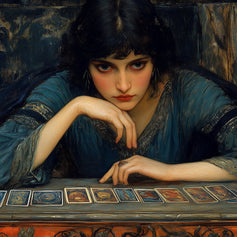




Voodoo originated in West Africa and was brought to the New World through the slave trade. Over the centuries, it took root in various regions of the Americas, particularly in Haiti (called Vo-Dù) and Louisiana, where the famous Marie Laveau lived. Often reduced to the use of dolls and the manipulation of human bones, it is in fact a form of magic that is both rich and complex. Follow me as we discover these fascinating and mysterious practices that resonate in the hearts of millions of practitioners.
The History of Voodoo Magic
A Birth in West Africa
Voodoo, as we know it today, originated among the peoples of West Africa, mainly in Benin, Ghana, and Nigeria. The origin of the name Voodoo (Vodou or Voodoo) is obscure and is thought to derive from the term designating the body of beliefs and the pantheon. These practices are integrated into daily life and include ancestor worship, divination, and belief in several deities or spirits. The rituals of these African religions are intended to harmonize the forces of nature with human activities, thereby ensuring the community’s protection, fertility, and success.
And a settlement in the Americas
With the transatlantic slave trade, millions of Africans were deported to the Americas, taking their religious beliefs and practices with them. In the crucible of the diaspora, confronted with the horrors of slavery and oppression, these traditions were transformed. In Haiti in particular, Voodoo emerged as a coherent spiritual system, blending elements from various African traditions with aspects of Christianity brought by European colonists. This syncretism was not only religious but also an act of resistance, allowing enslaved people to preserve their connection to their heritage while adapting to a brutal and oppressive environment.


Dutty Boukman was an enslaved man who played a decisive role in triggering the Haitian Revolution. He is famous for leading a Voodoo ceremony at Bois Caïman in 1791, which served as a catalyst for the slave revolt and is said to have enabled the emergence of Voodoo.
The Different Branches of Voodoo
Voodoo is actually plural; it varies considerably from one region to another, resulting in several distinct branches.
-
Haitian Vodou: the best-known form of Vodou developed in Haiti and plays a central role in the country’s culture and national identity. Haitian Vodou is characterized by the worship of the Loas, spirits who serve as intermediaries between humans and the divine. These spirits are honored through complex ceremonies involving songs, dances, and offerings.
-
Louisiana Vodou: in the United States, particularly in Louisiana, Vodou was introduced by enslaved people and Haitian refugees arriving after the Haitian Revolution of 1804. Louisiana Vodou incorporates elements of Catholicism and European folk magic, with an iconic figure in popular culture, Marie Laveau, often referred to as the Queen of Vodou in New Orleans.
-
Cuban and Brazilian Vodou: although technically distinct from Vodou and often classified under other names, such as Santería in Cuba and Candomblé in Brazil, these belief systems share many similarities with Vodou in terms of religious syncretism and rituals. They demonstrate how African traditions evolved differently depending on local contexts and colonial influences.
The Vodou Organization
Vodou is well structured, but its hierarchy differs slightly from other traditions, as each priest takes care of their own house. Here are the main roles:
Houngan and Mambo
They are respectively the male and female priests of Vodou. They hold the highest positions in the Vodou hierarchy. They are responsible for conducting ceremonies, initiating new members, healing, and divination. Houngans and Mambos are often regarded as spiritual leaders and guides within their communities.
La-Place
La-Place is the master of Vodou ceremonies, alongside the Houngan or Mambo. He or she helps prepare ceremonies, maintain order during rituals, and care for altars and sacred objects.
Bokor
Unlike Houngans and Mambos, who primarily practice white magic and beneficial rituals, Bokors are priests often associated with black magic. They are sometimes called upon for rituals involving spells or more radical actions, or invoking dark forces. They are particularly renowned for creating zombies (a punishment ritual based on psychotropic substances).
Hounsis
These are initiates who have dedicated their lives to serving the Loas and learning Vodou traditions under the guidance of a Houngan or Mambo. Hounsis often play active roles in ceremonies and are training to become priests or priestesses themselves by undergoing rites of passage.
The fundamental beliefs of Vodou
The Loas (or Lwas)
At the heart of Vodou is the worship of the Loas, intermediary spirits between Bondye, the distant and unapproachable creator, and humans. Each Loa has its own personality, symbols, specific rituals, and sphere of influence, ranging from war and love to justice and healing. These spirits are often regarded as extended members of the community and are honored during ceremonies called Sévis. The most representative figures include Legba (the guardian of crossroads who opens communication with the other Loas), Erzulie (the Loa of love and beauty), and the famous Baron Samedi (one of the Loas of death and rebirth).
For more information about the Loas, you can consult our dedicated grimoire. In addition, the spirits of the dead have a somewhat special place and are known as the Gédés. They are celebrated during the Cult of the Dead on November 2 (although it generally begins on November 1 under the influence of All Saints’ Day).
The concepts of the soul and the spirit
In Vodou cosmology, the soul is understood as being divided into two main parts: the Gros Bon Ange and the Ti Bon Ange.
The Gros Bon Ange is the part of the soul responsible for bodily vitality and biological functions, while the Ti Bon Ange corresponds to personality, memory, and consciousness. Protecting and preserving these aspects of the soul is essential, as they can be vulnerable to spiritual attacks or curses if not properly protected by rituals and amulets.
Notions of destiny and protection
In Voodoo, destiny is not perceived as immutable, but rather as a path that can be influenced by spiritual and human forces. Voodoo followers often seek to understand and alter their destiny through consultations with the Loas, divination, and rituals. Protection from bad luck, illness, or evil spirits is a very common concern in the daily practice of Voodoo.
Voodoo's moral code
Voodoo, like many spiritual and religious traditions, has a moral code that guides the behavior and practices of its followers. Although this code may vary slightly among different branches and regional practices, several fundamental principles are observed by Voodoo communities.
Respect for ancestors and Loas
Voodoo practitioners show profound respect for their ancestors and the Loas. These entities play an active role in the world of the living, offering protection, guidance, and divine intervention. Rituals, offerings, and prayers are therefore essential for maintaining a harmonious relationship with these spirits and must be made with generosity and a kind heart.
This respect goes even further, as Voodoo holds that a Loa will offer help only if rituals, dates, and offerings are followed to the letter. Otherwise, or worse, in cases of negligence, the Loa may express displeasure through misfortune, illness, and other hardships.
The importance of community
The image of a solitary voodoo priestess in the Bayou is more a cliché than reality. Even when geographically isolated (Louisiana is a state made up of vast expanses of water), a Voodoo practitioner is never truly alone. Thus, the community (and the family) is seen as one and the same being.
Moreover, practices and ceremonies are often communal and aim to strengthen social ties, resolve conflicts, and support community members in their material and spiritual needs. The well-being of the community is the priority, and individual practices are often directed toward the common good.
Respect for Nature
Voodoo teaches respect for nature and the environment, which are considered manifestations of divine forces and spirits. Natural elements and places are often sacred, and ritual practices include elements that emphasize this deep connection with the earth.
The symbols of Voodoo
The vevés
The vévés (or veves) in Vodou are graphic symbols representing the various Loas, which could be compared to sigils. These ritual drawings are traced on the ground with powder, generally made from cornmeal, ash, or brick dust. Each vévé is unique and serves as a focal point during ceremonies to specifically invoke the desired Loa. The precision and complexity of the vévé are essential, as every detail has a meaning and contributes to the ritual's effectiveness.

Here are simplified descriptions of each vévé:
-
Erzulie Freda (the Loa of love, beauty, and sensuality): her vévé contains hearts and motifs evoking femininity and grace.
-
Ogou (a group of Loas associated with iron, war, and labor): they often feature swords or other elements symbolizing combat and protection.
-
Baron Samedi (Loa of death): his vévé generally includes crosses, graves, and symbols reminiscent of cemeteries and the afterlife.
-
Damballah (Loa of creation and purity): his vévé is characterized by wavy lines that imitate the shape of a serpent.
-
Ayizan (Loa of markets and sanctuaries): her vévé is often composed of motifs resembling palm leaves or market structures.
-
Papa Ghede (another Loa of death, close to Baron Samedi, but with a more comic and approachable aspect): his vévé may include playful or macabre motifs.
-
Ezili Dantor (protectress of women and children): her vévé is often represented by a heart pierced by a sword or surrounded by flames.
-
Simbi (Loa of springs and magic): his vévé incorporates motifs evoking water, such as ripples or spirals.
-
Agwe (Loa of the sea): his vévé may include elements such as anchors or waves, symbolizing his maritime domain.
-
Loko (the Loa of trees and healers): his vévé is generally adorned with leaves or branches, representing the forest.
-
Marassa (the divine twins, representing duality): their vévé is often composed of two intertwined figures or symbols.
It is therefore very common to wear a talisman depicting the vévé of the Loa one feels closest to.
Colors
Colors are vitally important in Vodou, with each Loa having colors associated with it that are used for clothing, offerings, and altar decorations. For example, red is often associated with Ogou, the Loa of iron and war, while blue and white are linked to Damballah, the serpent Loa of peace and creation.
Animals
In Voodoo, different animals are associated with certain Lwas and represent their attributes.
Animals are also often used in offerings and sacrifices because the Lwas feed on the vital energy of living beings. Animal sacrifices may take place during major festivals, important ceremonies, or when a specific request is made to the spirits. The blood of sacrificed animals is considered particularly powerful for nourishing the Loas and establishing or strengthening a bond with them.
The snake, meanwhile, holds a special place: it is protected and honored, and its presence in rituals or on altars is seen as a sign of Damballah’s presence and blessing (Loa of peace and fertility).
The cross
The cross, emblematic of Christianity, is a recurring symbol in Voodoo, illustrating the religious syncretism inherent in this practice. In Voodoo, the cross does not merely represent the Christian faith but is also perceived as a crossroads between the physical and spiritual worlds. It symbolizes the point of intersection where communication with the Loas can occur. This type of syncretism is found in many aspects of Voodoo, where Christian icons are often reinterpreted and integrated into the framework of Voodoo beliefs and practices, illustrating a profound cultural and spiritual fusion.
Voodoo practices and rituals
Voodoo ceremonies
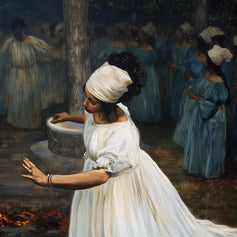
Voodoo ceremonies are vibrant but also physically exhausting expressions of spirituality, where music, dance, and chanting come together. These gatherings, often led by the Houngan or Mambo, are held to communicate with the Loas, seek their help, or thank them. The drums, which are essential, set the rhythm of the dances and serve as a sonic bridge between worshippers and spirits. Each rhythm is specifically linked to a particular Loa and can induce trance states in participants. Voodoo songs invoke the names and attributes of the Loas, calling them to join the ceremony. Dancing enables participants to enter a trance state in which they may be “ridden” by a Loa, thereby facilitating direct interaction with the spirit.
Among these ceremonies is the Service to the Spirits (or Sévis), which is the most common and most important. At the end of the ceremony, the Houngan or Mambo generally collapses from exhaustion, and time is set aside for rest.
These ceremonies also led Voodoo practitioners to be suspected of demonic possession, thereby fueling the evil reputation of Voodoo magic. This is where the confusion between witchcraft and Voodoo comes from.
The Cult of the Dead or the Gédé Rite
November 2 is a very special day, as it is devoted to celebrating the dead and invoking the Loas, more specifically the Gédés associated with death (nicknamed the Barons, such as Baron Samedi, to name just one).
A few days beforehand, families clean and renovate the tombs of their deceased loved ones. This often includes painting the tombs, decorating them with flowers, and repairing them if necessary.
On the Day of the Cult of the Dead, Voodoo practitioners go to the nearest cemetery dressed in white, black, and purple (the colors associated with the Gédé and Baron Samedi), in a large procession. Along the way, they consume a special drink made from fermented chili peppers and alcohol (very strong!). The Barons are called to join the procession by possessing the living. The procession is therefore very festive because they are reputed to "liven things up" with laughter, alcohol, and sex. It is also important to understand that death in Voodoo is relative: a dead person is not truly dead.
It is said that someone possessed by a gédé is capable of superhuman feats: climbing trees, lifting heavy loads, or resisting pain. Thus, tradition dictates that the possessed apply chili pepper to their genitals: if the gédé is still present, the living person will feel nothing.
Once they arrive at the cemetery, permission must be requested from the Barons to enter and leave offerings such as rum, cigarettes, food, or the deceased's personal belongings.
Voodoo Divination
Divination allows practitioners to receive guidance and answers from the Lwas. One of the commonly used divination methods is the reading. This session uses various tools such as cards, shells, or personal objects, which are interpreted by a Houngan or a Mambo.
In addition to divination sessions, Vodou includes rituals intended to facilitate more direct and deeper communication between humans and spirits. These practices are called Portal Openings. These rituals are particularly complex and are generally performed by experienced practitioners because they literally involve opening a channel between the physical and spiritual worlds.
Specific rituals
There may be many types of rituals and variations depending on the branches of Vodou. However, these broad categories can be identified.
Rites of passage
Kanzo is a fundamental initiation rite in Haitian Vodou, marking the transition of followers into spiritual guide roles such as Houngans or Mambos. This complex and deeply spiritual process is considered one of the most sacred and transformative stages in the life of a Vodou practitioner.
Vodou Baptism, although less intense than Kanzo, is another crucial rite of passage that marks a person's introduction into the Vodou community or the renewal of their commitment to this faith.
Healing and protection rituals
Leaf Baths are a typical example of these practices. They are used for purification and healing, incorporating sacred herbs and holy water prepared by Houngans or Mambos. These baths also aim to cleanse the aura and strengthen the spirit against negative energies or illnesses. The herbs used vary according to the symptoms or specific problems being treated, and their selection is often guided by the advice of the Loas.
Also, to defend against malevolent forces, Vodou has specific rituals such as Kanzwe. This ritual is practiced to repel or eliminate witchcraft and evil spirits. It involves incantations, protective amulets, or special concoctions to block negative influences.
Additionally, Unrolling (or Unrolling) is a ritual used to free a person from curses or hexes. This process can be literal, with cords or strips physically unrolled around the person, symbolizing the removal of the bonds holding back negative energies. Prayers and chants often accompany the unrolling to strengthen its effectiveness and ensure that the person is completely freed from adversity.
Possession rites
Possession rites are more impressive and allow direct communication between worshippers and the Loas. During these rituals, a participant is "ridden" by a Loa, meaning that the spirit enters the worshipper's body and temporarily controls it. This possession manifests through notable changes in behavior, voice, and movement. Possessed individuals may speak with the authority of the Loa, offering advice, predictions, or requests. This phenomenon is considered a blessing, and spiritual healing and conflict resolution often take place during these moments.
Ritual objects
Ritual objects in Vodou serve as physical catalysts for spiritual interactions. Vodou dolls, often misunderstood in popular culture, are actually used to represent spirits or people during rituals, serving as a focus for concentration and the projection of spiritual will.
Oufo (Vodou temples) are sacred spaces where ceremonies take place. They are often circular and contain a central post (poteau-mitan) that symbolizes the axis of the world and serves as a point of contact with the heavens. Vodou altars, laden with various objects such as images, candles, food offerings, and personal items, are focal points for devotion and interaction with the Loas.
Sacrifices and offerings
Sacrifices and offerings are fundamental aspects of Vodou practices. They may include animals, such as chickens or goats, whose blood is offered to the Loas as a sign of respect and submission. These acts are performed with great reverence and follow strict rules, as they strengthen the bonds between worshippers and the spirits.
Non-blood offerings include food, drinks, flowers, and other special items favored by the Loas. These offerings are often left on altars or scattered in nature as gestures of goodwill toward the spirits.
Secret societies
There are Vodou secret societies that play a role in preserving and transmitting esoteric knowledge and ritual practices within the Vodou tradition. These societies are generally closed to the public and are often considered cults. Here are a few of them:
-
Bizango: One of the most famous Vodou secret societies, Bizango is often associated with mystical practices and nighttime rituals. This society is said to have originated in the societies of rebellious enslaved people (maroons) and is known for its role in community protection, social justice, and sometimes even revenge. Bizango members share ritual secrets and knowledge that are inaccessible to the uninitiated and often use specific codes and symbols to communicate.
-
Sanpwèl: It is another secret society that operates in the shadows of Haitian Vodou. It is known for its complex rituals and ceremonies, which may include animal sacrifices and deep spiritual trances. Sanpwèl members often specialize in healing and magical protection, using a range of herbs, powders, and amulets in their practices.
-
Zobop: It is less well known but equally intriguing. This society is sometimes viewed with fear and respect because of its alleged involvement in darker Vodou practices, such as witchcraft and curses. Like other societies, the Zobop maintain strict secrecy about their activities and members.
-
Gray Pig: Less documented, the Gray Pig Society is another mysterious branch of Vodou. Its name comes from a historical episode in which the revolt against the colonizers was financed by the sale of a black pig. The society's practices are shrouded in mystery and linked to rituals of fertility and prosperity.
Vodou Today
Vodou continues to be a living and dynamic force in contemporary societies, particularly in Haiti, Louisiana, and other regions of the African diaspora. This religious system, rooted in beliefs brought by enslaved Africans to the New World, has evolved to incorporate elements of Indigenous and European cultures, resulting in a spiritual practice that addresses aspects of daily life, health, community, and identity.
Today, Vodou is practiced primarily in Haiti and among Haitian communities abroad, where it serves not only as a religion but also as a cultural system that guides social beliefs and practices. It has been officially recognized in Haiti as a religion since 2003, marking an important step in the recognition of religious and cultural rights. In Louisiana, Vodou also has a historical presence, although it is more folkloric and often staged for tourism. Despite this, there are more discreet communities that practice Vodou in its purest form.