




















































































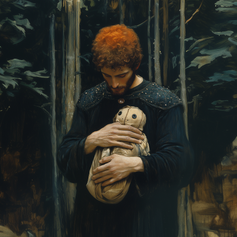





















































































































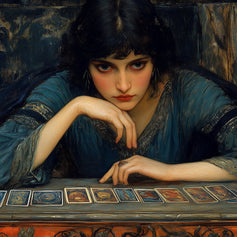




The Fortune Teller, painted by Caravaggio at the end of the 16th century, depicts a Romani woman reading the palm lines of a young man. This scene illustrates the ancient and enduring appeal of palmistry, the divinatory art based on interpreting the palms. A practice with a history spanning millennia, palm reading has never truly disappeared. History.
Eastern Origins: India and Classical Antiquity
The roots of palmistry reach back to the ancient East. According to tradition, the art of reading hands took shape several millennia ago on the Indian subcontinent. Ancient Hindu texts associate palmistry with the Samudrika Shastra, a body of knowledge that studies the marks on the human body, with the palm (hast-samudrika) occupying an important place. From India, this divinatory practice is believed to have spread to Central and East Asia, particularly China and Tibet, before reaching the Mediterranean world.
Authors of classical antiquity also refer to palm reading. The word palmistry derives from the Greek kheir (hand) and manteia (divination), suggesting that the Greeks may have been familiar with this art. Tradition holds that Anaxagoras (5th century BCE) took an interest in it. A famous legend further recounts that the philosopher Aristotle one day discovered a treatise on palmistry placed on an altar of Hermes and presented it to Alexander the Great. The Macedonian conqueror is said thereafter to have examined his officers’ hands in order to infer their character and destiny. Although this story is apocryphal—the text in question does not belong to Aristotle’s authentic corpus—it illustrates the ancient belief that the hand could “engrave readable characters” revealing an individual’s fate or nature.
Arab Knowledge and Medieval Transmission to the West
After antiquity, palmistry fades from Western sources until the High Middle Ages. It was in the medieval Arab-Muslim world that practices of palm reading reappear, eventually providing a bridge to Christian Europe. Medieval Arab scholars classified palmistry among the popular occult sciences, alongside physiognomy (the analysis of the face) and astrology. In Arabic, a distinction was made between ʿilm al-kaf (the “science of the palm,” studying the shape of the hand) and ʿilm al-asārīr (palmistry in the strict sense, interpreting the lines of the hand). Although the Quran and the hadith discourage divination, these techniques survived in tolerated or underground forms depending on the period, forming part of the rich esoteric heritage of the medieval Islamic world. The knowledge thus accumulated, through translations and travel, would prepare the return of palmistry to the Latin West.
In Europe, palmistry resurfaced in written texts around the 12th century. The English cleric John of Salisbury, in his Policraticus (1159), mentions it as a new art that had appeared in his time, evidence that the practice had only recently been introduced into Christendom. He gives an unequivocal definition: “Palmists are those who predict hidden things by inspecting the lines of the hand.” Shortly afterward, around 1160, the first Latin treatise on palmistry was written in England—possibly adapted by the itinerant scholar Adelard of Bath—and copied in the Canterbury scriptorium. This manuscript, inserted at the end of the Eadwine Psalter, attests to the recording of a tradition probably transmitted orally until then. Notably, its content appears intended for a cleric, since it explains that a certain c-shaped mark at the bottom of a line on the hand foretells that a man “will become a bishop.” This early English development coincided with the first mention of a famous client: John of Salisbury reports that his correspondent Thomas Becket, then chancellor to King Henry II, consulted a palmist in 1157 before a military expedition. This anecdote shows that the art of the hand, although on the margins of official knowledge, had intrigued the powerful from the moment it appeared in Europe.


The medieval Church’s position toward these practices was critical from the outset. John of Salisbury himself, while documenting the emerging art of palmistry, classified it among superstitious errors lacking a rational basis. In the Policraticus, he condemned the belief that “truths are hidden in the folds of the hands,” considering it pointless to refute the practice through reason since “those who boast of it do not rely on reason.” Implicitly, this severity suggests that palmistry, associated with pagan divinatory arts, violated Christian orthodoxy. Throughout the 13th and 14th centuries, the Church multiplied prohibitions against divinatory practices: councils and local synods notably denounced judicial astrology and spells, categories that implicitly encompassed palmistry. Despite these condemnations, palm reading continued to be practiced in diffuse forms. It circulated through popular tales of the marvelous, but also within more learned esoteric movements—including among certain Jewish Kabbalists in the early 13th century, who developed an esoteric palmistry connected to their mysticism of letters.
Humanist Renaissance: Between Occultism and Learned Knowledge
During the Renaissance, palmistry experienced significant growth, encouraged by the humanist enthusiasm for ancient occult sciences. Between the 15th and 17th centuries, numerous works devoted to it appeared across Europe, in connection with astrology and physiognomy. These treatises sought to legitimize the art of the hand by integrating it into the learned knowledge of the period, while also confronting the persistence of religious prohibitions.
From the beginning of the 16th century, publications laid the foundations for a “learned” palmistry. In Bologna in 1504, Bartolomeo della Rocca, known as Coclès, published a Compendium of physiognomy and palmistry (Chiromantie ac physionomie anastasis). He combined the examination of facial features and hands to make diagnoses concerning health and destiny, even directing his predictions toward princes—Coclès thus dared to draw a gloomy palmistic portrait of King Louis XII of France in his book. In 1522, the German scholar Johannes ab Indagine, a monk converted to humanist ideas, published an influential work in Strasbourg: Introductiones apotelesmaticae, a treatise that fused palmistry, physiognomy, and astrology into a single system. Indagine proposed a genuine synthetic method: he assigned each mount of the hand a ruling planet, linked the morphology of the palm to the four temperaments of humoral medicine, and used the lines to discern both a person’s character and future tendencies. The ambition was to encompass the human being in their entirety—body, temperament, and astral influences—through the study of the hand. Translated into German as early as 1523 and then into French in 1556, Indagine’s book demonstrates the reception of this occult knowledge in France: it was published in Lyon by the prestigious printer Jean de Tournes and prefaced by the humanist Antoine Du Moulin, proof of Lyon’s elites’ interest in these divinatory arts.
This integration of palmistry into the knowledge of the period was accompanied by close links with medicine and astrology, disciplines that were then intertwined. Renaissance authors sought to present palmistry not as superstitious magic, but as a “natural” art based on physical correspondences. Thus, Indagine’s treatise devotes extensive discussion to the “astrological and medical rules” used to determine an individual’s state of health and the appropriate remedies according to the signs observed in their hand. The work explains, with diagrams, how an expert palmist can determine a person’s temperament and “nature” from the dominant planet indicated by their palm, then advise the physician on the regimen to follow according to the horoscope at that moment. The hand was therefore regarded as a condensed version of the human microcosm—“the mother of all organs, the organ of organs,” as Coclès would write—whose careful examination complemented that of the pulse or urine in medical diagnosis. By blending palmistry with astrological and physiological knowledge inherited from Hippocrates and Galen, humanists hoped to elevate it to the status of an auxiliary science of medicine and the emerging study of psychology.
Despite these attempts at legitimization, palmistry remained contested and was frequently suppressed during the Renaissance. From a religious standpoint, it continued to be equated with occult divination prohibited by the Church. In 1560, the Council of Trent and the Catholic Inquisition strengthened censorship of the artes magicae: palmistry was listed among the seven prohibited divinatory arts, alongside necromancy, geomancy, hydromancy, and other suspect forms of divination. In 1559, Pope Paul IV placed several books on palmistry on the Index librorum prohibitorum, labeling them “diabolical divinations” contrary to the faith. An author such as Indagine, despite being a monk, saw his treatise placed on the Index and owed its survival to copies discreetly preserved in princely libraries. Likewise, in 1583 the Spanish Inquisition condemned Jean Taisnier’s Opus Mathematicum (1562), which combined astrology, palmistry, and sacred arithmetic, and ordered it purged. The witch hunts taking place at the time also fueled suspicion: people began examining the hands of accused women in search of the Devil’s marks, spots or natural signs that inquisitors interpreted as the seal of a satanic pact. Paradoxically, palmistry thus served as a tool for the very persecutions that condemned it.
However, far from disappearing, the art of the hand took root both in popular culture and among certain learned people until the classical period. In France, several works on palmistry were published in the 16th and 17th centuries, testifying to a practice that straddled scholarship and oral tradition. The monk Robert Fludd’s Compendion de chiromancie (1603) and the parish priest Jean Belot’s Instruction familière pour apprendre les sciences de chiromancie (1619) show that even clerics practiced this art, sometimes rationalizing it within an acceptable Christian framework. During the reigns of Louis XIII and Louis XIV, the physician and philosopher Martin Cureau de La Chambre incorporated palmistry into his studies of physiognomy (L’Art de connaître les hommes, 1660), seeking to distinguish the natural reading of hands, intended to reveal the inclinations of the soul, from an illicit divination of the future. These “scientific” appropriations by respected authors—sometimes members of the Academy or royal physicians—demonstrate a degree of intellectual tolerance: stripped of its overly prophetic aspects, palmistry could be reclaimed as an art of observing human temperament, akin to metoposcopy (the reading of forehead wrinkles) or the phrenology that would emerge later. Nevertheless, in the dominant opinion of the Enlightenment, it remained relegated to the status of superstition. Diderot and d’Alembert, in the Encyclopédie (1751), firmly rejected judicial astrology and, by extension, all divinations of destiny, calling them a “ridiculous prejudice” still widespread among the ignorant. By the end of the 18th century, rationalism was in fashion, and palmistry survived mainly in curiosity cabinets or among fortune tellers, preserving a traditional skill on the margins of enlightened science.
The Fortunes and Misfortunes of Palmistry in France
Despite its scientific disrepute, palmistry experienced a surprising revival in the 19th century, particularly in France and England. Interest in occultism, especially strong under the Second Empire and the Third Republic, was accompanied by an attempt to scientize palm reading. In 1839, a retired French captain, Casimir d’Arpentigny, published La Chirognomonie, a foundational work that laid the foundations of modern “chirology.” In it, d’Arpentigny developed a systematic classification of hand types (square, conical, spatulate,...) and inferred correspondences with individuals’ abilities and character. His non-predictive approach aimed to give palmistry the appearance of an empirical discipline studying the correlation between hand morphology and personality, free from accusations of magic. Following in his footsteps, Adolphe Desbarolles, mentor of Madame de Thèbes, a French artist and esotericist, published Les mystères de la main (1869), synthesizing ancient art and contemporary observations. Desbarolles popularized the reading of the major lines (life, head, heart, Saturn,...) and minor lines, while also mixing in anecdotes about the hands of famous figures of his time. Thanks to these authors, palmistry—renamed chirology—entered the fashionable salons of the 19th century. It fascinated part of the educated bourgeoisie, searching for mystery and self-knowledge in a century enamored with spiritualism. In England, the Irishman William John Warner, known as Cheiro, became the favored palmist of London’s elite around 1900, adding to its European popularity.
In France, palmistry also remained firmly rooted in popular culture. Itinerant Romani people, nicknamed fortune tellers, continued the practice at fairs and markets from the early modern period onward, contributing to its folklore. From Victor Hugo’s Romani woman reading Esmeralda’s hand to advertisements for female fortune tellers published in 19th-century newspapers, palm reading became associated with cartomancy among the divinatory arts accessible to the general public. Authorities continued to monitor it suspiciously: in 1835, a French law concerning vagrancy and fraud made it possible to prosecute undeclared card readers and palm readers, who were treated as charlatans. Nevertheless, these popular divinatory practices flourished even in the most remote countryside, where fortune-telling was among the forms of advice people secretly sought for matters of the heart or fortune.
With the 20th century and the triumph of positivist science, palmistry declined as a learned discipline but continued to exert a lasting appeal. Psychiatrists and psychologists occasionally took an interest in it from the perspective of character: Carl Jung, for example, saw it as a rich reservoir of archetypal symbols, without validating its predictive claims. Overall, the scientific community now classifies palmistry as a pseudoscience, noting that no rigorous study has corroborated its principles. Nevertheless, the human hand, as an object of study, does reveal certain objective realities—signs of age, profession, or health (calluses, tremors, coloration)—without requiring us to see in it a magic of destiny. Perhaps it is this element of genuine observation, combined with the suggestive power of interpretation, that explains palmistry’s longevity. Between seriousness and playfulness, the “science of the hand” has reinvented itself in every era to adapt to changing mentalities. In this sense, the ancient art of palm divination remains a fascinating object of cultural history: that of a universal human practice seeking to elucidate the mystery of our destiny inscribed... in the hollow of the hand.









Bonjour,
Merci pour votre gentil commentaire !
Alors, les textes qui documentent les pratiques magiques et divinatoires du Nord de l’Europe (Eddas, sagas islandaises, récits de Tacite) mentionnent en effet les runes, le seiðr, le galdr et des formes de tirages au sort, mais jamais l’observation des lignes de la main.
Pourquoi ça ? La chiromancie vient d’Inde, passe par le monde grec, puis par les traductions arabes et entre en Europe latine médiévale. Le monde scandinave, avant la christianisation, restait “en marge” de ces réseaux intellectuels. Ceci peut donc expliquer cela.
J’espère avoir répondu à vos interrogations !
Olivier – Aeternum
Merci pour cet article passionnant! J’ai trouvé très intéressant le rappel des racines indiennes, grecques et de la transmission arabo-médiévale.
À priori, la chiromancie n’a pas fait partie des pratiques du Nord de l’Europe, où l’on retrouvait plutôt runes, seiðr ou galdr comme supports divinatoires et pratiques magiques. Mais par curiosité: lors de vos recherches, êtes-vous tombé sur des mentions, même anecdotiques, d’un usage de la chiromancie en contexte nordique ?
Merci encore pour ce bel éclairage et au plaisir de vous lire !