






















































































































Why take an interest in tarot? As an ancestral divination tool, tarot offers a window into our cultural past while allowing us to explore the world of symbols and archetypes that populate the collective unconscious. It thus provides insights that resonate with each of us, sometimes helping us discover our true selves. It was therefore time to create a comprehensive guide to tarot, its history, and its proper use.
A little history
A birth in the Italian aristocracy
The history of tarot begins in the mid-15th century in Italy, specifically in the aristocratic courts of Milan, Ferrara, and Bologna. Initially, these cards were not intended for divination but served as a form of entertainment among the elite. The earliest known decks, called tarocchi, such as the Visconti-Sforza tarot, were richly decorated and used in sophisticated games at court, commissioned by noble families from artists of the period. The cards were notably covered in gold.
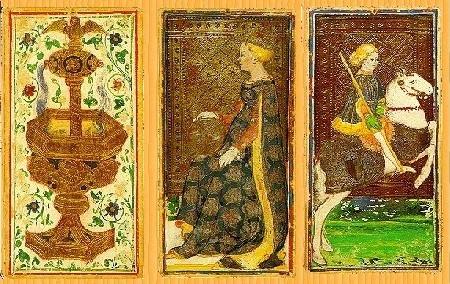
These decks included cards now known as the Major Arcana, allegorical figures bearing symbols rich in meaning. At that time, the card images reflected Christian, classical, and medieval themes, echoing the concerns and values of Renaissance Italian society.
Then came a shift toward esotericism
During the Renaissance, with the emergence of humanism and renewed interest in the art and symbolism of Antiquity, tarot cards began to spread throughout Europe and were seen as more than mere entertainment. It was also during this period that Marseille became a major center for tarot production, as its port facilitated distribution across Europe. Thus was born the famous Marseille tarot.
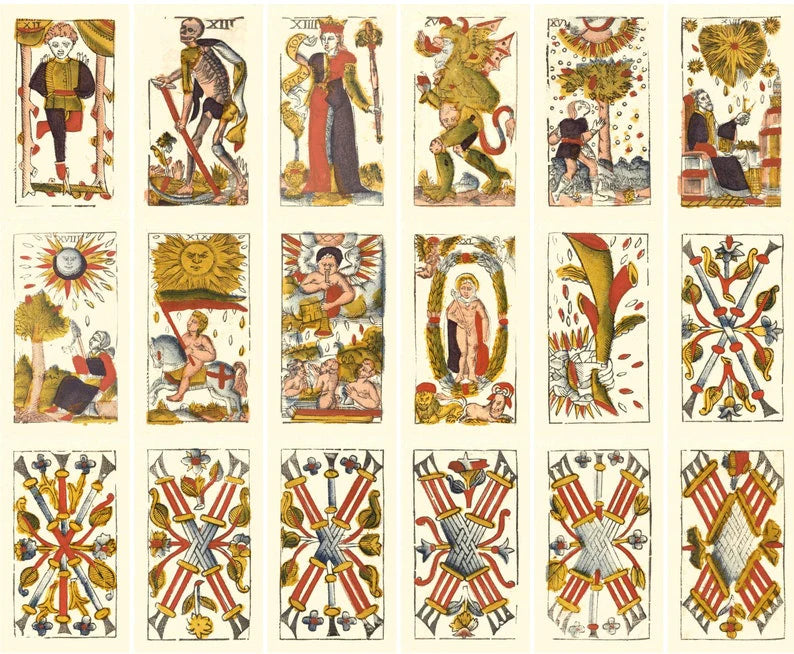
The true transformation of tarot into a divination tool began with the European esoteric movement, particularly in France in the 18th century. Antoine Court de Gébelin, a scholar and occultist, played a decisive role in this transformation. In 1781, in his work Le Monde Primitif, he claimed that tarot cards contained the secret wisdom of the ancient Egyptians. According to him, the cards were a book preserving mystical teachings and capable of revealing universal truths.


In the 19th century, Éliphas Lévi, another occult scholar, linked tarot to the Kabbalah, asserting that the 22 Major Arcana corresponded to the 22 paths of the Kabbalistic Tree of Life. This association strengthened the connection between tarot and esoteric systems of thought, solidifying its role as a tool for divination.
Then, in the 20th century, figures such as Arthur Edward Waite and Pamela Colman Smith designed the Rider-Waite Tarot, which incorporated highly symbolic images intended for divination. This deck became one of the most popular for divinatory practice. More specifically, Aleister Crowley created his version of the tarot after becoming fascinated with Thoth.
Structure and symbolism of tarot cards
Tarot is a tool rich in symbolism, with each card depicting a scene full of meaning. Understanding its structure and symbolism is essential for anyone wishing to use it for divination or personal development.
Tarot Glossary
Before going into detail, I think it is necessary to pause for a moment to consider the terminology of tarot, which uses terms specific to its practice:
-
Arcana: the word “arcane” comes from the Latin arcanum, meaning secret or mystery. In the context of tarot, the arcana are the cards themselves.
-
Cards: this term is often used as a synonym for tarot cards. Each “card” is a sheet of cardboard or paper on which a symbol, figure, or scene is drawn. The cards may be referred to as arcana, particularly in French writings on tarot.
-
Suits: in the Minor Arcana, the suits correspond to the traditional categories of cards, similar to those found in a standard deck of playing cards.
-
Querent: the querent is the person who consults the tarot cards, often as part of a reading. This person asks questions or expresses the subjects on which they are seeking clarification.
-
Tarot reader: the tarot reader is the interpreter of the cards, the person who reads and explains the meanings of the cards drawn, often in relation to the querent’s life or questions.
-
Spread or Draw: this is the method by which the cards are arranged after being shuffled and cut. There are various spreading methods, each suited to specific types of questions or objectives. The patterns of the spread can influence the interpretation of the cards in relation to one another.
Structure of divinatory tarot
Traditional tarot is divided into two main categories: the Major Arcana and the Minor Arcana:
-
The Major Arcana comprises 22 traditional cards. Each card depicts a scene with characters and powerful symbolic elements. These cards follow a numerical order from 0 to 21, beginning with The Fool and ending with The World. The Major Arcana represents the major stages of life, important spiritual lessons, and archetypal forces that influence human existence.
-
The Minor Arcana consists of 56 cards, divided into four suits (wands, swords, cups, and pentacles), each containing 14 cards: ten numbered cards (from Ace to 10) and four court cards (Page, Knight, Queen, and King). The Minor Arcana reflects daily events, practical challenges, and the emotional aspects of life.
Description of the Major Arcana
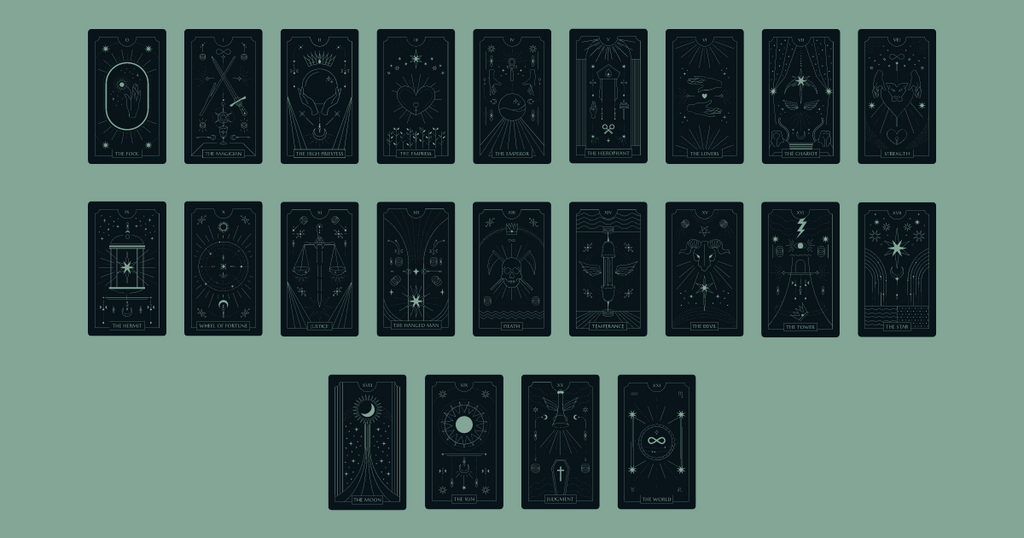
Each card of the Major Arcana is rich in symbolism, and its interpretation can vary considerably depending on the context and tradition.
| / | The Fool (or the Madman) | The Fool represents freedom, new beginnings, carefree abandon, and often a naive yet promising spiritual journey |
| I | The Magician (or the Juggler) | This card symbolizes creation, ingenuity, confidence, and the power to manifest one's desires through one's skills and available resources |
| II | The High Priestess (or the Papess) | The High Priestess embodies wisdom, hidden mysteries, intuition, and profound knowledge. |
| III | The Empress | It symbolizes fertility, abundance, nurturing action, and the beauty of nature |
| IV | The Emperor | It represents structure, authority, regulation, and the father figure. |
| V | The Hierophant (or the High Priest) | This card signifies teaching, traditional beliefs, conformity, and organized spirituality |
| VI | The Lovers | It indicates relationships, moral choices, dilemmas, and love |
| VII | The Chariot | It symbolizes victory, determination, and control over the direction of one's life |
| VIII XI |
Justice | It represents fairness, truth, karmic law, and the consequences of one's actions |
| IX | The Hermit | It embodies reflection, prudence, isolation, and the search for truth |
| X | The Wheel of Fortune | This card evokes the cycles of life, destiny, opportunities, and change |
|
XI |
Strength | It symbolizes courage, perseverance, self-control, and inner strength. |
| XII | The Hanged Man | It represents sacrifice, suspension, an inverted perspective, and renunciation |
| XIII | Death (or the Nameless One) | BAlthough frightening, this card signifies change, transformation, the necessary ending, and the beginning of a new cycle |
| XIV | Temperance | It evokes balance, moderation, patience, and the aim of finding the right measure |
| XV | The Devil | It represents material attachments, excesses, addictions, and illusions |
| XVI | The Tower (or The House of God) | She symbolizes brutal destruction, sudden revelations, and the collapse of false structures |
| XVII | The Star | She offers hope, faith, inspiration, and a guiding light after troubled times |
| XVIII | The Moon | She illustrates illusion, uncertainty, emotional challenges, and psychological turmoil |
| XIX | The Sun | It brings radiance, joy, success, vitality, and renewed energy |
| XX | Judgment | It speaks of resurrection, judgment, a call to new life, or redemption |
| XXI | The World | It represents fulfillment, total harmony, and spiritual realization |
Description of the Minor Arcana
The Minor Arcana of the tarot include numbered cards and court cards in each of the four suits (which correspond to the four elements): Wands, Cups, Swords, and Coins (or Pentacles). Each suit contains 14 cards, comprising 10 number cards (from the Ace to the 10) and 4 court cards (Page, Knight, Queen, King).
The court cards (or figures) provide the main direction for the interpretation. They may represent real people, aspects of the personality, or influences affecting the situation in question.
The number cards, meanwhile, help refine the interpretation. They They focus mainly on daily events, circumstances, and the challenges of everyday life. They reflect the practical, emotional, intellectual, or material aspects of existence.
The Wands (Fire element)
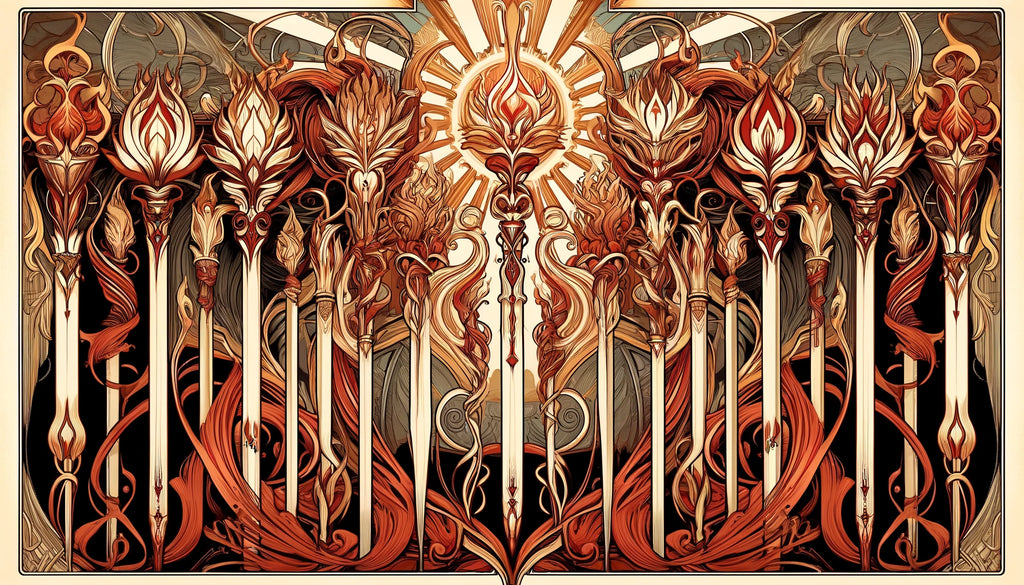
The Wands suit in tarot, associated with the Fire element, embodies the dynamics of inspiration, action, and passion. Like fire that transforms everything it touches, the Wands symbolize the human mind’s ability to initiate change and ardently pursue its aspirations. This suit reflects our inner strength, the force that drives us to act, innovate, and stand up for our convictions.
The Fire element is the driving force behind the ambitions and inspirations represented by the Wands. It is the creative spark that initiates projects, the persistent flame that sustains effort, and the fire that forges determination and courage in the face of challenges. In the context of divinatory tarot, cards from this suit often invite the querent to harness their potential to take initiative or embark on bold adventures.
The Wands reflect life situations in which the energy of Fire is evident: starting new projects, facing challenges, or experiencing moments of genuine personal fulfillment. They highlight the need for action and commitment where passivity would allow ambitions to fade. Thus, in a tarot reading, these cards encourage us to cultivate and channel this fiery energy toward concrete goals, reminding us that it is through our will and actions that we shape our reality.
Thus, each numbered card has a very specific meaning:
| Ace of Wands | New beginning, creation, inspiration |
| Two of Wands | Planning, future decision, progress |
| Three of Wands | Expansion, exploration, anticipating results |
| Four of Wands | Celebration, harmony, security |
| Five of Wands | Competition, minor conflict, struggle |
| Six of Wands | Victory, recognition, success |
| Seven of Wands | Defense, persistence, challenging opponents |
| Eight of Wands | Speed, movement, rapid action |
| Nine of Wands | Perseverance, preparation, inner strength |
| Ten of Wands | Burden, excessive responsibilities |
Likewise for the court cards:
| Page of Wands | Discovery, enthusiasm, exploration |
| Knight of Wands | Adventure, energy, impulsiveness |
| Queen of Wands | Warmth, hospitality, maturity in action |
| King of Wands | Leadership, charisma, control |
The Cups (Water element)
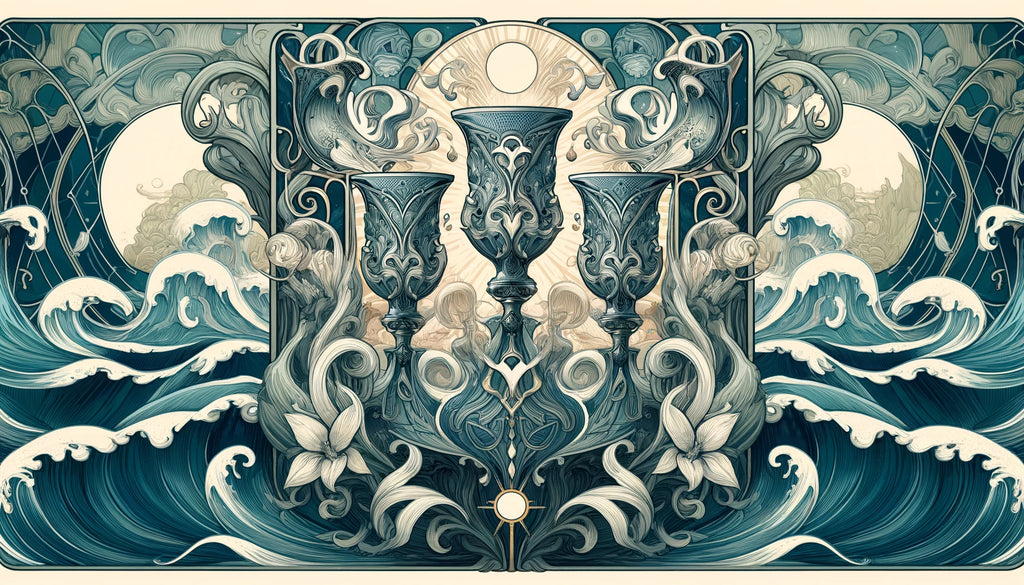
The Cups suit in tarot is linked to the Water element, representing the flow of emotions, relationships, and intuition. Like water, which takes the shape of whatever contains it, the Cups reflect the adaptive and receptive nature of our emotions and psyche. They are the mirror of our inner world, bringing our deepest feelings, emotional reactions, and interpersonal connections to light.
The Water element characterizes the themes of the Cups: love, empathy, joy, but also sadness, disappointment, and melancholy. This suit captures the richness of human experience through the nuances of our interactions and the complexity of our emotional states. The Cups carry a message of emotional awareness, inviting us to dive into our depths to better understand and express what we feel.
In tarot readings, the Cups cards signal a time of emotional healing, relationship development, or introspection. They may indicate moments of family happiness, romance, and enriching friendships, but also periods of solitude, grief, or inner reflection. Each cup, full or empty, speaks to us of balance and imbalance in our emotional lives and emphasizes the importance of harmony in our relationships.
Thus, each numbered card has a very specific meaning:
| Ace of Cups | New love and joy, emotional beginning |
| Two of Cups | Union, partnership, mutual attraction |
| Three of Cups | Celebration, friendship, creativity |
| Four of Cups | Meditation, reconsideration, apathy |
| Five of Cups | Loss, grief, regret |
| Six of Cups | Nostalgia, pleasant memories, innocence |
| Seven of Cups | Choices, illusions, desire |
| Eight of Cups | Search for meaning, disappointment, abandonment |
| Nine of Cups | Satisfaction, gratification, wishes fulfilled |
| Ten of Cups | Family harmony, complete happiness |
Likewise for the court cards:
| Page of Cups | Sensitivity, romance, messenger of love |
| Knight of Cups | Charming, idealistic, chivalrous |
| Queen of Cups | Compassion, calm, emotional care |
| King of Cups | Emotionally stable, generous, diplomatic |
Swords (Air element)
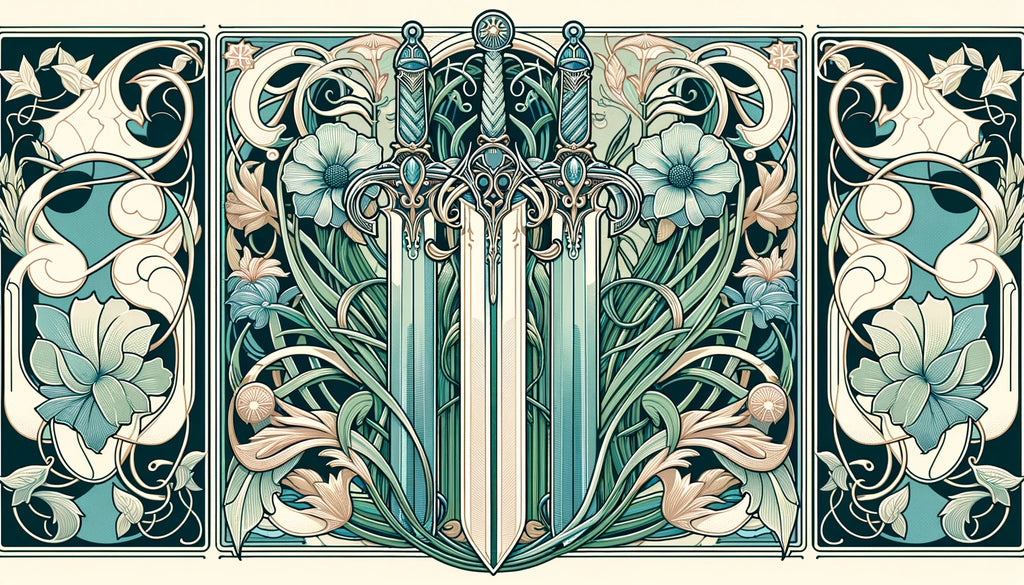
The suit of Swords, associated with the element of Air, embodies the realm of the mind, communication, and intellectual conflicts. This element symbolizes clarity of thought, the power of logic, and the ability to cut through illusion to reach the truth. Swords highlight aspects of life involving judgment, decision-making, and sometimes confrontation.
Like air, which is essential but invisible, Swords represent forces that are often intangible but powerful in our lives: our thoughts, words, and beliefs. They can reveal the duality of our intellect, capable of great wisdom but also harsh criticism or conflict. This is the suit that speaks most directly to mental challenges and inner struggles, evoking situations involving decisions, disputes, or the need for clarity.
In tarot readings, Swords can indicate periods of tension or conflict, requiring a thoughtful approach and sometimes decisive action. They often bring uncomfortable truths or the need to face reality without illusion to light. However, they also remind us of the importance of justice, ethics, and integrity in resolving problems.
The Swords cards encourage us to examine the way we think and communicate. They urge us to be aware of how our ideas and words shape our reality and influence our surroundings. This suit challenges us to cultivate our intelligence, seek the truth, and practice fairness, while warning us of the dangers of aggression or manipulation.
Thus, each numbered card has a very specific meaning:
| Ace ofSword | Breakthrough, clarity, sharp judgment |
| Two of' Sword |
Deadlock, difficult decision, balance |
| Three of' Sword | Sorrow, separation, emotional loss |
| Four of' Sword | Rest, recovery, contemplation |
| Five of' Sword | Conflict, hollow victory, tension |
| Six of' Sword | Transition, change, physical or mental journey |
| Seven of' Sword | Cunning, strategy, deception |
| Eight of' Sword | Restriction, confusion, limited power |
| Nine of' Sword | Anxiety, nightmare, intense fear |
| Ten of' Sword | End, failure, catastrophe |
Likewise for the court cards:
| Page of' Sword | Curious, restless, tactically skilled |
| Knight of' Sword | Combative, fast, action without thought |
| Queen of' Sword | Independent, perceptive, organized |
| King of' Sword | Intellectual authority, ethical decision, analytical power |
Pentacles or Coins (Earth element)
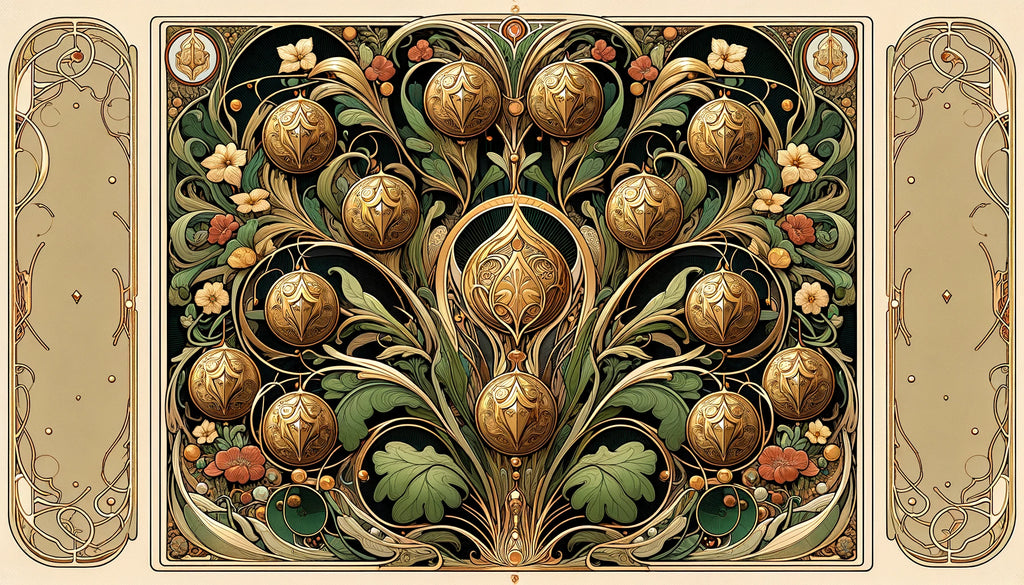
The suit of Pentacles, also known as Coins, is associated with the element of Earth. It embodies materiality, encompassing not only money and physical possessions but also health, security, and the practical aspects of daily life. Pentacles address themes of prosperity, stability, and hard work, reflecting our interaction with the material world and our ability to manifest concrete results.
Like the earth beneath our feet, which is firm and supportive, Pentacles symbolize the solid foundation on which we build our lives. They represent the effort to cultivate resources, build lasting structures, and maintain a balance between giving and receiving. This suit highlights the importance of perseverance, responsibility, and prudent management of material possessions.
In tarot readings, Pentacles cards can signal times when attention should be focused on the practical aspects of existence. They may indicate opportunities for financial growth, challenges related to resource management, or periods of harvest resulting from hard work. Pentacles encourage us to assess our relationship with the physical world, reminding us that health, education, and well-being are just as important as financial success.
The cards in this suit urge us to build and maintain a stable life by planning wisely and acting thoughtfully. They encourage us to stay grounded and realistic in our expectations while working diligently to achieve security and abundance. The Pentacles remind us that tangible rewards often come from sustained, measured effort, and that patience is essential to seeing the fruits of our labor.
Thus, each numbered card has a very specific meaning:
| Ace of Pentacles | New financial opportunity, prosperity |
| Two of Pentacles | Financial balance, adaptability |
| Three of Pentacles | Collaboration, learning, achievement |
| Four of Pentacles | Security, stinginess, control |
| Five of Pentacles | Financial hardship, isolation, financial loss |
| Six of Pentacles | Generosity, charity, fair sharing |
| Seven of Pentacles | Patience, investment, future harvest |
| Eight of Pentacles | Hard work, mastery, commitment |
| Nine of Pentacles | Independence, luxury, well-being |
| Ten of Pentacles | Wealth, inheritance, family |
Likewise for the court cards:
| Page of Pentacles |
Student, new project, financial beginnings |
| Knight of Pentacles |
Trustworthy, hardworking, methodical |
| Queen of Pentacles | Practical, warm, reassuring |
| King of Pentacles | Prosperity, business, skill |
Tarot card spread methods
We are now ready to do a tarot reading. Even though there is a great deal of information and interpretation possible depending on the spreads, the most important thing is to trust your intuition and therefore yourself. This also means setting aside any hopes or preconceptions that could distort the result. Tarot is an objective practice and must remain so in order to provide you with the right answers.
Preparation
Prepare your space and your mind
As with any divination practice, it is essential to prepare the space where you will practice. Tidy up, cleanse the space, burn incense or sage, and play concentration music if that helps you.
Preparation also involves yourself: distance yourself as much as possible from intrusive thoughts and distractions. You need to focus on your questions, the present moment, and the cards.
Refine your question
Asking the right question should not be taken lightly, much less neglected. Everything will depend on this question. Generally speaking, avoid closed questions at all costs.
I know that we tend to want precise answers. But asking a closed question (one that can be answered with yes or no) will confine you and may even influence you in the wrong way. The purpose of tarot is to give you as much insight as possible into yourself and what surrounds you.
You need to rework your question to allow a complete interpretation of the cards. Also, make sure to focus on the essence of your question to eliminate unnecessary answers, even if that means dividing your question into subquestions if necessary.
To be clearer, here is an example (very cliché, intentionally):
| Basic Question | Will I become rich? |
| Rephrasing | What should I do to improve my standard of living? |
| Possible Sub-Questions |
What career paths should I explore to achieve my goal? What obstacles are preventing me from achieving my goal? What changes should I make to achieve my goal? |
Shuffle the Tarot Cards
Before performing a spread, it is essential to shuffle the cards thoroughly. This step not only randomly distributes the cards, but also transfers your energy and the energy of the question asked to them. The most common method of shuffling is to gather the cards into a single deck and then shuffle them by hand several times.
After shuffling, it is customary to cut the deck into three piles with the left hand—the hand associated with intuition—and then reassemble them into a single pile, choosing the order that feels most intuitive to you.
Draw the Tarot Cards
When drawing the cards, focus on your question or on the question of the person you are reading for. You can draw the cards from the top of the deck or spread them out and choose the ones that attract your attention. Then place each card in the position defined by the type of spread you are using.
If you have sub-questions, draw one card for each sub-question.
Tarot Card Spread Methods
There are several methods for drawing and laying out cards, as well as methods specific to each practitioner. Here, I’ll explain the most common and easiest to apply.
The Three-Card Spread
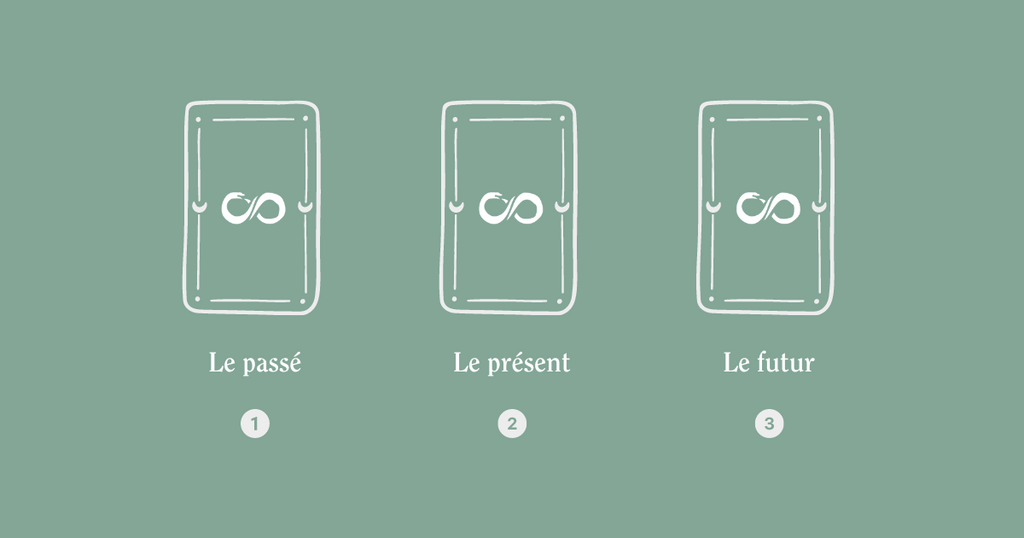
This simple spread provides a quick and direct reading. The three cards represent the past, present, and future, or the body, mind, and soul, depending on what you want to explore. This spread is ideal for beginners or for gaining a general overview of a situation.
The Celtic Cross Spread
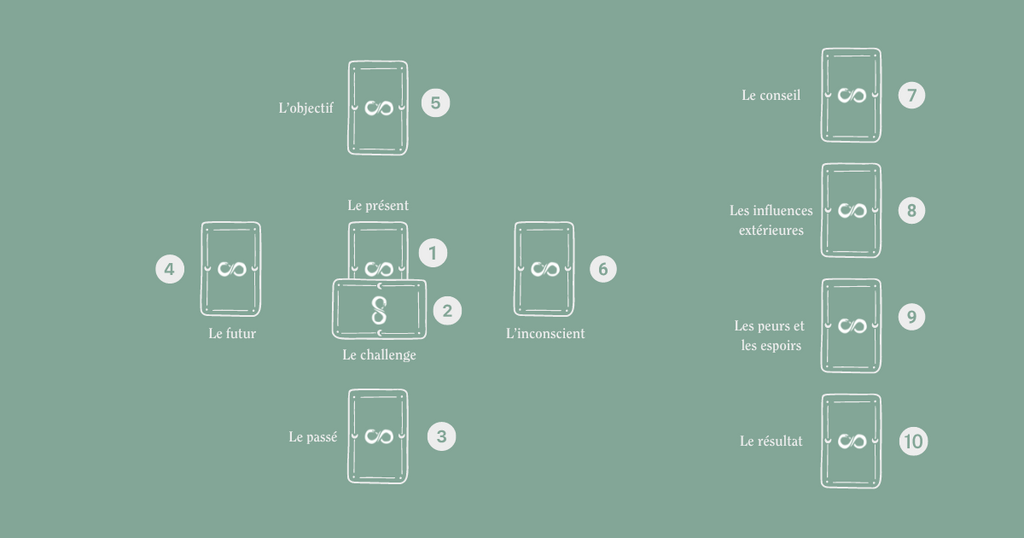
This ten-card spread offers a detailed, more complex, and comprehensive analysis of the situation. It examines past influences, current issues, conscious and unconscious goals, possible future influences, and likely outcomes. It is very popular for its depth and flexibility.
The Star Spread
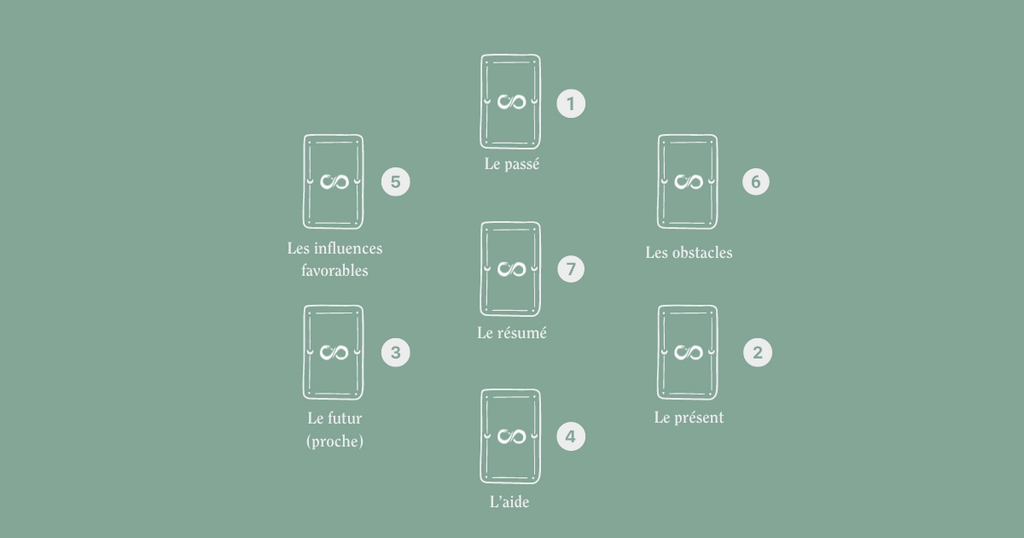
Used to explore specific questions, this spread involves seven cards arranged in a star shape. Each position can represent a different aspect of the question, such as underlying causes, external influences, hopes, fears, and the likely outcome.
Interpreting tarot card combinations
Interpreting tarot card combinations requires careful analysis of the elements, the dynamics between the Major and Minor Arcana, as well as the interactions between court cards. Of course, it would be impossible to list every possible card combination here, but these broad guidelines can already help facilitate interpretation.
The influences
The elements and their interactions
Here is how suit combinations can be interpreted in relation to one another:
| Pentacles + Water | These elements may suggest a natural synergy, where material stability (Earth) supports and nurtures emotional needs (Water). For example, the Ten of Pentacles combined with the Two of Cups could indicate a prosperous relationship or a fruitful partnership supported by financial security. |
| Swords + Wands | These elements are dynamic and may indicate conflicts or challenges, but also actions inspired by ideas. The Page of Swords next to the Eight of Wands may suggest that rapid news or information will catalyze urgent action. |
| Wands + Cups | As mentioned, this combination can symbolize the tension between action and emotion, where the desire for progress (Fire) is tempered or complicated by emotional considerations (Water). |
| Swords + Pentacles | This may represent the need for planning or logical reflection before undertaking material endeavors. The Three of Swords followed by the Four of Pentacles could indicate periods of difficulty or loss preceding a period of financial stability or resource conservation. |
The influences of the Major Arcana on the Minor Arcana
When a Major Arcana card appears with a Minor Arcana card, it is often interpreted as an indicator of the profound influence or overall context affecting the details of daily life represented by the Minor Arcana.
For example, the Wheel of Fortune appearing with the Five of Pentacles may indicate major changes or fluctuations in a person's financial situation.
The Major Arcana can also act as catalysts for the lessons or energies indicated by the Minor Arcana, such as the Devil appearing with the Seven of Wands, which may suggest a struggle against temptation or a confrontation with darker aspects of competition or defending one's own interests.
Interactions between court cards
Court cards, representing individuals or character traits, can indicate different facets of personality or influences from outside individuals. The dynamic between the Queen of Cups and the King of Swords may illustrate an internal or external dialogue between logic and emotion, or between rationality and intuition.
These interactions can also reflect complex relationship scenarios, such as a Page of Wands (young, energetic, perhaps impulsive) next to a Queen of Pentacles (maternal, pragmatic), perhaps suggesting a mentorship or support dynamic in the pursuit of new initiatives.
Interpreting Combinations
Build Your Story
Consider each sequence of cards as a narrative thread in which each card represents an event or aspect of the situation. Analyzing how one card leads to another helps clarify the transitions and developments within the situation being explored. This method allows you to approach the reading as a dynamic flow in which the cards’ energies interact, counteract, or support one another.
Opposing and Complementary Cards
Certain cards have natural affinities, and when they appear together, they can amplify a particular interpretation or theme. Card combinations that support one another often reinforce the positive or negative aspects of the situation, highlighting clear trends or guidance for the querent.
Identifying cards that contain contradictory elements is essential for detecting the tensions or challenges at the heart of the question. These oppositions often reveal internal or external conflicts and may point to obstacles to overcome or compromises to reach.
The Position in the Reading
The meaning of a card can vary considerably depending on its position in a reading. Each position may represent a different aspect of the question, such as the past, present, future, hidden influences, or possible outcomes. Understanding how position affects the meaning of the cards helps put their message into context and provide specific interpretations that directly apply to the querent’s current stage of life or circumstances.
Unusual readings
Each reading has its own particularities depending on your question and the cards presented. There may also be somewhat unusual readings that are equally meaningful, particularly “unmixed” readings, which do not include certain cards.
| Absence of Major Arcana | A spread without Major Arcana suggests that the situation or period in question is largely influenced by everyday concerns or immediate problems, rather than by major themes or life changes. These cards indicate interactions, events, or feelings that are more down-to-earth and directly connected to the querent's current life. |
| Absence of Minor Arcana | A spread composed solely of Major Arcana indicates that the situation or period under examination is influenced by major forces and significant events. The Major Arcana are often associated with important life lessons, karmic themes, profound changes, and powerful psychological or spiritual forces. Their exclusive presence suggests that the issues at hand are far-reaching and have a considerable impact on the querent's life path. |
| Absence of court cards | Without the presence of court cards, the spread emphasizes more universal themes and general dynamics rather than specific individuals or relationships. Spiritual questions, important life lessons, and significant developments may be brought to the fore. |
| Absence of numbered cards | The absence of numbered cards suggests that the question asked or the situation at hand is less concerned with concrete details or practical aspects, and focuses instead on qualities or fundamental principles. The symbolic and conceptual aspects of the Major Arcana and court cards may be more relevant in this context. Questions of destiny, personal growth, and spirituality may take center stage. |
To finish
If you have made it to the end of this guide, I can understand that you may feel overwhelmed by all the information. But remember one thing: tarot is a tool that will guide you through moments of doubt or uncertainty. You simply need to ask it the right question or questions. Above all, trust yourself and focus on your concerns so that your spread can also provide the answers you are looking for.
Also, as with any method of divination, the answer must be interpreted by taking into account the spread's composition, the influence of the cards on one another, and so on.
But don't worry: whichever tarot deck interests you on our site, each one comes with a clear and simple explanatory booklet. And now you also know the theoretical basics. All that's left is to seek out your answers!