


















































































































Marcelle Sénard belonged to a generation of educated women who moved through the first decades of the 20th century between philosophy, symbolism, astrology, and esoteric research, without ever fitting entirely into the institutional frameworks that structured these fields. Born in 1879 into a wealthy Catholic Burgundian family and educated in an intellectual environment unusual for a woman of her time, she moved from the Sorbonne to Paris’s literary circles, from Les Avenières to Edward Carpenter’s world, and then from Switzerland to an immense body of work on the Zodiac, published in 1948.
Her name remains almost entirely associated today with a single book: The Zodiac, Key to Ontology Applied to Psychology. The title might suggest a mere astrology manual. Nothing could be further from the truth. Sénard is less interested in casting horoscopes than in reconstructing the Zodiac as a universal symbolic architecture in which mythology, religions, psychology, Hermeticism, astrology, and the history of civilizations would all be different forms of the same structure.
This ambition explains the particular place she occupies in French esotericism. She founded neither an order nor a school, left no initiatory system comparable to those of Papus or Oswald Wirth, and her biography remains less well known than theirs. Yet her work brings together several currents that ran through the occultist circles of her time: theosophy, symbolism, Eastern traditions, psychology, Hermeticism, and learned astrology.
A Burgundian childhood and an unconventional education
Marcelle Sénard was born in 1879. Her father, Jules Senard, was a wine merchant in Beaune and owner of the Aloxe-Corton estate. In 1891, Pope Leo XIII granted him the title of Roman count. Her mother, Mathilde Borderel, also came from a wealthy and deeply Catholic background. The family lived notably at Cussigny Castle, near Corgoloin, in Burgundy.
This social background gave her access to an education that few French women could receive at the time. A study by the Salesian Academy devoted to the history of Les Avenières indicates that in 1898 she attended the Sorbonne, where she met the American sisters Violet and Mary Wallace Shillito. Her relationship with the Shillitos would become one of the guiding threads of her youth.
Edward Carpenter, who knew her personally, offers another valuable portrait in his autobiography My Days and Dreams. He describes her as coming from a traditional Burgundian family, educated in a convent and then determined to free herself from that upbringing. He also highlights her command of English, German, and Italian. This linguistic ability would have a direct impact on her career: Sénard became a translator and mediator between several European intellectual cultures.
Her path therefore does not follow that of an astrologer trained from the outset in a specialized circle. Philosophy, languages, poetry, and international exchanges come first. Astrology would appear later as a framework capable of organizing materials she had accumulated over decades.
The late 19th century and early 20th century provided Paris with particularly fertile ground for this type of path. Symbolists, Theosophists, astrologers, occultists, and Orientalists could frequent the same bookshops and salons. The Librairie de l’Art indépendant, run by Edmond Bailly, became one of these crossroads. It was in this milieu that Sénard would publish her first important works.
Mary Shillito and the Early Years of Les Avenières
The relationship between Marcelle Sénard and Mary Wallace Shillito plays an important role in her life before the First World War. After Violet Shillito’s death in 1901, Mary and Marcelle remain extremely close. In the early 1900s, they stay together between Paris, Geneva, and the Alps.
In 1904, Marcelle accompanies Mary to the slopes of Salève, above Cruseilles. The two women discover the site that would become the Les Avenières estate. Mary Shillito decides to build a monumental residence there. Local sources describe Marcelle as an active presence during the project’s early years, alongside her friend.
It is important, however, to distinguish this early period from what would later make Les Avenières famous in esoteric circles. The chapel’s Hermetic décor, with its Zodiac, alchemical symbols, and twenty-two Tarot arcana, belongs primarily to the period of Assan Farid Dina, after his marriage to Mary in 1914. Attributing this ensemble to Marcelle Sénard would therefore be anachronistic.
The connection nevertheless remains important. Sénard finds herself very early in a place where architecture, memory, religion, symbolism, and fascination with ancient traditions meet. The future setting of Les Avenières belongs to the same intellectual climate in which her work on the Zodiac would mature, even though it should not be presented as her own work.
It is also through these networks that Sénard encounters, directly or indirectly, several figures linked to French esotericism. Assan Farid Dina, the future master of Les Avenières, frequents the same bookshops and takes an interest in Assyriology, astronomy, and Hermeticism. Later, Oswald Wirth will also stay at Les Avenières. Their paths cross, but this should not be turned into shared membership in a nonexistent order.
What characterized Sénard during these years was not membership in an organization. It was her presence within a cultural network where the boundaries between art, philosophy, comparative religion and the occult sciences were far more porous than they are today.
Edward Carpenter, Translation and Intellectual Emancipation
In 1913, Marcelle Sénard traveled to England to work with Edward Carpenter. The socialist writer, former Anglican clergyman, poet and thinker on individual emancipation, occupied a distinctive place in British intellectual life at the time. He advocated radical social reform, criticized the Victorian order and took an interest in the spiritual traditions of India.
Carpenter recounts that Sénard spent several months near his home in order to revise her French translation of Towards Democracy. He was particularly full of praise for her qualities as a translator and her ability to grasp the nuances of his thought. In 1914, the Librairie de l’Art indépendant published Vers l’Affranchissement, a translation of several parts of Towards Democracy.
That same year, Sénard published Edward Carpenter et sa philosophie. This short work shows that she did not consider herself merely a translator. She sought to present French readers with a body of thought in which social reform, individual freedom and the transformation of consciousness remained interconnected.
The choice of the Librairie de l’Art indépendant was not neutral. Edmond Bailly belonged to the Symbolist world and maintained ties with Theosophy. His bookshop distributed texts devoted to religions, esotericism and Eastern traditions. Sénard therefore came into direct contact with a milieu that did not completely separate Western philosophy from the doctrines of the East.
It would be excessive to conclude from this that she formally belonged to the Theosophical Society. The available sources establish her contact with Theosophical and esoteric circles, but not clearly documented institutional membership. This distinction is important: Sénard remained an independent figure, closer to a symbolist researcher than to an organization member.
When war broke out in 1914, her activities changed abruptly. Carpenter reports that she took part in organizing and equipping a hospital for wounded soldiers in Nevers, where she worked as an administrator and secretary for nearly a year, until exhaustion. This episode shows a woman very far removed from the image of an occultist withdrawn from the world. Her spiritual quest coexisted with a considerable capacity for concrete action.
Travels, Switzerland and the development of a symbolic astrology
After the breakup of the first Avenières circle and the war years, Marcelle Sénard’s life becomes more difficult to trace. Local sources attribute long journeys to her and indicate that she subsequently settled mainly in Switzerland. Several accounts mention a stay in Asia, but the available documentation is too fragile to reconstruct this part of her life with the same precision as her years with Carpenter.
What is better established is her settlement in the Lake Geneva region. She lived notably in Bois-de-Romont, above Épesses, and later in Blonay. It was in this environment that she carried out much of the work that would lead to The Zodiac.
A typewritten manuscript of the work, signed and dated 1945, was reported in the antiquarian book trade. It contains more than six hundred pages and reproductions of ancient zodiacs. This document makes it possible to gauge the scale of the undertaking even before the first edition.
Sénard does not intend to write a manual designed to predict the events of everyday life. Her astrology seeks a structure behind the multiplicity of myths. The Zodiac becomes a language of correspondences: twelve signs, planets, elements, religious figures, mythological traditions, and stages of psychic development respond to one another.
This approach belongs fully to the esoteric culture of the early 20th century. The principle of correspondences, inherited from Hermeticism and several occult traditions, makes it possible to consider that the same law manifests on several levels: cosmic, human, mythological, and spiritual. Sénard attempts to offer a vast documentary synthesis rather than an initiatory catechism.
Her method is comparative. Greek, Egyptian, Hebrew, Christian, Indian, and Nordic traditions appear side by side. Their juxtaposition does not follow current methods in the history of religions: Sénard seeks common structures where a contemporary historian would place greater emphasis on differences in context. It is precisely this search for unity that defines her project.
1948, The Zodiac, Key to Ontology Applied to Psychology
In 1948, The Zodiac, Key to Ontology Applied to Psychology was finally published in Lausanne by F. Roth and in Paris by Éditions de la Colonne Vendôme. The original edition runs to more than five hundred pages. It was subsequently reissued several times by Éditions Traditionnelles, which explains why the book continued to circulate long after its author’s death.
The word “ontology” indicates the book’s true ambition. The Zodiac is not presented merely as an astrological wheel. It becomes a representation of being, manifestation, and becoming. Sénard begins with the circular form, the center, and the divisions into hemispheres and quadrants, then seeks to understand how the twelve signs express phases of a cosmic order.
The book draws on the four elements, the three modalities, the planets, the houses, and the decans, but its interest goes far beyond astrological technique. Sénard brings these structures closer to the gunas and tanmâtras of Indian thought, Greek myths, Egyptian traditions, the Kabbalah, Christianity, the Tarot, and alchemy.
This accumulation is not decorative. It serves a hypothesis: the great myths express, in different forms, the same stages in the transformation of consciousness. The astrological sign then becomes a nexus where divine figures, natural forces, psychological structures, and initiatory narratives meet.
One of the characteristic passages concerns Scorpio. Sénard does not stop at a few character traits. She connects it with death and resurrection, the serpent, Osiris, transformations of consciousness, sexuality, sacrifice, and the Taurus-Scorpio polarity. The sign thus becomes a true symbolic constellation.
Pisces are in turn linked to Hermes, the Logos, Christ, Vedanta, alchemy, and the idea of the return of consciousness to a higher state. This way of reading clearly shows that she is working within an initiatory and comparative astrology, not newspaper horoscopes.
The title “applied to psychology” must also be understood in the context of its time. Sénard is interested in the relationship between myths and the psyche, between symbols and inner structures. In particular, she refers to C. G. Jung in the sections devoted to alchemy. Her book thus lies at the crossroads of an ancient doctrine of correspondences and a psychology of the symbol that was gaining influence in the mid-20th century.
The Zodiac as a universal language
Sénard’s strongest idea is that the Zodiac constitutes a universal symbol whose twelve divisions should not be understood as a mere astronomical nomenclature. For her, the zodiacal circle becomes a model of manifestation. The center represents the principle; the circumference, its unfolding; the signs, the phases of that unfolding.
This conception belongs to a long esoteric tradition in which the circle, the cross, the number twelve, and celestial cycles possess a value that goes beyond their technical use. The twelve signs can be compared with the twelve months, the twelve tribes of Israel, the twelve apostles, or other groups of twelve. Sénard does not merely line up the analogies: she seeks to show that they result from the same symbolic structure.
The risk of such a method is obvious. By seeking resemblance relentlessly, the author may erase the historical differences between cultures. An Egyptian myth, an Indian text, and a Christian figure were not born in the same world. Sénard’s reading therefore belongs more to the history of comparative esotericism than to that of contemporary philology.
But this is also what explains the persistence of her book. It offers a vast repertory of correspondences to those who wish to study the Zodiac as a symbolic language. The successive editions show that the text has found a lasting readership among astrologers, scholars of symbolism, and readers of initiatory traditions.
Her influence also appears in more philosophical circles. A study devoted to Raymond Abellio notes that he encountered Sénard in the postwar esoteric and theosophical world and knew her work, whose system of correspondences echoes his own research into universal structures.
The book also appears in specialized libraries devoted to the history of astrology and occultism. The Warburg Institute holds the 1948 edition, while French collections devoted to divinatory sciences also possess the work. This documentary status matters: Sénard is not merely a reprinted author; she now belongs to the sources for the history of 20th-century French astrology.
An occultist without an order and a work without a school
Marcelle Sénard does not resemble the great organizing figures of French occultism. She did not create a fraternity, confer ranks, or establish a public initiatory lineage. Nor did she possess the media visibility of a fortune-teller or palm reader from the Belle Époque.
Her place lies elsewhere. She belongs to a current of esoteric scholarship in which the principal task is to compare symbols and seek their common law. The book almost replaces the initiatory order: more than five hundred pages become a journey through the zodiacal wheel, religions, myths, and the psyche.
This position also explains why her memory has faded. An initiatory society preserves archives, members, and heirs. A media personality leaves behind photographs, articles, and anecdotes. Sénard left primarily a demanding work, difficult to summarize and poorly suited to the rapid consumption of astrology.
Yet she remains closely tied to the French occultist landscape. The Librairie de l’Art indépendant, Edmond Bailly, the theosophical circles, Les Avenières, Assan Dina, and the postwar astrological networks create a highly recognizable environment around her. She is not outside this world; she occupies an independent position within it.
The contrast with Oswald Wirth is illuminating. Wirth develops an initiatory language strongly connected to the Tarot, Freemasonry, and symbolism. Sénard begins with the Zodiac and seeks an ontology of correspondences. Both regard the symbol as a path to knowledge, but they construct very different systems.
Her work can also be linked to the interest that French occultism has shown since the 19th century in the relationships between the stars, myths, and human destiny. But Sénard shifts the center of gravity: the Zodiac is not primarily a forecasting machine. It is a map of the evolution of consciousness.
The Final Years and a Quiet Legacy
Marcelle Sénard spent much of her final decades in Switzerland. Local sources mention her residences in Bois-de-Romont, Blonay, Gstaad, and Lausanne. She remained connected to her family’s Burgundy, but Lake Geneva became her primary horizon.
Modern references do not entirely agree on the exact year of her death: several catalogs and studies give 1971, while a historical investigation based in particular on family testimonies places it in Lausanne in 1972. It is therefore more prudent to place her death in the early 1970s, at approximately ninety-two years of age.
This biographical uncertainty contrasts with the stability of her book. The Zodiac has been republished several times in France, notably by Éditions Traditionnelles. Later editions run to nearly six hundred pages, a sign that it continues to be regarded as a reference work in an astrology oriented toward symbolism and correspondences.
However, this publishing longevity should not be turned into proof of astrology’s scientific validity. The book’s interest is primarily historical, symbolic, and cultural. It documents a way of thinking about the cosmos in which myths and the stars serve to organize a vision of the human being.
For the history of occultism, Marcelle Sénard thus represents a less spectacular but crucial path: that of synthesis. Where others invoke invisible masters, create orders, or develop rituals, she brings together centuries of symbols in an attempt to reconstruct a grammar of the world.
This ambition explains why her work remains difficult to date intellectually. It belongs to the old Hermetic principle of correspondences, 19th-century religious comparative studies, Theosophy, scholarly astrology, and mid-20th-century psychology. The result is a book that carries several eras at once.
Marcelle Sénard therefore deserves to regain a place in biographies of French esotericism. Her life connects Catholic Burgundy, the Sorbonne, Les Avenières, Edward Carpenter, the Librairie de l’Art indépendant, Switzerland, and symbolic astrology. Behind a name that has become obscure was a woman who devoted decades to an immense question: why do the same forms, the same numbers, and the same narratives seem to reappear when we seek to represent the cosmos and the human being?
Sources and reference points
Edward Carpenter’s autobiography, My Days and Dreams, published in 1916, constitutes a direct source on Marcelle Sénard. Carpenter recounts her stay in England in 1913, her translation work, her mastery of languages, the publication of Vers l’Affranchissement and Edward Carpenter et sa philosophie, and then her work at a hospital in Nevers at the beginning of the war.
Issue 12 of Rendez-vous de l’Académie salésienne, devoted to Les Avenières, documents her family, her meeting with the Shillitos at the Sorbonne, her role during the estate’s early years, her links with esoteric circles, and her later life in Switzerland. The study draws in particular on testimonies from members of the Sénard family.
The catalogue of the Warburg Institute library confirms the original edition of Le Zodiaque: Lausanne, Roth, 1948, 542 pages. A catalogue of manuscripts and old books also records a typescript corrected in Sénard’s own hand, dated 1945, three years before printing.
National and university library catalogues preserve the book’s various reissues and classify it at the intersection of the Zodiac, psychology, mythology, and occultism. Modern editions also make it possible to retrieve its detailed table of contents, with sections devoted to correspondences, mythologies, hermeticism, the Kabbalah, the Tarot, and alchemy.
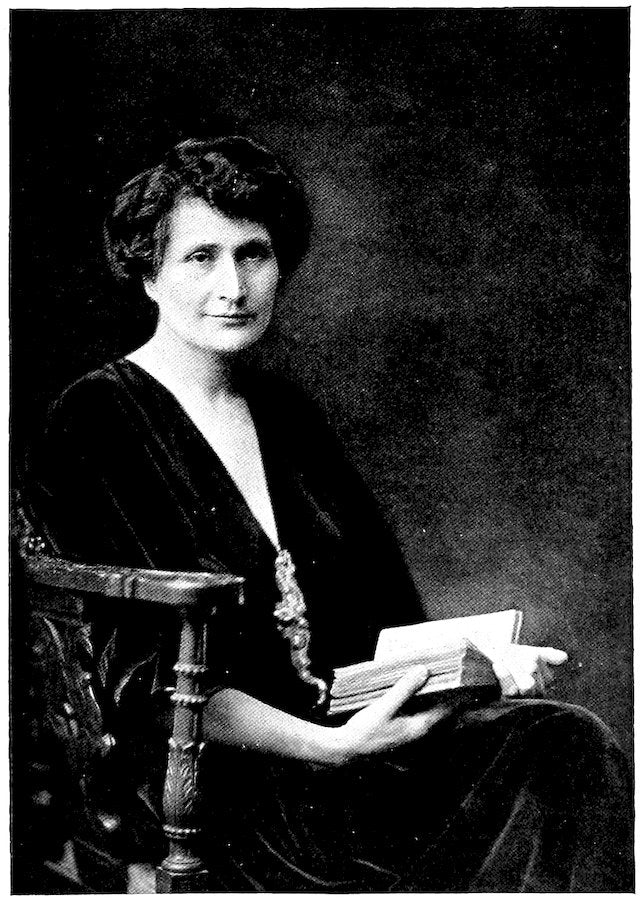
The photograph used for the cover was taken by L. Fréon in Neuilly and published in My Days and Dreams by Edward Carpenter in 1916. It depicts Marcelle Sénard during her lifetime and is now in the public domain through the digitized edition by Project Gutenberg.

Par Olivier of Aeternum
Passionate about esoteric traditions and the history of the occult from the earliest civilizations to the 18th century, I share articles exploring these subjects. I am also a co-founder of Aeternum, the online esoteric store.