















































































































































































































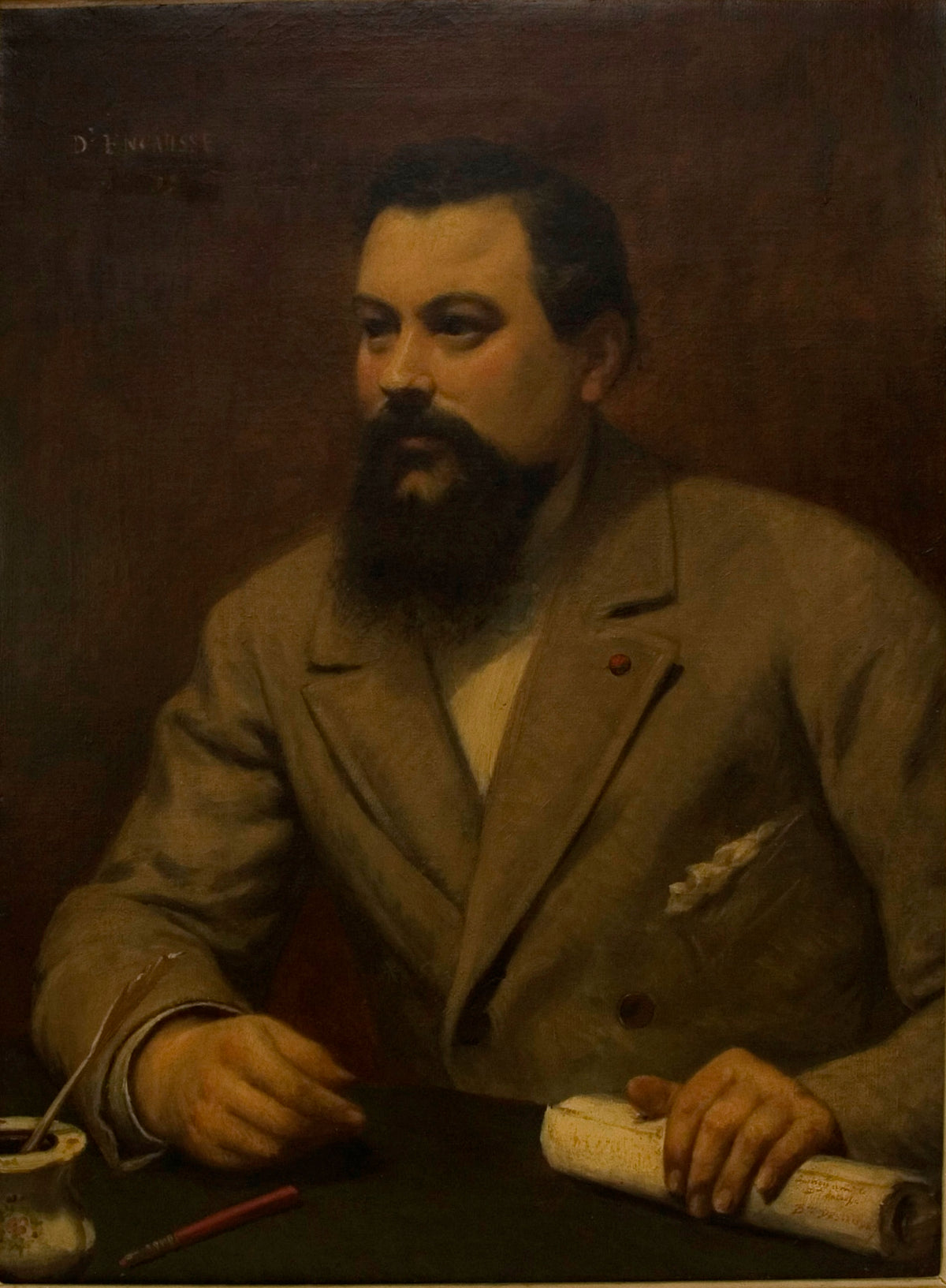
Gérard Encausse, better known by the pseudonym Papus, was one of the major figures of French occultism at the end of the 19th century and the beginning of the 20th century. A physician, author, journal editor, organizer of initiatory groups, and founder of the Martinist Order, he occupied a central place in the esoteric revival of the Belle Époque. His influence rested not only on his doctrines, but also on an exceptional ability to create networks, journals, schools, publishing houses, and structures for the transmission of knowledge.
A genuine initiatory legend formed around Papus very early on. He was said to be the grand master of numerous secret societies, an occult adviser to Nicholas II, the imperial family’s physician, a summoner of the dead at Tsarskoye Selo, or an adversary of Rasputin. Some of these accounts came from his disciples and family, while others came from the press. They are not all equally well documented, but they reveal something very real: to his contemporaries, Papus appeared to be a man capable of moving between medicine, politics, initiatory societies, and the invisible world.
The Bibliothèque nationale de France retains a well-established chronology: Gérard Encausse was born on July 13, 1865, in Spain and died in Paris on October 25, 1916. It describes him as a physician, occultist, founder of the Martinist Order, and founder of the journal L’Initiation in 1888. From this foundation, printed archives make it possible to reconstruct a far richer career than that of a mere “Parisian magus.”
A Birth in La Coruña and a Parisian Childhood
Gérard Anaclet Vincent Encausse was born on July 13, 1865, in La Coruña, Galicia. His father was French and his mother Spanish. The family later settled in Paris, where Gérard spent most of his youth.
This Franco-Spanish dual heritage would remain a component of his identity, but it was in Paris that he truly received his education. The capital at the end of the 19th century offered exceptional opportunities for anyone interested in medicine, magnetism, spiritualism, theosophy, Kabbalah, and initiatory societies.
Encausse grew up during a period when the boundaries between psychic research, fringe medicine, magnetism, religious philosophy, and occultism were still porous. Hypnosis experiments were the subject of debate, psychic research societies were multiplying, Allan Kardec’s Spiritism already had a substantial following, and the works of Éliphas Lévi were being extensively revisited. This context explains the dual path he chose early on: medicine on one side, and the study of occultism on the other.
Gérard Encausse adopts the name Papus in the 1880s. This pseudonym is borrowed from the Nuctéméron, a text attributed to Apollonius of Tyana and popularized in occultist circles by Éliphas Lévi.
In the esoteric editions of this text, Papus is presented as one of the genies associated with the hours. The French occultist tradition connects him with medicine, which explains the particular appeal of the name to Encausse, who was already engaged in medical studies.
The pseudonym also functions as a public identity. Gérard Encausse signs his medical texts with his civil name, while Papus gradually becomes the signature under which his major works on occultism are published.
This separation is never complete: the doctor and the occultist work in parallel, and Papus would spend his life presenting his esoteric research as compatible with a methodical approach to the body and nature.
Even before becoming a doctor, Gérard Encausse published works. The BnF preserves a text entitled Hypotheses dating from 1884. In the mid-1880s, he became increasingly active in networks devoted to occultism.
In 1887, Contemporary Occultism is published, a work devoted to Louis Lucas, Wroński, Éliphas Lévi, Saint-Yves d’Alveydre, and Helena Blavatsky. The choice of these figures already reveals his project: to establish a contemporary genealogy of occult science and create connections between several schools.
In 1888, he publishes Elementary Treatise on Occult Science, whose subtitle promises to enable readers to understand the theories and symbols used by the ancients, alchemists, and Freemasons. This desire to popularize knowledge would become one of his defining characteristics. Papus does not write for a small, closed elite. He wants to organize doctrines, make them accessible, and provide the public with methods of classification.
The Influence of Éliphas Lévi
The work of Éliphas Lévi plays a major role in shaping Papus. Lévi provides him with a vocabulary of magic, a reading of the tarot, a theory of correspondences, and above all the idea that occultism can form a general discipline capable of unifying several traditions.
Papus would devote texts to him and help establish Lévi as one of the great forebears of modern French occultism. He also adopted Lévi’s tendency to read symbols as fragments of a lost general science that had later been reconstructed.
However, he did not merely imitate Lévi. Papus also added a pronounced taste for classification, diagrams, tables, and systematic correspondences. His books resemble manuals intended to organize a field he considered too scattered. This approach explains his extraordinary editorial productivity. The same question could be addressed in a manual, a pamphlet, a lecture, a journal article, and a course.
At the end of the 1880s, Papus took part in the French branch of the Theosophical Society. The BnF preserves, in particular, an 1888 pamphlet entitled Fabre d’Olivet et Saint-Yves d’Alveydre, published in the “Publications of Isis, French branch of the Theosophical Society.” This affiliation was important but did not last. Papus gradually distanced himself from the Theosophical Society and from the direction Helena Blavatsky gave to the study of Asian traditions. Instead, he wanted to reconstruct a Western school based on Hermeticism, Christian Kabbalah, Éliphas Lévi, Saint-Yves d’Alveydre, and the French illuminist tradition.
This shift toward Western esotericism helped distinguish the Papusian milieu from theosophy. It also explains why Papus would become a major figure in what historians describe as French occultism during the Belle Époque.
L’Initiation, the major organ of dissemination
In October 1888, the first issue of L’Initiation appeared. The Bibliothèque nationale de France preserves the series and confirms monthly publication from October 1888 through September 1912.
The journal bears the subtitle “independent philosophical journal of higher studies” and announces fields such as hypnotism and theosophy. Gérard Encausse is its publishing director.
L’Initiation quickly became much more than a personal journal. It provided a place of publication for an entire milieu: occultists, Martinists, magnetists, religious authors, psychical researchers, and spiritualist Freemasons.
The journal’s role was decisive. A doctrine exists not only through its founder’s books; it also exists through exchanges, reviews, debates, and the circulation of texts. L’Initiation created this space.
After 1912, the journal gave way to Mysteria, published under Papus’s direction in 1913-1914. A network of booksellers and publishers also formed around Papus. Librairie du Merveilleux became one of the emblematic venues of Parisian occultist life.
Specialist bookshops then played a role similar to that of today’s forums or digital networks: people went there to buy books, but also to meet authors, students, publishers, and members of initiatory societies. Figures such as Stanislas de Guaita, Joséphin Péladan, François-Charles Barlet, Marc Haven, Sédir, and several of Papus’s collaborators crossed paths in these networks.
French occultism during the Belle Époque was therefore not a series of isolated authors. It was an organized intellectual milieu, with its journals, publishing houses, disputes, and schools.
Stanislas de Guaita and the Kabbalistic Order of the Rose-Cross
Papus joined the circle formed around Stanislas de Guaita and Joséphin Péladan. The Kabbalistic Order of the Rose-Cross emerged at the end of the 1880s and brought together several figures from Parisian occultism. Papus played an active role in it. The order sought to give an intellectual structure to the study of Kabbalah, hermeticism, and Rosicrucian traditions.
The relationships between these men were not always simple. Péladan distanced himself from the group and founded his own Catholic and aesthetic Rosicrucian movement. Guaita and Papus, for their part, pursued a more directly occultist orientation.
This period explains the strong interconnection between the biographies of the great French occultists of the late 19th century. Papus cannot be understood without Guaita, just as Guaita cannot be separated from Lévi, Péladan, Barlet, and the circle surrounding L’Initiation.
In December 1889, Papus created the Independent Group for Esoteric Studies, generally abbreviated as GIEE. Its purpose was educational: to organize research, courses, and lectures. The group became an external structure enabling people interested in occultism to study before possibly joining an initiatory society.
In 1897, this activity took the name Free Faculty of Hermetic Sciences. The BnF directly associates Gérard Encausse with this institution. This project reflects the almost scholastic character of Papus’s occultism. He did not merely want to transmit secret degrees. He sought to establish curricula, courses, and a hierarchy of knowledge. This educational approach greatly contributed to his success. It gave occultism the appearance of a structured field, with its disciplines, methods, and manuals.
Martinism Before Papus
The word Martinism is one of the most difficult terms in the history of French esotericism because it encompasses several different realities. In the 18th century, Martinez de Pasqually founded the Order of Élus Coëns, a theurgical and Masonic system. Jean-Baptiste Willermoz subsequently developed the Rectified Scottish Rite, while Louis-Claude de Saint-Martin largely abandoned the ritual work of the Élus Coëns in favor of an inner path focused on the regeneration of man.
These three legacies are connected but are not identical. The “Martinism” created around Papus at the end of the 19th century was therefore not simply the institutional continuation of Martinez de Pasqually's order. David Allen Harvey describes this French neo-Martinism as a modern synthesis that drew on the Illuminist heritage to address the religious and political problems of post-Revolutionary France.
According to the traditional account, Papus and Augustin Chaboseau discovered in the 1880s that each possessed an individual transmission connected to Saint-Martin. These private initiatory lineages are difficult to document according to current historical standards. Nevertheless, they play a foundational role in the movement's memory.
Papus and Chaboseau decided to combine their transmissions and create an organized structure. The exact date of the first activities varies according to the sources. The BnF dates the birth of the Martinist Order to around 1882 with a question mark, while also noting that a standard Masonic source gives 1891. Contemporary historians generally place the formalization of the movement around 1891. It is therefore misleading to claim that the Martinist Order was “co-founded in 1884” as an already structured institution.
1891, the formalization of the Martinist Order
Around 1891, the Martinist Order took on a clearer institutional form, with a Supreme Council and Papus at its head. The movement used a relatively simple degree system and placed the figure of the “Unknown Superior” at its center. It claimed to pursue a path of spiritual reintegration inspired by Saint-Martin and French Illuminism.
Papusian Martinism spread rapidly through journals and foreign correspondents. Groups appeared in Europe, the Russian Empire, and the American continent. This expansion was one of Papus's major achievements. The Order was not merely a Parisian society: it became an international network.
Papus did not merely lead the Order. He sought to reconstruct its history. He published works on Martinez de Pasqually, Saint-Martin, and the various currents of French Illuminism. In 1899, Martinésisme, willermosisme, martinisme et franc-maçonnerie was published. In 1902, he devoted an entire book to Louis-Claude de Saint-Martin.
These works remain important because they preserved or reproduced documents, but they should be read with some distance. Papus also wrote to legitimize the order he led. His way of connecting Martinez, Willermoz, Saint-Martin, and modern Martinism created a genealogy that greatly influenced subsequent generations.
Medicine, Gérard Encausse’s Other Career
At the same time, Gérard Encausse continued his medical studies. The Committee for Historical and Scientific Works indicates that he received his medical doctorate in Paris in July 1894. His medical work is generally associated with L’Anatomie philosophique et ses divisions, published in 1894. The title already reveals his desire to establish correspondences between anatomical structure and general thought.
Encausse was also interested in hypnosis, homeopathy, and several therapeutic methods debated in his time. He directed an Annuaire de l’homéopathie à Paris and published on dosimetry and the cutaneous absorption of medicines.
However, it would be an exaggeration to present him as the founder of “holistic medicine” in the contemporary sense. His career belongs to medicine in the late 19th century, a period when several competing therapeutic schools were still seeking their place. For Papus, medicine primarily becomes a model: the body constitutes an organized system, and he imagines that the universe or society can be studied by analogy.
The Methodical Treatise on Occult Science
In 1891, Traité méthodique de science occulte was published. The title should be noted precisely: it is indeed Traité méthodique de science occulte, not a “Methodical Treatise on Practical Magic.”
The book seeks to synthesize the major doctrines that Papus associates with the occult sciences. It presents general principles, correspondences, classifications, and a method based on analogy.
The analogical method occupies a major place in his thinking. Papus maintains that induction studies details, deduction the whole, while analogy would make it possible to connect the two. This way of reasoning becomes characteristic of his manuals. He compares organs, planets, levels of the human being, and social structures in extensive tables.
In 1889, Papus published Le Tarot des Bohémiens, subtitled “the oldest book in the world, the absolute key to occult science.” The title reflects the theories of his time, but does not correspond to the actual history of the tarot. The cards appeared in Europe at the end of the Middle Ages; they are not an ancient book transmitted intact by a nomadic people.
Papus continues and develops the occultist tradition begun in the 18th century by Court de Gébelin and Etteilla, then transformed in the 19th century by Éliphas Lévi. He links the tarot to the Kabbalah, numbers, letters, and cycles. His influence on French esoteric tarot would be considerable.
Our article Understanding tarot helps distinguish the material history of the cards from these modern occultist constructions. The first edition of La Kabbale, tradition secrète de l’Occident was published in 1892. A second, considerably expanded edition was published in 1903.
Papus presents Kabbalah as one of the great keys to the Western tradition. He draws on Adolphe Franck, Éliphas Lévi, Saint-Yves d’Alveydre, and several authors from his circle.
Here again, his work must be placed in context. Papus's “Kabbalah” belongs to European Christian and occultist Kabbalah. It is not a neutral presentation of the history of Jewish traditions.
His historical importance lies elsewhere: he helped spread in France a vocabulary of the sefirot, the Kabbalistic tree, and correspondences that would become ubiquitous in 20th-century occultism. Our Introduction to Kabbalah helps distinguish these Western receptions from Judaism's own tradition.
The 1890s were also a period of major occultist controversies. The affair of Joseph-Antoine Boullan occupied an important place in the networks of Papus and Stanislas de Guaita.
Joris-Karl Huysmans then gathered a great deal of information about an alleged contemporary Satanism. The work of Ruben van Luijk has shown that much of this information, transmitted notably by Boullan, was highly unreliable.
Papus belonged to the Lévi occultist camp around Guaita. The controversy became public and led to duels, accusations of bewitchment, and press articles. This episode contributed to the dark legend of Parisian occultism. It also shows that conflicts between occultists did not take place only in closed circles: they became a media spectacle.
One encounter gradually transformed Papus's path: that with Nizier Anthelme Philippe, better known as Maître Philippe of Lyon. Martinist circles date their meeting to around 1894. Papus later presented Philippe as his “spiritual master,” while Saint-Yves d’Alveydre occupied more the role of intellectual master.
Philippe is known as a healer and a man of prayer. His influence led Papus to give greater importance to charity, inner Christianity, and a moral transformation that does not depend solely on the study of the occult sciences.
This development is comparable in some respects to that of Paul Sédir, who was close to Papus but moved even more clearly away from occultist organizations to devote himself to Christianity.
Russia, between history and legend
Papus’s connections with Russia contributed greatly to his legend. It is certain that his movement had Russian contacts and that he traveled to Russia at the turn of the 20th century. His pseudonym “Niet” appears in La Russie d’aujourd’hui, published in 1902, and the BnF associates this work with Gérard Encausse.
Family and Martinist tradition attributes three important journeys to Papus, in 1901, 1905, and 1906. The 1901 journey, in the milieu of Philippe of Lyon and circles close to the court, constitutes the best-established core.
From that point onward, a much more spectacular narrative developed: Papus was supposedly summoned by Nicholas II, conducted mediumistic séances, and invoked the spirit of Alexander III to obtain political advice.
The problem is that these episodes come largely from Martinist memoirs and later accounts. They must be presented as such. A contemporary source helps measure how this reputation was constructed. In July 1906, Le Petit Parisien published an article entitled “The Tsar’s Medium?”
The newspaper reported dispatches claiming that Papus had become a powerful figure at the court of Peterhof and was organizing séances that influenced Nicholas II’s decisions. But the article immediately specifies that Papus was then in Paris and denies several rumors circulating about him. This document is valuable: it does not confirm the extraordinary stories, but shows that they already existed during Papus’s lifetime.
His Russian connections and proximity to certain court networks are quite real; around them developed the more mysterious image of the “tsar’s medium,” fueled by the press, Martinist memoirs, and the era’s fascination with occult advisers to sovereigns. Later accounts readily set Papus against Grigori Rasputin. Papus allegedly warned Nicholas II and Alexandra about the danger posed by the Siberian religious figure.
This story fits well with the competition between spiritual figures surrounding the Russian court, but the evidence needed to make it a central episode in Papus’s career remains limited.
One must certainly not construct a simplistic succession in which Papus was the Romanovs’ “official occult adviser” before being replaced by Rasputin. The Russian imperial court received several religious figures, healers, and advisers, in an environment where personal relationships changed rapidly.
Papus’s presence in this world is historically interesting; turning it into an official role is not. Papus’s relationship with Freemasonry is complex. Contrary to a frequent claim, he was not simply “elected Grand Master of Freemasonry in 1901.”
He had difficult relationships with certain regular French obediences, while seeking spiritualist Masonic systems that corresponded more closely to his program. He received patents connected with the Swedenborgian rite through John Yarker. In 1908, he organized an important Masonic and spiritualist conference in Paris.
That year, around Papus, Teder, and Theodor Reuss, a Supreme Grand Council connected with the Ancient and Primitive Rite of Memphis-Misraïm in France was established. Papus's role was therefore real but must be stated precisely: he led spiritualist and marginal Masonic structures in relation to the major French obediences, rather than “Freemasonry” as a whole.
The spiritualist Masonic congress of June 1908 was one of the high points of his institutional activity. It brought representatives of several initiatic and Masonic organizations together in Paris. Theodor Reuss, who was associated with the Ordo Templi Orientis and Germanic Masonic rites, participated in this environment.
Papus sought to build an international alliance of spiritualist rites in opposition to a French Freemasonry he considered too rationalist or too political. This desire for international organization was characteristic of his method. Papus was never content with a doctrinal school; he wanted structures, charters, journals, and networks capable of connecting the groups.
Papus also maintained ties with the French Gnostic movement formed around Jules Doinel. This modern Gnostic Church emerged in the same climate as Martinism and occultist Rosicrucianism. It incorporated elements of ancient Gnostic Christianity but reworked them according to the esoteric ideas of the late 19th century.
The exact affiliations and titles attributed to Papus vary according to internal sources. What is certain is his participation in the network through which Doinel, Bricaud, and the leaders of several Gnostic organizations circulated. Our article on Gnosticism helps distinguish ancient movements from the Gnostic churches reinvented in the contemporary era. Papus played a mediating role for an entire generation. Marc Haven, Sédir, Phaneg, Teder, Jean Bricaud, Victor-Émile Michelet, Barlet, and several others worked in his circle.
The young René Guénon also moved through organizations connected with this milieu before breaking with occultism. Mark Sedgwick has shown that Martinism and the groups led by Papus belonged to the intellectual landscape in which Guénon developed his initial positions.
This influence is significant: Papus does not merely transmit doctrines; he provides an infrastructure for authors who would later take very different directions. Some would remain Martinists, while others would turn toward a Christian path, Freemasonry, Gnosticism, or radical criticism of occultism.
For Papus, the universe is organized by analogies. Man constitutes a microcosm that reflects more general laws. He readily uses ternary schemes: body, soul, and spirit; matter, life, and intelligence; the physical plane, the astral plane, and the spiritual plane.
This synthesis-based approach seeks to integrate the sciences of his time without abandoning occult correspondences. Papus uses terms from physiology, electricity, magnetism, and medicine to explain concepts inherited from magic. Our article The world according to Papus specifically develops this doctrinal framework, so that the present page remains a true biography.
The First World War
When the First World War broke out, Gérard Encausse was nearly fifty years old. He withdrew some of his occultist activities and served as a doctor. The biographical tradition portrays him working in military medical facilities and exhausting himself in the service of the wounded. Several Martinist sources indicate that this period severely damaged his health.
It is necessary to remain measured about the heroic details added after his death. His medical commitment during the war is attested by the consistent biographical tradition and by documents from those around him, but certain scenes of absolute devotion belong to the posthumous tribute.
What is indisputable is that Papus died in the midst of the war, while several of his networks were disorganized and the Belle Époque world to which he belonged was disappearing.
Gérard Encausse died in Paris on October 25, 1916, at the age of 51. This date is confirmed by the National Library of France and the Committee for Historical and Scientific Works.
Pulmonary tuberculosis is given as the cause of death in the family and Martinist biographical tradition. It is frequently linked to the exhaustion caused by his medical service during the war.
He is buried in Père-Lachaise Cemetery. His grave is in the 93rd division and bears the name of the Encausse family. Our Guide to occultists in Père-Lachaise places his grave among those of other figures connected to the history of French esotericism.
Papus's death did not bring Martinism to an end, but it opened a period of divisions. Teder succeeded him in some of the structures. Jean Bricaud subsequently played a major role in reorganizing the movement, while other lineages claimed distinct continuities. In the 20th century, several organizations would use the name Martinist Order. They cannot all be regarded as a single institution that remained identical from the time of Papus.
This plurality is important to the history of the movement. “Martinism” today denotes a family of groups and lineages that share a reference to Saint-Martin and Papus, but whose filiations and doctrines may differ.
Why did Papus have such influence?
Papus's strength does not lie in a doctrinal discovery comparable to that of a philosopher constructing an entirely new system. His talent is that of an organizer. He takes Lévi, Saint-Yves, Wroński, Christian Kabbalah, the tarot, Martinism, and magnetism, then transforms them into a curriculum.
He also knew how to use the media of his time: inexpensive books, pamphlets, monthly journals, lectures, bookstores, and international networks. This ability explains why his name appears throughout French-speaking occultism from 1885 to 1914. Where Éliphas Lévi had constructed a symbolic philosophy, Papus constructed a genuine ecosystem.
Papus's output is immense. The BnF links several dozen records to Gérard Encausse and more than two hundred records to his pseudonym. Contemporary Occultism, published in 1887, presents his main modern references. Elementary Treatise on Occult Science, published in 1888, provides a general introduction. The Tarot of the Bohemians, published in 1889, is his major book on the tarot. Methodical Treatise on Occult Science was published in 1891.
Kabbalah, the Secret Tradition of the West was published in 1892 and greatly expanded in 1903. Papus also published on spiritualism, magnetism, hypnosis, alchemy, secret societies, and Martinism. His works on Martinez de Pasqually, Saint-Martin, and French Illuminism are among those that have most shaped the modern memory of these currents.
It would be misleading to read Papus's historical books as academic works in the modern sense. He has a genuine interest in archives and publishes documents. But he also seeks to establish an initiatory continuity and legitimize the organizations to which he belongs.
His accounts of Martinism therefore combine historical documents, oral traditions, and initiatory memory. This combination does not make his books useless. It simply requires us to use them as sources for the history of modern Martinism as much as accounts of the 18th century.
Academic studies of French occultism now make it possible to place Papus within a much broader context. Jean-Pierre Laurant situates him within the history of French Christian esotericism at the end of the 19th century. David Allen Harvey analyzes modern Martinism as an attempt to reconcile the political and religious fractures of postrevolutionary France.
Alex Owen recalls the importance of French occultism and its “high magic” in the spread of European occultism at the turn of the 20th century. Mark Sedgwick finally shows that Papus’s networks formed part of the milieu in which René Guénon developed before becoming one of the leading critics of occultism. This research reveals a Papus who is less legendary but much more interesting: a physician, publisher, organizer, and builder of a modern initiatory culture.
Sources and reference points
The authority record of the Bibliothèque nationale de France is the most reliable source for his dates and activities: born on July 13, 1865, died on October 25, 1916, physician, founder of the Martinist Order and L’Initiation in 1888. The BnF also preserves a considerable portion of his books and periodicals.
The Comité des travaux historiques et scientifiques, affiliated with the École nationale des chartes, provides a biographical entry based on several studies devoted to Papus. It confirms, in particular, his medical doctorate obtained in Paris in July 1894 and lists his principal publications.
For Martinism, David Allen Harvey’s Beyond Enlightenment: Occultism and Politics in Modern France, Northern Illinois University Press, 2005, is a major reference. The book places Papus’s neo-Martinism within French political and religious history and emphasizes its modern character rather than a straightforward institutional continuity with the 18th century.
Jean-Pierre Laurant’s L’Ésotérisme chrétien en France au 19ème siècle examines the milieu to which Éliphas Lévi, Saint-Yves d’Alveydre, Papus, Péladan, Barlet, Sédir, and their contemporaries belonged. The book remains an essential reference for understanding the networks and transformations of French esotericism.
The BnF collections finally make it possible to work directly with primary sources: L’Initiation began appearing in October 1888; Le Tarot des Bohémiens was published in 1889; La Kabbale in 1892; Martinésisme, willermosisme, martinisme et franc-maçonnerie in 1899. These editions make it possible to verify the actual chronology of his work without relying on modern reprints.

Par Olivier of Aeternum
Passionate about esoteric traditions and the history of the occult from the earliest civilizations to the 18th century, I share some articles on these topics. I am also co-creator of the online esoteric shop Aeternum.













un très grand personnage.