







































































































Nizier Anthelme Philippe, better known as Monsieur Philippe or Maître Philippe of Lyon, occupies a unique place in the history of French esotericism. He founded neither an initiatory order, nor a complex doctrine, nor a school comparable to those of Papus or Stanislas de Guaita. Yet several of the leading figures of late-19th-century French occultism gathered around him: Papus, Marc Haven, Phaneg, and Sédir. All of them saw in him something more than a mesmerist.
Philippe, for his part, expressly refused to present himself as a mage. The surviving testimonies show him constantly directing his listeners back toward prayer, charity, forgiveness, personal responsibility, and the Gospel. Those close to him attributed instantaneous healings, remote diagnoses, predictions, and phenomena they interpreted as miraculous. The historian must distinguish these testimonies from what can be established through the archives: his birth in Savoy, his attempts to study medicine in Lyon, his work as a healer, the prosecutions for illegally practicing medicine, his school of mesmerism, his relations with Parisian occultists, his stay with Nicholas II, and his death in L'Arbresle in 1905.
This distinction does not diminish the strangeness of the man. On the contrary, it helps explain why Maître Philippe exerted such fascination. He stood exactly at the crossroads of several worlds: unofficial medicine, mesmerism, popular Christianity, fin-de-siècle occultism, Martinist networks, and European high society. Yet he was absorbed by none of them.
From Sardinian Savoy to Lyon
Nizier Anthelme Philippe was born on April 25, 1849, in Rubathier, a hamlet in Loisieux, Savoy. At the time, the region belonged to the Kingdom of Sardinia; it did not become French until Savoy was annexed in 1860. The National Library of France officially recognizes Loisieux as his place of birth and L'Arbresle as his place of death.
He came from a rural family. As a teenager, he moved to Lyon and worked for a butcher uncle in La Croix-Rousse. Later accounts would surround his youth with numerous episodes of early healing, but their documentation is late. What emerges more clearly is his very early interest in the sick, medicine, and ways of relieving pain.
He attended the Sainte-Barbe institution and then tried to enroll in the health officer program. Between November 1874 and July 1875, he submitted several applications to the Faculty of Medicine and Pharmacy in Lyon. His training was soon interrupted. Disciples' accounts speak of hostility toward his methods; the administrative records mainly show that he failed to obtain the French medical qualification that would have allowed him to practice legally.
This lack of an official diploma followed him throughout his career. Philippe treated and advised patients and received the sick, but institutional medicine refused to regard him as a physician. He nevertheless did not give up his research. His activities extended to chemistry and the manufacture of products. Patents were filed in the late 1870s for hair and dental preparations.
In 1877, he married Jeanne Julie Landar in L’Arbresle. The marriage provided him with a more comfortable material situation. The couple had two children: Jeanne Marie Victoire, born in 1878, and Albert, who died in infancy. In 1897, Victoire married Dr. Emmanuel Lalande, later known as Marc Haven, who would himself become one of the major figures of French occultism and one of Philippe’s close associates.
In 1884, the Bibliothèque nationale de France records a medical doctorate for Nizier Philippe, awarded in Cincinnati. He obtained it remotely with a thesis devoted to the hygiene of pregnancy and childbirth. However, this degree did not give him the right to practice medicine in France. The distinction is important: Philippe did possess a foreign diploma cited in bibliographical sources, but he never became a physician recognized by the French administration.
35 rue Tête-d’Or and the healing séances
It is in Lyon that Monsieur Philippe’s reputation truly takes shape. Regional heritage records confirm that a house at 35 rue de la Tête-d’Or was occupied by him from the 1880s until 1905. The building has disappeared, but the address has become inseparable from his legend.
In this house, Philippe receives sick people and organizes what his close associates call séances. The word does not refer to a spiritist séance. Rather, it is an assembly where people describe their own illnesses or those of a loved one. Philippe asks questions, prays, occasionally asks those present to make a moral commitment, and then announces that the sick person will improve or that no cure can be granted.
The accounts of Alfred Haehl, Papus, Victoire Philippe, and several other witnesses constitute the main body of material underlying the Lyonnais’s thaumaturgical reputation. They include cures attributed to a word, illnesses diagnosed without examination, absent people described precisely, sudden changes of state, and announcements of forthcoming events.
These testimonies are numerous, but to a large extent they come from disciples, friends, or admirers. They must therefore be read as records from a circle convinced that it had witnessed extraordinary phenomena, not as medical trials meeting contemporary standards. This does not prevent us from seriously studying their content, their repetition, and the role they played in shaping Philippe’s circle.
What is most striking is the way Philippe explained his actions. He did not claim the personal magnetism of a healer who simply transmitted a fluid. He spoke of a power that did not belong to him and associated it with God, prayer, and charity. In the session notebooks, healing is linked to moral conduct: not speaking ill of others, forgiving, making amends for a wrong, helping someone poorer than oneself, and returning good for evil.
Illness was therefore never merely physical in his teaching. It became an opportunity to work on oneself and on one’s relationship with others. This language explains why several occultists who came seeking a thaumaturge would eventually see him as a Christian spiritual master.
Philippe did not ask his visitors to join a secret society. He did not confer grades on them. He did not teach them any complicated ritual. This absence is crucial to understanding his place in French occultism: his influence operated through the person, the word, and the relationship, not through an organization.
Justice, Official Medicine, and Magnetism
Such activity could not go without a reaction. Between the late 1880s and the early 1890s, Nizier Philippe was prosecuted several times for illegal medical practice. Sources close to him emphasize the acquittals and the absence of regular payment for the healings. Other documents recall that tensions with the medical profession were very real.
This situation belonged to a period when the boundary between medicine, magnetism, and popular healing was the subject of repeated conflicts. Animal magnetism, inherited from Mesmer and his successors, continued to attract a substantial public, while hypnosis gradually entered the medical field by other routes. Healers and magnetizers therefore occupied a legally precarious position.
Philippe was no stranger to organized magnetism, either. The Annuaire de l’École pratique des hautes études notes that Hector Durville founded an École pratique de magnétisme et de massage in Paris, and that a Lyon branch officially established in 1895 was entrusted to Nizier Anthelme Philippe. The Lyon Archives also report that this school opened in November 1895.
This information is important because it shows a Philippe far more integrated into contemporary networks than the legend of an isolated healing saint would suggest. He took part in a structured movement linked to therapeutic magnetism, teaching, and the dissemination of an alternative approach to health.
Yet here again, Philippe quickly goes beyond the label of magnetizer. His disciples claim that he did not systematically perform the classic passes and that he attributed his results to another power. Magnetic terminology therefore serves as a bridge to the world of his time without exhausting his own discourse.
The tension between these two interpretations explains much of his reputation. To his opponents, he is an uncertified healer. To some magnetists, he is an exceptional practitioner. To Papus and several occultists, he becomes a man possessing a spiritual authority superior to the methods taught in their schools.
Papus, Sédir, and the French occultist world
The encounter with Papus, whose real name was Gérard Encausse, gave Philippe a new place in the history of occultism. Papus was then one of the most active organizers of the French esoteric revival: Martinism, the Kabbalistic Order of the Rose-Cross, journals, bookstores, lectures, and international networks.
Everything thus seems to set the two men apart. Papus classified, organized, published, and founded. Philippe wrote little, codified nothing, and refused to place himself at the head of an order. This difference became precisely the source of Papus's admiration. The occultist physician eventually came to regard the Lyon healer as his spiritual master.
Emmanuel Lalande, known as Marc Haven, Georges Descormiers, known as Phaneg, and Yvon Le Loup, the future Paul Sédir, also gravitated around Philippe. Several belonged to the same Martinist or occultist networks, but Philippe himself should not be presented as a simple Martinist dignitary. The closest testimonies, on the contrary, emphasize his independence from initiatory societies.
This relationship would have consequences for Sédir. After years of active occultism, he gradually withdrew from societies and refocused his life on an inner Christianity. The encounter with Philippe is generally considered one of the major events in this evolution. For Sédir, the pursuit of occult powers gave way to service, prayer, and imitation of Christ.
This shift reveals the effect Philippe had on part of French occultism. He does not necessarily oppose the occult sciences, but he puts their importance into perspective. Knowing how to read symbols, understanding the Kabbalah, or manipulating correspondences is worth nothing, in his teaching, if a person remains dominated by pride, slander, and selfishness.
It is probably this simplicity that is most disconcerting. Occultists come from a world filled with grades, correspondences, sacred names, and invisible hierarchies. Philippe responds to them with elementary moral obligations whose fulfillment is, in reality, much more difficult: forgiving, not judging, helping, enduring, praying.
Imperial Russia, Between Documented History and Legend
The Russian chapter is the one that has produced the most spectacular accounts. At the beginning of the 20th century, Philippe did indeed come into contact with the Russian imperial family. The Lyon Municipal Library, in a documented response devoted to his role among the Romanovs, considers the existence of a privileged relationship with Nicholas II and Alexandra Feodorovna to be certain.
The context is well known. The imperial couple had several daughters but were awaiting a male heir. The Grand Duchesses Militza and Anastasia of Montenegro frequented spiritualist circles and introduced several religious figures or wonder-workers to the court. Philippe entered this circle during the imperial couple’s official visit to France in 1901.
He then stayed in Russia. On November 8, 1901, according to sources gathered by the Lyon Municipal Library, the Imperial Military Medical Academy of Saint Petersburg awarded him a doctorate in medicine. A status linked to sanitary services also gave him a rank equivalent to that of a general. These honors are genuine according to the documentation concerning his stay, even though France still does not recognize these titles as equivalent to a French medical degree.
A much more difficult-to-establish body of stories developed around this historical core. Philippe allegedly predicted the birth of the future tsarevich, influenced the imperial couple’s decisions, received extraordinary gifts, or made impossible diagnoses remotely from Saint Petersburg. Some of these accounts come from people close to him, while others appeared later and changed over the course of the biographies.
A particularly widespread misconception must be dispelled: Philippe did not treat Tsarevich Alexei for hemophilia. Alexei was born in August 1904, when Philippe was no longer visiting the Russian court as he had before, and he died the following year. The role of healer to the child belongs to the history of Rasputin, who arrived in imperial circles later.
It would also be excessive to present Philippe as Rasputin’s direct predecessor in a simple chain of “court magicians.” The two men came from different backgrounds, received different teachings, and had different relationships with power. This comparison was mainly constructed by the press and later accounts fascinated by the religious dimension of the Romanov court.
What remains remarkable is that a Lyon healer without a medical qualification recognized in France was able to gain such intimate access to one of Europe’s most powerful sovereign families. This fact alone explains part of the legend that formed around him during his lifetime.
Jean Chapas, Transmission Without an Initiatory Order
Jean Chapas occupies a central place in the continuity of the Lyon circle. Disciples' accounts relate that Philippe healed him during his childhood and later called him to become his collaborator. The miraculous episodes associated with this first encounter cannot be established independently, but the closeness between the two men is well attested in the following years.
Chapas took part in the sessions and in the Practical School of Magnetism. He gradually became the person Philippe designated as his successor to those who came to ask for help and healing. After the master's death, he continued the meetings at 35 rue Tête-d'Or.
This succession does not resemble that of a great master of an initiatory order. Philippe did not transmit a supreme rank or a secret charter. Continuity rests on fidelity to a way of receiving the sick, teaching, and praying.
This is one of the reasons why his legacy quickly became fragmented. Papus, Sédir, Marc Haven, Jean Chapas, and the other close associates each retained a different facet. Some integrated him into a history of Martinism; others emphasized Christianity; still others focused on healing, magnetism, or thaumaturgy.
This plurality makes Maître Philippe difficult to claim entirely for a single tradition. Those seeking an occultist find his connections with Papus. Those seeking a healer find his Lyon sessions. Those seeking a Christian discover a discourse centered on Christ. Those seeking an initiate note that he precisely refuses to display a lineage.
Victoire's Death and the Final Years
The final period of his life was marked by a considerable family ordeal. His daughter Victoire, wife of Emmanuel Lalande, died in 1904 at the age of twenty-five. The documents and accounts do not all give the same exact date, but they agree on the importance of this death during Philippe's final year.
Testimonies from those close to him recount that he refused to ask for his daughter what he had asked for so many other sick people. In their interpretation, he would have considered Victoire's death to belong to a higher will that he should not oppose. This interpretation belongs to the circle's tradition; it obviously cannot be verified from outside.
Nevertheless, it reveals something about his teaching: healing is never presented as an automatic power. Philippe may announce that certain requests will not be granted. The thaumaturge whom his disciples describe as capable of extraordinary healings therefore accepts, in their own account, not to save the being dearest to him.
His health declined rapidly. He withdrew increasingly to Clos Landar, the family property in L'Arbresle. The Friends of Old L'Arbresle preserve the memory of the site, which remains directly associated with his final years.
Nizier Anthelme Philippe died in L'Arbresle on August 2, 1905, at the age of fifty-six. The Lyon Archives recorded his death on that date under the designation “The Mage.” He was buried in the Loyasse Cemetery in Lyon, where the family tomb remains a place of pilgrimage.
The disappearance of the man did not bring an end to his influence. His words initially circulated in the form of notebooks and notes taken by assistants at the séances. Papus published memoirs. Alfred Haehl later compiled a life and sayings. Philippe Encausse, Papus's son, in turn devoted several works to the Lyon healer. A written tradition thus took shape after the death of a man who had himself published very little.
An occultist who refused to call himself an occultist
The question remains: should Maître Philippe be classified among French occultists? Historically, there is little doubt about his place in this milieu. His best-known associates belonged to organized occultism; he directed a school of magnetism; he was acquainted with Papus, Sédir, Marc Haven, and Phaneg; his name appears in every serious history of the fin-de-siècle movement.
But classifying him as an ordinary occultist would be just as misleading. Philippe did not build his legitimacy on knowledge of grimoires, the Kabbalah, the Tarot, or magical ceremonies. He did not display any initiatory rank. He did not ask to be recognized as the custodian of a secret tradition.
His authority derives from what his disciples believed they had seen. His entire reputation rests on an experience: sick people who said they had been healed, assistants who claimed to have heard words impossible to know, and learned occultists who declared that they had encountered in him a power superior to their own methods.
This situation explains his influence on Papus's generation. Philippe represents the idea that beyond occult systems there existed an operative sainthood, a direct relationship with the divine that would make initiatory constructions secondary. This is precisely what several of his close associates sought after meeting him.
It would be easy to portray him either as an unquestionable saint or as a charlatan. The sources justify neither of these simplifications. They show a genuinely active healer in Lyon for several decades, prosecuted by the authorities, involved with a school of magnetism, surrounded by doctors and occultists, received at the Russian court, and, after his death, becoming the center of a highly influential hagiographic tradition.
Maître Philippe thus remains a borderline figure. Between healer and thaumaturge, magnetism and prayer, occultism and Christianity, verifiable history and extraordinary testimony. This boundary explains why, more than a century after his death, he remains one of the most enigmatic figures in French esotericism.
Sources and reference points
The National Library of France establishes the main biographical facts about Nizier Anthelme Philippe: born on April 25, 1849, in Loisieux; died on August 2, 1905, in L’Arbresle; healer by profession; and medical degree obtained in Cincinnati in 1884. Its catalog also preserves the main biographies and collections of testimonies devoted to Philippe.
The Lyon Archives record the opening in November 1895 of the Practical School of Magnetism and Massage directed by Anthelme Philippe. They also mention his death on August 2, 1905. The Annuaire de l’École pratique des hautes études places this school within Hector Durville’s network and the French magnetism movement.
The General Inventory of the Cultural Heritage of Auvergne-Rhône-Alpes confirms Nizier Anthelme Philippe’s presence at 35 rue de la Tête-d’Or in Lyon from the 1880s until 1905.
The Guichet du Savoir of the Lyon Municipal Library provides a useful file on his relations with Nicholas II and Alexandra Feodorovna. It recalls the Russian medical title awarded in November 1901 and emphasizes the need to distinguish the existence of this relationship from later accounts that exaggerated his role at the court.
The works of Alfred Haehl, Serge Caillet, and Philippe Encausse, along with Victoire Philippe’s notebooks, are the main sources for the tradition within Monsieur Philippe’s circle. They are essential for learning about the words, attributed healings, and disciples’ memories, but they should be read as committed testimonies and compared with administrative records.
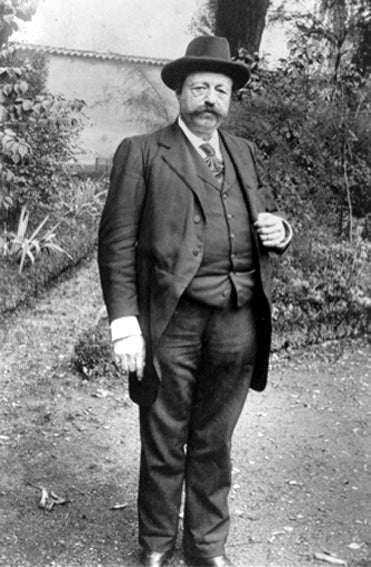
The photograph used on the cover depicts Nizier Anthelme Philippe around 1900. Preserved and distributed on Wikimedia Commons, it is in the public domain. It makes it possible to use a genuine photographic portrait of the figure rather than a contemporary reconstruction.

Par Olivier of Aeternum
Passionate about esoteric traditions and the history of the occult from the earliest civilizations to the 18th century, I share articles exploring these subjects. I am also a co-founder of Aeternum, the online esoteric store.