
























































































































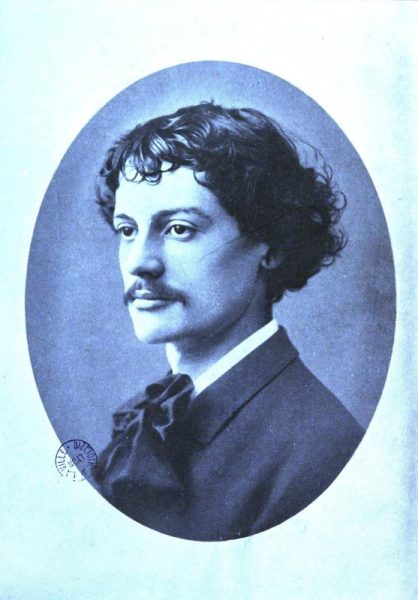
Albert Jounet is one of the most distinctive figures in the revival of French occultism at the end of the 19th century. A Symbolist poet under the name Alber Jhouney, Christian Kabbalist, contributor to Papus’s journals, associate of Stanislas de Guaita, co-founder with René Caillié of the Fraternity of the Star, and later author of The Key of the Zohar, he spent nearly forty years seeking to resolve the same question: how can science, religion, art, social reform, and esoteric tradition be brought together without sacrificing any of these dimensions?
Yet his path does not resemble that of an order leader. Jean-Pierre Laurant, who devoted a study to him at the École pratique des hautes études, notes instead that he had relatively little contact with secret societies and maintained considerable independence. Jounet participated in the world of Papus, Stanislas de Guaita, and Joséphin Péladan, but pursued a highly personal program, which he would notably call Messianic Harmony.
We must first resolve a biographical difficulty. Some modern music databases give Jounet’s dates as 1860–1926. However, sources related to his occult activities converge on 1863–1923 : the 1896 census of Saint-Raphaël lists him as thirty-three years old; a bibliographical guide published in 1916 says he was born in Marseille in January 1863; French manuscript catalogs retain 1863–1923; and Jean-Pierre Laurant uses this same chronology. This is therefore the one we follow here.
Marseille, Paris, and the Birth of Alber Jhouney
Albert Jounet was born in Marseille in January 1863 into a Provençal family. A biographical guide published during his lifetime states that he studied at the lycée in Marseille and then spent a year at the Collège Rollin in Paris. He turned very early toward literature, poetry, and the spiritual questions stirring the young Symbolist generation.
His first collection, The Holy Star, appeared in 1884. It was followed by The Kingdom of God in 1887 and The Black Lilies in 1888. During these years, Jounet changed the spelling of his name to Alber Jhouney. Laurent Tailhade would cruelly mock him in In the Land of the Brute, presenting this spelling as a cabalistic affectation. The satire proves at least that the young author was visible enough in literary Paris to become a target.
Victor-Émile Michelet, who knew him personally, would retain a very different image. He remembered a slender young man with curly hair, exceptionally gentle and wholly absorbed in symbolic questions. Michelet considered him one of the companions of a generation that sought to restore a connection between poetry, tradition, and esoteric knowledge.
Jounet never completely abandoned poetry. Ernest Chausson would set his Cantique à l’épouse, excerpted from Lys noirs, to music, and Albert Cahen d’Anvers would compose several melodies based on his texts. Poetry is therefore not merely a prelude to “serious occultism”: it already constitutes one of the means by which he seeks a language capable of connecting the sensible, the symbol, and the spiritual order.
This quest appears even more clearly in The Book of Judgment, a vast poetic project devoted to Creation, the Fall, Redemption, and Judgment. The themes of the Apocalypse and Kabbalah become architectures of universal history. Jounet then begins to move beyond literature in order to construct a doctrine.
1889, L’Étoile and the Fraternity of the Star
In 1889, Jounet founded the journal L’Étoile with René Caillié. The periodical soon presented itself as an organ of Messianic Kabbalah, Christian socialism, and experimental spiritualism. These three terms summarize the project fairly well: the secret tradition must illuminate religion, religion must produce social transformation, and the invisible world must be studied through psychic phenomena.
The journal does not remain a simple literary periodical. It becomes the center of a Fraternity of the Star, whose manifesto is published in 1889. The organization offers several levels of training, ranging from morality and sociology to the search for spiritual certainty attained through prayer, intuition, and the study of religions.
This fraternity does not resemble Papus’s Martinist Order. Jounet is not primarily seeking to build a chain of degrees or multiply dignities. His project is more open: to bring together people from social Christianity, spiritualism, Kabbalah, occultism, and religious reform movements around a shared idea of synthesis.
The pages of L’Étoile thus feature biblical studies, Kabbalistic texts, translations, and communications attributed to spirits. The periodical nevertheless upholds a distinctly Western and Christian orientation. At a time when the Theosophical Society was popularizing Indian doctrines in Europe, Jounet refused to let Western esotericism be treated as an inferior or exhausted tradition.
Yet his position is less closed than it might seem. Years later, he would translate Patañjali’s Traité de Yoga, published by Chacornac in 1914. This contrast is characteristic of Jounet: he defended the priority of his Christian synthesis without ceasing to study other traditions.
Guaita, Papus, and the Kabbalistic Rose-Cross
In the occultist Paris of the 1880s and 1890s, Jounet was fully recognized as a Kabbalist. Stanislas de Guaita, in Au seuil du mystère, cites “two new Kabbalists,” Alber Jhouney and Papus, together. The wording is important because it comes from a contemporary directly involved in the same networks.
Jounet maintained good relations with Guaita. The latter’s library contained several works by Jounet bearing dedications and Kabbalistic signs. Documents published later in L’Initiation also associate Jounet with the name Nergal in the environment of the Kabbalistic Order of the Rose-Cross.
Yet these elements should not be turned into the career of an organizational man. Jean-Pierre Laurant emphasizes that Jounet had relatively little contact with secret societies. He participated in their milieu, corresponded with their leaders, and appears in their archives, but remained more a writer and theoretician than an administrator of orders.
This independence distinguishes him from Papus. Papus built institutions, created courses, organized congresses, and developed an international network. Jounet was more interested in defining the intellectual and spiritual content that these organizations should serve. The two men met in journals and spiritualist movements, without being interchangeable.
His relationship with Sédir belongs to the same landscape. Both knew the occultism of the Belle Époque, but each would move toward a more openly embraced form of Christianity. In Jounet’s case, this movement became particularly visible from the mid-1890s onward.
1895, return to Catholicism without abandoning esotericism
In October 1895, Jounet returned more clearly to the fold of the Catholic Church. This choice brought about a transformation of his environment. L’Étoile soon ceased to appear in its original form, and Jounet attempted to promote a highly liberal Catholic reform capable of integrating science, esotericism, and independent research.
This return therefore does not constitute a simple repudiation of his years as an occultist. Rather, he seeks to move esotericism inside Christianity. For him, Kabbalah, psychic science, and symbolic traditions can help restore a lost dimension of religion.
Tension with the institution was inevitable. Jounet wanted a Church capable of advancing its interpretation, engaging in dialogue with scientific discoveries and recognizing the existence of an inner tradition. His writings from the end of the century addressed religious freedom, psychology, salvation, Catholic doctrine and the relationship between Christianity and other religions.
This period saw the publication of Ontomystical Proof of God, The Spiritual Sacraments, General Principles of Psychic Science, Catholic Doctrine and the Psychic Body, and then Jesus Christ According to the Gospel. Jounet sought to demonstrate that faith could be supported by reason and that reason, when properly pursued, opened the way to the spiritual.
His objective remained the same: to abolish the separation between domains that were at odds with one another. Where positivism opposed science and religion, Jounet wanted a science open to the spirit and a religion capable of examination. Where socialism rejected religion, he envisioned a socialism founded on Christian fraternity.
Messianic Harmony, an occultism that seeks to transform society
Jounet's occultism never stopped at hidden phenomena. As early as Esotericism and Socialism in 1893, he sought to translate spiritual principles into the social order. This orientation later became what he called Messianic Harmony.
His idea was ambitious: religious, philosophical, scientific and political conflicts were symptoms of a humanity that no longer knew how to perceive unity behind its differences. It was therefore necessary to build forms of cooperation capable of bringing together partial truths without crushing them.
Jounet published The Social Question, the Harmonists, Elements of Messianic Harmony and Social Redemption. He envisioned religious, intellectual and political institutions flexible enough to enable collaboration among believers, rationalists, artists, scholars and reformers.
This doctrine explains his interest in major international congresses on religion and in projects for the peaceful unification of humanity. After the First World War, the hopes placed in the League of Nations gave new relevance to his ideas of universal harmony.
However, it would be misleading to portray him as a direct precursor of modern international institutions. Jounet still thought in messianic and esoteric terms. For him, social unification was inseparable from a spiritual transformation of the human being.
1909, The Key to the Zohar
In 1909, the Chacornac Library published The Key to the Zohar: Clarification and Complete Unification of the Mysteries of the Kabbalah in the Classics of the Occult collection. The National Library of France holds this 231-page edition.
The title expresses the full scope of Jounet's ambition. He does not merely want to present the Zohar. He wants to offer a “key” to it, that is, to identify a structure capable of unifying passages considered obscure or contradictory. This approach belongs directly to the synthetic occultism of his time.
Jounet reads Kabbalah through a Christian framework. This is not the reading of rabbinical Judaism or of contemporary Kabbalah scholarship. It belongs to the long tradition of Christian Kabbalah, in which Hebrew texts are interpreted as bearing truths compatible with Christianity.
He also uses scientific analogies characteristic of the early 20th century: electricity, magnetism, polarities, and ternary diagrams serve to shed light on certain Zoharic relationships. These parallels may seem dated today, but they show a consistent desire to make traditional language compatible with modern knowledge.
La Clef du Zohar is therefore as much a document about Jounet as it is a book about Kabbalah. It reveals his lifelong obsession: finding the common architecture behind scattered fragments.
Alliance Spiritualiste and an attempt to unite the schools of the invisible
Around 1910, Jounet helped create the Alliance Spiritualiste, with Jeanne Beauchamp and Louis Le Leu. The movement sought to be a neutral federation capable of bringing together spiritualist schools that spent much of their time fighting one another.
This initiative directly extends the Harmonie messianique. Spiritualists, occultists, psychical researchers, and religious figures may differ in their interpretation of the phenomena; Jounet believed that they should nevertheless cooperate on what they had in common.
The archives preserve letters from 1911 written on Alliance Spiritualiste letterhead. Periodicals of the time also mention Jounet among the organizers of spiritualist conferences and action committees alongside Papus, Gabriel Delanne, Camille Flammarion, and other figures in the movement.
René Guénon would severely criticize this type of project. In his view, bringing together schools based on incompatible principles mainly produces confusion. This criticism belongs to Guénon's system, which seeks to radically distinguish initiatory tradition, spiritualism, and modern occultism. Nevertheless, it shows that Jounet remained visible enough to become a target in the esoteric debates of the early 20th century.
Jounet continued to contribute to several journals: L’Initiation, Le Voile d’Isis, La Voie, and La Synthèse. His activity therefore never became confined to a fixed structure.
1923, the death of a Kabbalist whom his era had almost forgotten
Jounet’s final years are quieter. Victor-Émile Michelet recounts in his memoirs that he gradually lost his sight and that his final letters were darkened by this ordeal. He died in 1923; Michelet dates his death to December 23, around the time of the winter solstice.
His death goes almost unnoticed in the literary world. Michelet himself notes this: the man had long since withdrawn from the bustle of the literary circles that had accompanied his youth. The manuscripts he left behind were, according to the same account, destroyed in accordance with his wishes.
The material disappearance of some of his papers probably explains why the figure faded from view. Jounet had nevertheless been at the center of several networks: Symbolist poetry, Kabbalah, the Rosicrucians, spiritualism, Catholic reform, and movements for social synthesis.
His work survives today in fragmentary form. The Key to the Zohar continues to circulate among readers of Christian Kabbalah. Historians of occultism encounter L’Étoile. Musicologists rediscover his poems in the works of Chausson and Cahen d’Anvers. Martinist and Rosicrucian archives preserve his name alongside those of Guaita and Papus.
It is precisely this dispersion that makes Jounet interesting. He is not merely a Kabbalist, poet, or Christian socialist. These three dimensions belong to the same project: recovering, behind modern divisions, a unity capable of connecting human beings, the cosmos, and society.
Why Albert Jounet Deserves to Reclaim His Place in French Occultism
Albert Jounet first helps us understand that the French Kabbalah of the Belle Époque cannot be reduced to Papus and Guaita. Around them exists an entire milieu of readers, translators, and doctrinaires seeking to reconstruct a Western tradition capable of competing with Orientalizing theosophy.
He then shows how political the occultism of this period could be. Symbols serve not only to explain the soul or invisible worlds. Jounet wants them to help reform the Church, socialism, and relations between peoples.
His career finally reveals a tension running through the entire history of modern esotericism: should one remain in initiatory societies or return to historical religions? Jounet tries both paths without managing to separate them completely. He joins the Rosicrucians, founds his own fraternity, returns to Catholicism, and then continues publishing on the Kabbalah and psychic sciences.
This apparent contradiction may be the best summary of his era. At the end of the 19th century, French occultism was not seeking only ancient secrets. It was seeking a new form of civilization. Albert Jounet was one of those who took this dream seriously to the very end.
Sources and references
Jean-Pierre Laurant, in his lecture published by the École pratique des hautes études under the title Un Kabbaliste chrétien à la Belle-Époque : Albert Jounet (1863-1923), provides one of the best historical frameworks for understanding Jounet, L’Étoile, his return to Catholicism in 1895, and his project of reconciling science and religion.
The Ministry of Culture, in its inventory of the Villa Albert in Saint-Raphaël, states that in 1896 Albert Jounet, a man of letters, was thirty-three years old. This document supports the 1863–1923 chronology adopted by historians of his esoteric activity.
The guide Poètes d’hier et d’aujourd’hui, published in 1916 and now available on Wikisource, states that he was born in Marseille in January 1863 and provides an extensive bibliography of his publications through the beginning of the 20th century.
The Bibliothèque nationale de France preserves the original edition of La Clef du Zohar, published in Paris by the Bibliothèque Chacornac in 1909 as part of the Les Classiques de l’occulte collection. The BnF likewise identifies Albert Jounet (1863-1923) as the author.
The archives of the International Association for the Preservation of Spiritualist and Occult Periodicals make it possible to trace the journal L’Étoile and the Fraternity founded with René Caillié. They also document the Spiritualist Alliance created in the early 1910s.
The photograph used on the cover comes from the 1905 reissue of L’Étoile sainte. Les Lys noirs published by the Bibliothèque Chacornac. It depicts Albert Jounet during his lifetime and is an authentic historical portrait, reproduced from the old edition.

Par Olivier of Aeternum
Passionate about esoteric traditions and the history of the occult from the earliest civilizations to the 18th century, I share articles exploring these subjects. I am also a co-founder of Aeternum, the online esoteric store.