















































































































































































































The alchemical Great Work is not a simple four-step journey. Contemporary manuals readily summarize alchemy as an immutable sequence - black, white, yellow, red - as though every author followed the same protocol. Historical texts reveal a more fluid reality. Colors matter, but their number, order, and the operations associated with them vary according to the periods, languages, and schools.
Alchemy itself cannot be reduced to the making of gold, an early form of psychology, or a “primitive chemistry” that simply awaited modern science. It was at once a set of laboratory practices, a theory of matter, an art of transmutation, a chemical medicine, a language of images, and, for some authors, a religious reflection on nature and its perfection.
Alchemy was an art of matter before it became a metaphor
The earliest traditions that historians associate with Western alchemy developed in Greco-Roman Egypt. Technical recipes for coloring metals, making alloys, dyeing, or imitating materials gradually became intertwined with more ambitious theories about the transformation of matter.
Zosimos of Panopolis, active around the year 300, is one of the earliest alchemical authors from whom we possess a substantial body of texts. Born in Panopolis, present-day Akhmim in Egypt, he described apparatuses, furnaces, procedures, and visions in which material work also took on a religious and symbolic dimension. The Science History Institute presents him as one of the founding figures of the Greco-Egyptian alchemical tradition.
Greek knowledge was then taken up and transformed in the Arab world before reaching the Latin West. From the Middle Ages onward, translations, commentaries, and new treatises multiplied theories about metals, sulfur, mercury, elixirs, and the possibility of accelerating transformations that nature would carry out slowly underground.
Speaking of alchemy as merely an “ancestor of chemistry” therefore remains inadequate. Alchemists did indeed work with furnaces, retorts, crucibles, salts, acids, metals, and distillation. They passed on know-how that belongs to the history of chemistry and pharmacy. But their goals, their theory of matter, and their religious framework are not those of a contemporary laboratory.
This complexity explains why historians sometimes use the English word chymistry to refer to the 16th and 17th centuries: it avoids too sharply separating "alchemy" and "chemistry" at a time when this boundary did not yet have its current meaning.
What does the Great Work refer to?
The Great Work refers, in alchemical literature, to the work that leads to the preparation of the Philosopher's Stone or a comparable transmuting agent. It should not be imagined as an identical recipe transmitted intact from antiquity to the 18th century.
The authors describe different prima materiae, use cover names, conceal certain operations, and contradict one another on points that nevertheless appear fundamental. Jennifer M. Rampling has shown how treatises claiming to provide precise instructions could deliberately omit information, substitute symbolic names for substances, or use language that only readers who were already trained could hope to interpret.
This obscurity is not merely literary. Alchemy operates within a culture of secrecy. The adept's knowledge must be protected, transmitted in a controlled manner, and recognized behind words such as Sun, Moon, Green Lion, Philosophers' Mercury, Philosophical Sulfur, King, Queen, or dragon. These terms do not always mean the same thing from one author to another.
The materia prima, or prima materia, belongs to this vocabulary. It does not necessarily correspond to a simple substance that one could purchase under this name. In many texts, it is precisely one of the great secrets of the Work.
Colors are signs of transformation
In many alchemical texts, the matter changes color during the work. These changes serve as markers for assessing the state of the operation. Black, white, yellow, and red thus become major milestones in alchemical literature.
However, we must abandon the idea of a universal, rigid sequence. Recent research into the history of alchemical colors shows that the four-color scheme - black, white, yellow, and red - is ancient, but that from the 15th century onward, many authors favored a triad of black, white, and red. Yellow could then be absorbed into the progression toward the final red.
The Latin vocabulary that has become famous today — nigredo, albedo, citrinitas, rubedo — therefore provides an excellent way to understand a family of alchemical descriptions, not a mandatory table of contents for all alchemy.
Our article The Language of Colors in Magic and Occultism explores the role of colors in Western systems in greater detail.
Nigredo, when matter turns black
Nigredo denotes blackness. In texts where it appears, it signals a transformation of matter associated with death, putrefaction, corruption, or the decomposition of the previous form.
Directly equating nigredo with calcination is too mechanical. Calcination can produce a dark substance, but alchemical texts also link blackness to putrefaction, digestion, the fermentation of certain substances, or specific reactions occurring in the vessel.
The image of death is not, however, merely a modern addition. Alchemical authors themselves speak of bodies that must die, be corrupted, or buried before being reborn in another form. This language draws on natural cycles, medicine, and Christianity. The seed that disappears into the earth before germinating, the body placed in the tomb, or matter that decomposes become models for thinking about transformation.
It remains important to preserve the order of the planes: in historical texts, black initially refers to the work on matter. Reading nigredo as an individual’s psychological crisis belongs to a much later reinterpretation.
Albedo, the appearance of white
Albedo corresponds to whiteness. It indicates the attainment of a new state of matter after the dark phase. Authors associate it with purification, washing, sublimation, separation, or the fixation of a white body, depending on the process followed.
In some medieval treatises, the transition from black to white already constitutes a major stage of the Work. Some texts associate albedo with the Moon, silver, a white queen, or images of resurrection. These figures do not imply that a single chemical process lies behind all the descriptions.
Historical research on alchemical laboratories shows that actual operations could produce spectacular visual changes: sublimation of substances, salt formation, phase changes, precipitation, crystallization, or progressive purification. Symbolic language therefore often draws on material observation, even when the author subsequently develops it within a theological or cosmological framework.
Citrinitas, the yellow that does not always appear
Citrinitas refers to yellowing. It occupies a remarkable place precisely because it shows that the famous series of four stages is not fixed.
In medieval traditions, black, white, yellow, and red can form a sequence. However, scholarship on the history of alchemical colors shows that from the 15th century onward, citrinitas loses its autonomy in part of the literature. The transition from white to red can be described without a clearly separate yellow stage.
It is therefore not accurate to claim that citrinitas is by definition equivalent to fermentation. Texts may associate yellowing with maturation, but the operation of fermentation has its own history and does not automatically correspond to a color.
Yellow can be understood as an approach to red, an intermediate stage of maturation, or a sign observed during a given operation. Its status depends on the text being followed.
Rubedo, the red of attainment
Rubedo, or redness, occupies a final position in many Western alchemical schemes. Red then indicates the completion of the process and is linked to the perfection of the Stone.
Alchemists attach great importance to the intensity and stability of this color. Red is not merely a graphic convention: it must indicate that the matter has acquired the desired qualities. Some descriptions evoke a vivid red, purple, or a color comparable to ruby.
Here again, reducing rubedo to “coagulation” gives an overly simple picture. Coagulation is an important alchemical operation, but it can occur in several contexts. According to different authors, the final redness belongs to a set of transformations that also include cooking, multiplication, fixation, and the perfection of matter.
Alchemical red has inspired an immense body of imagery: the solar king, the phoenix, blood, the red rose, the royal child, and the Sun and Moon united. These figures recount the union of opposites, the generation of a new body, and the arrival at a state deemed more perfect.
Calcination, dissolution, sublimation and distillation do not constitute a universal recipe
Alchemical literature uses a broad operative vocabulary: calcination, dissolution, putrefaction, sublimation, distillation, separation, conjunction, fermentation, coagulation, fixation, multiplication. Later authors attempted to arrange these operations in series of seven, twelve, or more.
However, it would be just as misleading to turn these lists into a universal protocol as to reduce the Work to four colors. The same operation may have several names, the same name may cover different actions, and the treatises do not all follow the same order.
Distillation consists of heating a substance to collect the condensed vapors. Sublimation can refer to the passage of a volatile body toward an upper part of the vessel, where it is redeposited. Calcination transforms a substance through fire. Coagulation returns to a more solid state what has been dissolved or made fluid. Putrefaction allows a substance to decay or transform under controlled heat.
These words have a laboratory reality, even when they also become images. This is one reason why contemporary historians refuse to reduce alchemy to a spiritual language detached from all material experimentation.
The Philosopher’s Stone was not merely a machine for making gold
The Philosopher’s Stone represents one of the most famous goals of Western alchemy. In chrysopoeia, it is supposed to enable the transmutation of less noble metals into gold or silver. Alchemical sources also attribute to it, in certain forms, a medical function.
Speaking of “immortality” nevertheless calls for caution. Elixir traditions refer to healing, restoration of the body, prolongation of life, or a universal medicine. The promise of literal immortality as it appears in modern fiction simplifies more complex traditions.
Works devoted to medicinal alchemy in the 16th and 17th centuries also show that metallic transmutation and the search for remedies could converge. In Paracelsus and the traditions that followed him, the laboratory also became a place for preparing chemical medicines. Our article Who Was Paracelsus? examines this turning point, while Spagyria, Alchemy’s Plant Sister shows one particular continuation of it.
The Great Work does not simply oppose matter and spirit
Alchemical texts can unite material operations and highly developed religious thought. This does not mean that every experiment was merely a mask for inner meditation.
Peter Forshaw reminds us that the expression “spiritual alchemy” must be used with caution. There are indeed texts in which material transformation, salvation, perfection, and theology respond to one another. However, modern historiography prefers to speak of several alchemies rather than reducing the entire tradition to a single hidden doctrine.
Christian imagery provides a good example. Medieval and modern alchemists compare matter to Christ, the vessel to a tomb or a tabernacle, and transformation to a death followed by a resurrection. These analogies are genuinely present in the sources. However, they belong to a specific religious culture and accompany work on matter.
The spiritual dimension of historical alchemy therefore exists, but it must not obscure the furnace, the crucible, the ore, and distillation.
Was Nicolas Flamel Really an Alchemist?
Nicolas Flamel did exist. He was a public writer and Parisian bourgeois at the end of the 14th century and the beginning of the 15th century. However, nothing allows us to state with certainty that he was the adept who discovered the Philosopher’s Stone during his lifetime.
The alchemical legend was constructed after his death. The famous Book of Hieroglyphic Figures appeared in 1612, nearly two centuries after Flamel’s time. The National Library of France also classifies Flamel as the “alleged author” of these writings, and the work of Didier Kahn has recalled that the text was attributed to him at a later date.
The fascination is no less real. Flamel has become one of the great figures of French alchemical memory, to the point that later accounts attribute transmutations, unexplained wealth, and extraordinary longevity to him.
To distinguish the historical figure from his legend, see our article Who Is Nicolas Flamel?.
Jung profoundly changed the modern way we read alchemy.
In the 20th century, Carl Gustav Jung proposed a psychological interpretation of alchemical imagery. He saw the texts and engravings as a reservoir of symbols for thinking about the processes of the unconscious and individuation.
This interpretation has had a considerable influence. It explains why current presentations describe the nigredo as a crisis of the ego, the albedo as inner purification, and the rubedo as the fulfillment of the Self.
These correspondences nevertheless belong to Jung and the psychological tradition that followed him. They do not constitute the historical definition of the alchemical stages. Historians of alchemy have emphasized this point: projecting Jungian psychology onto medieval or Renaissance laboratories obscures what alchemists were actually seeking to accomplish with their substances.
It is entirely possible to study the Jungian reading of alchemy, but it must be presented as a modern reinterpretation, not as the secret key that all the ancient adepts used without saying so.
How Should an Alchemical Image Be Read?
An alchemical engraving does not work like a rebus in which each object has a fixed translation. The Sun and Moon, king and queen, dragon, lion, raven, fountain, egg, tree, or child may change function depending on the work.
The image may represent a substance, an operation, a state of the compound, a cosmological principle, or several levels at once. Recent research into alchemical iconography shows that these images could help convey procedures that were difficult to express directly, while also preserving the secret by leaving readers responsible for recognizing the correct interpretation.
To take this approach further, our article Alchemical Symbols looks back at their use, while What Is the Emerald Tablet? places one of the most famous texts of alchemical Hermeticism within its actual tradition.
From Black to Red: What the Great Work Really Tells Us
Black, white, yellow, and red remain magnificent points of reference for entering the imaginary world of alchemy. Their strength lies precisely in the fact that they stand at the intersection of the laboratory and the symbol. A substance turns black, white, or red; at the same time, the author may interpret this change through death, purification, the Sun, the Moon, or resurrection.
But the Great Work must not become a modern formula simpler than the texts it claims to explain. There are neither four absolutely fixed operations nor a universal psychology hidden behind every color. There is a long tradition, made up of recipes, experiments, theories of matter, secrets, commentaries, and images that themselves transform over the centuries.
It is precisely this richness that makes alchemy interesting today. To learn more, the Alchemy Books collection brings together works devoted to its history, texts, and symbols, while our article Everything You Need to Know About Hermeticism helps place alchemy within a broader intellectual framework.
Sources and references
For a general history of alchemy attentive to laboratory practice: Lawrence M. Principe, The Secrets of Alchemy, University of Chicago Press, 2013, as well as the presentation by the Science History Institute.
For the sequence of colors and its evolution: Matteo Martelli, Colours, humours and material change in late Renaissance chymistry and medicine, BJHS Themes, 2025, as well as Jennifer M. Rampling’s work on the colors of transmutation.
For the practical reading of alchemical texts: Jennifer M. Rampling, Reading alchemically: guides to ‘philosophical’ practice in early modern England, BJHS Themes, 2020.
For the question of spiritual alchemy and its reinterpretations: Peter J. Forshaw, Isn’t Alchemy a Spiritual Tradition?, in Hermes Explains, Amsterdam University Press.
For Nicolas Flamel: Bibliothèque nationale de France, record for the Écrits alchimiques attributed to Nicolas Flamel, where he is identified as the “alleged author”; see also Didier Kahn and Claude Gagnon on the formation of Flamel’s alchemical legend.
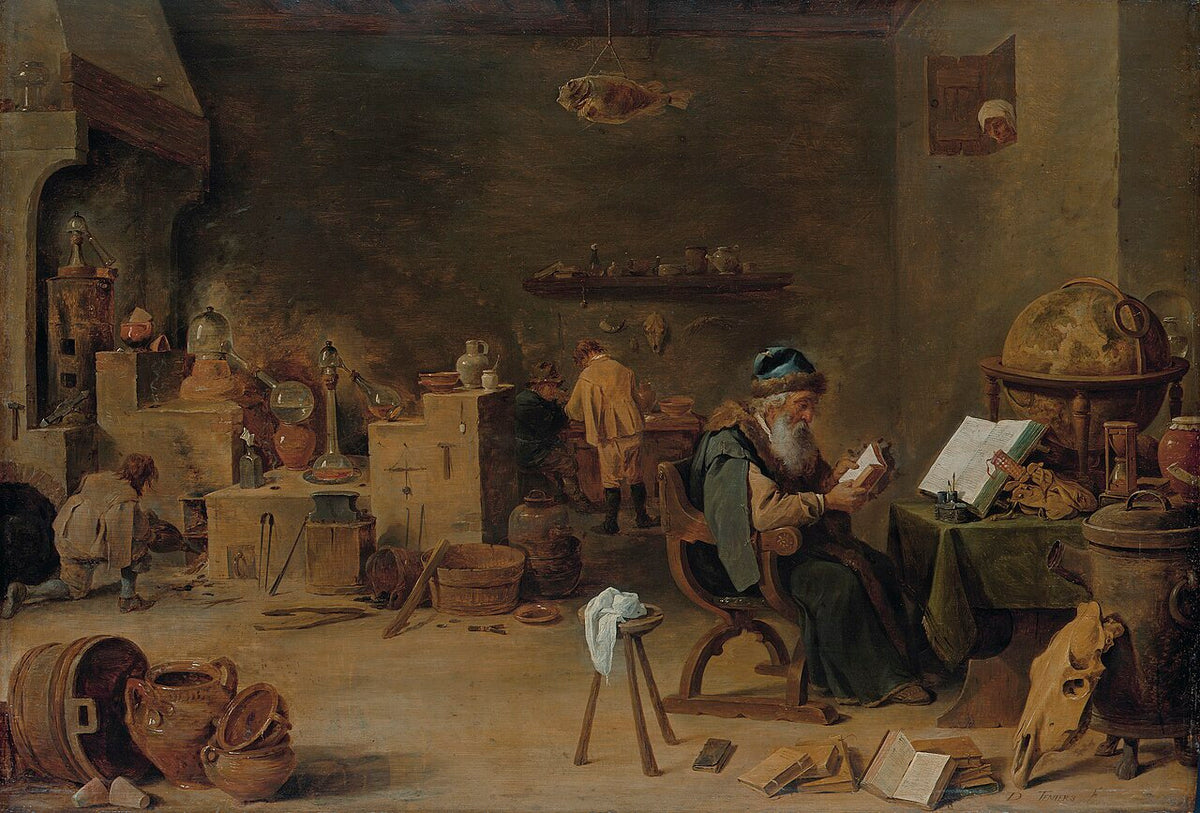
Cover image: David Teniers the Younger, The Alchemist, circa 1643–1645, Herzog Anton Ulrich-Museum, Braunschweig. Public domain reproduction.

Par Olivier of Aeternum
Passionate about esoteric traditions and the history of the occult from the earliest civilizations to the 18th century, I share some articles on these topics. I am also co-creator of the online esoteric shop Aeternum.













J’ai adoré l’article. Il est passionant et accrochant sur le sujet de l’alchimie il est aussi très complet