















































































































































































































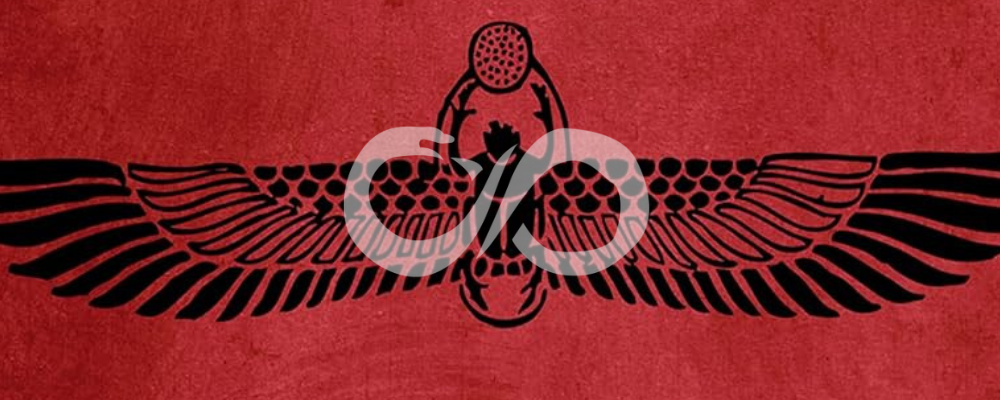
At the beginning of the 20th century, British occultist Aleister Crowley (1875-1947) inaugurated a bold new spiritual path that he called Thelema. In April 1904, while staying in Cairo with his wife Rose, Crowley claimed to have received, through the voice of an intangible being named Aiwass, The Book of the Law. This short prophetic text announced the advent of a New Aeon for humanity and laid the foundations for a new religion centered on the principle of each person’s “telos,” or True Will. An exploration.
The Sacred Sources of Thelema
Thelema originated in a foundational mystical experience. In April 1904, inside a room at the Boulak Museum in Cairo, Crowley allegedly transcribed, under Aiwass’s dictation, a three-chapter text titled Liber AL vel Legis, known in English as The Book of the Law. Crowley reported that the dictation took place over three days, from April 8 to 10, at precisely noon each day. The content of this book, which he claimed to have heard rather than composed, held sacred significance for him: it proclaimed humanity’s entry into the Aeon of Horus, a new aeon supposedly succeeding the bygone aeons of Isis and Osiris. The Book of the Law thus set out the fundamental principles of the religion of Thelema and became its central text. Crowley, initially bewildered by this revelation, did not fully grasp its importance until several years later: it was not until 1909 that he published the text and began surrounding it with commentaries to explain its doctrine.
“The word of the Law is Thelema,” proclaims chapter I of The Book of the Law (verse 39), immediately emphasizing the guiding idea of this new message. The term Thelema is borrowed from the Greek θέλημα (thelêma), meaning will or deliberate intention. Crowley, a great scholar of ancient traditions, could not have been unaware that this was also the word used by Rabelais in the 16th century to name the imaginary Abbey of Thelema in Gargantua. The famous Rabelaisian motto “Fay ce que vouldras” also resonates as a precursor to the Thelemic law. Nevertheless, Crowley gave this maxim a new esoteric and universal scope: it was no longer merely a humanist satire, but the sacred commandment of a new spiritual age of which he considered himself the herald.
After The Book of the Law, Crowley produced, over the following years, other writings that he presented as likewise “inspired” or received from higher sources. These works - including Liber VII, Liber Cordis Cincti Serpente (Liber LXV), and Liber Legis - would later be gathered under the title Holy Books of Thelema. Crowley regarded them as sacred texts of Class A, meaning untouchable texts transmitted by divine intelligences rather than written by his own hand. However, none of these writings held equal importance for Thelemites to The Book of the Law itself. The latter remains the cornerstone of Thelemic faith - Thelema’s Holy Scripture, in a sense - around which all other teachings are organized.
The Law of Will and Its Foundations
“Do what thou wilt shall be the whole of the Law. Love is the law, love under will.” This formula, taken from The Book of the Law, summarizes its ethical and metaphysical core. Far from being an invitation to anarchic license, it expresses a demanding principle: each being must discover and follow their True Will (True Will in English) as their sole guide in life. For Crowley, every individual possesses an essential purpose of their own, a deep mission or vocation inscribed in their very nature. Realizing this inner will - rather than satisfying selfish whims - constitutes the purpose of existence. This is how “Do what thou wilt” should be understood: not as “do whatever pleases you,” but as “fulfill your true will.” The second verse, “Love is the law, love under will,” clarifies that love (in the sense of agape, the energy of union and creation) must permeate every willed action, while remaining subordinate to enlightened will. In other words, universal love is the law, provided that it serves the True Will.
Crowley places this concept of supreme Will at the summit of his philosophy. “Pride and the superior will are placed above all,” he notes, placing the aspiration of the sovereign soul far beyond ordinary moral constraints. Thelema thus exalts the individual’s absolute freedom to fulfill their purpose, without social or religious restraints: “The word of Sin is Restriction,” Aiwass proclaims in The Book of the Law, rejecting as the only “sin” the act of restraining one’s true nature. Every arbitrary prohibition and every morality imposed from outside is perceived as an obstacle to the realization of the True Will. Crowley summarizes this idea by declaring that “all the old restraints” must be abolished and that “every other bond than love is a curse,” breaking with the repressive dogmas of the past.
At the foundation of Thelema, therefore, lies a sacred individualism. Crowley indeed asserts that “every man and every woman is a star,” a poetic image meaning that every being is a unique luminous center in the universe. Like the stars, individuals each follow their own orbit - that is, their destined path - and must not encroach upon that of another. Through this cosmic metaphor, Crowley suggests that every person carries a divine spark and can attain a high state of spiritual fulfillment, provided they follow their True Will to the end. Thelema’s precise aim is to help each person recognize this higher purpose in life and fully attain it. This quest is called the Great Work (Great Work), a notion borrowed from alchemy and Western esotericism that refers to realizing one’s authentic self and harmonizing it with the cosmos. By fulfilling their True Will, the Thelemic adept aligns with the deep order of the universe - a universe conceived as living and spiritual - and becomes “in tune with the movement of the stars.”
Thelemic philosophy is accompanied by a radically new conception of the universe. Crowley taught that, following the revelation of 1904, we had entered the Aeon of Horus, the crowned and conquering child-god. He distinguished three successive great aeons in humanity’s spiritual history, each governed by a particular divine figure: first, the Aeon of Isis, ruled by the primordial Mother (ancient societies honoring the Goddess and nature); then the Aeon of Osiris, marked by the sacrificial Father (patriarchal religions, the age of dying and resurrecting gods, including Christianity); and now the Aeon of Horus, governed by the crowned and conquering Child - the symbol of the free and fulfilled individual. In The Book of the Law, these three aeons are embodied by three deities: the goddess Nuit (the starry, infinite celestial vault, the cosmic mother) for the age of Isis; the god Hadit (the immanent point of consciousness, connected to the heart of things) for the age of Osiris; and Ra-Hoor-Khuit (the warrior form of the falcon god Horus) for the present age. Crowley viewed the Aeon of Horus as the era of the divine individual, freed from ancient dogmas, in which a renewed freedom and exploration of the self would prevail. This cosmic vision gives Thelema’s law a sense of historical inevitability: according to Crowley, humanity is in some sense maturing toward spiritual adulthood, where each being will become an autonomous “star.” Following the law “Do what thou wilt” thus means attuning oneself to the very energy of the new aeon.
Thelemic Practices and Esoteric Orders
To put the law of Thelema into practice and guide aspirants along the path of their True Will, Crowley developed an entire system of magical and ritual practices. Magic, which he spelled magick to distinguish it from sleight of hand (magic), lies at the heart of the Thelemic approach. Crowley classically defined it as “the Science and Art of causing Change to occur in conformity with Will.” It involved not only occult ceremonies, but also a discipline of self-transformation at every level of being. From the Thelemic perspective, every act of daily life can become a magical act when performed in perfect accordance with the True Will. Nevertheless, Crowley - trained in the arcana of the Hermetic Order of the Golden Dawn - attached great importance to properly conducted ceremonial rituals, which he saw as privileged means of training the will and exploring invisible worlds. Like the Golden Dawn, he established a structured initiatory progression through grades, with symbols and ritual ordeals, by which the disciple sharpened their mind and climbed the stages of spiritual realization.
As early as 1907, Crowley founded his own esoteric order, the Argenteum Astrum (A∴A∴, meaning “Silver Star”), to provide this initiatory teaching. The A∴A∴ partly adopted the Golden Dawn’s grade structure (Neophyte, Adept,...) but reformulated it according to the law of Thelema and incorporated practices drawn from Eastern wisdom traditions that Crowley had studied during his travels. Indeed, the contribution of Hindu yoga and Buddhism is notable in the training he proposed: meditation, breath control, and concentration practices complemented the invocations and pentagrams of the Western tradition. The motto he assigned to his order, “the method of science, the aim of religion,” illustrates his approach: combining experimental rigor (observing, recording, and repeating the effects of rituals on consciousness) with an authentically mystical quest for illumination. The ultimate goal of the A∴A∴’s initiatory path is attaining the “Knowledge and Conversation of the Holy Guardian Angel,” that is, conscious communion with one’s inner divine Self. Crowley described this experience as communion with a “quasi-divine” tutelary entity that reveals the adept’s true nature and guides them toward Union with the All. In short, it means reaching the Higher Self and awakening to one’s divine dimension, an objective that can be compared with enlightenment in other traditions, although Crowley presented it in his own provocative and magical manner.
At the same time, Crowley took over and reshaped another existing order, the Ordo Templi Orientis (O.T.O.), turning it into a vehicle for the broader dissemination of Thelema. In 1912, he met Theodor Reuss, founder of the O.T.O. in Germany, who initiated him into the highest grades of his order and entrusted him with its leadership in the English-speaking world. The O.T.O. was originally an organization inspired by Freemasonry and devoted to esoteric mysteries. Crowley completely restructured it in order to incorporate the law of Thelema as its central principle. He rewrote the rituals of the various degrees so that they included the Adoration of the True Will, and he added new ceremonies imbued with Thelemic symbolism. Above all, it was through the O.T.O. that Crowley introduced one of the most controversial - and, in his view, powerful - components of his magic: sexual magic. After Reuss told him that the O.T.O. possessed secrets of high magic, Crowley discovered that these were in fact techniques of sexual magic, meaning the use of energy generated by erotic ecstasy for spiritual purposes. Enthralled by this revelation, he immediately incorporated these practices into the Thelemic corpus.
In Crowley’s view, sexual energy is a sacred force and a powerful means of elevation when directed by the will. He therefore explored every facet of sexuality - Eastern tantra, the mysticism of courtly love, the witches’ sabbath - to enrich his magic. He taught his O.T.O. students how to sublimate orgasm into a magical act through codified rituals in which carnal union served as a vehicle for concentrating the will on a specific objective. According to him, “the ecstasy obtained during these sessions makes it possible to approach a divine state in order to converse with a higher being” (that is, one’s inner Angel). This exaltation of pleasure, including pleasure beyond Victorian norms (Crowley advocated free sexuality, without gender or orientation taboos), accorded with Thelema’s libertarian spirit. It nevertheless earned him a scandalous reputation: the period’s scandal press, upon discovering rumors of ritual orgies at the Abbey of Thelema he founded in Sicily in 1920, nicknamed him “the wickedest man in the world.” Crowley nevertheless considered these practices sacred and liberating, believing that by “taking his pleasure freely, without fear of a god,” the adept was in fact honoring the immanent divinity within.
In addition to individual practices, Crowley also introduced collective rites intended to bind the Thelemic community together and celebrate the new religion. The most famous is the Gnostic Mass (Liber XV), which he wrote in Moscow in 1913. This ceremony, still practiced today in O.T.O. lodges, serves as Thelema’s sacramental mass. It features a priest (embodying the solar principle and the High Priest of Thelema) and a priestess (embodying the goddess Nuit), performing a rite inspired both by traditional Catholic liturgy and Eastern mysticism. During this mass, Liber AL is enthroned on the altar, invocations are addressed to Nuit and Hadit, and communicants share a mystical wine and cake representing the elements of the divine body. The atmosphere is solemn and poetic, charged with esoteric symbols - Crowley himself described the Gnostic Mass as “filled with Thelemic symbolism,” while acknowledging that he was inspired by Orthodox liturgy observed at Saint Basil’s (Moscow) as well as by the Tridentine Catholic Mass. This ritual serves to give Thelemites a regular experience of the communal sacred, in a framework that exalts freedom (no sin is confessed except restriction) and mystical union under the auspices of love and will.
Moreover, The Book of the Law itself prescribes the celebration of Thelemic religious festivals on fixed dates. Crowley established an annual spring festival (from April 8 to 10) to commemorate the anniversary of the reception of The Book of the Law. Other festivals honor the solstices and equinoxes - continuing the pagan cycles - or events connected with the prophet’s life (such as October 12, “Crowleymass,” Crowley’s birthday, humorously elevated to the status of a festival). These celebrations give Thelemites an opportunity to gather, practice festive rites, hold banquets and mystery plays, and perform collective magic rituals. Crowley encouraged these moments of communion, which helped establish Thelema as a true Church rather than merely a closed esoteric circle. He also structured the O.T.O.’s religious wing as an Ecclesia Gnostica Catholica (E.G.C.), whose official liturgy is the Gnostic Mass. Thus, through the A∴A∴, Crowley offered a path of individual illumination, while through the O.T.O./E.G.C. he offered an initiatory and religious community in which to live Thelema daily. These two complementary paths of practice enabled Thelemic doctrine to become firmly established and spread far beyond the restricted circle of Crowley’s direct disciples.
Thelemic Religion, Myths, and Spirituality
Although Thelema takes the form of a new religion, its approach to the divine and to symbolism is deliberately non-dogmatic and esoteric. Crowley variously spoke of Thelema as a cult of the new gods, a philosophy of life, or a magical system. This plurality reflects the interpretive flexibility left to adherents. Indeed, historian Ethan Doyle White notes that “attitudes toward this theology vary among Thelemites: some are theists and believe in the literal existence of Thelemic deities, while others are atheists and see them only as symbolic figures.” In other words, Thelema can be practiced either as a deistic religion (by worshiping Nuit, Hadit, Horus, and the other gods of the Thelemic pantheon as genuine higher entities) or as a humanistic path in which these gods are merely psychological archetypes or poetic metaphors representing forces of nature and the soul. Crowley himself maintained a certain ambiguity on this subject. On the one hand, he invoked the gods with flamboyant realism in his rituals - he even proclaimed himself the reincarnation of the spirit of the god Thoth and adopted the title To Mega Therion (“The Great Beast” in Greek), referring to the Beast of the Apocalypse. On the other hand, he wrote in Magick that the gods could be viewed as “portions of the human soul” and that invoking them actually served to explore one’s own unconscious. This tension between literal and symbolic readings is accepted in Thelema, with each practitioner free to adopt the approach that suits them. What matters is that the mythic language employed by Crowley speaks to the soul and acts as a catalyst for transformation.
The Thelemic pantheon draws extensively from various traditions: primarily ancient Egypt (Nuit, the sky goddess; Hadit, assimilated to the winged disk of Horus Behdet; Ra-Hoor-Khuit, the form of child Horus), but also a reimagined Christian mythology (Crowley identified himself with the Beast 666 of the Apocalypse and celebrated the figure of Babalon, the “Scarlet Woman” of the Apocalypse, whom he elevated into a liberating goddess). In Thelema, the goddess Babalon indeed occupies a special place: her name, borrowed from the “whore of Babylon” in the biblical Book of Revelation, is positively reinterpreted to designate the aspect of emancipated divine femininity, the sacred companion of the Beast in the New Aeon. Babalon represents uninhibited sacred femininity, the embodiment of absolute love that consumes the ego. Crowley described her as “she who tears away the veil of illusion and drowns the adept in the ecstasy of the Infinite.” According to a Thelemic exegesis, “Babalon is associated with the destruction of the practitioner’s ego and their union with all existence,” which constitutes a crucial stage of spiritual development in Thelema. Crowley thus surrounded himself with “Scarlet Women” - successive companions to whom he granted this title - whom he saw as vehicles of Babalon’s energy in his sexual and mystical rites. This Beast/Babalon pair symbolizes the union of active and passive, masculine and feminine polarities, with the aim of generating the spiritual androgyne, the complete initiate.
Another central symbol of Thelema is the crowned and conquering Child, Horus, whom Crowley considered the ruling god of the present aeon. Horus is often depicted as Harpocrates (the child Horus, with a finger to his lips) or as Ra-Hoor-Khuit (the aggressive and solar form of Horus). He symbolizes the divine child in each of us, called to grow freely. Crowley encouraged his adherents to “become as little children” again, meaning to free themselves from the conditioning of the past in order to follow their deep Will spontaneously, in the innocence and power of divine childhood. Thus, all Thelemic mythology aims to provide the adept with symbolic landmarks for their journey: Nuit is the Infinite to which they aspire; Hadit is the divine spark in their heart; the child Horus is themselves being born into a higher consciousness; Babalon is the mystical love that transfigures them; etc... Thelema can therefore be lived as a renovated polytheistic religion, in which these deities are worshiped and the Golden Age of the Aeon of Horus awaited. But it can equally be lived as an esoteric philosophy in which these gods are merely masks of inner forces.
Finally, the ethical and spiritual dimension of Thelema must be emphasized. Although Crowley often shocked people with his iconoclastic tone, his doctrine was not merely a call for anti-Victorian rebellion; fundamentally, it was a path toward the flourishing of the self. By advocating self-knowledge and faithfulness to one’s True Will, Thelema echoes the Delphic maxim “Know thyself.” The Thelemite is invited to work on themselves (through magic, meditation, dream analysis, etc.) in order to dispel the illusions and fears that veil their True Will. The ideal Crowley envisioned was that of liberated men and women, conscious “stars” in the universe, united by authentic love rather than by laws imposed from outside. He spoke of the coming “Kingdom of Rabelais,” a world in which the only law would be Do what thou wilt - that is, where everyone would live in perfect harmony with their deepest nature, in collective harmony. Magical utopia or genuine spiritual prophecy? Whatever the case, Crowley laid the foundations with Thelema for a richly developed symbolic and practical system that continues to inspire and challenge seekers of truth.
Although the number of Thelemic adherents has always been limited, Thelema’s influence has been felt far beyond them, throughout the entire Western esoteric revival. Major figures in modern occultism drew inspiration from it, and Crowley’s imprint can be found in various later spiritual movements. Above all, Thelema offered an original spiritual framework in which the individual is responsible for their own sacred destiny. As Crowley himself wrote with the conviction characteristic of him: “There is a splendour in this which all may enjoy. [...] Every man and every woman is a star.”

Par Olivier of Aeternum
Passionate about esoteric traditions and the history of the occult from the earliest civilizations to the 18th century, I share some articles on these topics. I am also co-creator of the online esoteric shop Aeternum.













