















































































































































































































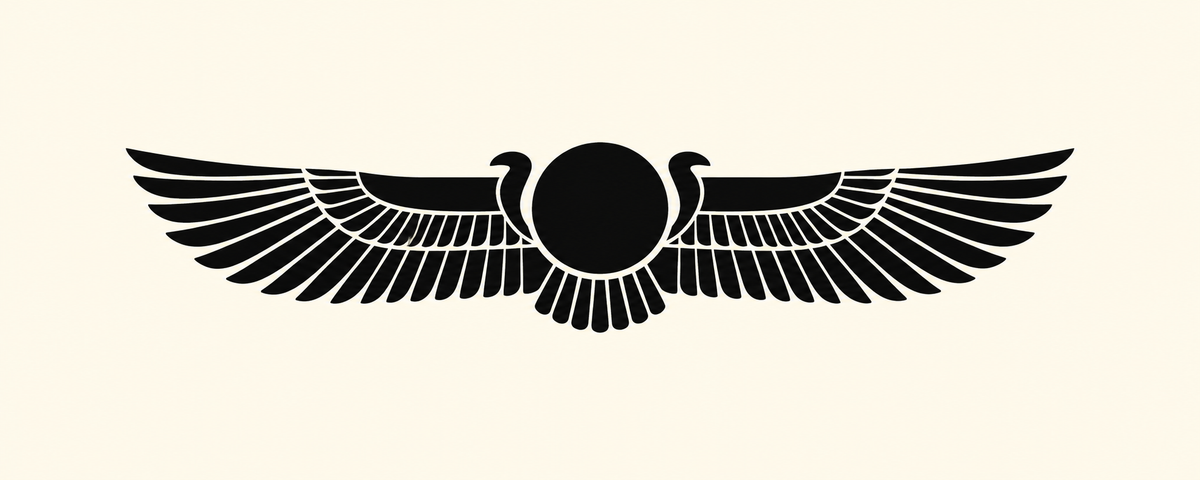
The winged solar disk combines a solar circle with two large outstretched wings. In ancient Egypt, it appears above doors, on lintels, and in royal scenes where it acts as an emblem of solar power and protection. Inscriptions may identify it with Horus, particularly in the form of Horus of Behdet. Its architectural position is essential: placed above an entrance, the sign marks and protects the passage into the sacred space.
| Form | Central solar disk flanked by two wings |
|---|---|
| Association | Horus, particularly Horus of Behdet |
| Function | Protection and solar affirmation |
| Main location | Lintels, doors, and architectural registers |
| Spread | A motif found in several Near Eastern cultures |
How can you recognize the winged solar disk?
The motif shows a circular disk positioned between two wings extended horizontally. Uraei may frame or accompany the disk, depending on the period.
Its construction is immediately recognizable: the sun occupies the center, while the wings give the solar power the ability to spread through space.
The Metropolitan Museum houses a Middle Kingdom relief in which the winged solar disk appears above a divine procession. The description explicitly identifies it with Horus.
Why is it linked to Horus of Behdet?
Horus of Behdet, a form of the god associated with Edfu, is closely linked to the winged solar disk. In the traditions of the Temple of Edfu, Horus fights the enemies of Ra in a solar, winged form.
This association transforms the disk into a warlike and protective power. The sun is not merely a source of light: it becomes an emblem capable of repelling hostile forces.
The connection with the Uraeus is natural, as both signs use dangerous or powerful images to protect the king and sacred space.
Why does it appear above doorways?
The Met explains that the presence of the winged disk at the bottom of a block makes it possible to identify its original position above a doorway. The motif therefore functions as an architectural sign.
Placing a protective image over a passage amounts to symbolically controlling what enters and leaves. The threshold becomes an area watched over by the power of Horus.
This logic is akin to the friezes of Uræi placed at the tops of sanctuaries. Egyptian architecture transforms symbols into devices for protecting space.
What is the connection with the pharaoh?
Horus is intimately linked to Egyptian kingship. The living king could be understood as having a privileged relationship with the god, giving the winged disk a political dimension in addition to its religious function.
The motif appears in royal temples and accompanies scenes in which divine power guarantees sovereignty. It thus forms part of the same visual language as crowns, the Uræus, and the Was scepter.
The symbol therefore expresses less an “abstract sun” than a solar power integrated into royal and cultic order.
How did the motif circulate beyond Egypt?
Winged disks appear in several cultures of the ancient Near East. The motif was adopted, transformed, and associated with other deities or conceptions of kingship.
A scarab housed at the Met shows a winged solar disk above a scene combining Egyptian and Levantine references. This type of object testifies to the circulation of iconography between Egypt, Phoenicia, and neighboring regions.
It is therefore necessary to distinguish the Egyptian origin of a specific type from the international history of the winged form. A Persian or Mesopotamian winged disk does not automatically have the same meaning as a winged Horus on an Egyptian temple.
Historical sources and reference points
The Metropolitan Museum of Art houses a Middle Kingdom relief in which a winged solar disk representing Horus surmounted a doorway. The museum also documents its circulation in Levantine and Egyptianizing objects.










