


Beneath hedges, Devil’s Turnip climbs with fine tendrils while an enormous root remains hidden in the soil. This root was used as a false Mandrake. Carved into a small human figure, replanted to grow “hair,” and then sold as a talisman, it reveals one of the most material mysteries of plant magic: the fabricated falsehood can also give rise to a long tradition.
The name here refers to Bryonia dioica, also treated as Bryonia cretica subsp. dioica in some floras. It is not a Solanaceae plant but a Cucurbitaceae plant, related to squash. The resemblance to Mandrake comes from the root, not from its botany or chemistry.
All parts require caution, especially the root and red berries. The fresh juice irritates the skin, and ingestion can cause severe digestive harm. The history of false talismans can be explored with an image, clay, or paper.
The Hedgerow Vine and Its Hidden Root
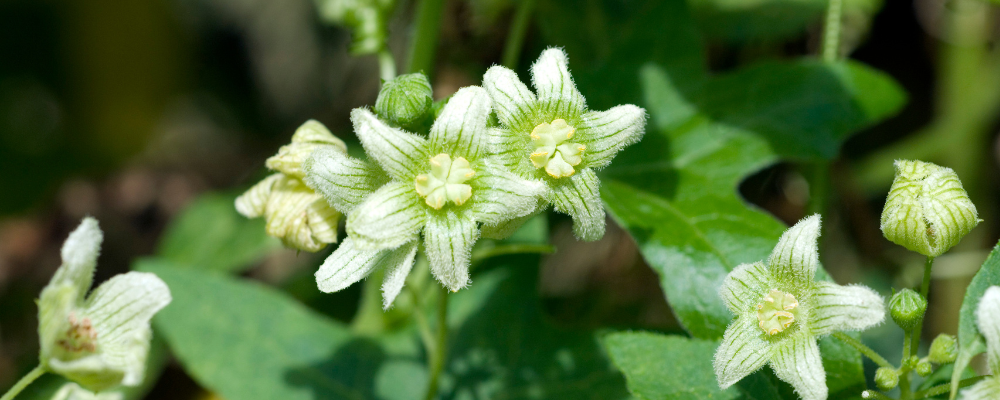
Bryonia dioica Jacq. is a climbing plant in the Cucurbitaceae family. Its stems cling to hedges with tendrils, bear palmate leaves, and produce small greenish flowers. Male and female plants are separate; only the latter produce berries that turn red.
The tuberous root can reach an impressive size. The Wildlife Trust describes a hedgerow and woodland-edge plant that is toxic in all its parts, whose roots were sold as Mandrakes. Northumberland Wildlife Trust, Bryony.
The French name Devil’s Turnip combines a vegetable appearance with prohibition. This “turnip” must never be treated like a vegetable or dug up for examination.
The Making of False Mandrakes
Mediterranean Mandrake was rare and expensive in northern Europe. Sellers used Bryony roots to meet demand. In the 16th century, John Gerard denounced those who carved them into men and women to deceive buyers.
T. F. Thiselton-Dyer reprises this passage and specifies that roots were also guided during their growth to obtain unusual shapes used as charms. Thiselton-Dyer, The Folk-lore of Plants.
The object being sold did not merely imitate a species. It imitated a story: the human body, fortune, the oracle, and the power of the uprooted root. Bryony shows how the market for magic manufactures authenticity.
Millet hair and the Alraune figure
In the 16th century, Pietro Andrea Mattioli described figures made from white Bryony. The root was carved, pierced, and then replanted with millet grains so that the shoots would resemble hair. Dressed or kept in a box, it could be presented as an Alraune.
An ethnobotanical study of Bryonia alba shows that written knowledge about Mandrake and oral accounts of Bryony became intertwined in Northern and Eastern Europe. Study of Bryony as a substitute for Mandrake.
The talisman has a biography. Its material, the sculptor’s gesture, the seller’s discourse, and the buyer’s expectations all contribute to its social power.
The medieval remedy and the dangerous substitution
The 15th-century Herbarius Latinus mentions Bryony as a purgative, diuretic, and abortifacient. It also appears in a medieval anesthetic preparation called dwale, presumably as a substitute for Mandrake, even though it does not share its narcotic alkaloids.
The Metropolitan Museum of Art highlights this gap between resemblance and actual action. The Met Cloisters, Medieval Bryony.
The episode serves as a reminder that a ritual substitution can become medically catastrophic. The human form and the name “English mandrake” do not transform Bryony into Mandrake.
Carve the false object without touching the root
Shape a small human root from air-dry clay. Mark “Bryony” on its back and “false Mandrake” on its base. This double inscription prevents the object from becoming a deceptive imitation.
Place the figure in a box with a copy of the passage from Gerard. Add a label describing its manufacture, date, and material. You create a talisman whose provenance remains legible.
Use this box during a study of fakes, substitutions, and the trade in curiosities. The ritual question becomes: “what gives this object its value?” No Bryony fragment is required.
Historical correspondences
| Reference | Correspondence |
|---|---|
| Botanical name | Bryonia dioica Jacq. |
| Family | Cucurbitaceae |
| Names | Devil’s Turnip, White Bryony, false Mandrake |
| Texts | Gerard, Mattioli, Herbarius Latinus, and Alraune traditions |
| Magical domains | Substitution, crafted talisman, fortune, oracle, and trade |
| Safe support | Clay, box, label, and text reproduction |