





















































































































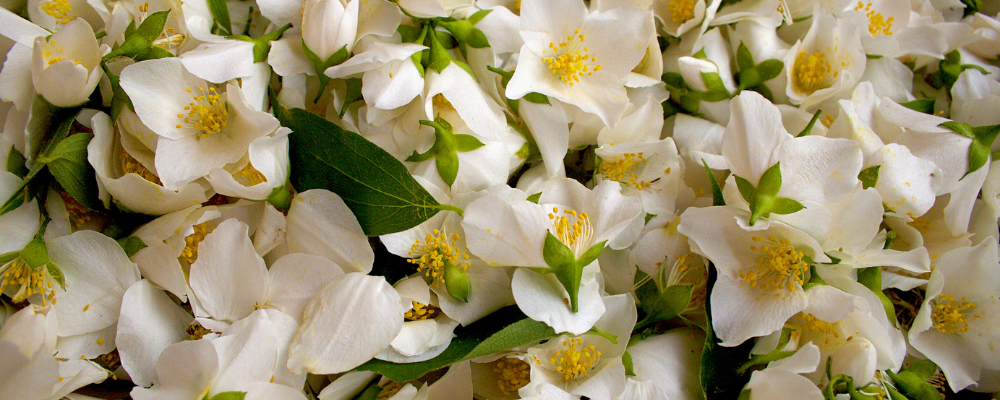
In the poetry of India, Jasmine becomes the “moonlit radiance of the grove.” In Persian and Arabic texts, its fragrance speaks for the lover and turns the flower into an offering slipped into the folds of a garment. In Tuscany, a cutting given in secret is even said to have enabled two fiancés to raise the money for their wedding.
Jasmine belongs neither to a single story nor to a single species. Jasminum officinale, J. grandiflorum, and J. sambac circulated between Asia, the Persian world, China, and Europe, with uses in fragrance, adornment, and offering. Sources must therefore be read in their geographical context.
Its magical identity takes shape around what travels unseen: fragrance, the message of love, the concealed cutting, and the promise passed on. Jasmine acts in stories through offering and propagation, not through a universal lunar correspondence.
Which Jasmine Is Used in the Rite?
Common Jasmine, Jasminum officinale L., belongs to the Oleaceae family. This woody climber bears opposite leaves divided into leaflets and clusters of star-shaped white flowers. Its powerful fragrance has encouraged its cultivation for nearly two millennia. Kew, Common jasmine. Its taxonomic profile places its native range from Transcaucasia to central China. Plants of the World Online, Jasminum officinale.
The name “Jasmine” covers more than two hundred species. Grandiflora Jasmine, J. grandiflorum, is associated with perfumery in India and the Mediterranean. J. sambac, native to tropical Asia, appears in garlands and perfumes across several cultures. The “star jasmine” of gardens belongs to the genus Trachelospermum.
This distinction protects the historical reading. An Indian custom based on J. sambac does not automatically become a property of every fragrant white flower. The botanical label and cultural origin always accompany the material.
The Grove’s Light and the Offering
Folkard reports that Hindu poets called Jasmine “Moonlight of the Grove,” the moonlit radiance of the grove. The phrase is not an astrological attribution. It describes the visual effect of pale flowers among the vegetation and the role of their fragrance in love poetry.
In an allegory translated from Persian and Arabic, jasmine asserts that despair is a mistake. Its penetrating scent explains why lovers choose it as an offering and place it in the folds of a dress. The flower conveys a message through its invisible yet recognizable presence. Richard Folkard, Plant Lore, Legends, and Lyrics, “Jasmine”.
Jasmine is thus suited to words that cannot be spoken immediately, gifts that open a conversation, and the olfactory memory of a bond. The offering respects the recipient: it proposes; it does not compel.
Adornment, Hair, and Fragrance
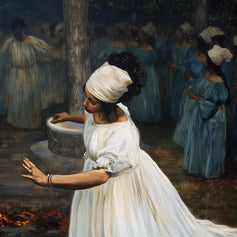
In India, several jasmine varieties are cultivated for their fragrance. In China and other regions of Asia, highly fragrant flowers are used to adorn the hair. The flower is therefore placed near the face and accompanies the public appearance of the person wearing it.
This adornment unites beauty and diffusion. Jasmine does not remain contained in the bouquet: its scent crosses the space between people. In magical practice, this movement can represent renown, presence, and the words that precede the person who is arriving.
That which travels unseen. Fragrance reaches the other person before the hand offering the flower. Jasmine gives form to discreet influence, memory, and the message carried through the air.
Perfumery, however, is an art of concentrated materials. An absolute jasmine oil is not handled like a flower. The symbolic work can remain attached to an image, a fragranced textile consistent with its label, or a cultivated flower.
The Secret Tuscan Cutting
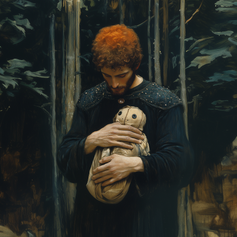
A Tuscan story places a rare double jasmine in the grand duke’s garden, where he forbade its cuttings from being distributed. Yet the gardener, who was in love, hid a stem in a bouquet given to his fiancée for her birthday. She planted the cutting and learned how to propagate it.
Selling the new plants enabled her to raise the sum needed for the wedding. In memory of this episode, young women in Tuscany wore a crown of jasmine on their wedding day. Here, the flower becomes a possession passed on against the owner’s wishes, then transformed into material independence and an alliance.
The mystery of Tuscan Jasmine lies in propagation. A fragment changes hands, takes root, and produces enough flowers to make marriage possible. Its magic does not fall from the sky: it passes through horticultural care, time, and the sharing of knowledge.
Offering and transmitting with Jasmine
To open a conversation, place a cultivated flower or an image of Jasmine in an envelope with a clear sentence. Give it without demanding a response. The gesture echoes the loving offering of Persian texts while protecting the recipient’s freedom.
To celebrate a transmission, repot a legally obtained cutting and label it with the name of the person who gave it to you, the date, and the species. When the plant can be divided, offer a fragment in turn, accompanied by its story. The ritual lives through the real chain of care.
A paper wreath decorated with drawn flowers can accompany a wedding or engagement. Each flower bears the name of a shared resource: time, labor, money, home, knowledge. The Tuscan wreath then becomes the sign of an alliance made possible through actions.
Historical correspondences
| Reference point | Correspondence |
|---|---|
| Species to distinguish | Jasminum officinale, J. grandiflorum, J. sambac |
| Poetic imagery | Moonlit clarity of the grove; fragrance offered in the folds of clothing |
| Cultural contexts | Indian poetry, Persian and Arabic allegories, Asian adornments, Tuscan weddings |
| Magical domains | Offering, freely received love, renown, olfactory memory, transmission |
| Central mystery | The hidden cutting that takes root and makes marriage possible |
| Ritual forms | Cultivated flower, image, envelope, paper wreath, legally sourced labeled cutting |